


 |
市场调查报告书
商品编码
1666719
工业发电机市场机会、成长动力、产业趋势分析与 2025 - 2034 年预测Industrial Generator Market Opportunity, Growth Drivers, Industry Trend Analysis, and Forecast 2025 - 2034 |
||||||

2024 年全球工业发电机市场价值为 215 亿美元,预计 2025 年至 2034 年期间将以 7.1% 的强劲复合年增长率增长。
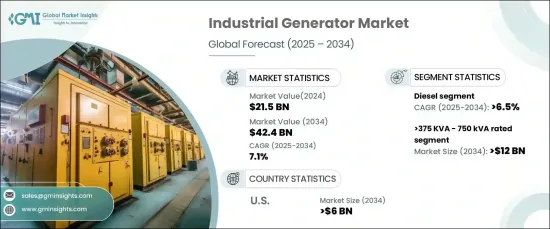
工业发电机旨在在停电期间或电网无法连接或不可靠的地方提供稳定的电力。这些发电机确保在关键工业环境中的无缝运行,支援尖峰能源需求并为偏远地区供电。技术进步进一步完善了这些系统,从而开发出符合更严格的永续性标准的省油、环保的车型。
| 市场范围 | |
|---|---|
| 起始年份 | 2024 |
| 预测年份 | 2025-2034 |
| 起始值 | 215亿美元 |
| 预测值 | 424亿美元 |
| 复合年增长率 | 7.1% |
预计到 2034 年,容量在 375 kVA 至 750 kVA 之间的发电机将产生超过 120 亿美元的收入。 它们能够处理要求苛刻的工业任务和高耗能设备,这使它们成为需要重型和可靠电力解决方案的行业的首选。此外,它们适用于偏远和离网地区,增强了它们满足多样化能源需求的吸引力。
到 2034 年,工业发电机市场中柴油动力部分的成长率预计将超过 6.5%。它们相对较低的前期成本和稳定的电力输出使其成为跨行业有吸引力的选择。工业能源需求的不断增长进一步促进了这一领域的扩张。
在美国,工业发电机市场规模到 2034 年将超过 60 亿美元。越来越多的企业采用这些系统来减轻停电的影响,停电可能会导致严重的生产和财务损失。工业发电机的耐用性、可靠性和高容量促进了其日益广泛的应用。
由于政府努力加强电气化和扩大工业基础设施,亚太地区有望见证显着的市场成长。工业发电机越来越多地被用作主要电源或与再生能源系统协同使用,以确保稳定的电力供应。频繁停电和生产中断成本的上升凸显了可靠备用解决方案的重要性,进一步推动了该地区市场的成长。
目录
第 1 章:方法论与范围
- 市场范围和定义
- 市场估计和预测参数
- 预测计算
- 资料来源
- 基本的
- 次要
- 有薪资的
- 民众
第 2 章:执行摘要
第 3 章:产业洞察
- 产业生态系统分析
- 监管格局
- 产业衝击力
- 成长动力
- 产业陷阱与挑战
- 成长潜力分析
- 波特的分析
- 供应商的议价能力
- 买家的议价能力
- 新进入者的威胁
- 替代品的威胁
- PESTEL 分析
第四章:竞争格局
- 介绍
- 战略展望
- 创新与永续发展格局
第五章:市场规模及预测:依功率等级,2021 – 2034 年
- 主要趋势
- ≤ 75 千伏安
- > 75 千伏安 - 375 千伏安
- > 375千伏安 - 750千伏安
- >750千伏安
第 6 章:市场规模与预测:依最终用途,2021 – 2034 年
- 主要趋势
- 石油和天然气
- 製造业
- 建造
- 电力设施
- 矿业
- 运输与物流
- 其他的
第 7 章:市场规模与预测:按应用,2021 – 2034 年
- 主要趋势
- 支援
- 调峰
- 初始/连续
第 8 章:市场规模与预测:按燃料,2021 – 2034 年
- 主要趋势
- 柴油引擎
- 气体
- 其他的
第 9 章:市场规模与预测:按地区,2021 – 2034 年
- 主要趋势
- 北美洲
- 我们
- 加拿大
- 欧洲
- 俄罗斯
- 英国
- 德国
- 法国
- 西班牙
- 奥地利
- 义大利
- 亚太地区
- 中国
- 澳洲
- 印度
- 日本
- 韩国
- 印尼
- 马来西亚
- 泰国
- 越南
- 菲律宾
- 缅甸
- 中东
- 沙乌地阿拉伯
- 阿联酋
- 卡达
- 土耳其
- 伊朗
- 阿曼
- 非洲
- 埃及
- 奈及利亚
- 阿尔及利亚
- 南非
- 安哥拉
- 肯亚
- 拉丁美洲
- 巴西
- 墨西哥
- 阿根廷
- 智利
第十章:公司简介
- Ashok Leyland
- Atlas Copco
- Caterpillar
- Cummins
- Deere & Company
- FG Wilson
- Generac Power Systems
- Greaves Cotton
- Himoinsa
- JCB
- Kirloskar
- Kohler
- Mahindra Powerol
- Mitsubishi Heavy Industries
- MTU Onsite Energy
- Powerica
- Perkins Engines Company
- Supernova Genset
- Wartsila
- Yanmar Holdings
The Global Industrial Generator Market, valued at USD 21.5 billion in 2024, is anticipated to grow at a robust CAGR of 7.1% from 2025 to 2034. This growth is driven by the rapid pace of industrialization, infrastructure advancements in emerging economies, and the increasing need for reliable and uninterrupted power supply in various sectors.
Industrial generators are designed to provide consistent electrical power during outages or in locations where grid access is unavailable or unreliable. These generators ensure seamless operations in critical industrial settings, support peak energy demands, and power remote areas. Technological advancements have further refined these systems, leading to the development of fuel-efficient and environmentally friendly models that align with stricter sustainability standards.
| Market Scope | |
|---|---|
| Start Year | 2024 |
| Forecast Year | 2025-2034 |
| Start Value | $21.5 Billion |
| Forecast Value | $42.4 Billion |
| CAGR | 7.1% |
Generators with a capacity between 375 kVA and 750 kVA are projected to generate over USD 12 billion by 2034. Their capability to handle demanding industrial tasks and power-intensive equipment makes them a preferred choice for industries requiring heavy-duty and reliable power solutions. Additionally, their suitability for remote and off-grid locations enhances their appeal in meeting diverse energy needs.
The diesel-powered segment of the industrial generator market is expected to grow at a rate exceeding 6.5% through 2034. Diesel generators remain popular due to their adaptability, scalability, and ability to perform in varied weather conditions. Their relatively lower upfront costs and consistent power output make them an attractive option across industries. Rising industrial energy demands further contribute to the expansion of this segment.
In the U.S., the industrial generator market is set to surpass USD 6 billion by 2034. Manufacturing activities are expected to be a significant driver, as continuous power is essential to maintain operational efficiency. Businesses are increasingly adopting these systems to mitigate the impact of power outages, which can lead to significant production and financial losses. The durability, reliability, and high capacity of industrial generators contribute to their growing adoption.
Asia Pacific is poised to witness significant market growth due to government efforts to enhance electrification and expand industrial infrastructure. Industrial generators are increasingly used as primary power sources or in tandem with renewable energy systems to ensure a stable electricity supply. Frequent power outages and the rising cost of disruptions to production underline the importance of dependable backup solutions, further fueling market growth in this region.
Table of Contents
Chapter 1 Methodology & Scope
- 1.1 Market scope & definitions
- 1.2 Market estimates & forecast parameters
- 1.3 Forecast calculation
- 1.4 Data sources
- 1.4.1 Primary
- 1.4.2 Secondary
- 1.4.2.1 Paid
- 1.4.2.2 Public
Chapter 2 Executive Summary
- 2.1 Industry synopsis, 2021 - 2034
Chapter 3 Industry Insights
- 3.1 Industry ecosystem analysis
- 3.2 Regulatory landscape
- 3.3 Industry impact forces
- 3.3.1 Growth drivers
- 3.3.2 Industry pitfalls & challenges
- 3.4 Growth potential analysis
- 3.5 Porter's Analysis
- 3.5.1 Bargaining power of suppliers
- 3.5.2 Bargaining power of buyers
- 3.5.3 Threat of new entrants
- 3.5.4 Threat of substitutes
- 3.6 PESTEL Analysis
Chapter 4 Competitive Landscape, 2024
- 4.1 Introduction
- 4.2 Strategic outlook
- 4.3 Innovation & sustainability landscape
Chapter 5 Market Size and Forecast, By Power Rating, 2021 – 2034 ('000 Units & USD Million)
- 5.1 Key trends
- 5.2 ≤ 75 kVA
- 5.3 > 75 kVA - 375 kVA
- 5.4 > 375 KVA - 750 kVA
- 5.5 > 750 kVA
Chapter 6 Market Size and Forecast, By End Use, 2021 – 2034 ('000 Units & USD Million)
- 6.1 Key trends
- 6.2 Oil & gas
- 6.3 Manufacturing
- 6.4 Construction
- 6.5 Electric utilities
- 6.6 Mining
- 6.7 Transport & logistics
- 6.8 Others
Chapter 7 Market Size and Forecast, By Application, 2021 – 2034 ('000 Units & USD Million)
- 7.1 Key trends
- 7.2 Standby
- 7.3 Peak shaving
- 7.4 Prime/continuous
Chapter 8 Market Size and Forecast, By Fuel, 2021 – 2034 ('000 Units & USD Million)
- 8.1 Key trends
- 8.2 Diesel
- 8.3 Gas
- 8.4 Others
Chapter 9 Market Size and Forecast, By Region, 2021 – 2034 ('000 Units & USD Million)
- 9.1 Key trends
- 9.2 North America
- 9.2.1 U.S.
- 9.2.2 Canada
- 9.3 Europe
- 9.3.1 Russia
- 9.3.2 UK
- 9.3.3 Germany
- 9.3.4 France
- 9.3.5 Spain
- 9.3.6 Austria
- 9.3.7 Italy
- 9.4 Asia Pacific
- 9.4.1 China
- 9.4.2 Australia
- 9.4.3 India
- 9.4.4 Japan
- 9.4.5 South Korea
- 9.4.6 Indonesia
- 9.4.7 Malaysia
- 9.4.8 Thailand
- 9.4.9 Vietnam
- 9.4.10 Philippines
- 9.4.11 Myanmar
- 9.5 Middle East
- 9.5.1 Saudi Arabia
- 9.5.2 UAE
- 9.5.3 Qatar
- 9.5.4 Turkey
- 9.5.5 Iran
- 9.5.6 Oman
- 9.6 Africa
- 9.6.1 Egypt
- 9.6.2 Nigeria
- 9.6.3 Algeria
- 9.6.4 South Africa
- 9.6.5 Angola
- 9.6.6 Kenya
- 9.7 Latin America
- 9.7.1 Brazil
- 9.7.2 Mexico
- 9.7.3 Argentina
- 9.7.4 Chile
Chapter 10 Company Profiles
- 10.1 Ashok Leyland
- 10.2 Atlas Copco
- 10.3 Caterpillar
- 10.4 Cummins
- 10.5 Deere & Company
- 10.6 FG Wilson
- 10.7 Generac Power Systems
- 10.8 Greaves Cotton
- 10.9 Himoinsa
- 10.10 JCB
- 10.11 Kirloskar
- 10.12 Kohler
- 10.13 Mahindra Powerol
- 10.14 Mitsubishi Heavy Industries
- 10.15 MTU Onsite Energy
- 10.16 Powerica
- 10.17 Perkins Engines Company
- 10.18 Supernova Genset
- 10.19 Wartsila
- 10.20 Yanmar Holdings

 发电机维护服务市场:按服务类型、发电机类型、维护频率、服务提供者和最终用户划分 - 全球预测 2026-2032 年发电机市场:2026年至2032年全球预测(依产品类型、额定输出功率、相数、冷却方式及应用划分)
 发电机市场规模、份额和成长分析:按类型、额定功率、最终用户和地区划分-2026-2033年产业预测
 全球发电机市场规模、份额、趋势和成长分析报告(2026-2034年)全球黑启动发电机市场规模、份额、趋势和成长分析报告(2026-2034年)
 日本发电机市场:规模、份额、趋势和预测:按燃料类型、输出功率、销售管道、设计、应用、最终用户和地区划分(2026-2034 年)
 2026年全球军用发电机市场报告2026年全球发电机市场报告2026年全球发电机销售市场报告
 中速大型发电机市场 - 全球产业规模、份额、趋势、机会及预测(按技术、功率输出、燃料类型、最终用户、地区和竞争格局划分,2021-2031年)