


 |
市场调查报告书
商品编码
1684695
资料中心储能市场机会、成长动力、产业趋势分析与 2025 - 2034 年预测Data Center Energy Storage Market Opportunity, Growth Drivers, Industry Trend Analysis, and Forecast 2025 - 2034 |
||||||

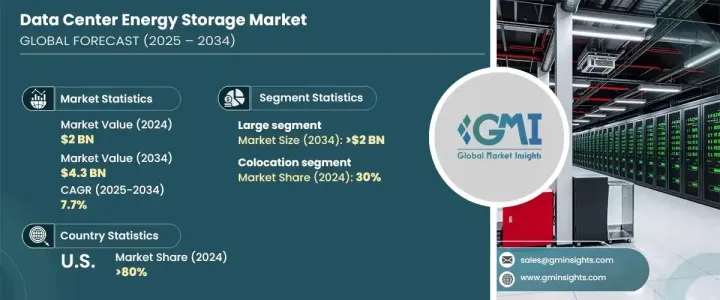
2024 年全球资料中心储能市场价值为 20 亿美元,呈现强劲成长趋势,预计 2025 年至 2034 年期间的复合年增长率为 7.7%。企业正在摆脱传统电网,转而专注于符合永续发展目标并增强营运弹性的先进储存技术。随着人们对碳足迹的担忧日益加剧以及能源成本的上升,对再生能源整合的推动力比以往任何时候都更加强劲。该公司正在利用尖端储存系统来维持正常运行时间、减少电力支出并支持向更环保的数位基础设施的转变。
云端运算、人工智慧和巨量资料分析的快速扩张加剧了对可扩展能源储存解决方案的需求。数位交易和资料处理不断升级,对能够维持高效能运算的节能係统的依赖性越来越强。世界各地的组织都在投资创新的能源储存技术,以提高电力可靠性并最大限度地降低停机风险。由于监管框架强调永续性,资料中心正在优先考虑环保能源解决方案,以在不断发展的市场中保持竞争力。该产业向混合能源储存的转变,包括锂离子电池、飞轮和其他节能係统,进一步强调了向有弹性、可持续的基础设施的转变。随着电源管理系统的不断进步,资料中心在保持高速运算效能的同时,也正在优化能源效率。
| 市场范围 | |
|---|---|
| 起始年份 | 2024 |
| 预测年份 | 2025-2034 |
| 起始值 | 20亿美元 |
| 预测值 | 43亿美元 |
| 复合年增长率 | 7.7% |
根据资料中心规模,市场细分为小型、中型和大型设施。 2024 年,大型资料中心占据了 46 %的市场份额,预计到 2034 年收入将达到 20 亿美元。随着能源需求的不断增长,企业正在整合先进的储存技术来增强系统弹性、减少电源故障并优化能源效率。这些大型中心需要强大的储存基础设施来支援不断增加的资料负载,从而推动对能源储存系统的大量投资。
该市场进一步按应用分类,涵盖银行、能源、政府、医疗保健、製造业、IT 和主机託管服务。 2024 年,主机託管中心占据了 30% 的市场份额,反映出人们对共享资料储存设施的偏好日益增长。利用主机託管服务的企业优先考虑持续的电力供应,使能源储存解决方案成为其营运策略的重要组成部分。对第三方资料储存的日益依赖加剧了对节能基础架构的需求,迫使主机託管供应商实施尖端的电源管理解决方案。先进的储能技术在保持可靠性的同时确保了经济高效的运营,进一步推动了整个产业的应用。
2024年美国资料中心储能市场将占据全球80%的份额,巩固其作为主要产业驱动力的地位。随着企业寻求更灵活、更具成本效益的能源消耗策略,该地区在大型基础设施专案中的领导地位加速了先进储存解决方案的采用。北美各地的公司正积极加强能源效率倡议,以实现永续发展目标、减少碳排放并提高电力可靠性。对环保基础设施的高度重视和对能源储存技术的持续投资使该地区处于市场成长的前沿。随着实现碳中和的努力不断加大,北美资料中心正在为能源效率制定新的标准,增强市场扩张和长期生存能力。
目录
第 1 章:方法论与范围
- 研究设计
- 研究方法
- 资料收集方法
- 基础估算与计算
- 基准年计算
- 市场估计的主要趋势
- 预测模型
- 初步研究和验证
- 主要来源
- 资料探勘来源
- 市场范围和定义
第 2 章:执行摘要
第 3 章:产业洞察
- 产业生态系统分析
- 原物料供应商
- 零件供应商
- 製造商
- 技术提供者
- 经销商
- 最终用户
- 供应商概况
- 利润率分析
- 技术与创新格局
- 专利分析
- 监管格局
- 定价分析
- 衝击力
- 成长动力
- 整合再生能源以提高效率
- 资料中心对备用电源解决方案的需求
- 采用绿色能源储存解决方案
- 储能係统的技术进步
- 产业陷阱与挑战
- 能源储存技术的前期成本高
- 大规模部署的技术限制
- 成长动力
- 成长潜力分析
- 波特的分析
- PESTEL 分析
第四章:竞争格局
- 介绍
- 公司市占率分析
- 竞争定位矩阵
- 战略展望矩阵
第 5 章:市场估计与预测:按资料中心规模,2021 - 2034 年
- 主要趋势
- 小的
- 中等的
- 大的
第六章:市场估计与预测:依层级,2021 - 2034 年
- 主要趋势
- 第 1 层
- 第 2 层
- 第 3 级
- 第 4 层
第 7 章:市场估计与预测:按技术,2021 - 2034 年
- 主要趋势
- 锂离子电池
- 铅酸电池
- 镍镉电池
- 飞轮储能
- 超级电容器
- 液流电池
第 8 章:市场估计与预测:按应用,2021 - 2034 年
- 主要趋势
- 金融保险业协会
- 主机託管
- 活力
- 政府
- 卫生保健
- 製造业
- 资讯科技和电信
- 其他的
第 9 章:市场估计与预测:按地区,2021 - 2034 年
- 主要趋势
- 北美洲
- 我们
- 加拿大
- 欧洲
- 英国
- 德国
- 法国
- 义大利
- 西班牙
- 俄罗斯
- 北欧
- 亚太地区
- 中国
- 印度
- 日本
- 澳洲
- 韩国
- 东南亚
- 拉丁美洲
- 巴西
- 墨西哥
- 阿根廷
- 中东及非洲
- 阿联酋
- 南非
- 沙乌地阿拉伯
第十章:公司简介
- ABB
- BYD
- Cummins
- Delta
- Eaton
- Generac Power Systems
- Hitachi Energy
- Huawei
- Johnson Controls International
- Legrand
- LG Energy Solution
- Mitsubishi
- Riello Elettronica
- Samsung SDI
- Schneider Electric
- Siemens
- Socomec
- Tesla
- Toshiba
- Vertiv
The Global Data Center Energy Storage Market, valued at USD 2 billion in 2024, is on a strong growth trajectory, with a projected CAGR of 7.7% between 2025 and 2034. As the demand for digital services surges, data centers are under increasing pressure to adopt efficient energy storage solutions that ensure uninterrupted power supply and optimize energy consumption. Businesses are moving away from traditional power grids, focusing instead on advanced storage technologies that align with sustainability goals and enhance operational resilience. With growing concerns over carbon footprints and rising energy costs, the push for renewable energy integration is stronger than ever. Companies are leveraging cutting-edge storage systems to maintain uptime, reduce electricity expenses, and support the shift toward a greener digital infrastructure.
The rapid expansion of cloud computing, artificial intelligence, and big data analytics has intensified the need for scalable energy storage solutions. Digital transactions and data processing continue to escalate, increasing dependency on energy-efficient systems that can sustain high-performance computing. Organizations worldwide are investing in innovative energy storage technologies to improve power reliability and minimize the risk of downtime. As regulatory frameworks emphasize sustainability, data centers are prioritizing eco-friendly energy solutions to remain competitive in the evolving market. The industry's transition toward hybrid energy storage, incorporating lithium-ion batteries, flywheels, and other energy-efficient systems, further underscores the shift toward a resilient, sustainable infrastructure. With the continued advancement of power management systems, data centers are optimizing energy efficiency while maintaining high-speed computing performance.
| Market Scope | |
|---|---|
| Start Year | 2024 |
| Forecast Year | 2025-2034 |
| Start Value | $2 Billion |
| Forecast Value | $4.3 Billion |
| CAGR | 7.7% |
Market segmentation by data center size includes small, medium, and large facilities. In 2024, large data centers accounted for 46% of the market share, with revenue projections reaching USD 2 billion by 2034. High-capacity data centers depend on sophisticated energy storage solutions to ensure seamless operations, preventing disruptions in critical computing environments. As energy demands rise, businesses are integrating advanced storage technologies to enhance system resilience, reduce power failures, and optimize energy efficiency. These large-scale centers require robust storage infrastructure to support increasing data loads, driving significant investments in energy storage systems.
The market is further categorized by application, covering banking, energy, government, healthcare, manufacturing, IT, and colocation services. In 2024, colocation centers held a 30% market share, reflecting the growing preference for shared data storage facilities. Businesses utilizing colocation services prioritize continuous power availability, making energy storage solutions an essential component of their operational strategy. The increasing reliance on third-party data storage has intensified the demand for energy-efficient infrastructure, compelling colocation providers to implement cutting-edge power management solutions. Advanced energy storage technology ensures cost-effective operations while maintaining reliability, further driving adoption across the sector.
The US data center energy storage market accounted for 80% of the global share in 2024, solidifying its position as a major industry driver. The region's leadership in large-scale infrastructure projects has accelerated the adoption of advanced storage solutions as businesses seek more flexible and cost-effective energy consumption strategies. Companies across North America are actively enhancing energy efficiency initiatives to meet sustainability targets, reducing carbon emissions, and improving power reliability. The strong focus on eco-friendly infrastructure and continuous investment in energy storage technologies have positioned the region at the forefront of market growth. With increasing efforts to achieve carbon neutrality, North American data centers are setting new standards for energy efficiency, reinforcing market expansion and long-term viability.
Table of Contents
Chapter 1 Methodology & Scope
- 1.1 Research design
- 1.1.1 Research approach
- 1.1.2 Data collection methods
- 1.2 Base estimates & calculations
- 1.2.1 Base year calculation
- 1.2.2 Key trends for market estimation
- 1.3 Forecast model
- 1.4 Primary research and validation
- 1.4.1 Primary sources
- 1.4.2 Data mining sources
- 1.5 Market scope & definition
Chapter 2 Executive Summary
- 2.1 Industry 3600 synopsis, 2021 - 2034
Chapter 3 Industry Insights
- 3.1 Industry ecosystem analysis
- 3.1.1 Raw material suppliers
- 3.1.2 Component suppliers
- 3.1.3 Manufacturers
- 3.1.4 Technology providers
- 3.1.5 Distributors
- 3.1.6 End users
- 3.2 Supplier landscape
- 3.3 Profit margin analysis
- 3.4 Technology & innovation landscape
- 3.5 Patent analysis
- 3.6 Regulatory landscape
- 3.7 Pricing analysis
- 3.8 Impact forces
- 3.8.1 Growth drivers
- 3.8.1.1 Integration of renewable energy sources for efficiency
- 3.8.1.2 Demand for backup power solutions in data centers
- 3.8.1.3 Adoption of green energy storage solutions
- 3.8.1.4 Technological advancements in energy storage systems
- 3.8.2 Industry pitfalls & challenges
- 3.8.2.1 High upfront costs of energy storage technologies
- 3.8.2.2 Technological limitations in large-scale deployments
- 3.8.1 Growth drivers
- 3.9 Growth potential analysis
- 3.10 Porter's analysis
- 3.11 PESTEL analysis
Chapter 4 Competitive Landscape, 2024
- 4.1 Introduction
- 4.2 Company market share analysis
- 4.3 Competitive positioning matrix
- 4.4 Strategic outlook matrix
Chapter 5 Market Estimates & Forecast, By Data Center Size, 2021 - 2034 ($Bn)
- 5.1 Key trends
- 5.2 Small
- 5.3 Medium
- 5.4 Large
Chapter 6 Market Estimates & Forecast, By Tier, 2021 - 2034 ($Bn)
- 6.1 Key trends
- 6.2 Tier 1
- 6.3 Tier 2
- 6.4 Tier 3
- 6.5 Tier 4
Chapter 7 Market Estimates & Forecast, By Technology, 2021 - 2034 ($Bn)
- 7.1 Key trends
- 7.2 Lithium-ion batteries
- 7.3 Lead-acid batteries
- 7.4 Nickel-cadmium batteries
- 7.5 Flywheel energy storage
- 7.6 Supercapacitors
- 7.7 Flow batteries
Chapter 8 Market Estimates & Forecast, By Application, 2021 - 2034 ($Bn)
- 8.1 Key trends
- 8.2 BFSI
- 8.3 Colocation
- 8.4 Energy
- 8.5 Government
- 8.6 Healthcare
- 8.7 Manufacturing
- 8.8 IT & telecom
- 8.9 Others
Chapter 9 Market Estimates & Forecast, By Region, 2021 - 2034 ($Bn)
- 9.1 Key trends
- 9.2 North America
- 9.2.1 U.S.
- 9.2.2 Canada
- 9.3 Europe
- 9.3.1 UK
- 9.3.2 Germany
- 9.3.3 France
- 9.3.4 Italy
- 9.3.5 Spain
- 9.3.6 Russia
- 9.3.7 Nordics
- 9.4 Asia Pacific
- 9.4.1 China
- 9.4.2 India
- 9.4.3 Japan
- 9.4.4 Australia
- 9.4.5 South Korea
- 9.4.6 Southeast Asia
- 9.5 Latin America
- 9.5.1 Brazil
- 9.5.2 Mexico
- 9.5.3 Argentina
- 9.6 MEA
- 9.6.1 UAE
- 9.6.2 South Africa
- 9.6.3 Saudi Arabia
Chapter 10 Company Profiles
- 10.1 ABB
- 10.2 BYD
- 10.3 Cummins
- 10.4 Delta
- 10.5 Eaton
- 10.6 Generac Power Systems
- 10.7 Hitachi Energy
- 10.8 Huawei
- 10.9 Johnson Controls International
- 10.10 Legrand
- 10.11 LG Energy Solution
- 10.12 Mitsubishi
- 10.13 Riello Elettronica
- 10.14 Samsung SDI
- 10.15 Schneider Electric
- 10.16 Siemens
- 10.17 Socomec
- 10.18 Tesla
- 10.19 Toshiba
- 10.20 Vertiv


