


 |
市场调查报告书
商品编码
1801829
专用及客製化机械市场机会、成长动力、产业趋势分析及 2025 - 2034 年预测Special and Custom Machinery Market Opportunity, Growth Drivers, Industry Trend Analysis, and Forecast 2025 - 2034 |
||||||

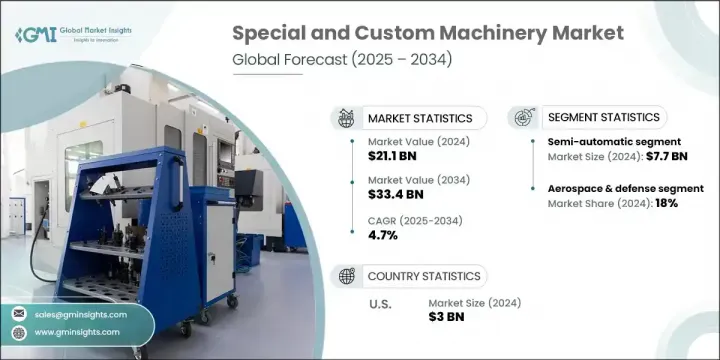
2024年,全球专用及客製化机械市场规模达211亿美元,预计到2034年将以4.7%的复合年增长率成长,达到334亿美元。受工业4.0技术的快速整合、数位化程度的提高以及各行业对自动化日益增长的需求的推动,该市场正稳步增长。专用及客製化机械是指专为执行标准机械无法高效执行的高度专业化任务而设计的设备。随着汽车、航太、製药、食品加工和电子等行业的製造商致力于提高生产力并降低误差幅度,他们越来越多地转向针对特定营运挑战而量身定制的系统。
这些客製化机器是透过机械供应商和最终用户之间的密切合作开发的,通常涉及针对单一应用的专门研究和工程设计。向更智慧、更有效率的生产流程转变,正在提升物联网、预测分析和机器人技术在客製化机械配置的应用。这种转变不仅提高了产量和安全性,还实现了早期缺陷检测和远端维护。随着製造业变得越来越复杂和专业化,客製化解决方案不再是小众产品——它们正成为注重创新、品质控制和灵活性的工业环境中营运成功不可或缺的一部分。
| 市场范围 | |
|---|---|
| 起始年份 | 2024 |
| 预测年份 | 2025-2034 |
| 起始值 | 211亿美元 |
| 预测值 | 334亿美元 |
| 复合年增长率 | 4.7% |
2024年,半自动机器市场规模达77亿美元。这些机器在手动操作和自动化之间取得平衡,能够高度适应不断变化的生产需求。其多功能性,加上较低的资本投资和维护成本,使其成为寻求客製化功能且无需承担全自动化成本的中小型企业的理想选择。其可重构特性在规格频繁变化的专业化生产中尤其重要。
2024年,航太和国防领域占18%,总额达39亿美元。这些行业对高精度和安全的要求使得定制机械对于製造导航系统、发动机部件和轻型国防级组件等复杂部件至关重要。这些机器通常采用数控系统、雷射切割工具和增材製造单元等技术,并根据严格的标准进行定制,能够处理先进材料和复杂的几何形状。
2024年,美国专用及客製化机械市场产值达30亿美元,巩固了其在全球专用及客製化机械领域的领导地位。凭藉着高度发展的工业基础设施、对研发的高度重视以及完善的航空航太和国防航太系统,美国持续推动该领域的创新。电子、汽车和医疗设备等行业日益增长的需求,正推动对满足特定生产需求的高精度、灵活且数位化的机械解决方案的投资。
推动成长和创新的知名市场参与者包括 Marel hf.、三菱电机株式会社、博世力士乐股份公司、德昌电机控股有限公司、ABB 有限公司、库卡股份公司、SPXFLOW 公司、霍夫曼工程公司、发那科公司、施耐德电气、西门子股份公司、丹佛斯集团、伊顿公司、Harms Equipment 和安川电机公司。为了在专用和客製化机械领域获得竞争优势,各公司正透过大量研发投资来优先进行创新,旨在开发高度专业化的智慧设备。许多公司正在采用数位孪生技术、物联网整合和自动化,以满足客户对效能、灵活性和远端诊断不断变化的需求。与最终用户的策略合作伙伴关係使公司能够共同创造与独特生产目标完美契合的机械。全球参与者正在向新兴市场扩张,建立本地製造或服务中心,以便更好地支援区域客户。客製化和服务差异化仍然是核心,各公司提供量身定制的安装后支援、预测性维护和模组化机械升级。
目录
第一章:方法论与范围
第二章:执行摘要
第三章:行业洞察
- 产业生态系统分析
- 供应商格局
- 利润率
- 每个阶段的增值
- 影响价值链的因素
- 产业衝击力
- 成长动力
- 提高工业自动化程度
- 利基应用的客製化需求不断增长
- 技术进步
- 产业陷阱与挑战
- 製造成本高
- 技术复杂性
- 机会
- 先进技术的融合
- 新兴产业的采用
- 成长动力
- 成长潜力分析
- 未来市场趋势
- 技术和创新格局
- 当前的技术趋势
- 新兴技术
- 价格趋势
- 按地区
- 按机器类型
- 监管格局
- 标准和合规性要求
- 区域监理框架
- 认证标准
- 波特的分析
- PESTEL分析
第四章:竞争格局
- 介绍
- 公司市占率分析
- 按地区
- 公司矩阵分析
- 主要市场参与者的竞争分析
- 竞争定位矩阵
- 关键进展
- 併购
- 伙伴关係与合作
- 新产品发布
- 扩张计划
第五章:市场估计与预测:按机器类型,2021 - 2034 年
- 主要趋势
- 自动的
- 半自动
- 手动的
第六章:市场估计与预测:按技术,2021 - 2034 年
- 主要趋势
- 气动
- 油压
- 电的
- 机器人
第七章:市场估计与预测:按应用,2021 - 2034 年
- 主要趋势
- 物料处理和输送系统
- 包装机械
- 製造机械
- 切割和钻孔机械
- 焊接和连接机械
- 检验检测设备
- 标记和贴标机
- 其他的
第八章:市场估计与预测:按最终用途产业,2021 - 2034 年
- 主要趋势
- 汽车与运输
- 航太与国防
- 电子和半导体
- 食品和饮料
- 建造
- 电力与能源
- 纺织品
- 矿业
- 其他的
第九章:市场估计与预测:按配销通路,2021 - 2034 年
- 主要趋势
- 直接的
- 间接
第十章:市场估计与预测:按地区,2021 - 2034 年
- 主要趋势
- 北美洲
- 我们
- 加拿大
- 欧洲
- 德国
- 英国
- 法国
- 西班牙
- 义大利
- 亚太地区
- 中国
- 日本
- 印度
- 澳洲
- 韩国
- 拉丁美洲
- 巴西
- 墨西哥
- 阿根廷
- 中东和非洲
- 南非
- 沙乌地阿拉伯
- 阿联酋
第 11 章:公司简介
- ABB Ltd.
- Bosch Rexroth AG
- Danfoss Group
- Eaton Corporation
- FANUC Corporation
- Harms Equipment
- Hofmann Engineering
- Johnson Electric Holdings Limited
- KUKA AG
- Marel hf.
- Mitsubishi Electric Corporation
- Schneider Electric
- Siemens AG
- SPXFLOW, Inc.
- Yaskawa Electric Corporation
The Global Special and Custom Machinery Market was valued at USD 21.1 billion in 2024 and is estimated to grow at a CAGR of 4.7% to reach USD 33.4 billion by 2034. This market is witnessing steady growth fueled by the rapid integration of Industry 4.0 technologies, increased digitalization, and the rising demand for automation across multiple sectors. Special and custom machinery refers to equipment engineered to perform highly specific tasks that standard machinery cannot execute efficiently. As manufacturers across sectors such as automotive, aerospace, pharmaceuticals, food processing, and electronics aim to boost productivity and reduce error margins, they are increasingly turning to customized systems tailored to unique operational challenges.
These custom machines are developed through close collaboration between machinery providers and end users, often involving dedicated research and engineering for a single application. The shift toward smarter, more efficient production processes is elevating the use of IoT, predictive analytics, and robotics within tailored machinery setups. This transition is not only enhancing output and safety but also enabling early defect detection and remote maintenance. With manufacturing becoming more complex and specialized, custom solutions are no longer niche-they are becoming an integral part of operational success in industrial environments focused on innovation, quality control, and flexibility.
| Market Scope | |
|---|---|
| Start Year | 2024 |
| Forecast Year | 2025-2034 |
| Start Value | $21.1 Billion |
| Forecast Value | $33.4 Billion |
| CAGR | 4.7% |
The semi-automatic machines segment generated USD 7.7 billion in 2024. These machines strike a balance between manual operation and automation, making them highly adaptable for changing production requirements. Their versatility, combined with lower capital investment and maintenance expenses, positions them as an ideal choice for small to mid-sized businesses seeking custom functionality without the cost of full automation. Their reconfigurable nature is especially valuable in specialized production where specifications frequently evolve.
In 2024, the aerospace and defense segment accounted for an 18% share, totaling USD 3.9 billion. High-precision and safety-critical requirements in these industries make custom-built machinery essential for fabricating complex parts such as navigation systems, engine components, and lightweight defense-grade assemblies. These machines are typically designed to work with advanced materials and intricate geometries using technologies like CNC systems, laser cutting tools, and additive manufacturing units customized to meet rigorous standards.
United States Special and Custom Machinery Market generated USD 3 billion in 2024, solidifying its leadership role in the global special and custom machinery sector. With its highly developed industrial infrastructure, strong focus on R&D, and established aerospace and defense ecosystems, the U.S. continues to push innovation in this space. Rising demand from industries such as electronics, automotive, and medical devices is fueling investment in high-precision, flexible, and digitally enabled machinery solutions tailored to niche production needs.
Prominent market players driving growth and innovation include Marel hf., Mitsubishi Electric Corporation, Bosch Rexroth AG, Johnson Electric Holdings Limited, ABB Ltd., KUKA AG, SPXFLOW, Inc., Hofmann Engineering, FANUC Corporation, Schneider Electric, Siemens AG, Danfoss Group, Eaton Corporation, Harms Equipment, and Yaskawa Electric Corporation. To gain a competitive advantage in the special and custom machinery space, companies are prioritizing innovation through heavy R&D investments aimed at developing highly specialized, smart equipment. Many are embracing digital twin technology, IoT integration, and automation to meet evolving customer needs for performance, flexibility, and remote diagnostics. Strategic partnerships with end users enable firms to co-create machinery that aligns perfectly with unique production goals. Global players are expanding into emerging markets, setting up local manufacturing or service hubs to better support regional clients. Customization and service differentiation remain central, with companies offering tailored post-installation support, predictive maintenance, and modular machinery upgrades.
Table of Contents
Chapter 1 Methodology and Scope
- 1.1 Market scope and definition
- 1.2 Research design
- 1.2.1 Research approach
- 1.2.2 Data collection methods
- 1.3 Data mining sources
- 1.3.1 Global
- 1.3.2 Regional/Country
- 1.4 Base estimates and calculations
- 1.4.1 Base year calculation
- 1.4.2 Key trends for market estimation
- 1.5 Primary research and validation
- 1.5.1 Primary sources
- 1.6 Forecast model
- 1.7 Research assumptions and limitations
Chapter 2 Executive Summary
- 2.1 Industry 3600 synopsis
- 2.2 Key market trends
- 2.2.1 Regional
- 2.2.2 Machine type
- 2.2.3 Technology
- 2.2.4 Application
- 2.2.5 End use industry
- 2.2.6 Distribution channel
- 2.3 CXO perspectives: Strategic imperatives
- 2.3.1 Key decision points for industry executives
- 2.3.2 Critical success factors for market players
- 2.4 Future outlook and strategic recommendations
Chapter 3 Industry Insights
- 3.1 Industry ecosystem analysis
- 3.1.1 Supplier landscape
- 3.1.2 Profit margin
- 3.1.3 Value addition at each stage
- 3.1.4 Factor affecting the value chain
- 3.2 Industry impact forces
- 3.2.1 Growth drivers
- 3.2.1.1 Increasing industrial automation
- 3.2.1.2 Growing customization demand for niche applications
- 3.2.1.3 Technological advancements
- 3.2.2 Industry pitfalls & challenges
- 3.2.2.1 High manufacturing costs
- 3.2.2.2 Technical complexity
- 3.2.3 Opportunities
- 3.2.3.1 Integration of advanced technologies
- 3.2.3.2 Adoption in emerging sectors
- 3.2.1 Growth drivers
- 3.3 Growth potential analysis
- 3.4 Future market trends
- 3.5 Technology and innovation landscape
- 3.5.1 Current technological trends
- 3.5.2 Emerging technologies
- 3.6 Price trends
- 3.6.1 By region
- 3.6.2 By machine type
- 3.7 Regulatory landscape
- 3.7.1 Standards and compliance requirements
- 3.7.2 Regional regulatory frameworks
- 3.7.3 Certification standards
- 3.8 Porter’s analysis
- 3.9 PESTEL analysis
Chapter 4 Competitive Landscape, 2024
- 4.1 Introduction
- 4.2 Company market share analysis
- 4.2.1 By region
- 4.2.1.1 North America
- 4.2.1.2 Europe
- 4.2.1.3 Asia Pacific
- 4.2.1.4 Latin America
- 4.2.1.5 Middle East and Africa
- 4.2.1 By region
- 4.3 Company matrix analysis
- 4.4 Competitive analysis of major market players
- 4.5 Competitive positioning matrix
- 4.6 Key developments
- 4.6.1 Mergers & acquisitions
- 4.6.2 Partnerships & collaborations
- 4.6.3 New product launches
- 4.6.4 Expansion plans
Chapter 5 Market Estimates and Forecast, By Machine Type, 2021 - 2034 (USD Billion) (Thousand Units)
- 5.1 Key trends
- 5.2 Automatic
- 5.3 Semi-automatic
- 5.4 Manual
Chapter 6 Market Estimates and Forecast, By Technology, 2021 - 2034 (USD Billion) (Thousand Units)
- 6.1 Key trends
- 6.2 Pneumatic
- 6.3 Hydraulic
- 6.4 Electric
- 6.5 Robotic
Chapter 7 Market Estimates and Forecast, By Application, 2021 - 2034 (USD Billion) (Thousand Units)
- 7.1 Key trends
- 7.2 Material handling & conveying systems
- 7.3 Packaging machinery
- 7.4 Fabrication machinery
- 7.5 Cutting & drilling machinery
- 7.6 Welding & joining machinery
- 7.7 Inspection & testing equipment
- 7.8 Marking & labeling machines
- 7.9 Others
Chapter 8 Market Estimates and Forecast, By End Use Industry, 2021 - 2034 (USD Billion) (Thousand Units)
- 8.1 Key trends
- 8.2 Automotive & transportation
- 8.3 Aerospace & defense
- 8.4 Electronics & semiconductors
- 8.5 Food & beverages
- 8.6 Construction
- 8.7 Power & energy
- 8.8 Textiles
- 8.9 Mining
- 8.10 Others
Chapter 9 Market Estimates and Forecast, By Distribution Channel, 2021 - 2034 (USD Billion) (Thousand Units)
- 9.1 Key trends
- 9.2 Direct
- 9.3 Indirect
Chapter 10 Market Estimates and Forecast, By Region, 2021 - 2034 (USD Billion) (Thousand Units)
- 10.1 Key trends
- 10.2 North America
- 10.2.1 U.S.
- 10.2.2 Canada
- 10.3 Europe
- 10.3.1 Germany
- 10.3.2 UK
- 10.3.3 France
- 10.3.4 Spain
- 10.3.5 Italy
- 10.4 Asia Pacific
- 10.4.1 China
- 10.4.2 Japan
- 10.4.3 India
- 10.4.4 Australia
- 10.4.5 South Korea
- 10.5 Latin America
- 10.5.1 Brazil
- 10.5.2 Mexico
- 10.5.3 Argentina
- 10.6 Middle East and Africa
- 10.6.1 South Africa
- 10.6.2 Saudi Arabia
- 10.6.3 UAE
Chapter 11 Company Profiles
- 11.1 ABB Ltd.
- 11.2 Bosch Rexroth AG
- 11.3 Danfoss Group
- 11.4 Eaton Corporation
- 11.5 FANUC Corporation
- 11.6 Harms Equipment
- 11.7 Hofmann Engineering
- 11.8 Johnson Electric Holdings Limited
- 11.9 KUKA AG
- 11.10 Marel hf.
- 11.11 Mitsubishi Electric Corporation
- 11.12 Schneider Electric
- 11.13 Siemens AG
- 11.14 SPXFLOW, Inc.
- 11.15 Yaskawa Electric Corporation

