


 |
市场调查报告书
商品编码
1871179
电子甲醇市场机会、成长驱动因素、产业趋势分析及预测(2025-2034年)E-Methanol Market Opportunity, Growth Drivers, Industry Trend Analysis, and Forecast 2025 - 2034 |
||||||

2024 年全球电子甲醇市场价值为 10 亿美元,预计到 2034 年将以 32.2% 的复合年增长率增长至 161 亿美元。
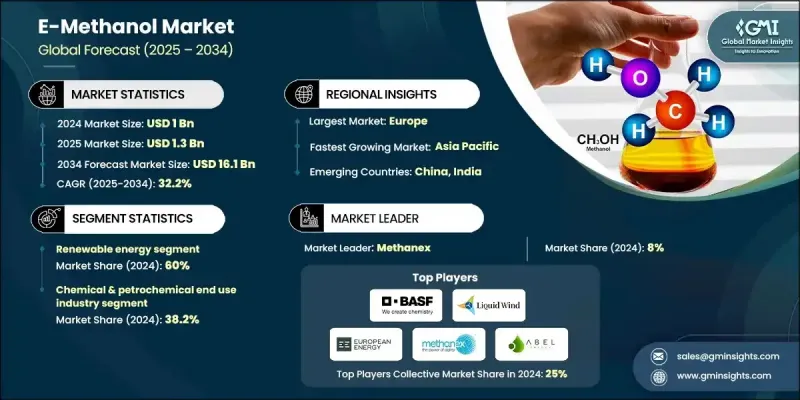
2024 年全球电子甲醇市场价值为 10 亿美元,预计到 2034 年将以 32.2% 的复合年增长率增长至 161 亿美元。
| 市场范围 | |
|---|---|
| 起始年份 | 2024 |
| 预测年份 | 2025-2034 |
| 起始值 | 10亿美元 |
| 预测值 | 161亿美元 |
| 复合年增长率 | 32.2% |
在全球范围内,尤其是在工业和交通运输领域,为减少碳排放所做的努力日益增多,这是推动市场发展的关键因素。电子甲醇正逐渐成为传统化石基甲醇的重要替代品,它提供了更干净的解决方案,符合国际气候目标。政策框架、政府激励措施和再生燃料生产补贴为这项转型提供了强有力的支持,所有这些都有助于降低营运成本并吸引大规模投资。与绿色氢气生产的融合,以及电解槽技术的进步,进一步巩固了市场发展动能。此外,人们对循环经济模式(尤其是废弃物製燃料计画)的兴趣日益浓厚,使电子甲醇成为永续发展的理想选择。将城市和工业废弃物转化为甲醇不仅有助于减少排放,还能降低原料成本。该产品在生产可持续航空燃料方面的作用及其在化学製造领域日益广泛的应用,预计将进一步增强市场需求。随着全球航空旅行和工业产出的持续成长,对电子甲醇等清洁能源替代品的需求也将随之成长。
2024年,再生能源领域占据60%的市场份额,预计到2034年将以33%的复合年增长率成长。绿色氢能与再生能源基础设施日益紧密的联繫正在推动市场需求。随着再生电力装置容量的成长和电解槽性能的提升,生产电甲醇的经济效益也日益凸显。这为全球清洁能源政策和脱碳目标提供了一个可扩展的解决方案。再生能源发电与绿色甲醇生产之间的协同效应将继续成为该领域成长的关键因素。
预计到2034年,船用燃料产业将以33.7%的复合年增长率成长,这主要得益于日益严格的排放法规和全球港口基础设施的扩张。随着新的排放法规逐步实施,由于与现有推进技术和燃料系统的兼容性,电子甲醇作为一种船用燃料正日益受到青睐。海运业者正不断转向低碳燃料,而电子甲醇提供了一种即用型选择,能够满足营运和环保要求。
美国电子甲醇市场占84%的市场份额,预计2024年市场规模将达1.2亿美元。区域成长的驱动力包括工业脱碳、对替代船用燃料日益增长的需求以及政策支持的甲醇生产。主要港口的基础设施升级改造正在促进清洁船用燃料的加註和分销。同时,製造商正将电子甲醇纳入其永续产品组合,从而支持美国的清洁能源转型目标。
全球电子甲醇产业的知名企业包括Enerkem、巴斯夫、Pacifico Mexinol、Andes Mining & Energy、ReIntegrate、MAN Energy Solutions、Liquid Wind、上海电气、Methanex、Carbon Recycling International、蒂森克虏伯乌德有限公司、三菱丰能化学、Khimod、晓星、Europe Energy、加拿大可再生科学研究所、加拿大可信水力学研究所、Europe Energy、Europe Energy、加拿大可信法研究所和大丰能化学研究所。领先的电子甲醇企业正积极投资于结合绿色氢气和二氧化碳捕集技术的综合生产设施,以扩大市场份额。与公用事业公司和氢气供应商的合作使他们能够建立端到端的低碳燃料价值链。许多企业也与工业企业和海运业者签订长期承购协议,以确保稳定的需求和投资报酬率。与政府的合作有助于获得拨款和监管部门的批准,尤其是在新兴市场。此外,各公司正在优化电解槽性能并采用模组化生产单元,以实现分散式生产。
目录
第一章:方法论与范围
第二章:执行概要
第三章:行业洞察
- 产业生态系分析
- 监管环境
- 产业影响因素
- 成长驱动因素
- 产业陷阱与挑战
- 成长潜力分析
- 波特的分析
- PESTEL 分析
- 新兴机会与趋势
- 数位化和物联网集成
- 新兴市场渗透
第四章:竞争格局
- 介绍
- 公司市占率分析
- 策略倡议
- 竞争性标竿分析
- 战略仪錶板
- 创新与技术格局
第五章:市场规模及预测:依原料划分,2021-2034年
- 主要趋势
- 水源
- 氢基
第六章:市场规模及预测:依来源划分,2021-2034年
- 主要趋势
- 再生能源
- 化石燃料
第七章:市场规模及预测:依最终用途划分,2021-2034年
- 主要趋势
- 化工及石油化工
- 船用燃料
- 发电
- 工业的
- 其他的
第八章:市场规模及预测:依地区划分,2021-2034年
- 主要趋势
- 北美洲
- 我们
- 加拿大
- 欧洲
- 德国
- 英国
- 法国
- 荷兰
- 西班牙
- 亚太地区
- 中国
- 澳洲
- 印度
- 日本
- 韩国
- 世界其他地区
第九章:公司简介
- ABEL Energy
- Andes Mining & Energy
- BASF
- Carbon Recycling International
- Celanese
- Dalian Institute of Chemical Physics
- Enerkem
- 欧洲能源
- Hyosung
- Johnson Matthey
- Khimod
- Liquid Wind
- Maersk
- MAN Energy Solutions
- Mitsubishi Gas Chemical
- Methanex
- Pacifico Mexinol
- ReIntegrate
- Renewable Hydrogen Canada
- Shanghai Electric
- Thyssenkrupp Uhde GmbH
The Global E-Methanol Market was valued at USD 1 Billion in 2024 and is estimated to grow at a CAGR of 32.2% to reach USD 16.1 Billion by 2034.
The Global E-Methanol Market was valued at USD 1 Billion in 2024 and is estimated to grow at a CAGR of 32.2% to reach USD 16.1 Billion by 2034.
| Market Scope | |
|---|---|
| Start Year | 2024 |
| Forecast Year | 2025-2034 |
| Start Value | $1 Billion |
| Forecast Value | $16.1 Billion |
| CAGR | 32.2% |
Growing global efforts to reduce carbon emissions, particularly across the industrial and transportation sectors, are a key driver for the market. E-methanol is emerging as a vital alternative to conventional fossil-based methanol, offering a cleaner solution that aligns with international climate targets. This transition is strongly supported by policy frameworks, government incentives, and subsidies for renewable fuel production, all of which are helping to lower operational costs and attract large-scale investment. Integration with green hydrogen production, along with advancements in electrolyzer technology, is further reinforcing market momentum. Additionally, increasing interest in circular economy models especially waste-to-fuel initiatives is making e-methanol an appealing option for sustainable development. Transforming municipal and industrial waste into methanol not only contributes to emission reductions but also brings down feedstock costs. The product's role in producing sustainable aviation fuel and its growing application across chemical manufacturing are expected to strengthen demand. As global air travel and industrial output continue to rise, so will the need for clean energy alternatives like e-methanol.
In 2024, the renewable energy segment held a 60% share and is forecasted to grow at a CAGR of 33% through 2034. The increasing connection between green hydrogen and renewable energy infrastructure is driving demand. As renewable electricity capacity grows and electrolyzer performance improves, the economics of producing e-methanol become more favorable. This creates a scalable solution aligned with clean energy policies and decarbonization objectives worldwide. The synergy between renewable power generation and green methanol production will continue to be a defining growth factor for this segment.
The marine fuel sector is anticipated to register a CAGR of 33.7% through 2034, supported by tightening emission regulations and the expansion of global port infrastructure. As new emission rules are enforced, e-methanol is gaining traction as a marine fuel due to its compatibility with existing propulsion technologies and fueling systems. Maritime operators are increasingly shifting toward low-carbon fuels, and e-methanol provides a ready-to-deploy option that meets operational and environmental requirements.
U.S. E-Methanol Market held 84% share and generated USD 120 million in 2024. Regional growth is being driven by industrial decarbonization efforts, rising demand for alternative marine fuels, and policy-backed methanol production. Infrastructure upgrades at major port locations are enabling bunkering and distribution for clean marine fuels. At the same time, manufacturers are adopting e-methanol into their sustainable product portfolios, supporting the country's clean energy transition goals.
Prominent companies in the Global E-Methanol Industry include Enerkem, BASF, Pacifico Mexinol, Andes Mining & Energy, ReIntegrate, MAN Energy Solutions, Liquid Wind, Shanghai Electric, Methanex, Carbon Recycling International, Thyssenkrupp Uhde GmbH, Mitsubishi Gas Chemical, Khimod, Hyosung, Europe Energy, Renewable Hydrogen Canada, Johnson Matthey, Maersk, Celanese, ABEL Energy, and Dalian Institute of Chemical Physics. Leading e-methanol companies are pursuing aggressive strategies to scale their market presence by investing in integrated production facilities that combine green hydrogen and CO2 capture technologies. Partnerships with utility firms and hydrogen suppliers are enabling them to build end-to-end, low-carbon fuel value chains. Many players are also entering long-term offtake agreements with industries and maritime operators to ensure stable demand and ROI. Collaborations with governments help secure grants and regulatory approvals, especially in emerging markets. Additionally, firms are optimizing electrolyzer performance and adopting modular production units to enable decentralized manufacturing.
Table of Contents
Chapter 1 Methodology & Scope
- 1.1 Research design
- 1.2 Base estimates & calculations
- 1.3 Forecast calculation
- 1.4 Data sources
- 1.4.1 Primary
- 1.4.2 Secondary
- 1.4.2.1 Paid
- 1.4.2.2 Public
- 1.5 Market definitions
Chapter 2 Executive Summary
- 2.1 Industry synopsis, 2021 - 2034
Chapter 3 Industry Insights
- 3.1 Industry ecosystem analysis
- 3.2 Regulatory landscape
- 3.3 Industry impact forces
- 3.3.1 Growth drivers
- 3.3.2 Industry pitfalls & challenges
- 3.4 Growth potential analysis
- 3.5 Porter's analysis
- 3.5.1 Bargaining power of suppliers
- 3.5.2 Bargaining power of buyers
- 3.5.3 Threat of new entrants
- 3.5.4 Threat of substitutes
- 3.6 PESTEL analysis
- 3.6.1 Political factors
- 3.6.2 Economic factors
- 3.6.3 Social factors
- 3.6.4 Technology factors
- 3.6.5 environmental factors
- 3.6.6 Legal factors
- 3.7 Emerging opportunities & trends
- 3.7.1 Digitalization and IoT integration
- 3.7.2 Emerging market penetration
Chapter 4 Competitive landscape, 2025
- 4.1 Introduction
- 4.2 Company market share analysis, 2024
- 4.3 Strategic initiatives
- 4.4 Competitive benchmarking
- 4.5 Strategic dashboard
- 4.6 Innovation & technology landscape
Chapter 5 Market Size and Forecast, By Feedstock, 2021 - 2034 (USD Million)
- 5.1 Key trends
- 5.2 Water sourced
- 5.3 Hydrogen based
Chapter 6 Market Size and Forecast, By Source, 2021 - 2034 (USD Million)
- 6.1 Key trends
- 6.2 Renewable energy
- 6.3 Fossil fuel
Chapter 7 Market Size and Forecast, By End Use, 2021 - 2034 (USD Million)
- 7.1 Key trends
- 7.2 Chemical & petrochemical
- 7.3 Marine fuel
- 7.4 Power generation
- 7.5 Industrial
- 7.6 Others
Chapter 8 Market Size and Forecast, By Region, 2021 - 2034 (USD Million)
- 8.1 Key trends
- 8.2 North America
- 8.2.1 U.S.
- 8.2.2 Canada
- 8.3 Europe
- 8.3.1 Germany
- 8.3.2 UK
- 8.3.3 France
- 8.3.4 Netherlands
- 8.3.5 Spain
- 8.4 Asia Pacific
- 8.4.1 China
- 8.4.2 Australia
- 8.4.3 India
- 8.4.4 Japan
- 8.4.5 South Korea
- 8.5 Rest of the world
Chapter 9 Company Profiles
- 9.1 ABEL Energy
- 9.2 Andes Mining & Energy
- 9.3 BASF
- 9.4 Carbon Recycling International
- 9.5 Celanese
- 9.6 Dalian Institute of Chemical Physics
- 9.7 Enerkem
- 9.8 European Energy
- 9.9 Hyosung
- 9.10 Johnson Matthey
- 9.11 Khimod
- 9.12 Liquid Wind
- 9.13 Maersk
- 9.14 MAN Energy Solutions
- 9.15 Mitsubishi Gas Chemical
- 9.16 Methanex
- 9.17 Pacifico Mexinol
- 9.18 ReIntegrate
- 9.19 Renewable Hydrogen Canada
- 9.20 Shanghai Electric
- 9.21 Thyssenkrupp Uhde GmbH

 甲醇加热器市场:按类型、容量、安装方式、应用领域和分销管道划分,全球预测(2026-2032年)
 甲醇市场分析及预测(至2035年):类型、产品、应用、技术、最终用户、製程、组件、安装类型、解决方案和模式
 全球甲醇市场规模、份额、趋势和成长分析报告(2026-2034年)
 2026年全球二氧化碳再生甲醇市场报告
 甲醇市场-全球产业规模、份额、趋势、机会、预测:按来源、最终用户、地区和竞争对手划分,2021-2031年二氧化碳再生甲醇市场:依反应路径、催化剂、原料及最终用途划分,全球预测(2026-2032年)
 甲醇市场规模、份额和成长分析(按类型、衍生、二次衍生、终端用户产业和地区划分):产业预测(2026-2033 年)
 全球电子甲醇市场:依能源、应用和地区划分,机会与预测(2018-2032 年)
 甲醇蛋白:全球市场份额和排名、总收入和需求预测(2025-2031 年)电子级甲醇 - 全球市场份额和排名、总销售量和需求预测(2025-2031 年)