


 |
市场调查报告书
商品编码
1871207
二氧化硅奈米粒子在先进应用领域的市场机会、成长驱动因素、产业趋势分析及预测(2025-2034年)Silica Nanoparticles for Advanced Applications Market Opportunity, Growth Drivers, Industry Trend Analysis, and Forecast 2025 - 2034 |
||||||

2024 年全球用于先进应用的二氧化硅奈米粒子市值为 6.953 亿美元,预计到 2034 年将以 6.9% 的复合年增长率增长至 14 亿美元。
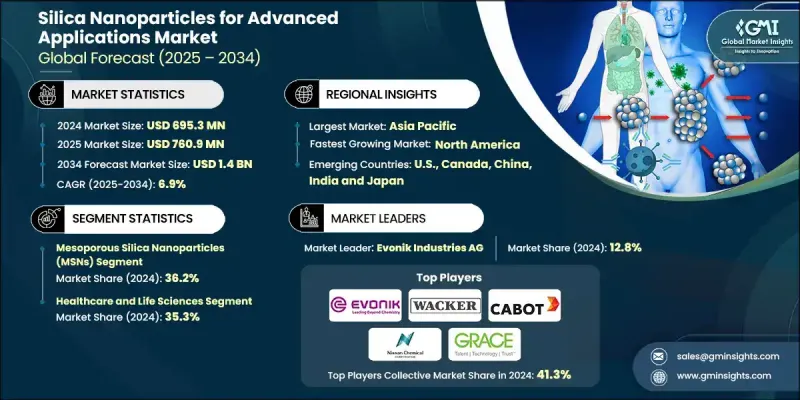
快速的技术创新和多个终端应用行业日益增长的需求推动了市场成长。二氧化硅奈米颗粒因其能够提高元件的电效率和热效率,从而提升整体可靠性和性能,在电子和半导体领域正获得广泛应用。它们在油漆和涂料领域的应用也在不断扩展,尤其是在汽车和建筑行业,它们能够增强产品的耐久性、透明度和防护性能。在再生能源领域,二氧化硅奈米颗粒已被证明可有效提高太阳能板和储能係统的能源效率。奈米技术研发投入的不断增加,以及人们对此材料优势的认识不断提高,持续推动市场扩张。儘管生产成本和安全法规方面存在挑战,但可持续的生产方式、与其他奈米材料整合製备混合复合材料以及在生物技术和医疗保健领域的新应用正在涌现出新的机会。这些发展为市场参与者提供了强大的动力,促使他们进行创新并扩大生产规模,以满足不断增长的全球需求。
| 市场范围 | |
|---|---|
| 起始年份 | 2024 |
| 预测年份 | 2025-2034 |
| 起始值 | 6.953亿美元 |
| 预测值 | 14亿美元 |
| 复合年增长率 | 6.9% |
2024年,緻密或无孔二氧化硅奈米颗粒市占率为25.8%,预计到2034年将以6.6%的复合年增长率成长。这些奈米颗粒主要应用于工业、涂料和电子领域,在这些领域中,机械强度、耐热性和结构增强至关重要。其优异的热稳定性使其在半导体製造和其他高性能工业製程中特别有效,在这些领域中,耐久性和精度至关重要。
2024年,医疗保健和生命科学应用领域占据35.3%的市场份额,预计到2034年将以7.2%的复合年增长率成长。该领域的成长主要得益于二氧化硅奈米颗粒在药物递送和诊断应用的日益普及。中孔奈米颗粒具有高载药量、精确的释放机制和优异的生物相容性,使其成为标靶治疗和医学影像的理想选择。它们与现代医疗保健解决方案的融合,反映了奈米技术在治疗和诊断领域日益普及的趋势,这种趋势旨在提高效率并改善患者预后。
2024年,北美二氧化硅奈米颗粒先进应用市场占32.4%的市场份额,预计2034年将以7.2%的复合年增长率成长。该地区的强劲市场地位得益于先进的奈米技术研究、完善的製药基础设施以及鼓励创新的先进监管体系。美国凭藉其集中的领先研究机构、生物技术公司和完善的投资生态系统,继续引领区域市场。此外,北美市场的成长也得益于大量的创投、广泛的智慧财产权基础以及产学合作,这些因素共同促进了新型奈米材料应用的开发和商业化。
全球先进应用二氧化硅奈米颗粒市场的主要参与者包括瓦克化学股份公司 (Wacker Chemie AG)、默克公司 (Merck)、日产化学公司 (Nissan Chemical Corporation)、卡博特公司 (Cabot Corporation)、诺力昂公司 (Nouryon)、WR & Co.、康宁公司 (Corning Inc.).和东方硅业株式会社 (Oriental Silicas Corporation)。为了巩固其在先进应用二氧化硅奈米颗粒市场的地位,领导企业正采取以创新、永续发展和扩张为核心的策略性倡议。许多企业正大力投资研发,以开发环境友善生产技术,并提升奈米颗粒的性能,从而满足下一代工业、医疗保健和电子应用的需求。与研究机构和终端用户产业的策略合作与伙伴关係正在加速产品开发和市场渗透。各公司也在扩大生产能力,以满足不断增长的全球需求,同时确保符合监管要求并实现成本效益。
目录
第一章:方法论与范围
第二章:执行概要
第三章:行业洞察
- 产业生态系分析
- 供应商格局
- 利润率
- 每个阶段的价值增加
- 影响价值链的因素
- 中断
- 产业影响因素
- 成长驱动因素
- 产业陷阱与挑战
- 市场机会
- 成长潜力分析
- 监管环境
- 北美洲
- 欧洲
- 亚太地区
- 拉丁美洲
- 中东和非洲
- 波特的分析
- PESTEL 分析
- 价格趋势
- 按地区
- 按产品类别
- 未来市场趋势
- 技术与创新格局
- 当前技术趋势
- 新兴技术
- 专利格局
- 贸易统计(HS编码)
(註:贸易统计仅针对重点国家提供)
- 主要进口国
- 主要出口国
- 永续性和环境方面
- 永续实践
- 减少废弃物策略
- 生产中的能源效率
- 环保倡议
- 碳足迹考量
第四章:竞争格局
- 介绍
- 公司市占率分析
- 按地区
- 北美洲
- 欧洲
- 亚太地区
- 拉丁美洲
- MEA
- 按地区
- 公司矩阵分析
- 主要市场参与者的竞争分析
- 竞争定位矩阵
- 关键进展
- 併购
- 合作伙伴关係与合作
- 新产品发布
- 扩张计划
第五章:市场估算与预测:依产品类型划分,2021-2034年
- 主要趋势
- 中孔二氧化硅奈米粒子(MSNs)
- 緻密(无孔)二氧化硅奈米颗粒
- 沉淀二氧化硅奈米颗粒
- 气相二氧化硅奈米颗粒
第六章:市场估算与预测:依应用领域划分,2021-2034年
- 主要趋势
- 医疗保健与生命科学
- 药物递送
- 诊断与影像
- 生物医学设备及植入物
- 工业製造
- 复合材料
- 涂层和表面处理
- 催化与化学加工
- 聚合物和橡胶应用
- 能源与环境
- 石油和天然气应用
- 环境修復
- 再生能源
- 储能与管理
- 农业与食品
- 食品加工与包装
- 精准农业
- 动物健康与营养
- 电子与半导体
- 半导体製造
- 电子元件
- 显示技术
- 光学元件
- 建筑与基础设施
- 混凝土和水泥强化
- 建筑涂料及密封剂
- 智慧建筑材料
- 基础设施保护
第七章:市场估计与预测:依地区划分,2021-2034年
- 主要趋势
- 北美洲
- 我们
- 加拿大
- 欧洲
- 德国
- 英国
- 法国
- 西班牙
- 义大利
- 欧洲其他地区
- 亚太地区
- 中国
- 印度
- 日本
- 澳洲
- 韩国
- 亚太其他地区
- 拉丁美洲
- 巴西
- 墨西哥
- 阿根廷
- 拉丁美洲其他地区
- 中东和非洲
- 沙乌地阿拉伯
- 南非
- 阿联酋
- 中东和非洲其他地区
第八章:公司简介
- Evonik Industries AG
- Cabot Corporation
- Wacker Chemie AG
- Nissan Chemical Corporation
- Tokuyama Corporation
- WR Grace & Co.
- Nouryon
- Merck
- Corning Inc.
- Oriental Silicas Corporation
The Global Silica Nanoparticles for Advanced Applications Market was valued at USD 695.3 million in 2024 and is estimated to grow at a CAGR of 6.9% to reach USD 1.4 Billion by 2034.
Market growth is propelled by rapid technological innovation and rising demand across multiple end-use industries. Silica nanoparticles are gaining traction in electronics and semiconductors due to their ability to enhance the electrical and thermal efficiency of components, improving overall reliability and performance. Their adoption is also expanding in paints and coatings, where they add durability, transparency, and enhanced protection particularly within the automotive and construction sectors. In renewable energy, silica nanoparticles are proven valuable in improving energy efficiency in solar panels and energy storage systems. Increasing R&D investment in nanotechnology, coupled with greater awareness of the material's advantages, continues to drive market expansion. Despite challenges related to production costs and safety regulations, new opportunities are emerging through sustainable manufacturing practices, integration with other nanomaterials for hybrid composites, and novel applications in biotechnology and healthcare. These developments are creating strong momentum for market players to innovate and scale production to meet rising global demand.
| Market Scope | |
|---|---|
| Start Year | 2024 |
| Forecast Year | 2025-2034 |
| Start Value | $695.3 Million |
| Forecast Value | $1.4 Billion |
| CAGR | 6.9% |
The dense or non-porous silica nanoparticles segment held a 25.8% share in 2024 and is expected to grow at a CAGR of 6.6% through 2034. These nanoparticles are primarily used in industrial, coating, and electronic applications, where mechanical strength, heat resistance, and structural reinforcement are essential. Their superior thermal stability makes them particularly effective in semiconductor manufacturing and other high-performance industrial processes, where durability and precision are key.
The healthcare and life sciences applications segment held 35.3% share in 2024 and is estimated to grow at a CAGR of 7.2% through 2034. The growth of this segment is being driven by the increasing use of silica nanoparticles in drug delivery and diagnostic applications. Mesoporous silica nanoparticles offer high drug-loading capacity, precise release mechanisms, and excellent biocompatibility, making them ideal for targeted therapeutics and medical imaging. Their integration into modern healthcare solutions reflects the broader shift toward nanotechnology-based treatments and diagnostics that enhance efficiency and patient outcomes.
North America Silica Nanoparticles for Advanced Applications Market held 32.4% share in 2024, growing at a CAGR of 7.2% through 2034. The region's strong presence is supported by advanced nanotechnology research, well-established pharmaceutical infrastructure, and progressive regulatory systems that encourage innovation. The U.S. continues to lead the regional landscape due to its concentration of leading research institutions, biotechnology firms, and supportive investment ecosystems. North American growth is also fueled by substantial venture capital funding, an extensive intellectual property base, and active collaboration between academia and industry, which together promote the development and commercialization of new nanomaterial applications.
Key players in the Global Silica Nanoparticles for Advanced Applications Market include Wacker Chemie AG, Merck, Nissan Chemical Corporation, Cabot Corporation, Nouryon, W.R. Grace & Co., Corning Inc., Evonik Industries AG, Tokuyama Corporation, and Oriental Silicas Corporation. To strengthen their foothold in the Silica Nanoparticles for Advanced Applications Market, leading companies are adopting strategic initiatives centered on innovation, sustainability, and expansion. Many are investing heavily in R&D to develop environmentally responsible production technologies and enhance nanoparticle performance for next-generation industrial, healthcare, and electronic applications. Strategic collaborations and partnerships with research organizations and end-user industries are accelerating product development and market penetration. Firms are also expanding manufacturing capacities to meet increasing global demand while ensuring regulatory compliance and cost efficiency.
Table of Contents
Chapter 1 Methodology & Scope
- 1.1 Market scope and definition
- 1.2 Research design
- 1.2.1 Research approach
- 1.2.2 Data collection methods
- 1.3 Data mining sources
- 1.3.1 Global
- 1.3.2 Regional/Country
- 1.4 Base estimates and calculations
- 1.4.1 Base year calculation
- 1.4.2 Key trends for market estimation
- 1.5 Primary research and validation
- 1.5.1 Primary sources
- 1.6 Forecast model
- 1.7 Research assumptions and limitations
Chapter 2 Executive Summary
- 2.1 Industry 360° synopsis
- 2.2 Key market trends
- 2.2.1 Regional
- 2.2.2 Product type
- 2.2.3 Application
- 2.3 TAM Analysis, 2025-2034
- 2.4 CXO perspectives: Strategic imperatives
- 2.4.1 Executive decision points
- 2.4.2 Critical success factors
- 2.5 Future Outlook and Strategic Recommendations
Chapter 3 Industry Insights
- 3.1 Industry ecosystem analysis
- 3.1.1 Supplier landscape
- 3.1.2 Profit margin
- 3.1.3 Value addition at each stage
- 3.1.4 Factor affecting the value chain
- 3.1.5 Disruptions
- 3.2 Industry impact forces
- 3.2.1 Growth drivers
- 3.2.2 Industry pitfalls and challenges
- 3.2.3 Market opportunities
- 3.3 Growth potential analysis
- 3.4 Regulatory landscape
- 3.4.1 North America
- 3.4.2 Europe
- 3.4.3 Asia Pacific
- 3.4.4 Latin America
- 3.4.5 Middle East & Africa
- 3.5 Porter's analysis
- 3.6 PESTEL analysis
- 3.7 Price trends
- 3.7.1 By region
- 3.7.2 By product category
- 3.8 Future market trends
- 3.9 Technology and Innovation landscape
- 3.9.1 Current technological trends
- 3.9.2 Emerging technologies
- 3.10 Patent Landscape
- 3.11 Trade statistics (HS code)
( Note: the trade statistics will be provided for key countries only)
- 3.11.1 Major importing countries
- 3.11.2 Major exporting countries
- 3.12 Sustainability and environmental aspects
- 3.12.1 Sustainable practices
- 3.12.2 Waste reduction strategies
- 3.12.3 Energy efficiency in production
- 3.12.4 Eco-friendly initiatives
- 3.13 Carbon footprint consideration
Chapter 4 Competitive Landscape, 2024
- 4.1 Introduction
- 4.2 Company market share analysis
- 4.2.1 By region
- 4.2.1.1 North America
- 4.2.1.2 Europe
- 4.2.1.3 Asia Pacific
- 4.2.1.4 LATAM
- 4.2.1.5 MEA
- 4.2.1 By region
- 4.3 Company matrix analysis
- 4.4 Competitive analysis of major market players
- 4.5 Competitive positioning matrix
- 4.6 Key developments
- 4.6.1 Mergers & acquisitions
- 4.6.2 Partnerships & collaborations
- 4.6.3 New Product Launches
- 4.6.4 Expansion Plans
Chapter 5 Market Estimates and Forecast, By Product Type, 2021-2034 (USD Million & Kilo Tons)
- 5.1 Key trends
- 5.2 Mesoporous silica nanoparticles (MSNs)
- 5.3 Dense (Non-Porous) silica nanoparticles
- 5.4 Precipitated silica nanoparticles
- 5.5 Fumed silica nanoparticles
Chapter 6 Market Estimates and Forecast, By Application, 2021-2034 (USD Million & Kilo Tons)
- 6.1 Key trends
- 6.2 Healthcare & life sciences
- 6.2.1 Pharmaceutical drug delivery
- 6.2.2 Diagnostic & imaging
- 6.2.3 Biomedical devices & implants
- 6.3 Industrial manufacturing
- 6.3.1 Composite materials
- 6.3.2 Coatings & surface treatments
- 6.3.3 Catalysis & chemical processing
- 6.3.4 Polymer & rubber applications
- 6.4 Energy & environment
- 6.4.1 Oil & gas applications
- 6.4.2 Environmental remediation
- 6.4.3 Renewable energy
- 6.4.4 Energy storage & management
- 6.5 Agriculture & food
- 6.5.1 Food processing & packaging
- 6.5.2 Precision agriculture
- 6.5.3 Animal health & nutrition
- 6.6 Electronics & semiconductors
- 6.6.1 Semiconductor manufacturing
- 6.6.2 Electronic components
- 6.6.3 Display technologies
- 6.6.4 Optical devices
- 6.7 Construction & infrastructure
- 6.7.1 Concrete & cement enhancement
- 6.7.2 Building coatings & sealants
- 6.7.3 Smart building materials
- 6.7.4 Infrastructure protection
Chapter 7 Market Estimates and Forecast, By Region, 2021-2034 (USD Million & Kilo Tons)
- 7.1 Key trends
- 7.2 North America
- 7.2.1 U.S.
- 7.2.2 Canada
- 7.3 Europe
- 7.3.1 Germany
- 7.3.2 UK
- 7.3.3 France
- 7.3.4 Spain
- 7.3.5 Italy
- 7.3.6 Rest of Europe
- 7.4 Asia Pacific
- 7.4.1 China
- 7.4.2 India
- 7.4.3 Japan
- 7.4.4 Australia
- 7.4.5 South Korea
- 7.4.6 Rest of Asia Pacific
- 7.5 Latin America
- 7.5.1 Brazil
- 7.5.2 Mexico
- 7.5.3 Argentina
- 7.5.4 Rest of Latin America
- 7.6 Middle East and Africa
- 7.6.1 Saudi Arabia
- 7.6.2 South Africa
- 7.6.3 UAE
- 7.6.4 Rest of Middle East and Africa
Chapter 8 Company Profiles
- 8.1 Evonik Industries AG
- 8.2 Cabot Corporation
- 8.3 Wacker Chemie AG
- 8.4 Nissan Chemical Corporation
- 8.5 Tokuyama Corporation
- 8.6 W.R. Grace & Co.
- 8.7 Nouryon
- 8.8 Merck
- 8.9 Corning Inc.
- 8.10 Oriental Silicas Corporation

 硅铁市场:依类型、形态、等级、製造流程、包装与应用划分-2026-2032年全球市场预测
 颗粒状硅市场规模、份额和成长分析:按类型、形态、纯度、应用、终端用户产业和地区划分 - 2026-2033 年产业预测全球镁硅酸盐市场(依纯度等级、粒径、形状、终端用途产业及通路划分)预测(2026-2032年)水雾化硅铁粉末市场依等级、粒径、应用、终端用户产业及通路划分,全球预测,2026-2032年萤光二氧化硅颗粒市场按应用、最终用户、形态、粒径、表面功能化和等级划分-全球预测,2026-2032年二氧化硅奈米颗粒分散液市场:依粒径、分散介质、合成方法及应用划分-2026-2032年全球预测
 按产品、最终用户和地区绿坡缕石市场
 一氧化硅市场规模、份额及成长分析(按形态、应用、最终用途及地区划分)-2026-2033年产业预测
 硅酸镁市场规模、份额及成长分析(按类型、形态、应用、终端用户产业及地区划分)-2026-2033年产业预测
 四氯化硅市场规模、份额和成长分析(按等级、应用、最终用户和地区划分)-2026-2033年产业预测