


 |
市场调查报告书
商品编码
1871297
生物样本库市场机会、成长驱动因素、产业趋势分析及预测(2025-2034年)Biobanking Market Opportunity, Growth Drivers, Industry Trend Analysis, and Forecast 2025 - 2034 |
||||||

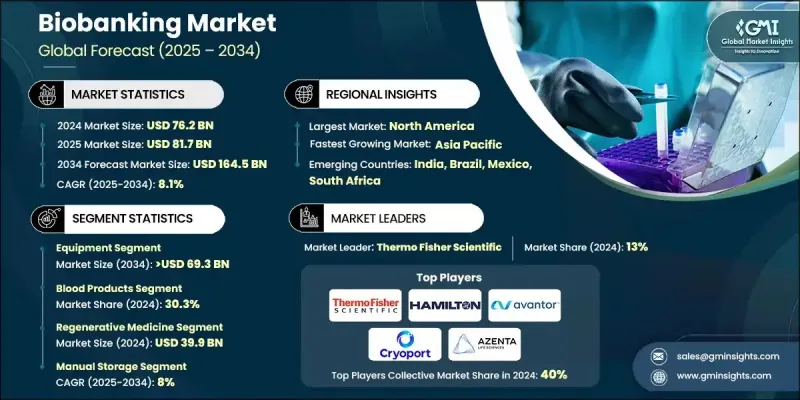
2024 年全球生物样本库市场价值为 762 亿美元,预计到 2034 年将以 8.1% 的复合年增长率增长至 1,645 亿美元。
个人化医疗的日益普及,以及基因组学和分子生物学研究投入的不断增长,正强劲推动着市场扩张。生物样本库在生物医学创新中发挥着至关重要的作用,它能够系统地收集、保存和分析血液、组织和DNA等生物样本,用于临床和治疗。越来越多的人参与国家生物样本库项目,公众对基因组资料利用的认识不断提高,这进一步巩固了生物样本库在现代医疗保健领域的重要性。数位平台和数据共享技术的日益整合,也促进了研究机构、製药公司和医疗服务提供者之间的全球合作。随着医疗保健产业向数据驱动和精准医疗模式转型,生物样本库正成为支持大规模人群研究、精准诊断和药物研发的关键基础设施。标准化生物样本库方案的不断改进,以及储存和样本管理的自动化,持续提升营运效率,并提高了生物材料在科学和临床应用中的可及性。
| 市场范围 | |
|---|---|
| 起始年份 | 2024 |
| 预测年份 | 2025-2034 |
| 起始值 | 762亿美元 |
| 预测值 | 1645亿美元 |
| 复合年增长率 | 8.1% |
2024年,设备类市占率达到42.5%,主要得益于先进低温冷冻机、超低温储存设备和自动化处理系统的日益普及。此细分市场可进一步细分为样品储存、运输、处理和分析设备。大规模基因组研究和生物製药计画的发展,推动了高容量、高可靠性储存解决方案的需求成长。先进的设备有助于维持生物样本的完整性,同时减少人工操作错误,确保样本在临床和研究环境中长期保存有效。
2024年,血液製品市占率达到30.3%,这主要得益于血液样本在生物标记鑑定、基因检测和临床诊断上的广泛应用。血液采集和保存流程的标准化使其成为用途最广泛的生物样本之一,也为该领域带来了显着优势。血液样本广泛应用于免疫学、流行病学和代谢研究等诸多领域,进一步巩固了其在生物样本库中的重要地位。此外,血液样本在疾病监测、临床检测和公共卫生研究中的重要角色也持续强化了该领域的领先地位。
2024年,北美生物样本库市占率预计将达到45.7%,这主要得益于其完善的医疗基础设施和先进的基因组研究计画。美国和加拿大引领该地区的成长,这主要得益于对精准医疗、癌症研究和先进生物样本管理实践的日益重视。政府措施和学术合作正在推动国家生物样本库的扩建,从而能够有效地收集和利用生物样本,用于临床和药物研究。数位化生物样本库系统和自动化技术的广泛应用进一步提升了资料的可近性和质量,加速了个人化治疗的研发进程。
全球生物样本库市场的主要参与者包括赛默飞世尔科技(Thermo Fisher Scientific)、Avantor、贝克顿·迪金森公司(Becton, Dickinson and Company)、Azenta、Cryoport、BioIVT、默克公司(Merck & Co.)、辉瑞(Pfizer)、查尔斯河实验室(Charles Riverigen)、Scorpcan(Scorpidgen)、Scorpion) Holdings、Eurofins Scientific、Hamilton Company、BioStorage Technologies、Brooks Life Sciences 和诺华(Novartis)。生物样本库市场的领导企业正采取多种策略来巩固其市场地位和竞争优势。许多企业正在扩展其全球生物样本库网络,并投资自动化技术以简化样本处理流程并提高可扩展性。此外,企业也积极寻求策略性併购和合作,以增强资料整合、样本多样性和营运效率。同时,各公司也致力于开发基于云端的生物样本库管理平台和先进的低温储存解决方案,以确保高品质的样本保存。
目录
第一章:方法论与范围
第二章:执行概要
第三章:行业洞察
- 产业生态系分析
- 供应商格局
- 每个阶段的价值增加
- 影响价值链的因素
- 产业影响因素
- 成长驱动因素
- 基因组学和药物研发领域的技术进步
- 对个人化医疗的需求日益增长
- 增加基因组研究的投资
- 生物资讯工具与先进资料分析技术的整合
- 产业陷阱与挑战
- 自动化系统成本高昂
- 与生物样本采集相关的问题
- 市场机会
- 发展去中心化和移动式生物样本库模型
- 拓展至多组学和纵向健康资料整合领域
- 成长驱动因素
- 成长潜力分析
- 监管环境
- 未来市场趋势
- 技术格局
- 目前技术
- 新兴技术
- 波特的分析
- PESTEL 分析
第四章:竞争格局
- 介绍
- 公司市占率分析
- 全球的
- 北美洲
- 欧洲
- 公司矩阵分析
- 主要市场参与者的竞争分析
- 竞争定位矩阵
- 关键进展
- 併购
- 伙伴关係与合作
- 新产品发布
- 扩张计划
第五章:市场估算与预测:依产品与服务划分,2021-2034年
- 主要趋势
- 装置
- 储存装置
- 样品分析设备
- 样品处理设备
- 样品运送设备
- 消耗品
- 储存耗材
- 分析耗材
- 加工耗材
- 收集耗材
- 服务
- 储存服务
- 处理服务
- 运输服务
- 供应服务
- 软体
第六章:市场估计与预测:依样本类型划分,2021-2034年
- 主要趋势
- 血液製品
- 人体组织
- 细胞系
- 核酸
- 生物体液
- 人类排泄物
- 其他样本类型
第七章:市场估计与预测:依应用领域划分,2021-2034年
- 主要趋势
- 再生医学
- 生命科学研究
- 临床研究
- 其他应用
第八章:市场估算与预测:依储存类型划分,2021-2034年
- 主要趋势
- 自动化存储
- 手动储存
第九章:市场估算与预测:依最终用途划分,2021-2034年
- 主要趋势
- 生物技术和製药公司
- 合约研究组织(CRO)
- 学术和研究机构
- 医院
第十章:市场估计与预测:依地区划分,2021-2034年
- 主要趋势
- 北美洲
- 我们
- 加拿大
- 欧洲
- 德国
- 英国
- 法国
- 西班牙
- 义大利
- 荷兰
- 亚太地区
- 中国
- 日本
- 印度
- 澳洲
- 韩国
- 拉丁美洲
- 巴西
- 墨西哥
- 阿根廷
- 中东和非洲
- 南非
- 沙乌地阿拉伯
- 阿联酋
第十一章:公司简介
- Avantor
- Azenta
- Becton, Dickinson and Company
- BioIVT
- BioStorage Technologies
- Brooks Life Sciences
- Charles River Laboratories
- Cryoport
- Eurofins Scientific
- Hamilton Company
- Labcorp
- Merck & Co.
- Novartis
- Pfizer
- PHC Holdings
- Qiagen
- STEMCELL Technologies
- Tecan Trading
- Thermo Fisher Scientific
The Global Biobanking Market was valued at USD 76.2 billion in 2024 and is estimated to grow at a CAGR of 8.1% to reach USD 164.5 billion by 2034.
The growing focus on personalized medicine, together with rising investments in genomics and molecular biology research, is strongly propelling market expansion. Biobanks play an essential role in biomedical innovation, enabling the systematic collection, preservation, and analysis of biological specimens such as blood, tissues, and DNA for clinical and therapeutic purposes. Increasing participation in national biobank programs and heightened public awareness of genomic data utilization are reinforcing the industry's importance in modern healthcare. The growing integration of digital platforms and data-sharing technologies is also enhancing global collaboration among research institutes, pharmaceutical companies, and healthcare providers. As the healthcare industry shifts toward data-driven and precision-based medical approaches, biobanking is emerging as a critical infrastructure that supports large-scale population studies, precision diagnostics, and drug discovery. The ongoing development of standardized biobanking protocols, along with automation in storage and sample management, continues to strengthen operational efficiency and improve the accessibility of biological materials for scientific and clinical use.
| Market Scope | |
|---|---|
| Start Year | 2024 |
| Forecast Year | 2025-2034 |
| Start Value | $76.2 Billion |
| Forecast Value | $164.5 Billion |
| CAGR | 8.1% |
In 2024, the equipment segment held a 42.5% share, supported by the growing adoption of advanced cryogenic freezers, ultra-low temperature storage units, and automated handling systems. This segment is further divided into sample storage, transport, processing, and analytical equipment. Increasing demand for high-capacity and reliable storage solutions is driven by large-scale genomic research and biopharmaceutical initiatives. Advanced equipment helps maintain biospecimen integrity while reducing manual handling errors, ensuring that samples remain viable for long-term use in both clinical and research environments.
The blood products segment held a 30.3% share in 2024, owing to the extensive use of blood samples in biomarker identification, genetic testing, and clinical diagnostics. The segment benefits from the standardized procedures for collection and preservation that make blood one of the most versatile biospecimens available. Blood samples are widely utilized in a range of studies, including immunology, epidemiology, and metabolic research, which further strengthens their contribution to biobanking. Their importance in disease surveillance, clinical testing, and public health research continues to reinforce this segment's leading position.
North America Biobanking Market held 45.7% share in 2024, supported by a strong presence of established healthcare infrastructure and advanced genomic research initiatives. The U.S. and Canada lead the region's growth, driven by increased focus on precision medicine, cancer research, and advanced biospecimen management practices. Government initiatives and academic collaborations are promoting the expansion of national biobanks, enabling efficient collection and utilization of biological samples for clinical and pharmaceutical research. The high adoption of digital biobanking systems and automation technologies is further enhancing data accessibility and quality, promoting faster progress in personalized therapy development.
Key companies operating in the Global Biobanking Market include Thermo Fisher Scientific, Avantor, Becton, Dickinson and Company, Azenta, Cryoport, BioIVT, Merck & Co., Pfizer, Charles River Laboratories, STEMCELL Technologies, Qiagen, Labcorp, Tecan Trading, PHC Holdings, Eurofins Scientific, Hamilton Company, BioStorage Technologies, Brooks Life Sciences, and Novartis. Leading players in the biobanking market are employing multiple strategies to strengthen their market presence and competitive position. Many are expanding their global biobank networks and investing in automation to streamline sample handling and improve scalability. Strategic mergers, acquisitions, and collaborations are pursued to enhance data integration, sample diversity, and operational efficiency. Companies are also focusing on developing cloud-based biobank management platforms and advanced cryogenic storage solutions to ensure high-quality sample preservation.
Table of Contents
Chapter 1 Methodology and Scope
- 1.1 Market scope and definitions
- 1.2 Research design
- 1.2.1 Research approach
- 1.2.2 Data collection methods
- 1.3 Data mining sources
- 1.3.1 Global
- 1.3.2 Regional/country
- 1.4 Base estimates and calculations
- 1.4.1 Base year calculation
- 1.4.2 Key trends for market estimation
- 1.5 Primary research and validation
- 1.5.1 Primary sources
- 1.6 Forecast model
- 1.7 Research assumption and limitations
Chapter 2 Executive Summary
- 2.1 Industry 3600 synopsis
- 2.2 Key market trends
- 2.2.1 Regional trends
- 2.2.2 Product and services trends
- 2.2.3 Sample type trends
- 2.2.4 Application trends
- 2.2.5 Storage type trends
- 2.2.6 End use trends
- 2.3 CXO perspectives: Strategic imperatives
- 2.3.1 Key decision points for industry executives
- 2.3.2 Critical success factors for market players
- 2.4 Future outlook and strategic recommendations
Chapter 3 Industry Insights
- 3.1 Industry ecosystem analysis
- 3.1.1 Supplier landscape
- 3.1.2 Value addition at each stage
- 3.1.3 Factor affecting the value chain
- 3.2 Industry impact forces
- 3.2.1 Growth drivers
- 3.2.1.1 Technological advancements in genomics and drug development
- 3.2.1.2 Increasing demand for personalized medicine
- 3.2.1.3 Increasing investments in genomic research
- 3.2.1.4 Integration of bioinformatics tools and advanced data analysis techniques
- 3.2.2 Industry pitfalls and challenges
- 3.2.2.1 High cost associated with automated systems
- 3.2.2.2 Issues related to biospecimen sample procurement
- 3.2.3 Market opportunities
- 3.2.3.1 Development of decentralized and mobile biobanking models
- 3.2.3.2 Expansion into multi-omics and longitudinal health data integration
- 3.2.1 Growth drivers
- 3.3 Growth potential analysis
- 3.4 Regulatory landscape
- 3.4.1 North America
- 3.4.2 Europe
- 3.4.3 Asia Pacific
- 3.4.4 Latin America
- 3.4.5 Middle East and Africa
- 3.5 Future market trends
- 3.6 Technological landscape
- 3.6.1 Current technologies
- 3.6.2 Emerging technologies
- 3.7 Porter's analysis
- 3.8 PESTEL analysis
Chapter 4 Competitive Landscape, 2024
- 4.1 Introduction
- 4.2 Company market share analysis
- 4.2.1 Global
- 4.2.2 North America
- 4.2.3 Europe
- 4.3 Company matrix analysis
- 4.4 Competitive analysis of major market players
- 4.5 Competitive positioning matrix
- 4.6 Key developments
- 4.6.1 Merger and acquisition
- 4.6.2 Partnership and collaboration
- 4.6.3 New product launches
- 4.6.4 Expansion plans
Chapter 5 Market Estimates and Forecast, By Product and services, 2021 - 2034 ($ Mn)
- 5.1 Key trends
- 5.2 Equipment
- 5.2.1 Storage equipment
- 5.2.2 Sample analysis equipment
- 5.2.3 Sample processing equipment
- 5.2.4 Sample transport equipment
- 5.3 Consumable
- 5.3.1 Storage consumables
- 5.3.2 Analysis consumables
- 5.3.3 Processing consumables
- 5.3.4 Collection consumables
- 5.4 Service
- 5.4.1 Storage services
- 5.4.2 Processing services
- 5.4.3 Transport services
- 5.4.4 Supply services
- 5.5 Software
Chapter 6 Market Estimates and Forecast, By Sample Type, 2021 - 2034 ($ Mn)
- 6.1 Key trends
- 6.2 Blood products
- 6.3 Human tissues
- 6.4 Cell lines
- 6.5 Nucleic acids
- 6.6 Biological fluids
- 6.7 Human waste products
- 6.8 Other sample types
Chapter 7 Market Estimates and Forecast, By Application, 2021 - 2034 ($ Mn)
- 7.1 Key trends
- 7.2 Regenerative medicine
- 7.3 Life-science research
- 7.4 Clinical research
- 7.5 Other applications
Chapter 8 Market Estimates and Forecast, By Storage Type, 2021 - 2034 ($ Mn)
- 8.1 Key trends
- 8.2 Automated storage
- 8.3 Manual storage
Chapter 9 Market Estimates and Forecast, By End Use, 2021 - 2034 ($ Mn)
- 9.1 Key trends
- 9.2 Biotechnology & pharmaceutical companies
- 9.3 Contract research organizations (CROs)
- 9.4 Academic & research institutes
- 9.5 Hospitals
Chapter 10 Market Estimates and Forecast, By Region, 2021 - 2034 ($ Mn)
- 10.1 Key trends
- 10.2 North America
- 10.2.1 U.S.
- 10.2.2 Canada
- 10.3 Europe
- 10.3.1 Germany
- 10.3.2 UK
- 10.3.3 France
- 10.3.4 Spain
- 10.3.5 Italy
- 10.3.6 Netherlands
- 10.4 Asia Pacific
- 10.4.1 China
- 10.4.2 Japan
- 10.4.3 India
- 10.4.4 Australia
- 10.4.5 South Korea
- 10.5 Latin America
- 10.5.1 Brazil
- 10.5.2 Mexico
- 10.5.3 Argentina
- 10.6 Middle East and Africa
- 10.6.1 South Africa
- 10.6.2 Saudi Arabia
- 10.6.3 UAE
Chapter 11 Company Profiles
- 11.1 Avantor
- 11.2 Azenta
- 11.3 Becton, Dickinson and Company
- 11.4 BioIVT
- 11.5 BioStorage Technologies
- 11.6 Brooks Life Sciences
- 11.7 Charles River Laboratories
- 11.8 Cryoport
- 11.9 Eurofins Scientific
- 11.10 Hamilton Company
- 11.11 Labcorp
- 11.12 Merck & Co.
- 11.13 Novartis
- 11.14 Pfizer
- 11.15 PHC Holdings
- 11.16 Qiagen
- 11.17 STEMCELL Technologies
- 11.18 Tecan Trading
- 11.19 Thermo Fisher Scientific

 生物银行市场:2026-2032年全球市场预测(按服务类型、生物样本库类型、检体类型、应用程式和最终用户划分)
 2026年全球机器人生物银行系统市场报告2026年全球生物样本库自动化系统市场报告
 生物银行市场分析及预测(至2035年):依类型、产品、服务、技术、应用、材料类型、最终使用者、流程、设备及解决方案划分
 2026-2034年全球生物银行市场规模、份额、趋势和成长分析报告
 日本生物样本库市场报告(按样本类型、生物样本库类型、应用、最终用户和地区划分,2026-2034年)
 生物样本库市场规模、份额和趋势分析报告:按产品/服务、生物样本类型、生物样本库类型、服务、应用、地区和细分市场预测(2026-2033 年)
 生物银行市场规模、份额和成长分析(按产品和服务、生物样本库类型、样本类型、储存方法、所有权、应用、最终用户和地区划分)—产业预测(2026-2033 年)
 生物样本库市场-全球产业规模、份额、趋势、竞争格局、机会及预测,按类型、样本类型、应用、最终用户、地区和竞争格局划分,2020-2030年预测2025 年至 2033 年生物样本库市场规模、份额、趋势及预测(按样本类型、生物样本库类型、应用、最终用户和地区划分)