


 |
市场调查报告书
商品编码
1871322
特种化学品市场机会、成长驱动因素、产业趋势分析及预测(2025-2034年)Specialty Chemicals Market Opportunity, Growth Drivers, Industry Trend Analysis, and Forecast 2025 - 2034 |
||||||

2024年全球特用化学品市场价值为8,500亿美元,预计到2034年将以3%的复合年增长率成长至1.15兆美元。
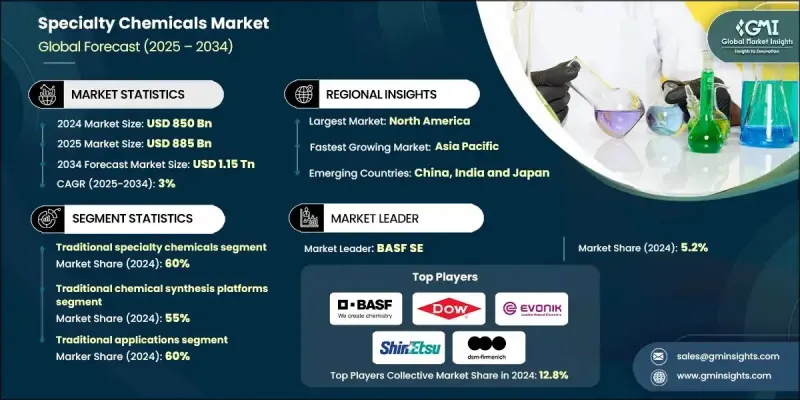
市场已证明其在众多工业应用领域具有强大的韧性和不可或缺性,即使在经济不确定时期也能保持稳定的需求。其稳定性源自于特种化学品的高性能及其在多个产业中的关键作用。在技术进步和对永续发展的关注推动下,成长模式正逐渐从单纯的销售扩张转向以价值驱动的创新。越来越多的特种解决方案涌现,应用于清洁能源、数位基础设施和其他高价值领域,这体现了市场从规模化向性能和影响力的转变。儘管传统特种化学品仍占据行业主导地位,但面向先进电子产品和电动车的新一代解决方案正日益受到关注。已开发市场凭藉着成熟的产业生态系统和严格的品质标准保持着强劲的市场地位,而亚太地区则凭藉快速的工业化和技术应用,在新兴经济体中引领成长。
| 市场范围 | |
|---|---|
| 起始年份 | 2024 |
| 预测年份 | 2025-2034 |
| 起始值 | 8500亿美元 |
| 预测值 | 1.15兆美元 |
| 复合年增长率 | 3% |
2024年,传统特用化学品领域占市场份额的60%,预计到2034年将以2.1%的复合年增长率成长。虽然传统的化学合成因其可靠性和基础设施的成熟而被广泛依赖,但为了满足监管、成本和永续发展目标,创新正日益集中于生物基和环境友善技术。
2024年,传统化学合成领域占55%的市场份额,预计2025年至2034年将以1.6%的复合年增长率成长。儘管该领域技术成熟且应用广泛,但随着产业向更永续、更有效率的生产方式转型,其成长速度正在放缓。
预计到2024年,北美特用化学品市场将占据50%的份额。该地区受益于先进的基础设施、高产能的研发设施以及供应商与终端用户之间的紧密合作。北美企业利用数位化和永续发展概念,打造差异化的高价值、特定应用化学解决方案,而对清洁技术的投资则推动了长期成长。
全球特种化学品市场的主要企业包括巴斯夫 (BASF SE)、科思创公司 (Covestro AG)、科莱恩国际公司 (Croda International)、索尔维公司 (Solvay SA)、住友化学公司 (Sumitomo Chemical)、三井化学公司 (Mitsui Chemicals)、陶氏公司 (Dow Inc.)、亨斯迈斯玛曼公司 (Huntk (DSM-Firmenich)、阿克苏诺贝尔公司 (AkzoNobel NV)、赢创工业集团 (Evonik Industries)、瓦克化学公司 (Wacker Chemie AG)、LG化学公司 (LG Chem)、旭化成株式会社 (Asahi Kasei Corporation)、三菱化学集团 (Mitsub Chemical Chemical. (Lanxess AG)、Indovinya、Scimplify 和 Honeywell Advanced Materials。市场领导者透过投资永续生产技术和创新化学解决方案来巩固其市场地位。各公司致力于扩大研发能力、建立策略伙伴关係并利用数位化工具进行製程优化。对清洁技术应用、环保产品和高价值特种解决方案的重视增强了市场差异化优势。
目录
第一章:方法论与范围
第二章:执行概要
第三章:行业洞察
- 产业生态系分析
- 供应商格局
- 利润率
- 每个阶段的价值增加
- 影响价值链的因素
- 中断
- 产业影响因素
- 成长驱动因素
- 电动车革命推动电池化学需求
- 再生能源的扩张需要先进材料
- 数位基础设施的成长对电子化学品的需求日益增长。
- 产业陷阱与挑战
- 原物料价格波动及原料依赖性
- 严格的环境法规增加了合规成本。
- 市场机会
- 人工智慧驱动的化学发现可将研发时间缩短50%。
- 能源转型催生了对专用电解槽组件的需求。
- 成长驱动因素
- 成长潜力分析
- 监管环境
- 北美洲
- 欧洲
- 亚太地区
- 拉丁美洲
- 中东和非洲
- 波特的分析
- PESTEL 分析
- 价格趋势
- 按地区
- 依产品类型
- 未来市场趋势
- 技术与创新格局
- 当前技术趋势
- 新兴技术
- 专利格局
- 贸易统计(HS编码 註:仅提供重点国家的贸易统计)
- 主要进口国
- 主要出口国
- 永续性和环境方面
- 永续实践
- 减少废弃物策略
- 生产中的能源效率
- 环保倡议
- 碳足迹考量
第四章:竞争格局
- 介绍
- 公司市占率分析
- 按地区
- 北美洲
- 欧洲
- 亚太地区
- 拉丁美洲
- MEA
- 按地区
- 公司矩阵分析
- 主要市场参与者的竞争分析
- 竞争定位矩阵
- 关键进展
- 併购
- 合作伙伴关係与合作
- 新产品发布
- 扩张计划
第五章:市场估算与预测:依产品类型划分,2021-2034年
- 主要趋势
- 传统特用化学品
- 下一代特种化学品
第六章:市场估计与预测:依技术划分,2021-2034年
- 主要趋势
- 传统化学合成平台
- 生物基生产技术
- 先进製造平台
- 循环化学技术
第七章:市场估计与预测:依应用领域划分,2021-2034年
- 主要趋势
- 传统应用
- 农业与作物保护
- 建筑与基础设施
- 汽车製造及售后市场
- 电子产品和消费性设备
- 个人护理及化妆品
- 高成长应用
- 电动车和电池系统
- 再生能源基础设施
- 水处理及管理系统
- 医疗保健和医疗器材应用
- 食品饮料加工
- 航太与国防技术
- 数位基础设施和资料中心
第八章:市场估算与预测:依地区划分,2021-2034年
- 主要趋势
- 北美洲
- 我们
- 加拿大
- 欧洲
- 德国
- 英国
- 法国
- 西班牙
- 义大利
- 欧洲其他地区
- 亚太地区
- 中国
- 印度
- 日本
- 澳洲
- 韩国
- 亚太其他地区
- 拉丁美洲
- 巴西
- 墨西哥
- 阿根廷
- 拉丁美洲其他地区
- 中东和非洲
- 沙乌地阿拉伯
- 南非
- 阿联酋
- 中东和非洲其他地区
第九章:公司简介
- BASF SE
- Dow Inc.
- Evonik Industries
- Shin-Etsu Chemical
- DSM-Firmenich
- Solvay SA
- Arkema SA
- Mitsubishi Chemical Group
- Asahi Kasei Corporation
- AkzoNobel NV
- Eastman Chemical Company
- Huntsman Corporation
- Clariant AG
- Indovinya
- LG Chem
- Sumitomo Chemical
- Mitsui Chemicals
- Covestro AG
- Wacker Chemie AG
- Olaplex Holdings
- Scimplify
- Honeywell Advanced Materials
- Croda International
- Nouryon
- Lanxess AG
The Global Specialty Chemicals Market was valued at USD 850 billion in 2024 and is estimated to grow at a CAGR of 3% to reach USD 1.15 trillion by 2034.
The market has proven resilient and essential across a wide range of industrial applications, maintaining steady demand even amid economic uncertainties. Its stability comes from the high-performance nature of specialty chemicals and their critical role in multiple industries. Growth is gradually shifting from sheer volume expansion to value-driven innovation, fueled by advancements in technology and a focus on sustainability. Increasingly, specialty solutions are emerging for clean energy, digital infrastructure, and other high-value applications, reflecting a transition from scale to performance and impact. While conventional specialty chemicals still dominate the industry, next-generation solutions targeting advanced electronics and electric mobility are gaining traction. Developed markets maintain a stronghold due to mature industrial ecosystems and strict quality standards, whereas Asia Pacific is leading growth among emerging economies through rapid industrialization and tech adoption.
| Market Scope | |
|---|---|
| Start Year | 2024 |
| Forecast Year | 2025-2034 |
| Start Value | $850 Billion |
| Forecast Value | $1.15 Trillion |
| CAGR | 3% |
The traditional specialty chemicals segment accounted for a 60% share in 2024 and is expected to grow at a CAGR of 2.1% through 2034. While traditional chemical synthesis remains widely relied upon due to its proven reliability and infrastructure, innovation is increasingly focused on bio-based and environmentally friendly technologies to meet regulatory, cost, and sustainability goals.
The traditional chemical synthesis segment held a 55% share in 2024 and is projected to grow at a CAGR of 1.6% from 2025 to 2034. Though well-established and widely used, this segment is experiencing slower growth as the sector pivots toward more sustainable and efficient production methods.
North America Specialty Chemicals Market held a 50% share in 2024. The region benefits from advanced infrastructure, high-capacity R&D facilities, and strong collaboration between suppliers and end-users. Companies in North America leverage digitalization and sustainability to differentiate high-value, application-specific chemical solutions, with clean-tech investments driving long-term growth.
Key companies in the Global Specialty Chemicals Market include BASF SE, Covestro AG, Croda International, Solvay S.A., Sumitomo Chemical, Mitsui Chemicals, Dow Inc., Huntsman Corporation, Arkema S.A., DSM-Firmenich, AkzoNobel N.V., Evonik Industries, Wacker Chemie AG, LG Chem, Asahi Kasei Corporation, Mitsubishi Chemical Group, Eastman Chemical Company, Olaplex Holdings, Lanxess AG, Indovinya, Scimplify, and Honeywell Advanced Materials. Market leaders strengthen their presence by investing in sustainable production technologies and innovative chemical solutions. Companies focus on expanding R&D capabilities, forming strategic partnerships, and leveraging digital tools for process optimization. Emphasis on clean-tech applications, environmentally responsible products, and high-value specialty solutions enhances market differentiation.
Table of Contents
Chapter 1 Methodology & Scope
- 1.1 Market scope and definition
- 1.2 Research design
- 1.2.1 Research approach
- 1.2.2 Data collection methods
- 1.3 Data mining sources
- 1.3.1 Global
- 1.3.2 Regional/Country
- 1.4 Base estimates and calculations
- 1.4.1 Base year calculation
- 1.4.2 Key trends for market estimation
- 1.5 Primary research and validation
- 1.5.1 Primary sources
- 1.6 Forecast model
- 1.7 Research assumptions and limitations
Chapter 2 Executive Summary
- 2.1 Industry 3600 synopsis
- 2.2 Key market trends
- 2.2.1 Regional
- 2.2.2 Product type
- 2.2.3 Technology
- 2.2.4 Application
- 2.3 TAM Analysis, 2025-2034
- 2.4 CXO perspectives: Strategic imperatives
- 2.4.1 Executive decision points
- 2.4.2 Critical success factors
- 2.5 Future Outlook and Strategic Recommendations
Chapter 3 Industry Insights
- 3.1 Industry ecosystem analysis
- 3.1.1 Supplier landscape
- 3.1.2 Profit margin
- 3.1.3 Value addition at each stage
- 3.1.4 Factor affecting the value chain
- 3.1.5 Disruptions
- 3.2 Industry impact forces
- 3.2.1 Growth drivers
- 3.2.1.1 Electric vehicle revolution driving battery chemistry demand
- 3.2.1.2 Renewable energy expansion requiring advanced materials
- 3.2.1.3 Digital infrastructure growth demanding electronic chemicals
- 3.2.2 Industry pitfalls and challenges
- 3.2.2.1 Raw material price volatility & feedstock dependencies
- 3.2.2.2 Stringent environmental regulations increasing compliance costs
- 3.2.3 Market opportunities
- 3.2.3.1 AI-driven chemical discovery reducing development time by 50%
- 3.2.3.2 Energy transition creating demand for specialized electrolyzer components
- 3.2.1 Growth drivers
- 3.3 Growth potential analysis
- 3.4 Regulatory landscape
- 3.4.1 North America
- 3.4.2 Europe
- 3.4.3 Asia Pacific
- 3.4.4 Latin America
- 3.4.5 Middle East & Africa
- 3.5 Porter's analysis
- 3.6 PESTEL analysis
- 3.7 Price trends
- 3.7.1 By region
- 3.7.2 By product type
- 3.8 Future market trends
- 3.9 Technology and Innovation landscape
- 3.9.1 Current technological trends
- 3.9.2 Emerging technologies
- 3.10 Patent Landscape
- 3.11 Trade statistics (HS code Note: the trade statistics will be provided for key countries only
- 3.11.1 Major importing countries
- 3.11.2 Major exporting countries
- 3.12 Sustainability and environmental aspects
- 3.12.1 Sustainable practices
- 3.12.2 Waste reduction strategies
- 3.12.3 Energy efficiency in production
- 3.12.4 Eco-friendly initiatives
- 3.13 Carbon footprint consideration
Chapter 4 Competitive Landscape, 2024
- 4.1 Introduction
- 4.2 Company market share analysis
- 4.2.1 By region
- 4.2.1.1 North America
- 4.2.1.2 Europe
- 4.2.1.3 Asia Pacific
- 4.2.1.4 LATAM
- 4.2.1.5 MEA
- 4.2.1 By region
- 4.3 Company matrix analysis
- 4.4 Competitive analysis of major market players
- 4.5 Competitive positioning matrix
- 4.6 Key developments
- 4.6.1 Mergers & acquisitions
- 4.6.2 Partnerships & collaborations
- 4.6.3 New Product Launches
- 4.6.4 Expansion Plans
Chapter 5 Market Estimates and Forecast, By Product Type, 2021-2034 (USD Billion) (Kilo Tons)
- 5.1 Key trends
- 5.2 Traditional specialty chemicals
- 5.3 Next-generation specialty chemicals
Chapter 6 Market Estimates and Forecast, By Technology, 2021-2034 (USD Billion) (Kilo Tons)
- 6.1 Key trends
- 6.2 Traditional chemical synthesis platforms
- 6.3 Bio-based production technologies
- 6.4 Advanced manufacturing platforms
- 6.5 Circular chemistry technologies
Chapter 7 Market Estimates and Forecast, By Application, 2021-2034 (USD Billion) (Kilo Tons)
- 7.1 Key trends
- 7.2 Traditional applications
- 7.2.1 Agriculture & crop protection
- 7.2.2 Construction & infrastructure
- 7.2.3 Automotive manufacturing & aftermarket
- 7.2.4 Electronics & consumer devices
- 7.2.5 Personal care & cosmetics
- 7.3 High-growth applications
- 7.3.1 Electric vehicles & battery systems
- 7.3.2 Renewable energy infrastructure
- 7.3.3 Water treatment & management systems
- 7.3.4 Healthcare & medical device applications
- 7.3.5 Food & beverage processing
- 7.3.6 Aerospace & defense technologies
- 7.3.7 Digital infrastructure & data centers
Chapter 8 Market Estimates and Forecast, By Region, 2021-2034 (USD Billion) (Kilo Tons)
- 8.1 Key trends
- 8.2 North America
- 8.2.1 U.S.
- 8.2.2 Canada
- 8.3 Europe
- 8.3.1 Germany
- 8.3.2 UK
- 8.3.3 France
- 8.3.4 Spain
- 8.3.5 Italy
- 8.3.6 Rest of Europe
- 8.4 Asia Pacific
- 8.4.1 China
- 8.4.2 India
- 8.4.3 Japan
- 8.4.4 Australia
- 8.4.5 South Korea
- 8.4.6 Rest of Asia Pacific
- 8.5 Latin America
- 8.5.1 Brazil
- 8.5.2 Mexico
- 8.5.3 Argentina
- 8.5.4 Rest of Latin America
- 8.6 Middle East and Africa
- 8.6.1 Saudi Arabia
- 8.6.2 South Africa
- 8.6.3 UAE
- 8.6.4 Rest of Middle East and Africa
Chapter 9 Company Profiles
- 9.1 BASF SE
- 9.2 Dow Inc.
- 9.3 Evonik Industries
- 9.4 Shin-Etsu Chemical
- 9.5 DSM-Firmenich
- 9.6 Solvay S.A.
- 9.7 Arkema S.A.
- 9.8 Mitsubishi Chemical Group
- 9.9 Asahi Kasei Corporation
- 9.10 AkzoNobel N.V.
- 9.11 Eastman Chemical Company
- 9.12 Huntsman Corporation
- 9.13 Clariant AG
- 9.14 Indovinya
- 9.15 LG Chem
- 9.16 Sumitomo Chemical
- 9.17 Mitsui Chemicals
- 9.18 Covestro AG
- 9.19 Wacker Chemie AG
- 9.20 Olaplex Holdings
- 9.21 Scimplify
- 9.22 Honeywell Advanced Materials
- 9.23 Croda International
- 9.24 Nouryon
- 9.25 Lanxess AG

 日本特种化学品市场报告(按类型和地区划分,2026-2034年)
 电子製造业特殊化学品市场预测(至2032年):按产品类型、应用、最终用户和地区分類的全球分析
 特种化学品市场规模、份额和成长分析(按技术、应用、产品类型和地区划分)—产业预测(2026-2033 年)
 水处理专用化学品:技术与全球市场
 特种化学品市场-全球产业规模、份额、趋势、机会和预测,按类型、地区和竞争格局划分,2020-2030年预测
 特种化学品市场按类型、功能、分销管道和最终用户划分 - 全球预测 2025-20322032 年特种化学品市场预测:按产品类型、功能、应用和地区进行的全球分析
 群勃龙庚酸的全球市场2025 年至 2033 年特种化学品市场报告(按类型(农业化学品、聚合物添加剂、建筑化学品、水处理化学品、油田化学品、食品添加剂、界面活性剂、电子化学品、特种聚合物等)和地区划分)
 2025-2029年全球瓶装空气市场