


 |
市场调查报告书
商品编码
1876563
医疗应用软体机器人市场机会、成长驱动因素、产业趋势分析及预测(2025-2034年)Soft Robotics for Medical Applications Market Opportunity, Growth Drivers, Industry Trend Analysis, and Forecast 2025 - 2034 |
||||||

2024 年全球医疗应用软体机器人市场价值为 9,690 万美元,预计到 2034 年将以 19.6% 的复合年增长率增长至 6.013 亿美元。
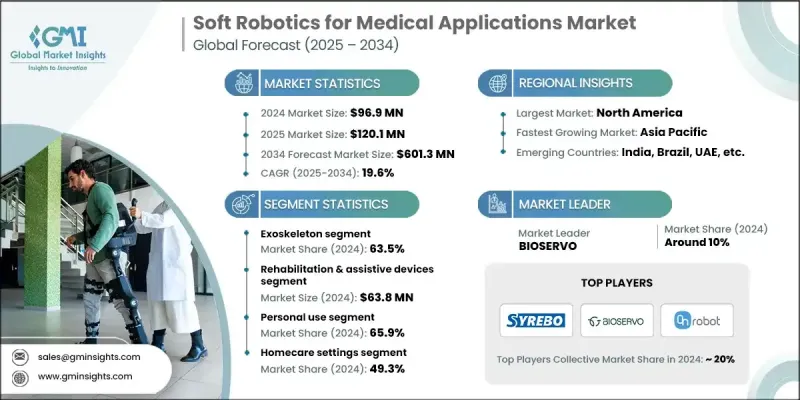
市场成长主要得益于材料科学和机器人技术的快速发展。弹性体、水凝胶和形状记忆聚合物等软性材料的开发,使得製造能够与人体安全互动的柔性生物相容性机器人设备成为可能。这些材料使机器人能够适应人体轮廓,从而提高患者的舒适度并最大限度地降低受伤风险。当与先进感测器整合时,软体机器人系统可以即时监测肌肉活动、压力和关节运动,从而提高治疗的精准度并实现个人化復健。这项技术革新正在拓展软体机器人在医疗程序、穿戴式健康设备、復健工具和植入式系统的应用。远距医疗、远端监测和以患者为中心的护理模式的兴起,进一步推动了软体机器人技术在增强患者復健、活动能力和长期健康方面的应用。
| 市场范围 | |
|---|---|
| 起始年份 | 2024 |
| 预测年份 | 2025-2034 |
| 起始值 | 9690万美元 |
| 预测值 | 6.013亿美元 |
| 复合年增长率 | 19.6% |
穿戴式医疗设备因其在持续健康追踪和远距治疗方面的应用而广受欢迎。软体机器人技术正在革新这一领域,提供更灵活、轻巧、舒适的可穿戴设备,可支持復健治疗、辅助运动并改善睡眠品质。专为家庭使用而设计的设备,例如机器人手套和外骨骼,使行动不便或患有神经系统疾病的患者能够独立接受治疗。与数位应用程式和云端系统的整合确保了即时监测、资料共享和个人化治疗方案的调整。随着人们对患者独立性和便利性的认识不断提高,穿戴式软体机器人解决方案正成为现代医疗保健系统的重要组成部分。
预计到2024年,外骨骼市占率将达到63.5%。行动不便者人数的不断增加,以及创伤和老年相关运动障碍病例的增多,正在推动这一领域的成长。软体机器人外骨骼利用先进的感测器和执行器来模拟人体自然运动,帮助使用者恢復行走、站立和进行復健运动的能力。其灵活轻巧的结构使其适用于各种环境,包括医院、家庭护理环境和復健中心。
到2024年,居家护理领域市占率将达到49.3%。软体机器人技术在居家復健的应用,透过提供便利且经济实惠的照护方案,正在改变患者的復健方式。专为居家使用而设计的设备注重使用者舒适度和易用性,同时允许医护人员进行远端监督。此类技术有助于减少患者就医次数,提升整体復健效果,使患者在熟悉的环境中独立进行復健治疗。
2024年,北美医疗软体机器人市场占据52.6%的市场份额,预计在整个预测期内将继续保持领先地位。该地区的领先地位得益于其先进的医疗基础设施、大量的研发投入以及对机器人和辅助技术的早期应用。不断增长的老龄人口和日益普遍的慢性病正在推动对康復和辅助机器人系统的需求,进一步巩固了区域市场的成长。
全球医疗应用软体机器人市场的主要参与者包括BIOSERVO、HUNIC、MyoSwiss、OnRobot、Roceso Technologies、SYREBO、SIFSOF、Somnox和SRT。这些公司致力于产品创新、技术合作和临床验证,以巩固其市场地位。许多公司投资开发生物相容性材料和整合感测器的系统,以提高医疗应用中的安全性、舒适性和适应性。与医院、研究机构和復健中心建立策略合作伙伴关係,有助于扩大实际应用范围并提高普及率。此外,各公司也优先考虑小型化和无线连接,以提升穿戴式装置和居家护理设备的易用性。
目录
第一章:方法论与范围
第二章:执行概要
第三章:行业洞察
- 产业生态系分析
- 产业影响因素
- 成长驱动因素
- 肌肉骨骼疾病发生率不断上升
- 软材料和感测器技术的进步
- 穿戴式医疗设备的日益普及
- 对復健治疗的需求不断增长
- 产业陷阱与挑战
- 设备成本高
- 监管障碍和安全合规问题
- 机会
- 用于药物传输和体内诊断
- 为罕见疾病患者订製义肢和辅助设备
- 成长驱动因素
- 成长潜力分析
- 监管环境
- 北美洲
- 欧洲
- 亚太地区
- 技术与创新格局
- 当前技术趋势
- 新兴技术
- 投资环境
- 软体机器人商业化面临的挑战
- 永续材料创新
- 未来路线图与创新计划
- 波特的分析
- PESTEL 分析
- 差距分析
- 未来市场趋势
第四章:竞争格局
- 介绍
- 公司矩阵分析
- 公司市占率分析
- 主要市场参与者的竞争分析
- 竞争定位矩阵
- 关键进展
- 併购
- 合作伙伴关係与合作
- 新产品发布
- 扩张计划
第五章:市场估算与预测:依产品类型划分,2021-2034年
- 主要趋势
- 外骨骼
- 软握把
第六章:市场估算与预测:依类别划分,2021-2034年
- 主要趋势
- 復健和辅助设备
- 拣选和放置
第七章:市场估计与预测:依应用领域划分,2021-2034年
- 主要趋势
- 个人使用
- 工业用途
第八章:市场估算与预测:依最终用途划分,2021-2034年
- 主要趋势
- 家庭护理机构
- 製药和生物技术公司
- 其他最终用途
第九章:市场估计与预测:依地区划分,2021-2034年
- 主要趋势
- 北美洲
- 我们
- 加拿大
- 欧洲
- 德国
- 英国
- 法国
- 西班牙
- 义大利
- 荷兰
- 亚太地区
- 中国
- 日本
- 印度
- 澳洲
- 韩国
- 拉丁美洲
- 巴西
- 墨西哥
- 阿根廷
- MEA
- 南非
- 沙乌地阿拉伯
- 阿联酋
第十章:公司简介
- BIOSERVO
- HUNIC
- MyoSwiss
- OnRobot
- Roceso Technologies
- SYREBO
- SIFSOF
- somnox
- SRT
The Global Soft Robotics for Medical Applications Market was valued at USD 96.9 million in 2024 and is estimated to grow at a CAGR of 19.6% to reach USD 601.3 million by 2034.
The market growth is primarily driven by rapid advancements in materials science and robotics technology. The development of soft materials such as elastomers, hydrogels, and shape-memory polymers has enabled the creation of flexible and biocompatible robotic devices that can safely interact with the human body. These materials allow the robots to adapt to body contours, improving patient comfort and minimizing the risk of injury. When integrated with advanced sensors, soft robotic systems can monitor muscle activity, pressure, and joint movement in real time, enhancing precision in therapy and enabling personalized rehabilitation. This technological evolution is expanding the use of soft robotics in medical procedures, wearable health devices, rehabilitation tools, and implantable systems. The rise of telemedicine, remote monitoring, and patient-centered care is further promoting the use of soft robotic technologies to enhance recovery, mobility, and long-term well-being.
| Market Scope | |
|---|---|
| Start Year | 2024 |
| Forecast Year | 2025-2034 |
| Start Value | $96.9 Million |
| Forecast Value | $601.3 Million |
| CAGR | 19.6% |
The wearable medical devices are gaining immense popularity for continuous health tracking and remote therapy. Soft robotics is revolutionizing this segment by delivering more adaptable, lightweight, and comfortable wearables that support rehabilitation, assist movement, and promote better sleep quality. Devices designed for home use, such as robotic gloves and exosuits, are enabling patients with limited mobility or neurological disorders to undergo therapy independently. Integration with digital applications and cloud-based systems ensures real-time monitoring, data sharing, and personalized treatment adjustments. With growing awareness around patient independence and convenience, wearable soft robotic solutions are becoming a vital part of modern healthcare systems.
The exoskeleton segment held a 63.5% share in 2024. The increasing number of individuals with mobility challenges, coupled with rising cases of trauma and age-related movement disorders, is fueling this segment's expansion. Soft robotic exoskeletons replicate the body's natural movements by using advanced sensors and actuators, helping users regain the ability to walk, stand, and perform rehabilitative exercises. Their flexible, lightweight structure makes them suitable for various settings, including hospitals, home care environments, and rehabilitation centers.
The home care settings segment held a 49.3% share in 2024. The adoption of soft robotics in home-based rehabilitation is transforming patient recovery by offering convenient and affordable care solutions. Devices designed for home use focus on user comfort and ease of operation while allowing remote supervision by healthcare providers. Such technologies help reduce hospital visits and enhance overall recovery outcomes, empowering patients to manage therapy independently in familiar surroundings.
North America Soft Robotics for Medical Applications Market held 52.6% share in 2024 and is projected to continue leading throughout the forecast period. The region's dominance is supported by its advanced healthcare infrastructure, significant investment in R&D, and early adoption of robotic and assistive technologies. A growing elderly population and the increasing prevalence of chronic conditions are driving demand for rehabilitation and assistive robotic systems, further strengthening regional market growth.
Prominent players in the Global Soft Robotics for Medical Applications Market include BIOSERVO, HUNIC, MyoSwiss, OnRobot, Roceso Technologies, SYREBO, SIFSOF, Somnox, and SRT. Companies in the Soft Robotics for Medical Applications Market are focusing on product innovation, technological collaboration, and clinical validation to strengthen their market position. Many are investing in the development of biocompatible materials and sensor-integrated systems that enhance safety, comfort, and adaptability in medical use. Strategic partnerships with hospitals, research institutions, and rehabilitation centers are helping expand real-world applications and adoption rates. Firms are also prioritizing miniaturization and wireless connectivity to improve usability in wearable and home care devices.
Table of Contents
Chapter 1 Methodology and Scope
- 1.1 Market scope and definition
- 1.2 Research design
- 1.2.1 Research approach
- 1.2.2 Data collection methods
- 1.3 Data mining sources
- 1.3.1 Global
- 1.3.2 Regional/Country
- 1.4 Base estimates and calculations
- 1.4.1 Base year calculation
- 1.4.2 Key trends for market estimation
- 1.5 Primary research and validation
- 1.5.1 Primary sources
- 1.6 Forecast model
- 1.7 Research assumptions and limitations
Chapter 2 Executive Summary
- 2.1 Industry 360° synopsis
- 2.2 Key market trends
- 2.2.1 Regional trends
- 2.2.2 Product type trends
- 2.2.3 Category trends
- 2.2.4 Application trends
- 2.2.5 End use trends
- 2.3 CXO perspectives: Strategic imperatives
- 2.3.1 Key decision points for industry executives
- 2.3.2 Critical success factors for market players
- 2.4 Future outlook and strategic recommendations
Chapter 3 Industry Insights
- 3.1 Industry ecosystem analysis
- 3.2 Industry impact forces
- 3.2.1 Growth drivers
- 3.2.1.1 Growing incidences of musculoskeletal disorders
- 3.2.1.2 Advancements in soft materials and sensor technologies
- 3.2.1.3 Growing adoption of wearable medical devices
- 3.2.1.4 Rising demand for rehabilitation therapies
- 3.2.2 Industry pitfalls and challenges
- 3.2.2.1 High device cost
- 3.2.2.2 Regulatory hurdles and safety compliance issues
- 3.2.3 Opportunities
- 3.2.3.1 Use in drug delivery and internal diagnostics
- 3.2.3.2 Custom prosthetics and assistive devices for rare conditions
- 3.2.1 Growth drivers
- 3.3 Growth potential analysis
- 3.4 Regulatory landscape
- 3.4.1 North America
- 3.4.2 Europe
- 3.4.3 Asia Pacific
- 3.5 Technology and innovation landscape
- 3.5.1 Current technological trends
- 3.5.2 Emerging technologies
- 3.6 Investment landscape
- 3.7 Challenges in commercializing soft robotics
- 3.8 Sustainable material innovation
- 3.9 Future roadmap and innovation pipeline
- 3.10 Porter's analysis
- 3.11 PESTEL analysis
- 3.12 Gap analysis
- 3.13 Future market trends
Chapter 4 Competitive Landscape, 2024
- 4.1 Introduction
- 4.2 Company matrix analysis
- 4.3 Company market share analysis
- 4.4 Competitive analysis of major market players
- 4.5 Competitive positioning matrix
- 4.6 Key developments
- 4.6.1 Mergers & acquisitions
- 4.6.2 Partnerships & collaborations
- 4.6.3 New product launches
- 4.6.4 Expansion plans
Chapter 5 Market Estimates and Forecast, By Product Type, 2021 - 2034 ($ Mn)
- 5.1 Key trends
- 5.2 Exoskeleton
- 5.3 Soft grippers
Chapter 6 Market Estimates and Forecast, By Category, 2021 - 2034 ($ Mn)
- 6.1 Key trends
- 6.2 Rehabilitation & assistive devices
- 6.3 Pick & place
Chapter 7 Market Estimates and Forecast, By Application, 2021 - 2034 ($ Mn)
- 7.1 Key trends
- 7.2 Personal use
- 7.3 Industrial use
Chapter 8 Market Estimates and Forecast, By End Use, 2021 - 2034 ($ Mn)
- 8.1 Key trends
- 8.2 Homecare settings
- 8.3 Pharma and biotech companies
- 8.4 Other end use
Chapter 9 Market Estimates and Forecast, By Region, 2021 - 2034 ($ Mn)
- 9.1 Key trends
- 9.2 North America
- 9.2.1 U.S.
- 9.2.2 Canada
- 9.3 Europe
- 9.3.1 Germany
- 9.3.2 UK
- 9.3.3 France
- 9.3.4 Spain
- 9.3.5 Italy
- 9.3.6 Netherlands
- 9.4 Asia Pacific
- 9.4.1 China
- 9.4.2 Japan
- 9.4.3 India
- 9.4.4 Australia
- 9.4.5 South Korea
- 9.5 Latin America
- 9.5.1 Brazil
- 9.5.2 Mexico
- 9.5.3 Argentina
- 9.6 MEA
- 9.6.1 South Africa
- 9.6.2 Saudi Arabia
- 9.6.3 UAE
Chapter 10 Company Profiles
- 10.1 BIOSERVO
- 10.2 HUNIC
- 10.3 MyoSwiss
- 10.4 OnRobot
- 10.5 Roceso Technologies
- 10.6 SYREBO
- 10.7 SIFSOF
- 10.8 somnox
- 10.9 SRT

 2026年全球整形外科生物器械及仪器市场报告2026年全球生物疝气修补网片市场报告
 整形外科生物製剂市场分析及预测(至2035年):依类型、产品类型、应用、技术、最终使用者、材料类型及器械划分
 全球骨生物製药市场规模、份额、趋势和成长分析报告(2026-2034年)牙科生物再生材料市场规模、占有率、成长及全球产业分析:依产品类型、形态、最终用户和地区划分的洞察与预测(2026-2034年)
 兽用整形外科生物製药市场-全球产业规模、份额、趋势、机会及预测(按产品、动物、应用、给药途径、最终用户、地区和竞争格局划分,2021-2031年)骨科生物製剂市场-2026-2031年预测
 日本骨科生物製剂市场报告(按产品、类型、应用、最终用户和地区划分,2026-2034年)
 整形外科生物製剂市场规模、份额及成长分析(按产品类型、应用、最终用户和地区划分)-2026-2033年产业预测
 软体机器人医疗应用市场预测至2032年:按产品类型、材料、技术、应用、最终用户和地区分類的全球分析