


 |
市场调查报告书
商品编码
1876573
药物再利用市场机会、成长驱动因素、产业趋势分析及预测(2025-2034年)Drug Repurposing Market Opportunity, Growth Drivers, Industry Trend Analysis, and Forecast 2025 - 2034 |
||||||

2024 年全球药物再利用市场价值为 326 亿美元,预计到 2034 年将以 4.7% 的复合年增长率增长至 511 亿美元。
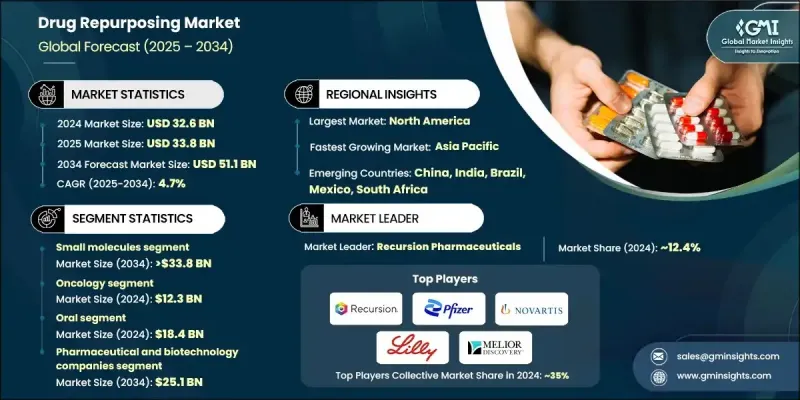
慢性复杂疾病(例如癌症、阿兹海默症和罕见遗传疾病)的日益普遍推动了药物重定位的扩张,这些疾病催生了对更快、更经济有效的治疗方案的需求。药物重定位能够更快地提供治疗,尤其适用于那些因商业诱因不足而难以进行传统研发的疾病。透过利用已知安全性和药理学特征的化合物,药物重定位可以绕过早期临床试验,缩短研发週期,并加快监管审批。这种方法对寻求更快投资回报的製药公司尤其具有吸引力。药物重定位是指为现有药物(包括已获批准、已停产或已放弃的药物)发现新的治疗用途,从而在减少药物研发总时间和成本的同时,拓展多种疾病领域的治疗选择。
| 市场范围 | |
|---|---|
| 起始年份 | 2024 |
| 预测年份 | 2025-2034 |
| 起始值 | 326亿美元 |
| 预测值 | 511亿美元 |
| 复合年增长率 | 4.7% |
2024年,小分子药物市占率达到67.5%,预计到2034年将达到338亿美元,复合年增长率(CAGR)为4.5%。小分子药物因其成熟的药物动力学、安全性资料和生产工艺,是药物再利用的理想候选药物。现有的临床资料可用于减少大规模临床试验的需求,而监管途径,例如FDA的505(b)(2)条款,则允许透过参考既往证据加快审批速度。
2024年,口服药物市场规模预计将达到184亿美元。口服製剂应用广泛,涵盖肿瘤、代谢性疾病、感染性疾病和中枢神经系统疾病等多个治疗领域。其多功能性和明确的药物动力学特性使其成为药物再利用的首选,具有广泛的临床应用价值和商业吸引力。
预计到2024年,北美药物再利用市场将占据48.2%的份额,其中美国占据主导地位。美国受益于健全的药物再利用监管框架。美国食品药物管理局(FDA)的505(b)(2)途径可让企业参考现有药物的安全性和有效性资料来开发新的适应症,从而显着缩短研发时间和降低成本。这种监管灵活性鼓励製药和生物技术公司大力投资药物再利用策略,促进创新并加速市场成长。
全球药物再利用市场的主要参与者包括勃林格殷格翰、礼来、安进、艾伯维、诺华、Pharnext、葛兰素史克、Schwarz Pharma、Recursion Pharmaceuticals、Revolution Medicines、Cyclica、辉瑞、Melior Discovery、赛诺菲和Valence Discovery。这些公司正采取多种策略来巩固市场地位并扩大业务范围。他们大力投资研发,以寻找现有药物的新治疗用途并优化临床试验效率。与生物技术公司、学术机构和研究机构的策略合作与伙伴关係有助于加速药物再利用化合物的发现和验证。
目录
第一章:方法论与范围
第二章:执行概要
第三章:行业洞察
- 产业生态系分析
- 供应商格局
- 每个阶段的价值增加
- 影响价值链的因素
- 产业影响因素
- 成长驱动因素
- 慢性病和罕见病患疾病率不断上升
- 药物再利用的成本与时间效率
- 人工智慧驱动平台的整合
- 未满足的医疗需求和药品短缺
- 产业陷阱与挑战
- 缺乏对非专利药物的激励措施
- 责任与安全问题
- 市场机会
- 对经济有效的疗法的需求日益增长
- 拓展至罕见疾病和被忽视疾病领域
- 成长驱动因素
- 成长潜力分析
- 监管环境
- 北美洲
- 欧洲
- 亚太地区
- 技术格局
- 当前技术趋势
- 新兴技术
- 未来市场趋势
- 定价分析
- 临床试验分析
- 波特的分析
- PESTEL 分析
第四章:竞争格局
- 介绍
- 公司市占率分析
- 全球的
- 北美洲
- 欧洲
- 公司矩阵分析
- 主要市场参与者的竞争分析
- 竞争定位矩阵
- 关键进展
- 併购
- 伙伴关係与合作
- 新产品发布
- 扩张计划
第五章:市场估算与预测:依药物类型划分,2021-2034年
- 主要趋势
- 小分子
- 生物製剂
第六章:市场估计与预测:依治疗领域划分,2021-2034年
- 主要趋势
- 肿瘤学
- 神经病学和中枢神经系统疾病
- 传染病
- 心血管疾病
- 代谢紊乱
- 其他治疗领域
第七章:市场估计与预测:依给药途径划分,2021-2034年
- 主要趋势
- 口服
- 静脉
- 其他给药途径
第八章:市场估算与预测:依最终用途划分,2021-2034年
- 主要趋势
- 製药和生物製药公司
- 合约研究组织(CRO)
- 其他最终用途
第九章:市场估计与预测:依地区划分,2021-2034年
- 主要趋势
- 北美洲
- 我们
- 加拿大
- 欧洲
- 德国
- 英国
- 法国
- 西班牙
- 义大利
- 荷兰
- 亚太地区
- 中国
- 日本
- 印度
- 澳洲
- 韩国
- 拉丁美洲
- 巴西
- 墨西哥
- 阿根廷
- 中东和非洲
- 南非
- 沙乌地阿拉伯
- 阿联酋
第十章:公司简介
- AbbVie
- Amgen
- Boehringer Ingelheim
- Cyclica
- Eli Lilly and Company
- GlaxoSmithKline
- Melior Discovery
- Novartis
- Pfizer
- Pharnext
- Recursion Pharmaceuticals
- Revolution Medicines
- Sanofi
- Schwarz Pharma
- Valence Discovery
The Global Drug Repurposing Market was valued at USD 32.6 billion in 2024 and is estimated to grow at a CAGR of 4.7% to reach USD 51.1 billion by 2034.
The expansion is driven by the rising prevalence of chronic and complex diseases such as cancer, Alzheimer's, and rare genetic disorders, which are creating demand for faster and more cost-effective therapeutic solutions. Drug repurposing enables quicker access to treatments, particularly for conditions where traditional R&D is limited due to low commercial incentives. By leveraging compounds with known safety and pharmacological profiles, repurposing bypasses early-stage trials, shortens development timelines, and accelerates regulatory approvals. This approach is particularly appealing to pharmaceutical firms seeking quicker returns on investment. Drug repurposing involves discovering new therapeutic applications for existing medications, including approved, discontinued, or abandoned drugs, reducing the overall time and cost of drug development while expanding treatment options across multiple disease areas.
| Market Scope | |
|---|---|
| Start Year | 2024 |
| Forecast Year | 2025-2034 |
| Start Value | $32.6 Billion |
| Forecast Value | $51.1 Billion |
| CAGR | 4.7% |
The small molecules segment held 67.5% share in 2024 and is expected to reach USD 33.8 billion by 2034, growing at a CAGR of 4.5%. Small molecules are ideal candidates for repurposing due to their established pharmacokinetics, safety data, and manufacturing processes. Existing clinical data can be leveraged to reduce the need for extensive trials, while regulatory pathways, such as the FDA's 505(b)(2), allow for faster approval by referencing prior evidence.
The oral drug segment generated USD 18.4 billion in 2024. Oral formulations are widely applicable across therapeutic areas, including oncology, metabolic, infectious, and CNS disorders. Their versatility and well-understood pharmacokinetics make them a preferred choice for repurposing, offering broad clinical utility and commercial appeal.
North America Drug Repurposing Market accounted for 48.2% share in 2024, led by the U.S., which benefits from a robust regulatory framework supporting drug repurposing. The FDA's 505(b)(2) pathway enables companies to reference existing safety and efficacy data for new indications, significantly reducing development time and costs. This regulatory flexibility has encouraged both pharmaceutical and biotech firms to invest heavily in repurposing strategies, fostering innovation and accelerating market growth.
Key players operating in the Global Drug Repurposing Market include Boehringer Ingelheim, Eli Lilly and Company, Amgen, AbbVie, Novartis, Pharnext, GlaxoSmithKline, Schwarz Pharma, Recursion Pharmaceuticals, Revolution Medicines, Cyclica, Pfizer, Melior Discovery, Sanofi, and Valence Discovery. Companies in the drug repurposing market are adopting multiple strategies to strengthen their market presence and expand their footprint. They are heavily investing in research and development to identify new therapeutic applications for existing drugs and optimize clinical trial efficiency. Strategic collaborations and partnerships with biotech firms, academic institutions, and research organizations help accelerate the discovery and validation of repurposed compounds.
Table of Contents
Chapter 1 Methodology and Scope
- 1.1 Market scope and definition
- 1.2 Research design
- 1.2.1 Research approach
- 1.2.2 Data collection methods
- 1.3 Data mining sources
- 1.3.1 Global
- 1.3.2 Regional/Country
- 1.4 Base estimates and calculations
- 1.4.1 Base year calculation
- 1.4.2 Key trends for market estimation
- 1.5 Primary research and validation
- 1.5.1 Primary sources
- 1.6 Forecast model
- 1.7 Research assumptions and limitations
Chapter 2 Executive Summary
- 2.1 Industry 3600 synopsis
- 2.2 Key market trends
- 2.2.1 Regional trends
- 2.2.2 Drug type trends
- 2.2.3 Therapeutic area trends
- 2.2.4 Route of administration trends
- 2.2.5 End use trends
- 2.3 CXO perspectives: Strategic imperatives
- 2.3.1 Key decision points for industry executives
- 2.3.2 Critical success factors for market players
- 2.4 Future outlook and strategic recommendations
Chapter 3 Industry Insights
- 3.1 Industry ecosystem analysis
- 3.1.1 Supplier landscape
- 3.1.2 Value addition at each stage
- 3.1.3 Factors affecting the value chain
- 3.2 Industry impact forces
- 3.2.1 Growth drivers
- 3.2.1.1 Rising prevalence of chronic and rare diseases
- 3.2.1.2 Cost and time efficiency of drug repurposing
- 3.2.1.3 Integration of AI-driven platforms
- 3.2.1.4 Unmet medical needs and drug shortages
- 3.2.2 Industry pitfalls and challenges
- 3.2.2.1 Lack of incentives for off-patent drugs
- 3.2.2.2 Liability and safety concerns
- 3.2.3 Market opportunities
- 3.2.3.1 Growing demand for cost-effective therapies
- 3.2.3.2 Expansion into rare and neglected diseases
- 3.2.1 Growth drivers
- 3.3 Growth potential analysis
- 3.4 Regulatory landscape
- 3.4.1 North America
- 3.4.2 Europe
- 3.4.3 Asia Pacific
- 3.5 Technology landscape
- 3.5.1 Current technological trends
- 3.5.2 Emerging technologies
- 3.6 Future market trends
- 3.7 Pricing analysis
- 3.8 Clinical trial analysis
- 3.9 Porter's analysis
- 3.10 PESTEL analysis
Chapter 4 Competitive Landscape, 2024
- 4.1 Introduction
- 4.2 Company market share analysis
- 4.2.1 Global
- 4.2.2 North America
- 4.2.3 Europe
- 4.3 Company matrix analysis
- 4.4 Competitive analysis of major market players
- 4.5 Competitive positioning matrix
- 4.6 Key developments
- 4.6.1 Merger and acquisition
- 4.6.2 Partnership and collaboration
- 4.6.3 New product launches
- 4.6.4 Expansion plans
Chapter 5 Market Estimates and Forecast, By Drug Type, 2021 - 2034 ($ Mn)
- 5.1 Key trends
- 5.2 Small molecules
- 5.3 Biologics
Chapter 6 Market Estimates and Forecast, By Therapeutic Area, 2021 - 2034 ($ Mn)
- 6.1 Key trends
- 6.2 Oncology
- 6.3 Neurology and CNS disorders
- 6.4 Infectious diseases
- 6.5 Cardiovascular diseases
- 6.6 Metabolic disorders
- 6.7 Other therapeutic areas
Chapter 7 Market Estimates and Forecast, By Route of Administration, 2021 - 2034 ($ Mn)
- 7.1 Key trends
- 7.2 Oral
- 7.3 Intravenous
- 7.4 Other routes of administration
Chapter 8 Market Estimates and Forecast, By End Use, 2021 - 2034 ($ Mn)
- 8.1 Key trends
- 8.2 Pharmaceutical and biopharmaceutical companies
- 8.3 Contract Research Organization (CROs)
- 8.4 Other end use
Chapter 9 Market Estimates and Forecast, By Region, 2021 - 2034 ($ Mn)
- 9.1 Key trends
- 9.2 North America
- 9.2.1 U.S.
- 9.2.2 Canada
- 9.3 Europe
- 9.3.1 Germany
- 9.3.2 UK
- 9.3.3 France
- 9.3.4 Spain
- 9.3.5 Italy
- 9.3.6 Netherlands
- 9.4 Asia Pacific
- 9.4.1 China
- 9.4.2 Japan
- 9.4.3 India
- 9.4.4 Australia
- 9.4.5 South Korea
- 9.5 Latin America
- 9.5.1 Brazil
- 9.5.2 Mexico
- 9.5.3 Argentina
- 9.6 Middle East and Africa
- 9.6.1 South Africa
- 9.6.2 Saudi Arabia
- 9.6.3 UAE
Chapter 10 Company Profiles
- 10.1 AbbVie
- 10.2 Amgen
- 10.3 Boehringer Ingelheim
- 10.4 Cyclica
- 10.5 Eli Lilly and Company
- 10.6 GlaxoSmithKline
- 10.7 Melior Discovery
- 10.8 Novartis
- 10.9 Pfizer
- 10.10 Pharnext
- 10.11 Recursion Pharmaceuticals
- 10.12 Revolution Medicines
- 10.13 Sanofi
- 10.14 Schwarz Pharma
- 10.15 Valence Discovery

 全球药物定序市场:按部署方法、治疗领域、最终用途、药物分子、方法类型、给药途径、国家和地区划分-产业分析、市场规模、份额和预测(2025-2032)
 药物再利用市场按方法、药物类型、治疗领域、给药途径、最终用户和地区划分
 药物定序市场预测至2032年:按治疗领域、药物类型、应用、最终用户和地区分類的全球分析
 药物重定位市场规模、份额和趋势分析报告:按治疗领域、药物类型、最终用途、地区和细分市场预测(2025-2033 年)
 全球药物再利用市场研究报告 - 产业分析、规模、份额、成长、趋势及预测(2025 年至 2033 年)
 药物再利用市场 - 全球产业分析、规模、份额、成长、趋势和预测,2024-2034 年