


 |
市场调查报告书
商品编码
1876580
植入式心臟监测器市场机会、成长驱动因素、产业趋势分析及预测(2025-2034年)Implantable Cardiac Monitor Market Opportunity, Growth Drivers, Industry Trend Analysis, and Forecast 2025 - 2034 |
||||||

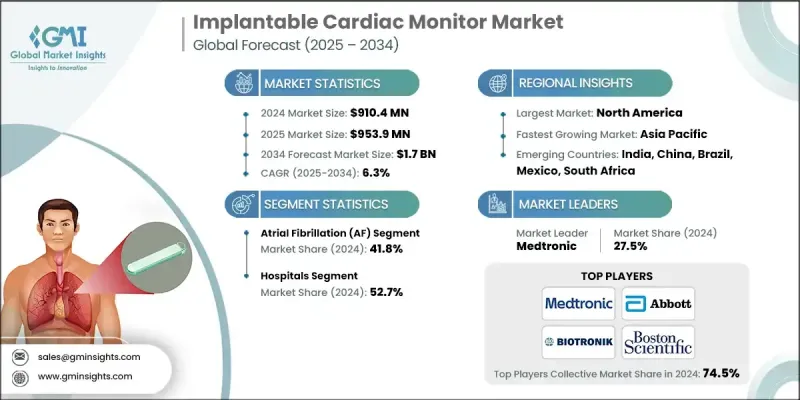
2024 年全球植入式心臟监视器市场价值为 9.104 亿美元,预计到 2034 年将以 6.3% 的复合年增长率增长至 17 亿美元。
心血管疾病盛行率的上升、人口老化以及对持续远端心臟监测需求的日益增长,正在推动市场扩张。远端监测解决方案的技术进步也透过改善患者预后和实现及时干预,促进了市场成长。植入式心臟监测器为医院、专科心臟中心、门诊手术中心和医疗技术公司提供先进的解决方案,以早期检测心律不整并简化临床工作流程。长期植入式循环记录器、无线传输系统和远端监测技术可实现持续的心律追踪、早期诊断和个人化患者管理。随着全球人口老化,慢性心血管疾病日益普遍,进一步增加了长期监测的需求。医护人员和患者对早期心律不整检测和持续监测的认识不断提高,正在推动市场应用。小型化设备和无线连接也提高了患者的依从性和临床效率。
| 市场范围 | |
|---|---|
| 起始年份 | 2024 |
| 预测年份 | 2025-2034 |
| 起始值 | 9.104亿美元 |
| 预测值 | 17亿美元 |
| 复合年增长率 | 6.3% |
2024年,心房颤动细分市场占据41.8%的市占率。这一领先地位主要得益于心房颤动盛行率的上升、中风风险的增加以及对早期诊断的需求,这些因素使得持续植入式监测至关重要。心房颤动仍然是最常见的心律不整,尤其是在老年人和患有基础心血管疾病的患者身上。透过长期监测进行早期发现有助于预防包括中风和心臟衰竭在内的严重併发症。
医院板块占据52.7%的市场份额,预计在2025年至2034年间将达到9.037亿美元。医院之所以占据主导地位,是因为拥有先进的基础设施、专业的心臟科室以及能够进行植入式手术的熟练医护人员。住院患者中心律不整和心房颤动发生率的不断上升,推动了持续监测的需求。与电子健康记录和远端监测平台的整合,进一步提高了医院的效率和病患资料管理水准。
2024年,北美植入式心臟监测器市占率达35.5%。该地区受益于老年人口中心血管疾病的高发生率、完善的医疗基础设施以及覆盖广泛的医院和专科心臟中心网络,这些机构均配备了植入式手术设备。小型化循环记录器、无线监测系统和人工智慧驱动的预测分析等技术创新进一步推动了植入式心臟监测器的普及,这些创新能够改善患者预后并提高营运效率。
植入式心臟监视器市场的主要参与者包括美敦力、Vectorious Medical Technologies、雅培、百多力、波士顿科学和AngelMed/Avertix。这些公司正透过加大研发投入,开发具备无线和远端监护功能的微型化、节能型设备,从而巩固其市场地位。许多公司正与医院、心臟病中心和技术供应商建立策略合作关係,将植入式心臟监视器系统整合到临床工作流程中。此外,各公司也正在拓展业务范围和分销网络,以进入新兴市场。增强用于预测分析、人工智慧驱动的诊断和即时患者监护的软体平台也是一项关键策略。
目录
第一章:方法论与范围
第二章:执行概要
第三章:行业洞察
- 产业生态系分析
- 产业影响因素
- 成长驱动因素
- 心律不整和心房颤动的盛行率不断上升
- 远端监控和连接技术的进步
- 老年人口增长及其相关的心臟风险
- 优惠的报销政策和早期诊断计划
- 产业陷阱与挑战
- 设备和植入手术费用高昂
- 患者和全科医师的认知程度有限
- 市场机会
- 与人工智慧和预测分析的集成
- 开发智慧、小型化和长寿命设备
- 成长驱动因素
- 成长潜力分析
- 2024年定价分析
- 2021-2034年植入式心臟监视器销售量(单位:台)
- 全球的
- 北美洲
- 欧洲
- 亚太地区
- 拉丁美洲
- MEA
- 监管环境
- 北美洲
- 欧洲
- 亚太地区
- 拉丁美洲
- 技术进步
- 当前技术趋势
- 用于长期心臟监测的微型植入式循环记录仪
- 可实现即时心律资料传输的远端监测平台
- 病人友善、微创的设备,可提高舒适度和手术效率
- 新兴技术
- 人工智慧驱动的心律不整检测和预测分析用于早期诊断
- 整合智慧型手机和云端平台的无线连接植入式心臟监视器
- 具备自适应警报系统和自动临床医生通知功能的智慧型设备
- 当前技术趋势
- 差距分析
- 波特的分析
- PESTEL 分析
- 未来市场趋势
- 人工智慧、数位医疗和互联心臟设备的融合
- 扩大居家和门诊心臟监测解决方案
- 随着新兴市场医疗基础设施的改善,其成长势头强劲。
第四章:竞争格局
- 介绍
- 公司矩阵分析
- 公司市占率分析
- 全球的
- 北美洲
- 欧洲
- 亚太地区
- 拉丁美洲
- 竞争定位矩阵
- 主要市场参与者的竞争分析
- 关键进展
- 併购
- 合作伙伴关係与合作
- 新服务类型推出
- 扩张计划
第五章:市场估算与预测:依指示剂划分,2021-2034年
- 主要趋势
- 心房颤动(心房颤动)
- 心律不整
- 心搏过缓
- 心跳过速
- 其他迹象
第六章:市场估算与预测:依最终用途划分,2021-2034年
- 主要趋势
- 医院
- 专业心臟中心
- 门诊手术中心
- 其他最终用途
第七章:市场估计与预测:依地区划分,2021-2034年
- 主要趋势
- 北美洲
- 我们
- 加拿大
- 欧洲
- 德国
- 英国
- 法国
- 西班牙
- 义大利
- 荷兰
- 亚太地区
- 中国
- 日本
- 印度
- 澳洲
- 韩国
- 拉丁美洲
- 巴西
- 墨西哥
- 阿根廷
- 中东和非洲
- 南非
- 沙乌地阿拉伯
- 阿联酋
第八章:公司简介
- Abbott
- AngelMed / Avertix
- BIOTRONIK
- Boston Scientific
- Medtronic
- Vectorious Medical Technologies
The Global Implantable Cardiac Monitor Market was valued at USD 910.4 million in 2024 and is estimated to grow at a CAGR of 6.3% to reach USD 1.7 billion by 2034.
The rising prevalence of cardiovascular diseases, an aging population, and the increasing need for continuous remote cardiac monitoring are driving market expansion. Technological advancements in remote monitoring solutions are also contributing to growth by enhancing patient outcomes and enabling timely intervention. Implantable cardiac monitors provide hospitals, specialized cardiac centers, ambulatory surgical facilities, and health technology companies with advanced solutions to detect arrhythmias early and streamline clinical workflows. Long-term implantable loop recorders, wireless transmission systems, and remote monitoring technologies allow continuous rhythm tracking, early diagnosis, and personalized patient management. With the global population aging, chronic cardiovascular conditions are becoming more common, further increasing demand for long-term monitoring. Greater awareness among healthcare providers and patients regarding early arrhythmia detection and continuous monitoring is boosting market adoption. Miniaturized devices and wireless connectivity have also improved patient compliance and clinical efficiency.
| Market Scope | |
|---|---|
| Start Year | 2024 |
| Forecast Year | 2025-2034 |
| Start Value | $910.4 Million |
| Forecast Value | $1.7 Billion |
| CAGR | 6.3% |
The atrial fibrillation segment held a 41.8% share in 2024. This leadership is driven by the rising prevalence of AF, heightened stroke risk, and demand for early diagnosis, which makes continuous implantable monitoring essential. Atrial fibrillation remains the most common cardiac arrhythmia, particularly among older adults and patients with underlying cardiovascular disorders. Early detection through long-term monitoring helps prevent serious complications, including stroke and heart failure.
The hospitals segment held a 52.7% share and is expected to reach USD 903.7 million during 2025-2034. Hospitals dominate because of their advanced infrastructure, specialized cardiology departments, and skilled personnel capable of performing implantable procedures. The increasing incidence of arrhythmias and atrial fibrillation among inpatients fuels demand for continuous monitoring. Integration with electronic health records and remote monitoring platforms further enhances hospital efficiency and patient data management.
North America Implantable Cardiac Monitor Market held a 35.5% share in 2024. The region benefits from a high prevalence of cardiovascular conditions among its elderly population, a well-established healthcare infrastructure, and an extensive network of hospitals and specialty cardiac centers equipped for implantable procedures. Adoption is further supported by technological innovations such as miniaturized loop recorders, wireless monitoring systems, and AI-driven predictive analytics, which enhance patient outcomes and improve operational efficiency.
Key players in the Implantable Cardiac Monitor Market include Medtronic, Vectorious Medical Technologies, Abbott, BIOTRONIK, Boston Scientific, and AngelMed / Avertix. Companies in the Implantable Cardiac Monitor Market are strengthening their presence by investing in R&D to develop miniaturized, energy-efficient devices with wireless and remote monitoring capabilities. Many are forming strategic collaborations with hospitals, cardiology centers, and technology providers to integrate their ICM systems into clinical workflows. Companies are also expanding their geographical footprint and distribution networks to access emerging markets. Enhancing software platforms for predictive analytics, AI-driven diagnostics, and real-time patient monitoring is another key strategy.
Table of Contents
Chapter 1 Methodology and Scope
- 1.1 Market scope and definitions
- 1.2 Research design
- 1.2.1 Research approach
- 1.2.2 Data collection methods
- 1.3 Data mining sources
- 1.3.1 Global
- 1.3.2 Regional/country
- 1.4 Base estimates and calculations
- 1.4.1 Base year calculation
- 1.4.2 Key trends for market estimation
- 1.5 Primary research and validation
- 1.5.1 Primary sources
- 1.6 Forecast model
- 1.7 Research assumptions and limitations
Chapter 2 Executive Summary
- 2.1 Industry 3600 synopsis
- 2.2 Key market trends
- 2.2.1 Regional trends
- 2.2.2 Indication trends
- 2.2.3 End use trends
- 2.3 CXO perspectives: Strategic imperatives
- 2.3.1 Key decision points for industry executives
- 2.3.2 Critical success factors for market players
- 2.4 Future outlook and strategic recommendations
Chapter 3 Industry Insights
- 3.1 Industry ecosystem analysis
- 3.2 Industry impact forces
- 3.2.1 Growth drivers
- 3.2.1.1 Rising prevalence of cardiac arrhythmias and atrial fibrillation
- 3.2.1.2 Advancements in remote monitoring and connectivity technologies
- 3.2.1.3 Growing geriatric population and associated cardiac risk
- 3.2.1.4 Favorable reimbursement policies and early diagnosis programs
- 3.2.2 Industry pitfalls and challenges
- 3.2.2.1 High cost of devices and implantation procedures
- 3.2.2.2 Limited awareness among patients and general practitioners
- 3.2.3 Market opportunities
- 3.2.3.1 Integration with artificial intelligence and predictive analytics
- 3.2.3.2 Development of smart, miniaturized, and long-life devices
- 3.2.1 Growth drivers
- 3.3 Growth potential analysis
- 3.4 Pricing analysis, 2024
- 3.5 Number of implantable cardiac monitors sold (Units), 2021 - 2034
- 3.5.1 Global
- 3.5.2 North America
- 3.5.3 Europe
- 3.5.4 Asia Pacific
- 3.5.5 Latin America
- 3.5.6 MEA
- 3.6 Regulatory landscape
- 3.6.1 North America
- 3.6.2 Europe
- 3.6.3 Asia Pacific
- 3.6.4 LAMEA
- 3.7 Technological advancements
- 3.7.1 Current technological trends
- 3.7.1.1 Miniaturized implantable loop recorders for long-term cardiac monitoring
- 3.7.1.2 Remote monitoring platforms enabling real-time heart rhythm data transmission
- 3.7.1.3 Patient-friendly, minimally invasive devices improving comfort and procedural efficiency
- 3.7.2 Emerging technologies
- 3.7.2.1 AI-powered arrhythmia detection and predictive analytics for early diagnosis
- 3.7.2.2 Wireless connected implantable cardiac monitors integrating smartphone and cloud platforms
- 3.7.2.3 Smart devices with adaptive alert systems and automated clinician notifications
- 3.7.1 Current technological trends
- 3.8 Gap analysis
- 3.9 Porter's analysis
- 3.10 PESTEL analysis
- 3.11 Future market trends
- 3.11.1 Convergence of AI, digital health, and connected cardiac devices
- 3.11.2 Expansion of home-based and outpatient cardiac monitoring solutions
- 3.11.3 Growth in emerging markets with improving healthcare infrastructure
Chapter 4 Competitive Landscape, 2024
- 4.1 Introduction
- 4.2 Company matrix analysis
- 4.3 Company market share analysis
- 4.3.1 Global
- 4.3.2 North America
- 4.3.3 Europe
- 4.3.4 Asia Pacific
- 4.3.5 LAMEA
- 4.4 Competitive positioning matrix
- 4.5 Competitive analysis of major market players
- 4.6 Key developments
- 4.6.1 Mergers & acquisitions
- 4.6.2 Partnerships & collaborations
- 4.6.3 New service type launches
- 4.6.4 Expansion plans
Chapter 5 Market Estimates and Forecast, By Indication, 2021 - 2034 ($ Mn)
- 5.1 Key trends
- 5.2 Atrial fibrillation (AF)
- 5.3 Arrhythmia
- 5.4 Bradycardia
- 5.5 Tachycardia
- 5.6 Other indications
Chapter 6 Market Estimates and Forecast, By End Use, 2021 - 2034 ($ Mn)
- 6.1 Key trends
- 6.2 Hospitals
- 6.3 Specialized cardiac centers
- 6.4 Ambulatory surgical centers
- 6.5 Other end use
Chapter 7 Market Estimates and Forecast, By Region, 2021 - 2034 ($ Mn)
- 7.1 Key trends
- 7.2 North America
- 7.2.1 U.S.
- 7.2.2 Canada
- 7.3 Europe
- 7.3.1 Germany
- 7.3.2 UK
- 7.3.3 France
- 7.3.4 Spain
- 7.3.5 Italy
- 7.3.6 Netherlands
- 7.4 Asia Pacific
- 7.4.1 China
- 7.4.2 Japan
- 7.4.3 India
- 7.4.4 Australia
- 7.4.5 South Korea
- 7.5 Latin America
- 7.5.1 Brazil
- 7.5.2 Mexico
- 7.5.3 Argentina
- 7.6 Middle East and Africa
- 7.6.1 South Africa
- 7.6.2 Saudi Arabia
- 7.6.3 UAE
Chapter 8 Company Profiles
- 8.1 Abbott
- 8.2 AngelMed / Avertix
- 8.3 BIOTRONIK
- 8.4 Boston Scientific
- 8.5 Medtronic
- 8.6 Vectorious Medical Technologies

 穿戴式心电图监测设备市场预测至2034年:按设备类型、监测方法、技术、应用、最终用户和地区分類的全球分析
 植入式心臟监测器市场:依产品类型、适应症、技术、最终用户和通路划分-2026-2032年全球市场预测远端心臟监测设备市场:按设备类型、连接方式、适应症、最终用户和分销管道划分-全球市场预测(2026-2032 年)
 心臟监护设备市场:商机、成长要素、产业趋势分析及2026-2035年预测携带式心电监视器市场:按类型、便携性、监护类型、应用、最终用户和分销管道划分-全球预测,2026-2032年
 2026年全球智慧型可携式心电图(ECG)设备市场报告2026年全球远距心臟监测市场报告2026年携带式心电图(ECG)设备订阅市场报告
 全球植入式心臟监测器市场规模、份额、趋势和成长分析报告(2026-2034年)依产品类型、技术、配戴时间、最终用户和通路连续型心电图监测设备市场-2026-2032年全球预测