


 |
市场调查报告书
商品编码
1876797
可拉伸电子产品市场机会、成长驱动因素、产业趋势分析及预测(2025-2034年)Stretchable Electronics Market Opportunity, Growth Drivers, Industry Trend Analysis, and Forecast 2025 - 2034 |
||||||

2024 年全球可拉伸电子产品市场价值为 4.829 亿美元,预计到 2034 年将以 12.7% 的复合年增长率增长至 15.8 亿美元。
市场成长主要得益于医疗保健、消费性电子和汽车产业对柔性、穿戴和贴合皮肤的设备日益增长的需求。可拉伸电子产品具有无与伦比的舒适性、适应性和耐用性,使其成为智慧纺织品、软体机器人和生物医学感测器的理想选择。材料科学的创新,包括可拉伸导电聚合物和奈米材料,正在推动更规模和可靠性的生产过程。物联网设备和个人化健康监测的日益普及正在加速对可拉伸电子产品的需求,而这些产品对于下一代互联技术至关重要。穿戴式装置和健康监测工具的日益普及正在推动市场需求,因为它们具有类似皮肤的柔韧性,能够支持持续的生物特征追踪和即时健康洞察。可拉伸电子产品还能够实现小型化和适应性,从而可以无缝整合到智慧家庭、工业系统和连网设备中,并透过植入式和皮肤贴附式感测器改善医疗保健诊断和治疗。
| 市场范围 | |
|---|---|
| 起始年份 | 2024 |
| 预测年份 | 2025-2034 |
| 起始值 | 4.829亿美元 |
| 预测值 | 15.8亿美元 |
| 复合年增长率 | 12.7% |
2024年,可拉伸导体市场占有率达到27%,引领产业发展,主要归功于其在弯曲、扭转或拉伸条件下维持电气性能的关键作用。这些导体对于穿戴式装置、医疗器材和软体机器人至关重要。石墨烯和银奈米线等材料的进步进一步提升了导电性和可拉伸性,促进了其在多个领域的广泛应用。
2024年,医疗保健领域预计将创造1.563亿美元的收入,这主要得益于对穿戴式医疗设备、植入式感测器和远端监测解决方案日益增长的需求。可拉伸电子产品具有良好的生物相容性、柔韧性和舒适性,能够实现对患者的持续监测和精准的资料收集。对个人化医疗的日益重视以及人口老化将进一步推动该领域的应用。
2024年,北美可拉伸电子产品市占率预计将达到35.9%,主要得益于市场对先进医疗技术、智慧消费性电子产品和穿戴式装置的强劲需求。该地区拥有强大的研发基础设施、领先的科技公司以及对创新材料的早期应用,并从中受益匪浅。远端健康监测、健身追踪和生物医学设备等领域的应用正在迅速扩展。政府的支持性措施以及大型汽车和航太企业的存在,进一步巩固了北美市场的领先地位。
全球可拉伸电子产品市场的主要参与者包括三星电子有限公司、3M公司、杜邦公司、LG Display有限公司、松下电器产业株式会社、罗杰斯公司、MC10公司、StretchSense有限公司、柔宇科技株式会社、Enfucell Flexible Electronics有限公司、Pragmatic Semiconductor、东洋纺株式有限公司、DtecatTA. Materials有限公司、PowerFilm公司、积水聚合物株式会社、Sensing Tex SL公司及Imprint Energy公司。这些公司透过大力投资研发下一代导电柔性材料,不断巩固其市场地位。策略合作、合资企业和收购有助于扩大其全球业务和生产能力。各公司致力于拓展产品线,以满足医疗保健、消费性电子和工业应用领域的需求,同时提升生产规模。
目录
第一章:方法论与范围
第二章:执行概要
第三章:行业洞察
- 产业生态系分析
- 产业影响因素
- 成长驱动因素
- 穿戴式健康设备需求不断成长
- 柔性导电材料的最新进展
- 物联网和智慧纺织品的扩展
- 汽车和航太领域采用率不断提高
- 人们对软体机器人和人机互动的兴趣日益浓厚
- 产业陷阱与挑战
- 高昂的製造成本和可扩展性问题
- 反覆拉伸下的耐久性有限
- 市场机会
- 生物相容性医用植入物的开发
- 用于运动和军事领域的智慧服装
- 成长驱动因素
- 成长潜力分析
- 监管环境
- 北美洲
- 我们
- 加拿大
- 欧洲
- 亚太地区
- 拉丁美洲
- 中东和非洲
- 北美洲
- 技术格局
- 当前趋势
- 新兴技术
- 管道分析
- 未来市场趋势
- 波特的分析
- PESTEL 分析
第四章:竞争格局
- 介绍
- 公司市占率分析
- 全球的
- 北美洲
- 欧洲
- 亚太地区
- 拉丁美洲
- 中东和非洲
- 公司矩阵分析
- 主要市场参与者的竞争分析
- 竞争定位矩阵
- 关键进展
- 併购
- 伙伴关係与合作
- 新产品发布
- 扩张计划
第五章:市场估算与预测:依组件划分,2021-2034年
- 主要趋势
- 电活性聚合物
- 可拉伸电池
- 可拉伸导体
- 光电
- 可拉伸电路
第六章:市场估算与预测:依应用领域划分,2021-2034年
- 主要趋势
- 卫生保健
- 消费性电子产品
- 汽车电子
- 航太与国防
- 其他的
第七章:市场估计与预测:依地区划分,2021-2034年
- 主要趋势
- 北美洲
- 我们
- 加拿大
- 欧洲
- 德国
- 英国
- 法国
- 义大利
- 西班牙
- 荷兰
- 亚太地区
- 中国
- 印度
- 日本
- 澳洲
- 韩国
- 拉丁美洲
- 巴西
- 墨西哥
- 阿根廷
- 中东和非洲
- 南非
- 沙乌地阿拉伯
- 阿联酋
第八章:公司简介
- DuPont de Nemours, Inc.
- 3M Company
- Samsung Electronics Co., Ltd.
- LG Display Co., Ltd.
- Panasonic Corporation
- Rogers Corporation
- StretchSense Ltd
- MC10, Inc.
- FlexEnable Ltd
- Royole Corporation
- Enfucell Flexible Electronics Co., Ltd.
- Pragmatic Semiconductor Ltd
- Toyobo Co., Ltd.
- Heraeus Holding GmbH
- Advanced Nano Products Co., Ltd.
- Dycotec Materials Ltd
- PowerFilm, Inc.
- Sekisui Polymatech Co., Ltd.
- Sensing Tex, SL
- Imprint Energy, Inc.
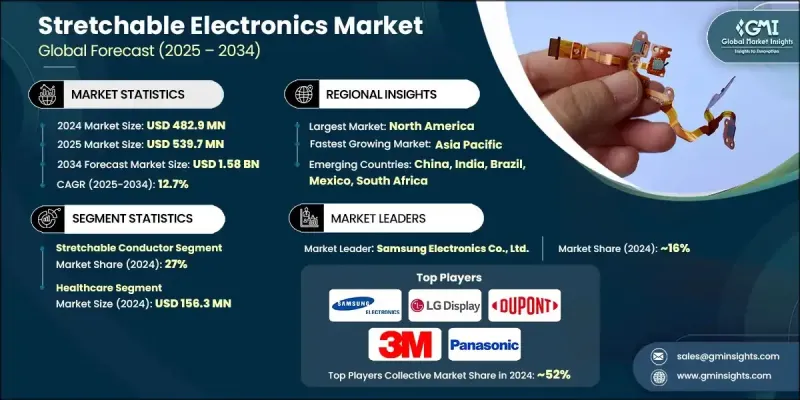
The Global Stretchable Electronics Market was valued at USD 482.9 million in 2024 and is estimated to grow at a CAGR of 12.7% to reach USD 1.58 billion by 2034.
Market growth is fueled by the increasing demand for flexible, wearable, and skin-conformable devices across healthcare, consumer electronics, and automotive industries. Stretchable electronics provide unmatched comfort, adaptability, and durability, making them ideal for smart textiles, soft robotics, and biomedical sensors. Innovations in materials science, including stretchable conductive polymers and nanomaterials, are enabling more scalable and reliable production processes. Rising adoption of IoT devices and personalized health monitoring is accelerating the demand for stretchable electronics, which are essential for next-generation connected technologies. The growing popularity of wearable devices and health-monitoring tools is driving demand, as their skin-like flexibility supports continuous biometric tracking and real-time health insights. Stretchable electronics also enable miniaturization and adaptability, allowing seamless integration in smart homes, industrial systems, and connected devices, while improving healthcare diagnostics and treatments through implantable and skin-mounted sensors.
| Market Scope | |
|---|---|
| Start Year | 2024 |
| Forecast Year | 2025-2034 |
| Start Value | $482.9 Million |
| Forecast Value | $1.58 Billion |
| CAGR | 12.7% |
The stretchable conductor segment held a 27% share in 2024, leading the industry due to its essential role in maintaining electrical performance under bending, twisting, or stretching. These conductors are critical for wearables, medical devices, and soft robotics. Advances in materials such as graphene and silver nanowires have further enhanced conductivity and stretchability, promoting widespread adoption across multiple sectors.
The healthcare segment generated USD 156.3 million in 2024, driven by increasing demand for wearable medical devices, implantable sensors, and remote monitoring solutions. Stretchable electronics offer high biocompatibility, flexibility, and comfort, enabling continuous patient monitoring and accurate data collection. Growing emphasis on personalized healthcare and an aging population further boost adoption in this sector.
North America Stretchable Electronics Market accounted for a 35.9% share in 2024, driven by strong demand for advanced medical technologies, smart consumer electronics, and wearable devices. The region benefits from robust research infrastructure, leading tech companies, and early adoption of innovative materials. Applications in remote health monitoring, fitness tracking, and biomedical devices are expanding rapidly. Supportive government initiatives and the presence of major automotive and aerospace industries further strengthen North America's market leadership.
Key players in the Global Stretchable Electronics Market include Samsung Electronics Co., Ltd., 3M Company, DuPont de Nemours, Inc., LG Display Co., Ltd., Panasonic Corporation, Rogers Corporation, MC10, Inc., StretchSense Ltd, Royole Corporation, Enfucell Flexible Electronics Co., Ltd., Pragmatic Semiconductor Ltd, Toyobo Co., Ltd., Heraeus Holding GmbH, Advanced Nano Products Co., Ltd., Dycotec Materials Ltd, PowerFilm, Inc., Sekisui Polymatech Co., Ltd., Sensing Tex, S.L., and Imprint Energy, Inc. Companies in the Stretchable Electronics Market strengthen their position by investing heavily in R&D to develop next-generation conductive and flexible materials. Strategic partnerships, joint ventures, and acquisitions help expand global presence and production capabilities. Firms focus on diversifying product offerings for healthcare, consumer electronics, and industrial applications while enhancing manufacturing scalability.
Table of Contents
Chapter 1 Methodology and Scope
- 1.1 Market scope and definition
- 1.2 Research design
- 1.2.1 Research approach
- 1.2.2 Data collection methods
- 1.3 Data mining sources
- 1.3.1 Global
- 1.3.2 Regional/Country
- 1.4 Base estimates and calculations
- 1.4.1 Base year calculation
- 1.4.2 Key trends for market estimation
- 1.5 Primary research and validation
- 1.5.1 Primary sources
- 1.6 Forecast model
- 1.7 Research assumptions and limitations
Chapter 2 Executive Summary
- 2.1 Industry 3600 synopsis
- 2.2 Key market trends
- 2.2.1 Component Trends
- 2.2.2 Application Trends
- 2.2.3 Regional Trends
- 2.3 CXO perspectives: Strategic imperatives
- 2.3.1 Key decision points for industry executives
- 2.3.2 Critical success factors for market players
- 2.4 Future outlook and strategic recommendations
Chapter 3 Industry Insights
- 3.1 Industry ecosystem analysis
- 3.2 Industry impact forces
- 3.2.1 Growth drivers
- 3.2.1.1 Growing Demand for Wearable Health Devices
- 3.2.1.2 Advancements in Flexible and Conductive Materials
- 3.2.1.3 Expansion of IoT and Smart Textiles
- 3.2.1.4 Increasing Adoption in Automotive and Aerospace
- 3.2.1.5 Rising Interest in Soft Robotics and Human-Machine Interfaces
- 3.2.2 Industry pitfalls and challenges
- 3.2.2.1 High Manufacturing Costs and Scalability Issues
- 3.2.2.2 Limited Durability Under Repeated Stretching
- 3.2.3 Market opportunities
- 3.2.3.1 Development of Biocompatible Medical Implants
- 3.2.3.2 Smart Clothing for Sports and Military Applications
- 3.2.1 Growth drivers
- 3.3 Growth potential analysis
- 3.4 Regulatory landscape
- 3.4.1 North America
- 3.4.1.1 U.S.
- 3.4.1.2 Canada
- 3.4.2 Europe
- 3.4.3 Asia Pacific
- 3.4.4 Latin America
- 3.4.5 Middle East and Africa
- 3.4.1 North America
- 3.5 Technology landscape
- 3.5.1 Current trends
- 3.5.2 Emerging technologies
- 3.6 Pipeline analysis
- 3.7 Future market trends
- 3.8 Porter's analysis
- 3.9 PESTEL analysis
Chapter 4 Competitive Landscape, 2024
- 4.1 Introduction
- 4.2 Company market share analysis
- 4.2.1 Global
- 4.2.2 North America
- 4.2.3 Europe
- 4.2.4 Asia Pacific
- 4.2.5 Latin America
- 4.2.6 Middle East and Africa
- 4.3 Company matrix analysis
- 4.4 Competitive analysis of major market players
- 4.5 Competitive positioning matrix
- 4.6 Key developments
- 4.6.1 Merger and acquisition
- 4.6.2 Partnership and collaboration
- 4.6.3 New product launches
- 4.6.4 Expansion plans
Chapter 5 Market Estimates and Forecast, By Component, 2021 - 2034 ($ Mn)
- 5.1 Key trends
- 5.2 Electroactive polymer
- 5.3 Stretchable batteries
- 5.4 Stretchable conductor
- 5.5 Photovoltaic
- 5.6 Stretchable circuit
Chapter 6 Market Estimates and Forecast, By Application, 2021 - 2034 ($ Mn)
- 6.1 Key trends
- 6.2 Healthcare
- 6.3 Consumer electronics
- 6.4 Automotive electronics
- 6.5 Aerospace & defense
- 6.6 Others
Chapter 7 Market Estimates and Forecast, By Region, 2021 - 2034 ($ Mn)
- 7.1 Key trends
- 7.2 North America
- 7.2.1 U.S.
- 7.2.2 Canada
- 7.3 Europe
- 7.3.1 Germany
- 7.3.2 UK
- 7.3.3 France
- 7.3.4 Italy
- 7.3.5 Spain
- 7.3.6 Netherlands
- 7.4 Asia Pacific
- 7.4.1 China
- 7.4.2 India
- 7.4.3 Japan
- 7.4.4 Australia
- 7.4.5 South Korea
- 7.5 Latin America
- 7.5.1 Brazil
- 7.5.2 Mexico
- 7.5.3 Argentina
- 7.6 Middle East and Africa
- 7.6.1 South Africa
- 7.6.2 Saudi Arabia
- 7.6.3 UAE
Chapter 8 Company Profiles
- 8.1 DuPont de Nemours, Inc.
- 8.2 3M Company
- 8.3 Samsung Electronics Co., Ltd.
- 8.4 LG Display Co., Ltd.
- 8.5 Panasonic Corporation
- 8.6 Rogers Corporation
- 8.7 StretchSense Ltd
- 8.8 MC10, Inc.
- 8.9 FlexEnable Ltd
- 8.10 Royole Corporation
- 8.11 Enfucell Flexible Electronics Co., Ltd.
- 8.12 Pragmatic Semiconductor Ltd
- 8.13 Toyobo Co., Ltd.
- 8.14 Heraeus Holding GmbH
- 8.15 Advanced Nano Products Co., Ltd.
- 8.16 Dycotec Materials Ltd
- 8.17 PowerFilm, Inc.
- 8.18 Sekisui Polymatech Co., Ltd.
- 8.19 Sensing Tex, S.L.
- 8.20 Imprint Energy, Inc.


