


 |
市场调查报告书
商品编码
1885818
威尔逊氏症治疗市场机会、成长驱动因素、产业趋势分析及预测(2025-2034年)Wilsons Disease Treatment Market Opportunity, Growth Drivers, Industry Trend Analysis, and Forecast 2025 - 2034 |
||||||

2024 年全球威尔逊氏症治疗市场价值为 6.311 亿美元,预计到 2034 年将以 6.2% 的复合年增长率增长至 11 亿美元。
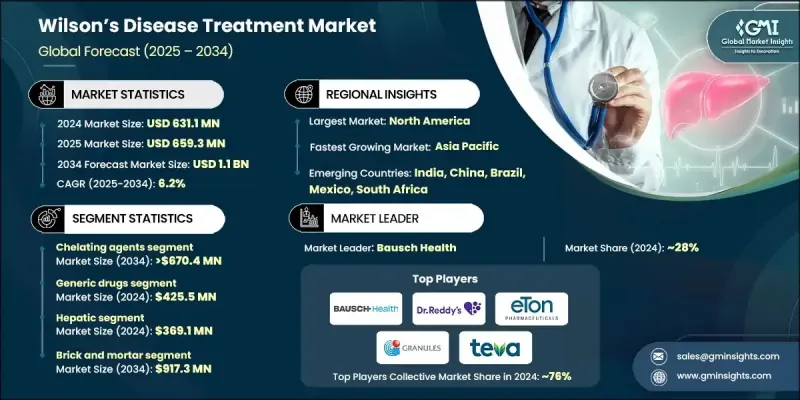
市场扩张持续受到疾病盛行率上升、临床意识提高、螯合疗法和锌疗法的广泛应用以及药物研发稳定进展的影响。专科护理和多学科治疗中心的普及也促进了长期治疗的推广。威尔逊氏症治疗的重点在于控制由遗传性铜调节缺陷引起的铜过度积累,主要依靠螯合剂和锌製剂来促进铜的排泄或减少吸收。这些疗法旨在保护器官(尤其是肝臟和中枢神经系统),同时在患者一生中维持健康的铜水平。
| 市场范围 | |
|---|---|
| 起始年份 | 2024 |
| 预测年份 | 2025-2034 |
| 起始值 | 6.311亿美元 |
| 预测值 | 11亿美元 |
| 复合年增长率 | 6.2% |
由于螯合剂在指引中长期占据重要地位,且能够快速清除体内过量铜,预计到2024年,螯合剂将占60%的市占率。它们在治疗神经系统和肝臟併发症方面的有效性,也使其在全球范围内持续受到医生的青睐。对三乙烯四胺和青霉胺等药物的持续依赖,进一步巩固了全球对螯合剂的强劲且稳定的需求。
2024年,仿製药市场规模达到4.255亿美元,预计2034年将以6.3%的复合年增长率成长。常用螯合剂和锌疗法的低成本版本显着降低了患者的用药成本,有助于提高患者的治疗依从性,因为这些疗法需要终身服用。多种疗法的专利到期使得更多生产商能够进入市场,从而提高了对成本敏感的医疗保健系统的可及性。
2024年,美国威尔逊氏症治疗市场规模达2.286亿美元。北美地区拥有强大的诊断基础设施,包括基因分析、生化检测和影像学工具的广泛应用,从而能够更及时地发现该疾病。随着早期诊断率的提高,治疗启动率也随之提高,从而支撑了市场的持续成长。该地区品牌药和仿製药的广泛可及性,以及监管部门的批准和强大的供应链,也确保了治疗的可靠性。
活跃于全球威尔逊氏症治疗市场的主要公司包括Breckenridge Pharmaceutical、Nobelpharma、TAJ PHARMA、Dr. Reddy's Laboratories、TSUMURA、Teva Pharmaceutical、Zydus Group、Bausch Health、Eton Pharmaceuticals、Optimus Pharmaceutical、Zydus Group、Bausch Health、Eton Pharmaceuticals、Optimus Pharma、Biophore、Zyd这些公司正透过多种策略巩固其市场地位。许多公司正在扩展其螯合剂和锌基製剂的产品组合,以满足不断增长的治疗需求并扩大患者的用药范围。对改善药物输送系统的投资旨在提高药物的耐受性和长期依从性,尤其是在慢性病管理方面。製造商也强调成本效益高的生产方式,以支持品牌药和仿製药的定价竞争力。与临床研究团队的合作有助于推动下一代疗法的研发,并支持实证医学的市场定位。
目录
第一章:方法论与范围
第二章:执行概要
第三章:行业洞察
- 产业生态系分析
- 产业影响因素
- 成长驱动因素
- 螯合剂和锌基疗法的可及性日益提高
- 扩大孤儿药认定范围和监管支持
- 治疗依从性和监测工具的进展
- 改进临床指引和治疗标准化
- 产业陷阱与挑战
- 品牌药和孤儿药价格高昂
- 病患群体有限,商业吸引力低
- 市场机会
- 引进新一代螯合剂和更安全的配方
- 日益关注基因疗法和治癒性研究
- 成长驱动因素
- 成长潜力分析
- 报销方案
- 监管环境
- 北美洲
- 欧洲
- 亚太地区
- 技术格局
- 当前技术趋势
- 新兴技术
- 消费者洞察
- 管道分析
- 波特的分析
- PESTEL 分析
- 未来市场趋势
- 临床试验场景
- 差距分析
第四章:竞争格局
- 介绍
- 公司矩阵分析
- 公司市占率分析
- 全球的
- 北美洲
- 欧洲
- 亚太地区
- 竞争定位矩阵
- 主要市场参与者的竞争分析
- 关键进展
- 併购
- 合作伙伴关係与合作
- 新型治疗方案推出
- 扩张计划
第五章:市场估计与预测:依治疗类型划分,2021-2034年
- 主要趋势
- 螯合剂
- D-青霉胺
- 盐酸三乙烯四胺
- 盐酸曲林
- 二巯基丙醇
- 锌盐
- 乙酸锌
- 硫酸锌
- 联合疗法
第六章:市场估算与预测:依药物类型划分,2021-2034年
- 主要趋势
- 仿製药
- 品牌药物
第七章:市场估算与预测:依指示剂划分,2021-2034年
- 主要趋势
- 肝臟
- 神经科和精神科
- 其他迹象
第八章:市场估算与预测:依配销通路划分,2021-2034年
- 主要趋势
- 砖瓦
- 电子商务
第九章:市场估计与预测:依地区划分,2021-2034年
- 主要趋势
- 北美洲
- 我们
- 加拿大
- 欧洲
- 德国
- 英国
- 法国
- 西班牙
- 义大利
- 荷兰
- 亚太地区
- 中国
- 日本
- 印度
- 澳洲
- 韩国
- 拉丁美洲
- 巴西
- 墨西哥
- 阿根廷
- 中东和非洲
- 南非
- 沙乌地阿拉伯
- 阿联酋
第十章:公司简介
- Bausch Health
- Biophore
- Breckenridge Pharmaceutical
- Dr. Reddy's Laboratories
- Eton Pharmaceuticals
- GRANULES
- Invagen Pharmaceuticals
- Nobelpharma
- Optimus Pharma
- Orphalan
- TAJ PHARMA
- Teva Pharmaceutical
- TSUMURA
- Zydus Group
The Global Wilsons Disease Treatment Market was valued at USD 631.1 million in 2024 and is estimated to grow at a CAGR of 6.2% to reach USD 1.1 billion by 2034.
Market expansion continues to be shaped by rising disease prevalence, improved clinical awareness, broader use of chelation and zinc-based therapies, and steady advancements in drug development. Increasing access to specialty care and multidisciplinary treatment centers also supports stronger adoption of long-term therapy. Wilson's disease treatment focuses on managing excessive copper buildup caused by inherited defects in copper regulation, relying mainly on chelators and zinc formulations that enhance excretion or reduce absorption. These therapies aim to protect organs-most critically the liver and central nervous system-while sustaining healthy copper levels throughout a patient's lifetime.
| Market Scope | |
|---|---|
| Start Year | 2024 |
| Forecast Year | 2025-2034 |
| Start Value | $631.1 Million |
| Forecast Value | $1.1 Billion |
| CAGR | 6.2% |
The chelating agents held a 60% share in 2024 owing to their longstanding role in guidelines and their ability to rapidly clear excess copper. Their effectiveness in addressing both neurological and hepatic complications supports ongoing physician preference worldwide. The continued reliance on agents such as trientine and penicillamine reinforces strong, consistent global demand.
The generic drugs category captured USD 425.5 million in 2024 and is expected to grow at a CAGR of 6.3% through 2034. Lower-cost versions of widely used chelators and zinc therapies provide significant affordability advantages, supporting sustained patient adherence since treatment must be maintained lifelong. Patent expirations across several therapies have enabled a broader range of manufacturers to enter the market, increasing availability within cost-sensitive healthcare systems.
U.S. Wilsons Disease Treatment Market generated USD 228.6 million in 2024. North America benefits from a strong diagnostic infrastructure, including widespread use of genetic analysis, biochemical testing, and imaging tools, enabling more timely detection of the condition. As early diagnosis rates rise, therapy initiation expands, supporting sustained market growth. Broad access to branded and generic medications across the region also ensures reliable treatment availability, supported by regulatory approvals and strong supply chains.
Prominent companies active in the Global Wilsons Disease Treatment Market include Breckenridge Pharmaceutical, Nobelpharma, TAJ PHARMA, Dr. Reddy's Laboratories, TSUMURA, Teva Pharmaceutical, Zydus Group, Bausch Health, Eton Pharmaceuticals, Optimus Pharma, Biophore, Granules, Invagen Pharmaceuticals, and Orphalan. Companies competing in the Global Wilsons Disease Treatment Market are strengthening their market foothold through multiple strategies. Many firms are expanding their portfolios of chelators and zinc-based formulations to meet increasing therapeutic demand and widen patient access. Investments in improved drug delivery systems aim to enhance tolerability and long-term adherence, especially for chronic management. Manufacturers are also emphasizing cost-efficient production to support competitive pricing in both branded and generic segments. Collaborations with clinical research groups help advance next-generation treatments and support evidence-based positioning.
Table of Contents
Chapter 1 Methodology and Scope
- 1.1 Market scope and definitions
- 1.2 Research design
- 1.2.1 Research approach
- 1.2.2 Data collection methods
- 1.3 Data mining sources
- 1.3.1 Global
- 1.3.2 Regional/country
- 1.4 Base estimates and calculations
- 1.4.1 Base year calculation
- 1.4.2 Key trends for market estimation
- 1.5 Primary research and validation
- 1.5.1 Primary sources
- 1.6 Forecast model
- 1.7 Research assumptions and limitations
Chapter 2 Executive Summary
- 2.1 Industry 3600 synopsis
- 2.2 Key market trends
- 2.2.1 Regional trends
- 2.2.2 Treatment type trends
- 2.2.3 Drug type trends
- 2.2.4 Indication trends
- 2.2.5 Distribution channel trends
- 2.3 CXO perspectives: Strategic imperatives
- 2.3.1 Key decision points for industry executives
- 2.3.2 Critical success factors for market players
- 2.4 Future outlook and strategic recommendations
Chapter 3 Industry Insights
- 3.1 Industry ecosystem analysis
- 3.2 Industry impact forces
- 3.2.1 Growth drivers
- 3.2.1.1 Rising availability of chelating agents and zinc-based therapies
- 3.2.1.2 Expansion of orphan drug designations and regulatory support
- 3.2.1.3 Advancements in treatment adherence and monitoring tools
- 3.2.1.4 Improved clinical guidelines and treatment standardization
- 3.2.2 Industry pitfalls and challenges
- 3.2.2.1 High cost of branded and orphan-designated drugs
- 3.2.2.2 Limited patient population and low commercial attractiveness
- 3.2.3 Market opportunities
- 3.2.3.1 Introduction of next-generation chelators and safer formulations
- 3.2.3.2 Growing focus on gene therapy and curative research
- 3.2.1 Growth drivers
- 3.3 Growth potential analysis
- 3.4 Reimbursement scenario
- 3.5 Regulatory landscape
- 3.5.1 North America
- 3.5.2 Europe
- 3.5.3 Asia Pacific
- 3.6 Technology landscape
- 3.6.1 Current technological trends
- 3.6.2 Emerging technologies
- 3.7 Consumer insights
- 3.8 Pipeline analysis
- 3.9 Porter's analysis
- 3.10 PESTEL analysis
- 3.11 Future market trends
- 3.12 Clinical trial scenario
- 3.13 Gap analysis
Chapter 4 Competitive Landscape, 2024
- 4.1 Introduction
- 4.2 Company matrix analysis
- 4.3 Company market share analysis
- 4.3.1 Global
- 4.3.2 North America
- 4.3.3 Europe
- 4.3.4 Asia Pacific
- 4.4 Competitive positioning matrix
- 4.5 Competitive analysis of major market players
- 4.6 Key developments
- 4.6.1 Mergers & acquisitions
- 4.6.2 Partnerships & collaborations
- 4.6.3 New treatment type launches
- 4.6.4 Expansion plans
Chapter 5 Market Estimates and Forecast, By Treatment Type, 2021 - 2034 ($ Mn)
- 5.1 Key trends
- 5.2 Chelating agents
- 5.2.1 D-penicillamine
- 5.2.2 Trientine hydrochloride
- 5.2.3 Trientine tetrahydrochloride
- 5.2.4 Dimercaprol
- 5.3 Zinc salts
- 5.3.1 Zinc acetate
- 5.3.2 Zinc sulfate
- 5.4 Combination therapy
Chapter 6 Market Estimates and Forecast, By Drug Type, 2021 - 2034 ($ Mn)
- 6.1 Key trends
- 6.2 Generic drugs
- 6.3 Branded drugs
Chapter 7 Market Estimates and Forecast, By Indication, 2021 - 2034 ($ Mn)
- 7.1 Key trends
- 7.2 Hepatic
- 7.3 Neurological and psychiatric
- 7.4 Other indications
Chapter 8 Market Estimates and Forecast, By Distribution Channel, 2021 - 2034 ($ Mn)
- 8.1 Key trends
- 8.2 Brick and mortar
- 8.3 E-commerce
Chapter 9 Market Estimates and Forecast, By Region, 2021 - 2034 ($ Mn)
- 9.1 Key trends
- 9.2 North America
- 9.2.1 U.S.
- 9.2.2 Canada
- 9.3 Europe
- 9.3.1 Germany
- 9.3.2 UK
- 9.3.3 France
- 9.3.4 Spain
- 9.3.5 Italy
- 9.3.6 Netherlands
- 9.4 Asia Pacific
- 9.4.1 China
- 9.4.2 Japan
- 9.4.3 India
- 9.4.4 Australia
- 9.4.5 South Korea
- 9.5 Latin America
- 9.5.1 Brazil
- 9.5.2 Mexico
- 9.5.3 Argentina
- 9.6 Middle East and Africa
- 9.6.1 South Africa
- 9.6.2 Saudi Arabia
- 9.6.3 UAE
Chapter 10 Company Profiles
- 10.1 Bausch Health
- 10.2 Biophore
- 10.3 Breckenridge Pharmaceutical
- 10.4 Dr. Reddy’s Laboratories
- 10.5 Eton Pharmaceuticals
- 10.6 GRANULES
- 10.7 Invagen Pharmaceuticals
- 10.8 Nobelpharma
- 10.9 Optimus Pharma
- 10.10 Orphalan
- 10.11 TAJ PHARMA
- 10.12 Teva Pharmaceutical
- 10.13 TSUMURA
- 10.14 Zydus Group

 威尔森氏症-2025年至2031年全球市占率及排名、总收入及需求预测
 威尔逊氏症药物市场 - 全球产业规模、份额、趋势、机会和预测,按产品、配销通路、地区和竞争细分,2020-2030 年预测
 全球威尔逊氏症治疗市场依治疗类型、给药途径、年龄层、通路及地区划分