


 |
市场调查报告书
商品编码
1885832
重型设备市场机会、成长驱动因素、产业趋势分析及预测(2025-2034年)Heavy Equipment Market Opportunity, Growth Drivers, Industry Trend Analysis, and Forecast 2025 - 2034 |
||||||

2024年全球重型设备市场价值为1,842亿美元,预计到2034年将以6.4%的复合年增长率成长至3,379亿美元。
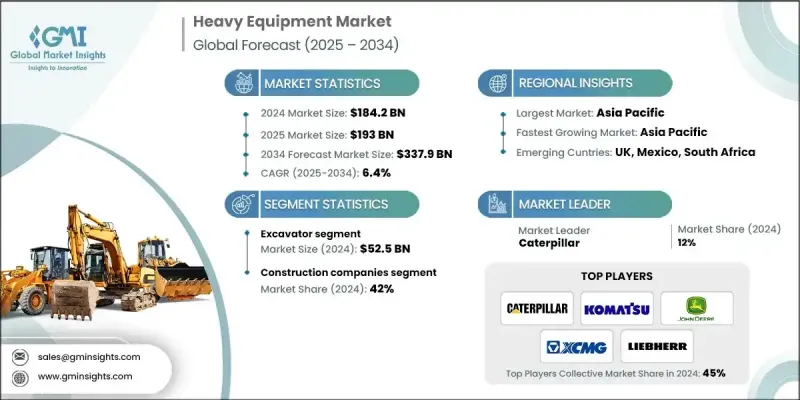
市场在支撑全球基础设施和工业发展方面发挥着至关重要的作用,是城市化、资源流动和经济扩张的支柱。其主要应用领域涵盖建筑、采矿、农业和物料搬运,这些产业对全球经济成长至关重要。新兴经济体大力投资道路、能源项目和住房,引领市场需求;而成熟市场则透过采用节能、数位互联和技术先进的机械设备来更新车队。自动化、远端资讯处理和电气化正在变革营运模式,帮助企业在降低营运成本的同时实现永续发展目标。对效率和生产力的日益重视,以及技术融合,正在重塑重型设备市场格局,并推动各行业实现更智慧、更环保的营运。
| 市场范围 | |
|---|---|
| 起始年份 | 2024 |
| 预测年份 | 2025-2034 |
| 起始值 | 1842亿美元 |
| 预测值 | 3379亿美元 |
| 复合年增长率 | 6.4% |
随着企业寻求灵活、经济高效的解决方案,避免前期大笔投资,租赁市场正经历强劲成长。然而,该行业也面临诸多挑战,包括原材料价格波动、劳动力短缺以及日益严格的排放法规,这些都迫使製造商在保持合规性和竞争力的同时,加快创新步伐。儘管有这些挑战,市场前景依然强劲。
预计到2024年,建筑公司板块将占据42%的市场。挖土机、装载机、推土机和起重机等机械设备广泛应用于土方工程、物料搬运、场地准备和结构组装。城市化进程的加速和政府基础设施项目的推进,正稳步推动对这些机械设备的需求。
2024年,柴油动力设备市场占据了相当大的份额,这得益于其高扭矩、高可靠性以及在建筑、采矿和农业作业中久经考验的性能。柴油引擎受益于完善的燃料供应基础设施、更长的作业里程以及操作人员的熟悉程度,使其成为电动车充电网路有限的偏远或难以到达地区不可或缺的设备。柴油动力对于持续的重型作业仍然至关重要。
2024年,美国重型设备市场规模达392亿美元,占全球82%的市占率。该地区注重先进机械、自动化和远端资讯处理技术,大型基础设施和采矿专案推动了强劲的需求。强劲的更新换代需求和成熟的设备租赁市场确保了稳定的收入来源,而持续的研发投入则巩固了北美在全球市场的地位。
全球重型设备市场的主要参与者包括日立建机、多田野株式会社、沃尔沃建筑设备、利勃海尔集团、小松株式会社、三一重工、卡特彼勒公司、中联重科、JCB、约翰迪尔、德维隆(原斗山工程机械)、特雷克斯公司、HD现代工程机械、马尼瓦克以及其他领先商。重型设备市场的企业正致力于技术创新,包括自动化、远端资讯处理和电气化,以实现产品差异化并吸引具有环保意识的客户。与承包商、租赁服务提供者和车队营运商建立策略合作伙伴关係和开展合作,有助于扩大市场覆盖范围并加强分销网络。製造商正在加大研发投入,以提高燃油效率、耐用性和运作性能,同时遵守更严格的排放法规。进军高成长的新兴市场,确保企业能够参与大型基础设施和工业专案。
目录
第一章:方法论与范围
第二章:执行概要
第三章:行业洞察
- 产业生态系分析
- 供应商格局
- 利润率
- 每个阶段的价值增加
- 影响价值链的因素
- 产业影响因素
- 成长驱动因素
- 基础设施建设和城市化
- 技术进步和自动化
- 永续性和排放法规
- 产业陷阱与挑战
- 较高的初始投资和维护成本
- 供应链中断与原物料价格波动
- 机会
- 电气化和绿色设备解决方案
- 数位化和预测性维护
- 成长驱动因素
- 成长潜力分析
- 未来市场趋势
- 技术与创新格局
- 当前技术趋势
- 新兴技术
- 价格趋势
- 按地区
- 按机器类型
- 监管环境
- 标准和合规要求
- 区域监理框架
- 认证标准
- 波特的分析
- PESTEL 分析
第四章:竞争格局
- 介绍
- 公司市占率分析
- 按地区
- 公司矩阵分析
- 主要市场参与者的竞争分析
- 竞争定位矩阵
- 关键进展
- 併购
- 合作伙伴关係与合作
- 新产品发布
- 扩张计划
第五章:市场估算与预测:依机器类型划分,2021-2034年
- 主要趋势
- 挖土机
- 起重机
- 反铲装载机
- 推土机/推土机
- 轮式装载机
- 平地机
- 自卸卡车
- 压路机/压路机
- 其他的
第六章:市场估算与预测:以出行方式划分,2021-2034年
- 主要趋势
- 行动装置
- 固定设备
- 半行动装置
第七章:市场估算与预测:依电源类型划分,2021-2034年
- 主要趋势
- 柴油动力
- 电动的
- 油电混合
第八章:市场估算与预测:按应用领域划分 2021-2034 年
- 主要趋势
- 建造
- 矿业
- 基础设施建设
- 工业製造
- 物料搬运
- 拆除
- 其他(农业、林业、公用事业等)
第九章:市场估算与预测:依最终用途划分,2021-2034年
- 主要趋势
- 建筑公司
- 租赁服务提供者
- 矿业公司
- 基础设施开发商
- 製造工厂
- 其他(公用事业、政府等)
第十章:市场估价与预测:依配销通路划分,2021-2034年
- 主要趋势
- 直销
- 间接销售
第十一章:市场估计与预测:按地区划分,2021-2034年
- 主要趋势
- 北美洲
- 我们
- 加拿大
- 欧洲
- 德国
- 英国
- 法国
- 义大利
- 西班牙
- 亚太地区
- 中国
- 日本
- 印度
- 澳洲
- 韩国
- 拉丁美洲
- 巴西
- 墨西哥
- 阿根廷
- 中东和非洲
- 南非
- 沙乌地阿拉伯
- 阿联酋
第十二章:公司简介
- Caterpillar Inc.
- Doosan Infracore (now Develon)
- Hitachi Construction Machinery
- Hyundai Construction Equipment (now HD Hyundai Construction Equipment)
- JCB
- John Deere
- Komatsu Ltd.
- Liebherr Group
- Manitowoc Company
- Sany Heavy Industry
- Tadano Ltd.
- Terex Corporation
- Volvo Construction Equipment
- XCMG Group
- Zoomlion Heavy Industry
The Global Heavy Equipment Market was valued at USD 184.2 billion in 2024 and is estimated to grow at a CAGR of 6.4% to reach USD 337.9 billion by 2034.
The market plays a critical role in supporting global infrastructure and industrial development, acting as a backbone for urbanization, resource movement, and economic expansion. Its primary applications span construction, mining, agriculture, and material handling, sectors that are pivotal for growth worldwide. Demand is being led by emerging economies investing heavily in roads, energy projects, and housing, while established markets are modernizing fleets with fuel-efficient, digitally connected, and technologically advanced machinery. Automation, telematics, and electrification are transforming operations, helping companies achieve sustainability goals while reducing operational costs. The growing emphasis on efficiency and productivity, coupled with technological integration, is reshaping the heavy equipment landscape and enabling smarter, greener operations across industries.
| Market Scope | |
|---|---|
| Start Year | 2024 |
| Forecast Year | 2025-2034 |
| Start Value | $184.2 Billion |
| Forecast Value | $337.9 Billion |
| CAGR | 6.4% |
The rental segment is witnessing strong growth as companies seek flexible, cost-effective solutions, avoiding large upfront investments. However, the industry faces challenges, including fluctuating raw material prices, labor shortages, and stricter emission regulations, which are pushing manufacturers to accelerate innovation while maintaining compliance and competitiveness. Despite these challenges, the market outlook remains strong.
The construction companies segment held 42% share in 2024. Machinery such as excavators, loaders, bulldozers, and cranes is heavily utilized in earthmoving, material handling, site preparation, and structural assembly. Rising urbanization and government infrastructure projects are steadily boosting demand for these machines.
The diesel-powered equipment segment generated significant share in 2024, supported by high torque, reliability, and established performance in construction, mining, and agricultural operations. Diesel engines benefit from a well-developed fuel supply infrastructure, extended operational range, and operator familiarity, making them essential in remote or hard-to-access areas where electric charging networks are limited. Diesel remains critical for continuous heavy-duty operations.
U.S. Heavy Equipment Market held 82% share with USD 39.2 billion in 2024. The region emphasizes advanced machinery, automation, and telematics, with large-scale infrastructure and mining projects driving high demand. Strong replacement demand and a mature rental equipment sector ensure steady revenue streams, while ongoing investment in research and development reinforces North America's global market position.
Major players in the Global Heavy Equipment Market include Hitachi Construction Machinery, Tadano Ltd., Volvo Construction Equipment, Liebherr Group, Komatsu Ltd., Sany Heavy Industry, Caterpillar Inc., Zoomlion Heavy Industry, JCB, John Deere, Develon (formerly Doosan Infracore), Terex Corporation, HD Hyundai Construction Equipment, Manitowoc Company, and other leading manufacturers. Companies in the heavy equipment market are focusing on technological innovation, including automation, telematics, and electrification, to differentiate their products and attract environmentally conscious customers. Strategic partnerships and collaborations with contractors, rental service providers, and fleet operators help expand market reach and strengthen distribution networks. Manufacturers are investing in research and development to improve fuel efficiency, durability, and operational performance while complying with stricter emission regulations. Expanding into high-growth emerging markets ensures access to large infrastructure and industrial projects.
Table of Contents
Chapter 1 Methodology and Scope
- 1.1 Market scope and definition
- 1.2 Research design
- 1.2.1 Research approach
- 1.2.2 Data collection methods
- 1.3 Data mining sources
- 1.3.1 Global
- 1.3.2 Regional/Country
- 1.4 Base estimates and calculations
- 1.4.1 Base year calculation
- 1.4.2 Key trends for market estimation
- 1.5 Primary research and validation
- 1.5.1 Primary sources
- 1.6 Forecast model
- 1.7 Research assumptions and limitations
Chapter 2 Executive Summary
- 2.1 Industry 360° synopsis
- 2.2 Key market trends
- 2.2.1 Regional
- 2.2.2 Machine type
- 2.2.3 Mobility
- 2.2.4 Power source
- 2.2.5 Application
- 2.2.6 End Use industry
- 2.2.7 Distribution channel
- 2.3 CXO perspectives: Strategic imperatives
- 2.3.1 Key decision points for industry executives
- 2.3.2 Critical success factors for market players
- 2.4 Future outlook and strategic recommendations
Chapter 3 Industry Insights
- 3.1 Industry ecosystem analysis
- 3.1.1 Supplier landscape
- 3.1.2 Profit margin
- 3.1.3 Value addition at each stage
- 3.1.4 Factor affecting the value chain
- 3.2 Industry impact forces
- 3.2.1 Growth drivers
- 3.2.1.1 Infrastructure development and urbanization
- 3.2.1.2 Technological advancements and automation
- 3.2.1.3 Sustainability and emission regulations
- 3.2.2 Industry pitfalls & challenges
- 3.2.2.1 High initial investment and maintenance costs
- 3.2.2.2 Supply chain disruptions and raw material volatility
- 3.2.3 Opportunities
- 3.2.3.1 Electrification and green equipment solutions
- 3.2.3.2 Digitalization and predictive maintenance
- 3.2.1 Growth drivers
- 3.3 Growth potential analysis
- 3.4 Future market trends
- 3.5 Technology and innovation landscape
- 3.5.1 Current technological trends
- 3.5.2 Emerging technologies
- 3.6 Price trends
- 3.6.1 By region
- 3.6.2 By machine type
- 3.7 Regulatory landscape
- 3.7.1 Standards and compliance requirements
- 3.7.2 Regional regulatory frameworks
- 3.7.3 Certification standards
- 3.8 Porter's analysis
- 3.9 PESTEL analysis
Chapter 4 Competitive Landscape, 2024
- 4.1 Introduction
- 4.2 Company market share analysis
- 4.2.1 By region
- 4.2.1.1 North America
- 4.2.1.2 Europe
- 4.2.1.3 Asia Pacific
- 4.2.1.4 Latin America
- 4.2.1.5 Middle East and Africa
- 4.2.1 By region
- 4.3 Company matrix analysis
- 4.4 Competitive analysis of major market players
- 4.5 Competitive positioning matrix
- 4.6 Key developments
- 4.6.1 Mergers & acquisitions
- 4.6.2 Partnerships & collaborations
- 4.6.3 New product launches
- 4.6.4 Expansion plans
Chapter 5 Market Estimates and Forecast, By Machine Type, 2021 - 2034 (USD Billion) (Thousand Units)
- 5.1 Key trends
- 5.2 Excavators
- 5.3 Cranes
- 5.4 Backhoe Loaders
- 5.5 Bulldozers/Dozers
- 5.6 Wheel loaders
- 5.7 Motor Graders
- 5.8 Dump Trucks
- 5.9 Compactors/Rollers
- 5.10 Others
Chapter 6 Market Estimates and Forecast, By Mobility, 2021 - 2034 (USD Billion) (Thousand Units)
- 6.1 Key trends
- 6.2 Mobile equipment
- 6.3 Stationary equipment
- 6.4 Semi-mobile equipment
Chapter 7 Market Estimates and Forecast, By Power Source, 2021 - 2034 (USD Billion) (Thousand Units)
- 7.1 Key trends
- 7.2 Diesel-powered
- 7.3 Electric-powered
- 7.4 Hybrid-powered
Chapter 8 Market Estimates and Forecast, By Application 2021 - 2034 (USD Billion) (Thousand Units)
- 8.1 Key trends
- 8.2 Construction
- 8.3 Mining
- 8.4 Infrastructure development
- 8.5 Industrial manufacturing
- 8.6 Material handling
- 8.7 Demolition
- 8.8 Others (agriculture, forestry, utilities, etc.)
Chapter 9 Market Estimates and Forecast, By End Use, 2021 - 2034 (USD Billion) (Thousand Units)
- 9.1 Key trends
- 9.2 Construction companies
- 9.3 Rental service providers
- 9.4 Mining companies
- 9.5 Infrastructure developers
- 9.6 Manufacturing plants
- 9.7 Others (utilities, government, etc.)
Chapter 10 Market Estimates and Forecast, By Distribution Channel, 2021 - 2034 (USD Billion) (Thousand Units)
- 10.1 Key trends
- 10.2 Direct sales
- 10.3 Indirect sales
Chapter 11 Market Estimates and Forecast, By Region, 2021 - 2034 (USD Billion) (Thousand Units)
- 11.1 Key trends
- 11.2 North America
- 11.2.1 U.S.
- 11.2.2 Canada
- 11.3 Europe
- 11.3.1 Germany
- 11.3.2 UK
- 11.3.3 France
- 11.3.4 Italy
- 11.3.5 Spain
- 11.4 Asia Pacific
- 11.4.1 China
- 11.4.2 Japan
- 11.4.3 India
- 11.4.4 Australia
- 11.4.5 South Korea
- 11.5 Latin America
- 11.5.1 Brazil
- 11.5.2 Mexico
- 11.5.3 Argentina
- 11.6 Middle East and Africa
- 11.6.1 South Africa
- 11.6.2 Saudi Arabia
- 11.6.3 UAE
Chapter 12 Company Profiles
- 12.1 Caterpillar Inc.
- 12.2 Doosan Infracore (now Develon)
- 12.3 Hitachi Construction Machinery
- 12.4 Hyundai Construction Equipment (now HD Hyundai Construction Equipment)
- 12.5 JCB
- 12.6 John Deere
- 12.7 Komatsu Ltd.
- 12.8 Liebherr Group
- 12.9 Manitowoc Company
- 12.10 Sany Heavy Industry
- 12.11 Tadano Ltd.
- 12.12 Terex Corporation
- 12.13 Volvo Construction Equipment
- 12.14 XCMG Group
- 12.15 Zoomlion Heavy Industry

 大型车辆市场:2026-2032年全球市场预测(依车辆类型、动力传动系统、重量等级、应用及销售管道)
 2026年中型卡车转向系统全球市场报告2026年全球重型卡车市场报告2026年全球重型卡车转向系统市场报告
 全球重型货车市场规模、份额、趋势和成长分析报告(2026-2034)重型车辆市场:2026-2032年全球预测(依动力来源、车辆类型、载客量、应用、终端用户产业及通路划分)
 日本重型汽车售后市场规模、份额、趋势及预测(按替换零件、车辆类型、服务管道和地区划分),2026-2034年2025年全球重型汽车售后市场报告Frost Radar:印度中重型卡车市场,2025 年
 重型卡车用电驱动桥-全球市占率及排名、总销售量及需求预测(2025-2031年)