


 |
市场调查报告书
商品编码
1885844
藻类塑胶回收市场机会、成长驱动因素、产业趋势分析及预测(2025-2034年)Algae-Based Plastic Recycling Market Opportunity, Growth Drivers, Industry Trend Analysis, and Forecast 2025 - 2034 |
||||||

2024 年全球藻类塑胶回收市场价值为 4.857 亿美元,预计到 2034 年将以 19.3% 的复合年增长率增长至 29 亿美元。
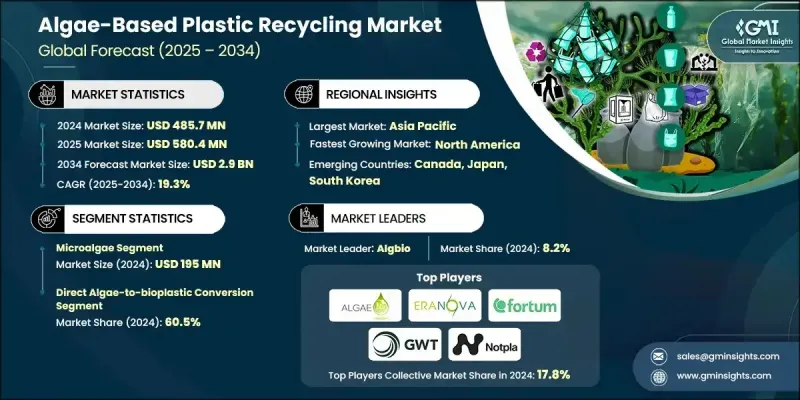
藻类塑胶回收正逐渐成为一种变革性的解决方案,它将藻类转化为可生物降解的塑料,为日益严重的塑胶垃圾和环境问题提供了一种切实可行的应对之策。不断增长的监管压力,包括对一次性塑胶的限制,正促使各国政府和各行业采用更永续的材料。各行各业的公司也在优先考虑碳减排承诺,并将环保原料融入产品线和包装中,这进一步增强了对藻类替代品的需求。消费者对环保产品的日益青睐也加速了藻类塑胶回收的普及。藻类培养系统的进步,包括高效光生物反应器和自动化收穫技术,不断提高生物质产量并降低生产成本。监管的推动、企业的永续发展措施以及消费者期望的转变,共同推动藻类塑胶回收成为全球转型为低影响材料的重要力量。
| 市场范围 | |
|---|---|
| 起始年份 | 2024 |
| 预测年份 | 2025-2034 |
| 起始值 | 4.857亿美元 |
| 预测值 | 29亿美元 |
| 复合年增长率 | 19.3% |
微藻领域在2024年创造了1.95亿美元的市场规模,反映了其在市场中的强大地位。微藻生长快速、生物化学生产力高,且应用潜力广泛,涵盖从可生物降解包装到农业材料和特定医疗用途等许多领域,使其成为生产藻基塑胶的一种经济高效且用途广泛的基础原料。
到2024年,藻类直接转化为生物塑胶的市占率将达到60.5%。此途径以藻类生物质为主要原料,生产聚羟基脂肪酸酯(PHA)等聚合物。此製程通常包括培养、生物质收集、细胞破碎和聚合物萃取,并利用生物技术基础设施来简化生产流程。与废水处理流程结合,既能降低培养成本,又能带来额外的环境效益,进而提高经济可行性。
预计2025年至2034年间,北美藻类塑胶回收市场将以19.4%的复合年增长率成长。消费者日益重视永续的生活方式,以及营养保健品、食品和化妆品产业对环保材料的需求不断增长,为藻类塑胶的发展创造了有利环境。溶剂系统和回收技术的改进,也使得藻类塑胶的加工成本更低、环境影响更小,与传统塑胶回收相比,这将促进其在包装和工业应用领域的更广泛应用。
参与藻类塑胶回收市场的主要公司包括Algbio、Danimer Scientific、Eranova、Fortum、Gross-Wen Technologies、Kelpi、Nenu2PHAr和Notpla。这些公司采用多种策略来巩固市场地位并加速商业化进程。许多公司透过优化藻类培养系统、改进营养输送和采用自动化技术来提高生物质产量,从而提升生产效率。此外,这些公司还与包装製造商、消费品品牌和生物技术合作伙伴建立联盟,以扩大分销规模并确保长期供应协议。研发投入仍是重中之重,各公司致力于开发更有效率的萃取技术、先进的聚合物共混物和更优异的生物降解性能。认证项目、生命週期评估和透明的永续发展报告有助于增强公司在监管机构和消费者中的信誉。
目录
第一章:方法论与范围
第二章:执行概要
第三章:行业洞察
- 产业生态系分析
- 供应商格局
- 利润率
- 每个阶段的价值增加
- 影响价值链的因素
- 中断
- 产业影响因素
- 成长驱动因素
- 监管部门推动减少塑胶垃圾
- 企业永续发展承诺
- 消费者对环保产品的需求
- 产业陷阱与挑战
- 与传统塑胶相比,生产成本高昂
- 材料性能限制
- 市场机会
- 与废水处理的整合
- 二氧化碳捕获与利用的协同效应
- 成长驱动因素
- 成长潜力分析
- 监管环境
- 北美洲
- 欧洲
- 亚太地区
- 拉丁美洲
- 中东和非洲
- 波特的分析
- PESTEL 分析
- 技术与创新格局
- 当前技术趋势
- 新兴技术
- 价格趋势
- 按地区
- 依藻类类型
- 未来市场趋势
- 专利格局
- 贸易统计(HS编码)(註:仅提供重点国家的贸易统计资料)
- 主要进口国
- 主要出口国
- 永续性和环境方面
- 永续实践
- 减少废弃物策略
- 生产中的能源效率
- 环保倡议
- 碳足迹考量
第四章:竞争格局
- 介绍
- 公司市占率分析
- 按地区
- 北美洲
- 欧洲
- 亚太地区
- 拉丁美洲
- MEA
- 按地区
- 公司矩阵分析
- 主要市场参与者的竞争分析
- 竞争定位矩阵
- 关键进展
- 併购
- 合作伙伴关係与合作
- 新产品发布
- 扩张计划
第五章:市场估算与预测:依藻类类型划分,2021-2034年
- 主要趋势
- 微藻
- 小球藻
- 螺旋藻
- 衣藻
- 大型藻类
- 蓝绿藻
- 其他的
第六章:市场估算与预测:依製程划分,2021-2034年
- 主要趋势
- 藻类直接转化为生物塑料
- 藻类辅助塑胶降解
- 其他的
第七章:市场估计与预测:依应用领域划分,2021-2034年
- 主要趋势
- 包装材料
- 食品包装
- 消费品
- 汽车零件
- 纺织品和纤维
- 生物医学
- 电子与先进材料
- 其他的
第八章:市场估算与预测:依地区划分,2021-2034年
- 主要趋势
- 北美洲
- 我们
- 加拿大
- 欧洲
- 德国
- 英国
- 法国
- 西班牙
- 义大利
- 欧洲其他地区
- 亚太地区
- 中国
- 印度
- 日本
- 澳洲
- 韩国
- 亚太其他地区
- 拉丁美洲
- 巴西
- 墨西哥
- 阿根廷
- 拉丁美洲其他地区
- 中东和非洲
- 沙乌地阿拉伯
- 南非
- 阿联酋
- 中东和非洲其他地区
第九章:公司简介
- Algbio
- Danimer Scientific
- Eranova
- Fortum
- Gross-Wen Technologies
- Kelpi
- Nenu2PHAr
- Notpla
The Global Algae-Based Plastic Recycling Market was valued at USD 485.7 million in 2024 and is estimated to grow at a CAGR of 19.3% to reach USD 2.9 billion by 2034.
Algae-based plastic recycling is emerging as a transformative solution that converts algae into biodegradable plastics, offering a practical response to escalating plastic waste and environmental concerns. Growing regulatory pressure, including restrictions on single-use plastics, is pushing governments and industries to adopt more sustainable materials. Companies across sectors are also prioritizing carbon-reduction commitments and integrating eco-friendly inputs into product lines and packaging, which strengthens demand for algae-based alternatives. Rising consumer preference for environmentally conscious products further accelerates adoption. Advances in algae cultivation systems, including high-efficiency photobioreactors and automated harvesting technologies, continue to improve biomass output and reduce production costs. Together, regulatory momentum, corporate sustainability initiatives, and shifting consumer expectations are positioning algae-based plastic recycling as a vital contributor to the global transition toward low-impact materials.
| Market Scope | |
|---|---|
| Start Year | 2024 |
| Forecast Year | 2025-2034 |
| Start Value | $485.7 Million |
| Forecast Value | $2.9 Billion |
| CAGR | 19.3% |
The microalgae segment generated USD 195 million in 2024, reflecting its strong role in the market. Its rapid growth rates, high biochemical productivity, and diverse application potential ranging from biodegradable packaging to agricultural materials and select medical uses make microalgae a cost-effective and versatile foundation for algae-based plastics.
The direct algae-to-bioplastic conversion accounted for a 60.5% share in 2024. This pathway relies on algal biomass as the primary source for producing polymers such as PHA. The process typically includes cultivation, biomass collection, cell disruption, and polymer extraction, utilizing biotechnology infrastructures to streamline production. Integration with wastewater treatment operations enhances economic feasibility by cutting cultivation expenses while generating additional environmental advantages.
North America Algae-Based Plastic Recycling Market is expected to grow at a CAGR of 19.4% between 2025 and 2034. Increasing consumer emphasis on sustainable lifestyles and stronger demand for environmentally responsible materials across nutraceuticals, food, and cosmetic sectors is creating a fertile environment for algae-derived plastics. Improvements in solvent systems and recycling technologies also support lower-cost and lower-impact processing compared with traditional plastic recycling, encouraging broader adoption across packaging and industrial applications.
Key companies participating in the Algae-Based Plastic Recycling Market include Algbio, Danimer Scientific, Eranova, Fortum, Gross-Wen Technologies, Kelpi, Nenu2PHAr, and Notpla. Companies in the Algae-Based Plastic Recycling Market employ multiple strategies to strengthen their market presence and accelerate commercialization. Many are enhancing production efficiency by optimizing algae cultivation systems, improving nutrient delivery, and adopting automation to increase biomass yields. Firms are also forming alliances with packaging manufacturers, consumer goods brands, and biotechnology partners to scale distribution and secure long-term supply agreements. Investment in R&D remains a priority, with companies developing more efficient extraction technologies, advanced polymer blends, and improved biodegradability profiles. Certification programs, life-cycle assessments, and transparent sustainability reporting help reinforce credibility with regulators and consumers.
Table of Contents
Chapter 1 Methodology & Scope
- 1.1 Market scope and definition
- 1.2 Research design
- 1.2.1 Research approach
- 1.2.2 Data collection methods
- 1.3 Data mining sources
- 1.3.1 Global
- 1.3.2 Regional/Country
- 1.4 Base estimates and calculations
- 1.4.1 Base year calculation
- 1.4.2 Key trends for market estimation
- 1.5 Primary research and validation
- 1.5.1 Primary sources
- 1.6 Forecast model
- 1.7 Research assumptions and limitations
Chapter 2 Executive Summary
- 2.1 Industry 360° synopsis
- 2.2 Key market trends
- 2.2.1 Algae type trends
- 2.2.2 Process trends
- 2.2.3 Application trends
- 2.2.4 Regional trends
- 2.3 TAM Analysis, 2025-2034
- 2.4 CXO perspectives: strategic imperatives
- 2.4.1 Executive decision points
- 2.4.2 Critical success factors
- 2.5 Future outlook and strategic recommendations
Chapter 3 Industry Insights
- 3.1 Industry ecosystem analysis
- 3.1.1 Supplier landscape
- 3.1.2 Profit margin
- 3.1.3 Value addition at each stage
- 3.1.4 Factor affecting the value chain
- 3.1.5 Disruptions
- 3.2 Industry impact forces
- 3.2.1 Growth drivers
- 3.2.1.1 Regulatory push for plastic waste reduction
- 3.2.1.2 Corporate sustainability commitments
- 3.2.1.3 Consumer demand for eco-friendly products
- 3.2.2 Industry pitfalls and challenges
- 3.2.2.1 High production costs vs conventional plastics
- 3.2.2.2 Material property limitations
- 3.2.3 Market opportunities
- 3.2.3.1 Integration with wastewater treatment
- 3.2.3.2 Co2 capture & utilization synergies
- 3.2.1 Growth drivers
- 3.3 Growth potential analysis
- 3.4 Regulatory landscape
- 3.4.1 North America
- 3.4.2 Europe
- 3.4.3 Asia Pacific
- 3.4.4 Latin America
- 3.4.5 Middle East & Africa
- 3.5 Porter's analysis
- 3.6 PESTEL analysis
- 3.7 Technology and Innovation landscape
- 3.7.1 Current technological trends
- 3.7.2 Emerging technologies
- 3.8 Price trends
- 3.8.1 By region
- 3.8.2 By algae type
- 3.9 Future market trends
- 3.10 Patent landscape
- 3.11 Trade statistics (HS code) ( Note: the trade statistics will be provided for key countries only)
- 3.11.1 Major importing countries
- 3.11.2 Major exporting countries
- 3.12 Sustainability and environmental aspects
- 3.12.1 Sustainable practices
- 3.12.2 Waste reduction strategies
- 3.12.3 Energy efficiency in production
- 3.12.4 Eco-friendly initiatives
- 3.13 Carbon footprint consideration
Chapter 4 Competitive Landscape, 2024
- 4.1 Introduction
- 4.2 Company market share analysis
- 4.2.1 By region
- 4.2.1.1 North America
- 4.2.1.2 Europe
- 4.2.1.3 Asia Pacific
- 4.2.1.4 LATAM
- 4.2.1.5 MEA
- 4.2.1 By region
- 4.3 Company matrix analysis
- 4.4 Competitive analysis of major market players
- 4.5 Competitive positioning matrix
- 4.6 Key developments
- 4.6.1 Mergers & acquisitions
- 4.6.2 Partnerships & collaborations
- 4.6.3 New product launches
- 4.6.4 Expansion plans
Chapter 5 Market Estimates and Forecast, By Algae Type, 2021-2034 (USD Billion) (Kilo Tons)
- 5.1 Key trends
- 5.2 Microalgae
- 5.2.1 Chlorella
- 5.2.2 Spirulina
- 5.2.3 Chlamydomonas
- 5.3 Macroalgae
- 5.4 Cyanobacteria
- 5.5 Others
Chapter 6 Market Estimates and Forecast, By Process, 2021-2034 (USD Billion) (Kilo Tons)
- 6.1 Key trends
- 6.2 Direct algae-to-bioplastic conversion
- 6.3 Algae-assisted plastic degradation
- 6.4 Others
Chapter 7 Market Estimates and Forecast, By Application, 2021-2034 (USD Billion) (Kilo Tons)
- 7.1 Key trends
- 7.2 Packaging materials
- 7.2.1 Food packaging
- 7.2.2 Consumer goods
- 7.3 Automotive components
- 7.4 Textiles & fibers
- 7.5 Biomedical
- 7.6 Electronics & advanced materials
- 7.7 Others
Chapter 8 Market Estimates and Forecast, By Region, 2021-2034 (USD Billion) (Kilo Tons)
- 8.1 Key trends
- 8.2 North America
- 8.2.1 U.S.
- 8.2.2 Canada
- 8.3 Europe
- 8.3.1 Germany
- 8.3.2 UK
- 8.3.3 France
- 8.3.4 Spain
- 8.3.5 Italy
- 8.3.6 Rest of Europe
- 8.4 Asia Pacific
- 8.4.1 China
- 8.4.2 India
- 8.4.3 Japan
- 8.4.4 Australia
- 8.4.5 South Korea
- 8.4.6 Rest of Asia Pacific
- 8.5 Latin America
- 8.5.1 Brazil
- 8.5.2 Mexico
- 8.5.3 Argentina
- 8.5.4 Rest of Latin America
- 8.6 Middle East and Africa
- 8.6.1 Saudi Arabia
- 8.6.2 South Africa
- 8.6.3 UAE
- 8.6.4 Rest of Middle East and Africa
Chapter 9 Company Profiles
- 9.1 Algbio
- 9.2 Danimer Scientific
- 9.3 Eranova
- 9.4 Fortum
- 9.5 Gross-Wen Technologies
- 9.6 Kelpi
- 9.7 Nenu2PHAr
- 9.8 Notpla


