


 |
市场调查报告书
商品编码
1885847
智慧病床市场机会、成长驱动因素、产业趋势分析及预测(2025-2034年)Smart Hospital Beds Market Opportunity, Growth Drivers, Industry Trend Analysis, and Forecast 2025 - 2034 |
||||||

2024 年全球智慧医院病床市场价值为 5.237 亿美元,预计到 2034 年将以 7.3% 的复合年增长率增长至 10 亿美元。
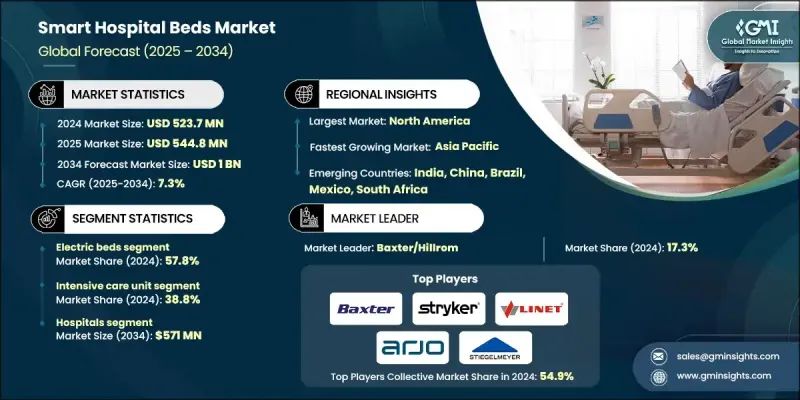
市场扩张的驱动力来自对以患者为中心的护理、医院自动化以及物联网和人工智慧技术融合的日益重视。医院和长期照护机构越来越重视能够提升病人安全、简化临床工作流程并支持早期发现健康恶化的解决方案。慢性病的普遍存在、人口老化以及需要重症监护或长期护理的患者数量不断增加,都推动了对配备感测器和连接功能的先进病床的需求。包括医疗物联网 (IoMT) 整合、人工智慧驱动的监测和基于云端的分析在内的技术进步,使医疗服务提供者能够做出数据驱动的决策并提高治疗的精准度。此外,医院生态系统向数位转型以及政府支持医疗现代化的倡议,尤其是在新兴地区,正在推动全球智慧病床的普及。
| 市场范围 | |
|---|---|
| 起始年份 | 2024 |
| 预测年份 | 2025-2034 |
| 起始值 | 5.237亿美元 |
| 预测值 | 10亿美元 |
| 复合年增长率 | 7.3% |
2024年,半电动病床市场规模达到1.45亿美元,预计2025年至2034年将以7.2%的复合年增长率成长。这类病床结合了电动功能和手动调节,实现了部分自动化。医院和家庭护理机构因其成本效益高且能保证患者舒适度而青睐这一市场。半电动病床可电动调整头部和脚部位置,而整体高度调整仍需手动完成,因此适合预算有限的中型医疗机构。
2024年,加护病房(ICU)市占率占38.8%,预计到2034年将达到4.08亿美元。 ICU市场份额占据主导地位,是因为在这些环境中,持续的患者监测和快速回应能力至关重要。 ICU中的智慧病床配备整合式感测器,可追踪生命征象、侦测患者移动并预防褥疮,从而显着提高病患安全。危重疾病盛行率的上升、术后护理需求的增加以及全球ICU入院人数的增加是主要的成长驱动因素。物联网赋能的连接和基于人工智慧的预测分析使医护人员能够远端监测患者、优化治疗方案并缩短反应时间。
2024年,北美智慧医院病床市占率达35.3%。该地区的领先地位归功于其成熟的医疗保健基础设施、先进医疗技术的广泛应用,以及老年人口不断增长、慢性健康状况需要持续监测和个人化护理。
智慧病床市场的主要参与者包括Arjo、Baxter/Hillrom、Betten Malsch、Drive DeVilbiss、Famed、Favero Health Projects、Invacare、Joerns Healthcare、LINET、Malvestio、Paramount Bed、Pardo、Stiegelmeyer和Stryker。这些公司正透过产品创新巩固其市场地位,将物联网、人工智慧和云端监控技术整合到病床系统中,以提升功能性、患者舒适度和临床效率。与医院、医疗服务提供者和科技公司建立策略合作伙伴关係,能够提供客製化解决方案并加速市场渗透。向新兴地区扩张有助于企业掌握不断成长的医疗基础设施投资机会。此外,各公司也致力于优化成本,为中型医疗机构提供半电动和模组化设计,同时维持品质标准。
目录
第一章:方法论与范围
第二章:执行概要
第三章:行业洞察
- 产业生态系分析
- 产业影响因素
- 成长驱动因素
- 老年人口不断增长和慢性病负担加重
- 将物联网和人工智慧融入医院基础设施
- 日益重视病人安全和照护效率
- 家庭医疗保健和远距医疗服务的扩展
- 产业陷阱与挑战
- 高昂的初始采购和维护成本
- 互通性和整合挑战
- 市场机会
- 无线和云端连接智慧床的出现
- 人工智慧驱动的预测性患者监测
- 成长驱动因素
- 成长潜力分析
- 监管环境
- 北美洲
- 欧洲
- 技术格局
- 当前技术趋势
- 具备物联网功能的智慧床
- 人工智慧驱动的患者监测
- 符合人体工学和自动化定位系统
- 新兴科技及其影响
- 无线和云端连接的床
- 与医院资讯系统(HIS/EHR)集成
- 远距医疗和远距患者护理解决方案
- 当前技术趋势
- 未来市场趋势
- 采用预测性和预防性护理解决方案
- 加大对智慧床功能的研发投入
- 拓展新兴市场
- 定价分析
- 投资和融资环境
- 波特的分析
- PESTEL 分析
第四章:竞争格局
- 介绍
- 公司矩阵分析
- 公司市占率分析
- 全球的
- 北美洲
- 欧洲
- 竞争定位矩阵
- 主要市场参与者的竞争分析
- 关键进展
- 併购
- 合作伙伴关係与合作
- 新产品发布
- 扩张计划
第五章:市场估算与预测:依产品类型划分,2021-2034年
- 主要趋势
- 电动床
- 半电动床
- 无线床
第六章:市场估算与预测:依应用领域划分,2021-2034年
- 主要趋势
- 重症监护室
- 内外科(普通病房)
- 长期照护
- 其他应用
第七章:市场估算与预测:依最终用途划分,2021-2034年
- 主要趋势
- 医院
- 门诊护理中心
- 其他最终用途
第八章:市场估算与预测:依地区划分,2021-2034年
- 主要趋势
- 北美洲
- 我们
- 加拿大
- 欧洲
- 德国
- 英国
- 法国
- 西班牙
- 义大利
- 荷兰
- 亚太地区
- 中国
- 日本
- 印度
- 澳洲
- 韩国
- 拉丁美洲
- 巴西
- 墨西哥
- 阿根廷
- 中东和非洲
- 南非
- 沙乌地阿拉伯
- 阿联酋
第九章:公司简介
- Arjo
- Baxter/Hillrom
- Betten Malsch
- Drive DeVilbiss
- Famed
- Favero Health Projects
- Invacare
- Joerns Healthcare
- LINET
- Malvestio
- Paramount Bed
- Pardo
- Stiegelmeyer
- Stryker
The Global Smart Hospital Beds Market was valued at USD 523.7 million in 2024 and is estimated to grow at a CAGR of 7.3% to reach USD 1 billion by 2034.
The market expansion is fueled by the rising focus on patient-centered care, hospital automation, and the integration of IoT and AI technologies. Hospitals and long-term care facilities are increasingly prioritizing solutions that enhance patient safety, streamline clinical workflows, and support early detection of health deterioration. The prevalence of chronic illnesses, an aging population, and a higher number of patients requiring intensive or long-term care are driving the need for advanced beds equipped with sensors and connectivity features. Technological advancements, including IoMT integration, AI-powered monitoring, and cloud-based analytics, allow healthcare providers to make data-driven decisions and improve treatment precision. Furthermore, the shift toward digitalized hospital ecosystems and government initiatives supporting healthcare modernization, particularly in emerging regions, is bolstering smart bed adoption worldwide.
| Market Scope | |
|---|---|
| Start Year | 2024 |
| Forecast Year | 2025-2034 |
| Start Value | $523.7 Million |
| Forecast Value | $1 Billion |
| CAGR | 7.3% |
The semi-electric beds segment generated USD 145 million in 2024 and is expected to grow at a CAGR of 7.2% from 2025 to 2034. These beds provide partial automation by combining electric motorized functions with manual adjustments. Hospitals and home care providers are attracted to this segment for its cost efficiency while maintaining patient comfort. Semi-electric beds allow motorized positioning of head and foot sections, while overall height adjustments remain manual, making them suitable for mid-sized facilities with budget considerations.
The intensive care unit (ICU) segment held a 38.8% share in 2024 and is projected to reach USD 408 million through 2034. The ICU segment dominates because continuous patient monitoring and rapid response capabilities are critical in these settings. Smart beds in ICUs feature integrated sensors to track vital signs, detect patient movement, and prevent bedsores, significantly improving patient safety. The rising prevalence of critical illnesses, post-operative care demands, and increasing ICU admissions globally are major growth drivers. IoT-enabled connectivity and AI-based predictive analytics allow healthcare staff to remotely monitor patients, optimize treatment plans, and reduce response times.
North America Smart Hospital Beds Market held 35.3% share in 2024. The region's dominance is attributed to a mature healthcare infrastructure, high adoption of advanced medical technologies, and a growing geriatric population with chronic health conditions requiring continuous monitoring and personalized care.
Leading players operating in the Smart Hospital Beds Market include Arjo, Baxter/Hillrom, Betten Malsch, Drive DeVilbiss, Famed, Favero Health Projects, Invacare, Joerns Healthcare, LINET, Malvestio, Paramount Bed, Pardo, Stiegelmeyer, and Stryker. Companies in the Smart Hospital Beds Market are strengthening their foothold through product innovation, integrating IoT, AI, and cloud-based monitoring into bed systems to enhance functionality, patient comfort, and clinical efficiency. Strategic partnerships with hospitals, healthcare providers, and technology firms enable tailored solutions and faster market penetration. Geographic expansion into emerging regions helps companies tap into rising healthcare infrastructure investments. Firms are also focusing on cost optimization by offering semi-electric and modular designs for mid-sized facilities while maintaining quality standards.
Table of Contents
Chapter 1 Methodology and Scope
- 1.1 Market scope and definitions
- 1.2 Research design
- 1.2.1 Research approach
- 1.2.2 Data collection methods
- 1.3 Data mining sources
- 1.3.1 Global
- 1.3.2 Regional/country
- 1.4 Base estimates and calculations
- 1.4.1 Base year calculation
- 1.4.2 Key trends for market estimation
- 1.5 Primary research and validation
- 1.5.1 Primary sources
- 1.6 Forecast model
- 1.7 Research assumptions and limitations
Chapter 2 Executive Summary
- 2.1 Industry 3600 synopsis
- 2.2 Key market trends
- 2.2.1 Regional trends
- 2.2.2 Product type trends
- 2.2.3 Application trends
- 2.2.4 End use trends
- 2.3 CXO perspectives: Strategic imperatives
- 2.3.1 Key decision points for industry executives
- 2.3.2 Critical success factors for market players
- 2.4 Future outlook and strategic recommendations
Chapter 3 Industry Insights
- 3.1 Industry ecosystem analysis
- 3.2 Industry impact forces
- 3.2.1 Growth drivers
- 3.2.1.1 Rising geriatric population and chronic disease burden
- 3.2.1.2 Integration of IoT and AI in hospital infrastructure
- 3.2.1.3 Growing focus on patient safety and care efficiency
- 3.2.1.4 Expansion of home healthcare and telehealth services
- 3.2.2 Industry pitfalls and challenges
- 3.2.2.1 High initial procurement and maintenance costs
- 3.2.2.2 Interoperability and integration challenges
- 3.2.3 Market opportunities
- 3.2.3.1 Emergence of wireless and cloud-connected smart beds
- 3.2.3.2 AI-powered predictive patient monitoring
- 3.2.1 Growth drivers
- 3.3 Growth potential analysis
- 3.4 Regulatory landscape
- 3.4.1 North America
- 3.4.2 Europe
- 3.5 Technology landscape
- 3.5.1 Current technological trends
- 3.5.1.1 IoT-enabled and connected beds
- 3.5.1.2 AI-powered patient monitoring
- 3.5.1.3 Ergonomic and automated positioning systems
- 3.5.2 Emerging technologies and their impacts
- 3.5.2.1 Wireless and cloud-connected beds
- 3.5.2.2 Integration with hospital information systems (HIS/EHR)
- 3.5.2.3 Telehealth and remote patient care solutions
- 3.5.1 Current technological trends
- 3.6 Future market trends
- 3.6.1 Adoption of predictive and preventive care solutions
- 3.6.2 Increased R&D in smart bed features
- 3.6.3 Expansion into emerging markets
- 3.7 Pricing analysis
- 3.8 Investment and funding landscape
- 3.9 Porter's analysis
- 3.10 PESTEL analysis
Chapter 4 Competitive Landscape, 2024
- 4.1 Introduction
- 4.2 Company matrix analysis
- 4.3 Company market share analysis
- 4.3.1 Global
- 4.3.2 North America
- 4.3.3 Europe
- 4.4 Competitive positioning matrix
- 4.5 Competitive analysis of major market players
- 4.6 Key developments
- 4.6.1 Mergers & acquisitions
- 4.6.2 Partnerships & collaborations
- 4.6.3 New product launches
- 4.6.4 Expansion plans
Chapter 5 Market Estimates and Forecast, By Product Type, 2021 - 2034 ($ Mn)
- 5.1 Key trends
- 5.2 Electric beds
- 5.3 Semi-electric beds
- 5.4 Wireless beds
Chapter 6 Market Estimates and Forecast, By Application, 2021 - 2034 ($ Mn)
- 6.1 Key trends
- 6.2 Intensive care unit
- 6.3 Med-surg (General wards)
- 6.4 Long term care
- 6.5 Other applications
Chapter 7 Market Estimates and Forecast, By End Use, 2021 - 2034 ($ Mn)
- 7.1 Key trends
- 7.2 Hospitals
- 7.3 Ambulatory care centres
- 7.4 Other End use
Chapter 8 Market Estimates and Forecast, By Region, 2021 - 2034 ($ Mn)
- 8.1 Key trends
- 8.2 North America
- 8.2.1 U.S.
- 8.2.2 Canada
- 8.3 Europe
- 8.3.1 Germany
- 8.3.2 UK
- 8.3.3 France
- 8.3.4 Spain
- 8.3.5 Italy
- 8.3.6 Netherlands
- 8.4 Asia Pacific
- 8.4.1 China
- 8.4.2 Japan
- 8.4.3 India
- 8.4.4 Australia
- 8.4.5 South Korea
- 8.5 Latin America
- 8.5.1 Brazil
- 8.5.2 Mexico
- 8.5.3 Argentina
- 8.6 Middle East and Africa
- 8.6.1 South Africa
- 8.6.2 Saudi Arabia
- 8.6.3 UAE
Chapter 9 Company Profiles
- 9.1 Arjo
- 9.2 Baxter/Hillrom
- 9.3 Betten Malsch
- 9.4 Drive DeVilbiss
- 9.5 Famed
- 9.6 Favero Health Projects
- 9.7 Invacare
- 9.8 Joerns Healthcare
- 9.9 LINET
- 9.10 Malvestio
- 9.11 Paramount Bed
- 9.12 Pardo
- 9.13 Stiegelmeyer
- 9.14 Stryker

 肥胖症患者病房市场:依设备类型、服务类型、年龄层、通路及医疗机构类型划分-2026-2032年全球市场预测医院病床市场:按类型、应用、材质、最终用户和分销管道划分-2026-2032年全球市场预测
 2026年全球医院病床市场报告2026年全球自动化医院病床市场报告
 日本床单市场规模、份额、趋势和预测:按类型、应用、销售管道和地区划分,2026-2034年一次性切片纸市场按产品类型、材料、最终用户和分销管道划分-2026-2032年全球预测半福勒床市场按产品类型、最终用户和分销管道划分,全球预测(2026-2032年)
 医院病床市场规模、份额和成长分析(按类型、用途、应用、最终用户和地区划分)—2026-2033年产业预测
 全球医院病床市场-产业规模、份额、趋势、机会和预测,按类型、功率、应用、最终用户、地区和竞争格局划分,2020-2030年预测
 全球医院床单和枕头套市场