

 |
市场调查报告书
商品编码
1885890
儿童三轮车市场机会、成长驱动因素、产业趋势分析及预测(2025-2034年)Kids Tricycle Market Opportunity, Growth Drivers, Industry Trend Analysis, and Forecast 2025 - 2034 |
||||||

2024 年全球儿童三轮车市场价值 47 亿美元,预计到 2034 年将以 4.4% 的复合年增长率增长至 71 亿美元。
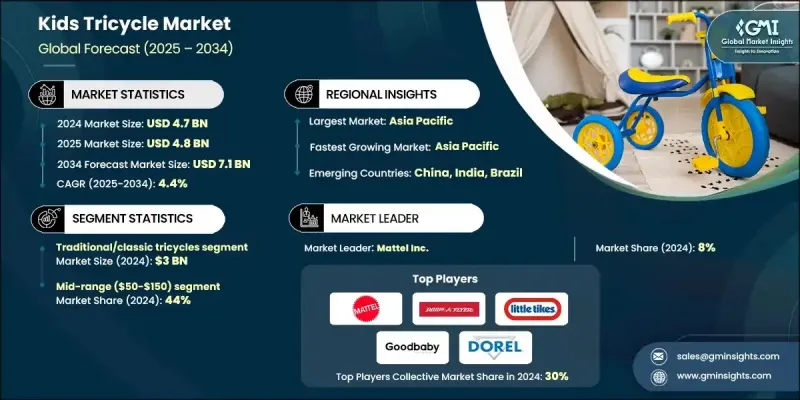
随着家长们越来越重视兼具趣味性、安全性和促进儿童发展的产品,并将三轮车视为支持孩子户外玩耍、减少萤幕依赖的有效途径,三轮车市场正在改变。越来越多的家庭将三轮车视为培养孩子早期运动技能和独立性的工具,而不仅仅是简单的娱乐用品。这种观念的转变正在重塑消费者的购买决策,在那些重新重视积极健康的儿童生活方式的市场中,三轮车的需求也不断增长。消费者对经久耐用、多功能设计和永续材料的日益关注,正促使製造商不断创新,重新思考传统的三轮车结构。这种对耐用性、灵活性和环保生产的追求,凸显了消费者期望的更广泛变化,而这种变化正持续影响整个产业的研发策略。
| 市场范围 | |
|---|---|
| 起始年份 | 2024 |
| 预测年份 | 2025-2034 |
| 起始值 | 47亿美元 |
| 预测值 | 71亿美元 |
| 复合年增长率 | 4.4% |
2024年,传统三轮车市场规模预计将达到30亿美元,主要得益于其价格亲民、结构坚固耐用以及广泛的市场覆盖范围。其结构简单、维护成本低,深受寻求可靠幼儿产品的家长青睐。强大的品牌影响力以及完善的销售管道也帮助其持续保持市场领先地位,吸引那些偏好可靠、易用且操作简单的车型的消费者。
中阶价位产品(价格介于 50 美元至 150 美元之间)在 2024 年占据了 44% 的市场份额。这款价位的产品以其价格、耐用性、实用安全功能和美观设计的平衡,吸引了中等收入家庭。中阶机型在实体店和线上零售通路的同步销售,显着提升了其市场接受度,使其在不同地区广受欢迎。
美国儿童三轮车市场占82%的市场份额,预计2024年市场规模将达到9.9亿美元。浓厚的户外运动文化和较高的家庭购买力巩固了美国的市场主导地位。广泛的零售网路和高度发展的电子商务生态系统使家长能够更便捷地购买到各种三轮车,进一步推动了美国市场的成长。
儿童三轮车市场的主要参与者包括Smoby Toys、TOMY Company Ltd.、好孩子国际控股有限公司、Coby Haus、美泰公司、People Co., Ltd.、Kettler、Radio Flyer Inc.、Little Tikes、Dorel Industries、Toyshine、广东洛帕尔科技有限公司、Alpha Group、Globber Tikes、Dorel Industries、Toyshine、广东洛帕尔科技有限公司、Alpha Group、Globber和中山。为了巩固市场地位,儿童三轮车市场的企业专注于多项策略性措施。许多製造商正在拓展产品线,采用模组化、可转换和符合人体工学的设计,以吸引追求长期价值的家长。对安全性的提升和高品质材料的投入有助于增强品牌信任度,并满足不断变化的消费者标准。企业越来越多地采用环保的生产方式,以符合永续发展的预期。行销策略强调与生活方式的契合,而与零售商的合作以及拓展电子商务业务则扩大了市场覆盖范围。
目录
第一章:方法论与范围
第二章:执行概要
第三章:行业洞察
- 产业生态系分析
- 供应商格局
- 利润率
- 每个阶段的价值增加
- 影响价值链的因素
- 产业影响因素
- 成长驱动因素
- 人们越来越关注儿童健康和户外活动
- 都市化进程加速和可支配所得增加
- 产品创新与安全特性
- 产业陷阱与挑战
- 其他骑乘玩具的竞争
- 季节性需求和有限的使用
- 机会
- 环保永续材料
- 智慧功能和客製化的集成
- 成长驱动因素
- 成长潜力分析
- 主要市场趋势和颠覆性因素
- 未来市场趋势
- 差距分析
- 风险及缓解分析
- 消费者行为分析
- 购买模式
- 偏好分析
- 消费者行为的区域差异
- 电子商务对购买决策的影响
- 技术与创新格局
- 当前技术趋势
- 新兴技术
- 价格趋势
- 按地区
- 依产品类型
- 监管环境
- 北美洲
- 欧洲
- 亚太
- 中东和非洲
- 拉丁美洲
- 波特的分析
- PESTEL 分析
第四章:竞争格局
- 介绍
- 公司市占率分析
- 按地区
- 公司矩阵分析
- 主要市场参与者的竞争分析
- 竞争定位矩阵
- 关键进展
- 併购
- 合作伙伴关係与合作
- 新产品发布
- 扩张计划
第五章:市场估算与预测:依产品划分,2021-2034年
- 主要趋势
- 传统/经典三轮车
- 推式三轮车(家长监护)
- 可转换/模组化三轮车
- 电动/智慧三轮车
第六章:市场估计与预测:依年龄划分,2021-2034年
- 主要趋势
- 幼儿(12-24个月)
- 学龄前儿童(2-4岁)
- 幼儿期(5-6岁)
第七章:市场估计与预测:依价格区间划分,2021-2034年
- 主要趋势
- 经济型(<50美元)
- 中檔(50-150美元)
- 高级版(>150美元)
第八章:市场估算与预测:依配销通路划分,2021-2034年
- 主要趋势
- 按配销通路
- 玩具专卖店
- 百货公司/大型超市
- 线上零售
- 直销/批发
第九章:市场估计与预测:依地区划分,2021-2034年
- 主要趋势
- 北美洲
- 我们
- 加拿大
- 欧洲
- 德国
- 英国
- 法国
- 义大利
- 西班牙
- 土耳其
- 亚太地区
- 中国
- 日本
- 印度
- 澳洲
- 韩国
- 拉丁美洲
- 巴西
- 墨西哥
- 阿根廷
- 中东和非洲
- 南非
- 沙乌地阿拉伯
- 阿联酋
第十章:公司简介
- Mattel Inc.
- Kettler
- Radio Flyer Inc.
- Smoby Toys
- Little Tikes
- Dorel Industries
- Goodbaby International Holdings Ltd.
- Alpha Group
- Guangdong Lopal Tech Co., Ltd.
- Zhongshan Baobaohao Industrial Co., Ltd.
- TOMY Company Ltd.
- People Co., Ltd.
- Coby Haus
- Toyshine
The Global Kids Tricycle Market was valued at USD 4.7 billion in 2024 and is estimated to grow at a CAGR of 4.4% to reach USD 7.1 billion by 2034.
The category is transforming as parents prioritize products that blend enjoyment, safety, and developmental benefits, seeing tricycles as an opportunity to support outdoor play and reduce screen dependence. Families increasingly view these products as tools that nurture early mobility skills and foster independence rather than simple recreational items. This shift in mindset is reshaping purchase decisions, with demand strengthening across markets where active, healthy childhood routines are gaining renewed importance. Rising interest in long-lasting, multifunctional designs and sustainable materials is driving manufacturers to innovate and rethink traditional tricycle construction. The move toward durability, flexibility, and environmentally conscious production underscores a broader change in consumer expectations that continues to shape product development strategies across the sector.
| Market Scope | |
|---|---|
| Start Year | 2024 |
| Forecast Year | 2025-2034 |
| Start Value | $4.7 Billion |
| Forecast Value | $7.1 Billion |
| CAGR | 4.4% |
The traditional tricycles segment generated USD 3 billion in 2024, supported by their affordability, sturdy build, and widespread accessibility. Their straightforward construction and minimal maintenance requirements make them appealing to parents seeking dependable products for toddlers. Strong brand presence and established distribution channels contribute to their continued leadership, appealing to consumers who prefer reliable, user-friendly models without added complexity.
The mid-range segment, priced between USD 50 and USD 150, accounted for a 44% share in 2024. This tier attracts middle-income households by balancing cost with durability, practical safety features, and visually appealing designs. The availability of mid-range models across both in-store and online retail channels significantly enhances their adoption, contributing to their popularity in diverse regions.
United States Kids Tricycle Market held an 82% share and generated USD 990 million in 2024. A strong culture of outdoor play and high household purchasing power reinforce the country's dominant position. Broad retail networks and a highly developed e-commerce ecosystem make it easier for parents to access a wide selection of tricycles, further supporting national market growth.
Key companies active in the Kids Tricycle Market include Smoby Toys, TOMY Company Ltd., Goodbaby International Holdings Ltd., Coby Haus, Mattel Inc., People Co., Ltd., Kettler, Radio Flyer Inc., Little Tikes, Dorel Industries, Toyshine, Guangdong Lopal Tech Co., Ltd., Alpha Group, Globber, and Zhongshan Baobaohao Industrial Co., Ltd. To strengthen their foothold, companies in the Kids Tricycle Market focus on multiple strategic initiatives. Many manufacturers are expanding product lines with modular, convertible, and ergonomic designs that appeal to parents seeking long-term value. Investments in safety enhancements and high-quality materials help reinforce brand trust and meet evolving consumer standards. Firms increasingly adopt eco-friendly production practices to align with sustainability expectations. Marketing strategies emphasize lifestyle alignment, while collaborations with retailers and expanded e-commerce operations broaden market reach.
Table of Contents
Chapter 1 Methodology and Scope
- 1.1 Market scope and definition
- 1.2 Research design
- 1.2.1 Research approach
- 1.2.2 Data collection methods
- 1.3 Data mining sources
- 1.3.1 Global
- 1.3.2 Regional/Country
- 1.4 Base estimates and calculations
- 1.4.1 Base year calculation
- 1.4.2 Key trends for market estimation
- 1.5 Primary research and validation
- 1.5.1 Primary sources
- 1.6 Forecast model
- 1.7 Research assumptions and limitations
Chapter 2 Executive Summary
- 2.1 Industry 360° synopsis
- 2.2 Key market trends
- 2.2.1 Regional
- 2.2.2 Product
- 2.2.3 Age
- 2.2.4 Price Range
- 2.2.5 Distribution channel
- 2.3 CXO perspectives: Strategic imperatives
- 2.3.1 Key decision points for industry executives
- 2.3.2 Critical success factors for market players
- 2.4 Future outlook and strategic recommendations
Chapter 3 Industry Insights
- 3.1 Industry ecosystem analysis
- 3.1.1 Supplier landscape
- 3.1.2 Profit margin
- 3.1.3 Value addition at each stage
- 3.1.4 Factor affecting the value chain
- 3.2 Industry impact forces
- 3.2.1 Growth drivers
- 3.2.1.1 Rising focus on child health and outdoor activities
- 3.2.1.2 Growing urbanization and disposable income
- 3.2.1.3 Product innovation and safety features
- 3.2.2 Industry pitfalls & challenges
- 3.2.2.1 Competition from alternative ride-on toys
- 3.2.2.2 Seasonal demand and limited usage
- 3.2.3 Opportunities
- 3.2.3.1 Eco-friendly and sustainable materials
- 3.2.3.2 Integration of smart features and customization
- 3.2.1 Growth drivers
- 3.3 Growth potential analysis
- 3.4 Major market trends and disruptions
- 3.5 Future market trends
- 3.6 Gap Analysis
- 3.7 Risk and mitigation analysis
- 3.8 Consumer behaviour analysis
- 3.8.1 Purchasing patterns
- 3.8.2 Preference analysis
- 3.8.3 Regional variations in consumer behavior
- 3.8.4 Impact of e-commerce on buying decisions
- 3.9 Technology and innovation landscape
- 3.9.1 Current technological trends
- 3.9.2 Emerging technologies
- 3.10 Price trends
- 3.10.1 By region
- 3.10.2 By product type
- 3.11 Regulatory landscape
- 3.11.1 North America
- 3.11.2 Europe
- 3.11.3 Asia-Pacific
- 3.11.4 Middle East and Africa
- 3.11.5 Latin America
- 3.12 Porter's analysis
- 3.13 PESTEL analysis
Chapter 4 Competitive Landscape, 2024
- 4.1 Introduction
- 4.2 Company market share analysis
- 4.2.1 By region
- 4.2.1.1 North America
- 4.2.1.2 Europe
- 4.2.1.3 Asia Pacific
- 4.2.1.4 Latin America
- 4.2.1.5 Middle East and Africa
- 4.2.1 By region
- 4.3 Company matrix analysis
- 4.4 Competitive analysis of major market players
- 4.5 Competitive positioning matrix
- 4.6 Key developments
- 4.6.1 Mergers & acquisitions
- 4.6.2 Partnerships & collaborations
- 4.6.3 New product launches
- 4.6.4 Expansion plans
Chapter 5 Market Estimates and Forecast, By Product, 2021 - 2034 (USD Billion) (Thousand Units)
- 5.1 Key trends
- 5.2 Traditional/classic tricycles
- 5.3 Push tricycles (parent-controlled)
- 5.4 Convertible/modular tricycles
- 5.5 Electronic/smart tricycles
Chapter 6 Market Estimates and Forecast, By Age, 2021 - 2034 (USD Billion) (Thousand Units)
- 6.1 Key trends
- 6.2 Toddlers (12-24 months)
- 6.3 Preschoolers (2-4 years)
- 6.4 Early childhood (5-6 years)
Chapter 7 Market Estimates and Forecast, By Price Range, 2021 - 2034 (USD Billion) (Thousand Units)
- 7.1 Key trends
- 7.2 Economy (<$50)
- 7.3 Mid-range ($50-$150)
- 7.4 Premium (>$150)
Chapter 8 Market Estimates and Forecast, By Distribution Channel, 2021 - 2034 (USD Billion) (Thousand Units)
- 8.1 Key trends
- 8.2 By Distribution Channel
- 8.3 Specialty toy stores
- 8.4 Department stores/hypermarkets
- 8.5 Online retail
- 8.6 Direct/wholesale
Chapter 9 Market Estimates and Forecast, By Region, 2021 - 2034 (USD Billion) (Thousand Units)
- 9.1 Key trends
- 9.2 North America
- 9.2.1 U.S.
- 9.2.2 Canada
- 9.3 Europe
- 9.3.1 Germany
- 9.3.2 UK
- 9.3.3 France
- 9.3.4 Italy
- 9.3.5 Spain
- 9.3.6 Turkey
- 9.4 Asia Pacific
- 9.4.1 China
- 9.4.2 Japan
- 9.4.3 India
- 9.4.4 Australia
- 9.4.5 South Korea
- 9.5 Latin America
- 9.5.1 Brazil
- 9.5.2 Mexico
- 9.5.3 Argentina
- 9.6 Middle East and Africa
- 9.6.1 South Africa
- 9.6.2 Saudi Arabia
- 9.6.3 UAE
Chapter 10 Company Profiles
- 10.1 Mattel Inc.
- 10.2 Kettler
- 10.3 Radio Flyer Inc.
- 10.4 Smoby Toys
- 10.5 Little Tikes
- 10.6 Dorel Industries
- 10.7 Goodbaby International Holdings Ltd.
- 10.8 Alpha Group
- 10.9 Guangdong Lopal Tech Co., Ltd.
- 10.10 Zhongshan Baobaohao Industrial Co., Ltd.
- 10.11 TOMY Company Ltd.
- 10.12 People Co., Ltd.
- 10.13 Coby Haus
- 10.14 Toyshine

