


 |
市场调查报告书
商品编码
1885912
老年护理服务市场机会、成长驱动因素、产业趋势分析及预测(2025-2034年)Geriatric Care Services Market Opportunity, Growth Drivers, Industry Trend Analysis, and Forecast 2025 - 2034 |
||||||

2024 年全球老年护理服务市场价值为 1.3 兆美元,预计到 2034 年将以 5.1% 的复合年增长率增长至 2.1 兆美元。
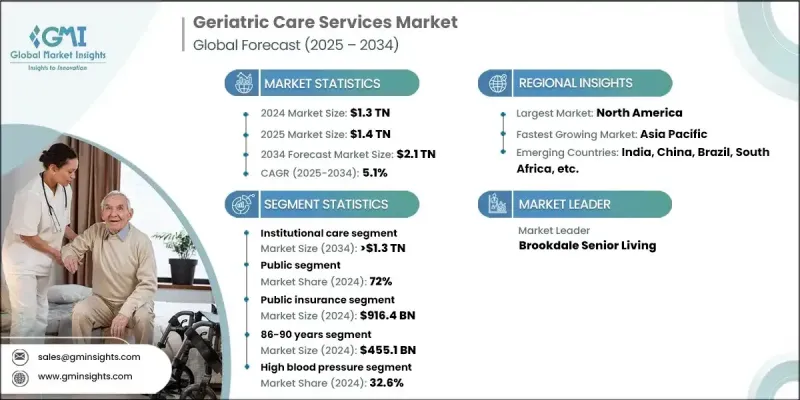
市场扩张的驱动因素包括老年人口的成长、有利的报销政策、慢性病盛行率的上升以及政府和社会对老年照护意识的增强。老年人由于患有糖尿病、心血管疾病、失智症和关节炎等多种疾病,往往需要持续的医疗监测、日常生活协助和专业照护。人口老化的趋势促使人们投资于个人化医疗、远距医疗和居家照护解决方案,从而在降低患者对医院依赖性的同时,改善患者的治疗效果。老化程度较高的国家加快了先进老年护理服务的普及,包括技术赋能的健康监测、整合式照护模式和人工智慧支援的解决方案,为市场长期成长创造了机会。
| 市场范围 | |
|---|---|
| 起始年份 | 2024 |
| 预测年份 | 2025-2034 |
| 起始值 | 1.3兆美元 |
| 预测值 | 2.1兆美元 |
| 复合年增长率 | 5.1% |
2024年,机构照护领域占了63.1%的市占率。机构照顾包括疗养院、辅助生活设施、医院和长期照护中心,为老年人提供全面的医疗和个人照顾服务。这些机构服务于患有慢性疾病或需要持续照顾的老年患者,提供专业的护理、復健和社交活动项目。机构照顾确保行动不便或健康状况不佳的患者能够获得结构化的日常安排、安全保障和专业级别的医疗保健服务,使其成为市场的重要组成部分。
2024年,公共医疗服务占比将达到72%。公共医疗服务机构包括政府资助的医院、社区健康中心和社会福利项目,为老年人提供价格合理或补贴的医疗服务。这些机构提高了私人医疗服务覆盖范围有限的地区的医疗可近性,提供护理、预防保健和復健等服务。公共老年医疗服务也符合国家医疗保健政策,旨在改善老年人的福祉,尤其是在低收入或医疗服务不足的社区。
预计到2024年,北美老年护理服务市占率将达到42.8%。该地区受益于高度发展的医疗保健体系、政府计画提供的广泛保险覆盖以及远距医疗和居家护理服务的普及。糖尿病和心血管疾病等慢性病发生率的上升,增加了对综合照护模式的需求。此外,远端监测、基于人工智慧的健康管理以及技术驱动的干预措施正被整合到老年护理计画中,从而推动了市场需求和服务的普及。
全球老年护理服务市场的主要参与者包括Atria Senior Living、Active Day、Brookdale Senior Living、Sunrise Senior Living、DIVERSICARE、Genesis、Kindred Hospitals、Home Instead、Ensign Group、Extendicare Inc.、Life Care Centers of America、Capital Health Care Network、Gentiva、Samvedna Care、ANTI、LHealth Centers of America、Stoneal Health Care Network Network、Gentiva、Samvedna Care、ANTI LHealth Centers of America、Stoneal Health Care Network。这些公司正采取多种策略来巩固其市场地位。他们专注于透过开设新机构和与当地医疗保健网络合作来扩大地域覆盖范围。投资于技术赋能型护理,例如远距医疗、远端监控和人工智慧驱动的患者管理系统,是提高服务品质和效率的关键途径。此外,各公司也强调针对慢性病管理和復原的专项项目,以吸引更广泛的老年人群。
目录
第一章:方法论与范围
第二章:执行概要
第三章:行业洞察
- 产业生态系分析
- 产业影响因素
- 成长驱动因素
- 老年人口增长
- 慢性病盛行率不断上升
- 针对老年族群的优惠报销政策
- 人们对老年照护的认识不断提高,政府投入也日益增加。
- 向整合式和个人化医疗模式转变
- 产业陷阱与挑战
- 发展中国家老年护理服务成本高昂
- 新兴市场保险普及率低,且训练有素的专业人员短缺
- 机会
- 远距医疗和远端监控解决方案的日益普及
- 扩大居家医疗保健和居家养老策略
- 日益重视老年族群的预防性医疗保健
- 成长驱动因素
- 成长潜力分析
- 监管环境
- 北美洲
- 欧洲
- 亚太地区
- 技术与创新格局
- 当前技术趋势
- 新兴技术
- 投资环境
- 报销方案
- 北美洲
- 欧洲
- 亚太地区
- 医疗服务模式转型
- 劳动力挑战和培训计划
- 消费者行为分析
- 社区照顾模式的作用
- 政策展望
- 波特的分析
- PESTEL 分析
- 差距分析
- 未来市场趋势
第四章:竞争格局
- 介绍
- 公司矩阵分析
- 公司市占率分析
- 主要市场参与者的竞争分析
- 竞争定位矩阵
- 关键进展
- 併购
- 合作伙伴关係与合作
- 新产品发布
- 扩张计划
第五章:市场估算与预测:依服务类型划分,2021-2034年
- 主要趋势
- 机构照护
- 养老院
- 医院
- 辅助生活
- 独立式老年生活
- 居家照护
- 成人日托
第六章:市场估算与预测:依服务提供者划分,2021-2034年
- 主要趋势
- 民众
- 私人的
第七章:市场估计与预测:依支付方式划分,2021-2034年
- 主要趋势
- 公共保险
- 私人保险
- 自费
- 其他支付方式
第八章:市场估算与预测:依年龄组别划分,2021-2034年
- 主要趋势
- 65-70岁
- 71-75岁
- 76-80岁
- 81-85岁
- 86-90岁
- 91岁以上
第九章:市场估计与预测:依应用领域划分,2021-2034年
- 主要趋势
- 高血压
- 阿兹海默症/痴呆症
- 沮丧
- 糖尿病
- 其他应用
第十章:市场估计与预测:依地区划分,2021-2034年
- 主要趋势
- 北美洲
- 我们
- 加拿大
- 欧洲
- 德国
- 英国
- 法国
- 西班牙
- 义大利
- 荷兰
- 亚太地区
- 中国
- 日本
- 印度
- 澳洲
- 韩国
- 拉丁美洲
- 巴西
- 墨西哥
- 阿根廷
- MEA
- 南非
- 沙乌地阿拉伯
- 阿联酋
第十一章:公司简介
- Active Day
- Amedisys
- ANTARA
- Atria Senior Living
- Brookdale Senior Living
- Capital Health Care Network
- DIVERSICARE
- Ensign Group
- Extendicare Inc.
- Genesis
- Gentiva
- Home Instead
- Kindred Hospitals
- KITES
- Life Care Centers of America
- Samvedna Care
- ScionHealth
- St Luke's ELDERCARE
- Sunrise Senior Living
The Global Geriatric Care Services Market was valued at USD 1.3 trillion in 2024 and is estimated to grow at a CAGR of 5.1% to reach USD 2.1 trillion by 2034.
The expansion of the market is driven by the rising elderly population, favorable reimbursement policies, increasing prevalence of chronic diseases, and growing government and societal awareness about senior care. Older adults often require ongoing medical monitoring, assistance with daily living activities, and specialized nursing care due to multiple health conditions such as diabetes, cardiovascular disorders, dementia, and arthritis. The demographic shift toward aging populations has prompted investments in personalized healthcare, telemedicine, and home-based care solutions, reducing hospital dependency while improving patient outcomes. Countries with significant aging populations have accelerated the adoption of advanced geriatric care services, including technologically enabled health monitoring, integrated care models, and AI-supported solutions, creating long-term opportunities for market growth.
| Market Scope | |
|---|---|
| Start Year | 2024 |
| Forecast Year | 2025-2034 |
| Start Value | $1.3 Trillion |
| Forecast Value | $2.1 Trillion |
| CAGR | 5.1% |
The institutional care segment held a 63.1% share in 2024. Institutional care includes nursing homes, assisted living facilities, hospitals, and long-term care centers that provide comprehensive medical and personal assistance for seniors. These facilities cater to elderly patients with chronic conditions or those requiring continuous supervision, offering skilled nursing, rehabilitation, and social engagement programs. Institutional care ensures structured routines, safety, and access to professional-level healthcare for patients with severe mobility or health challenges, making it a critical component of the market.
The public segment accounted for a 72% share in 2024. Public providers encompass government-funded hospitals, community health centers, and social welfare programs, delivering affordable or subsidized care to older adults. These providers enhance accessibility in regions with limited private healthcare engagement, offering services such as nursing, preventive care, and rehabilitation. Public geriatric services also align with national healthcare policies focused on improving senior well-being, especially in low-income or underserved communities.
North America Geriatric Care Services Market held a 42.8% share in 2024. The region benefits from a highly developed healthcare system, extensive insurance coverage through government programs, and widespread adoption of telehealth and home care services. Rising incidences of chronic illnesses such as diabetes and cardiovascular diseases are increasing the need for integrated care models. Additionally, remote monitoring, AI-based health management, and technology-driven interventions are being integrated into geriatric care programs, driving demand and adoption.
Key players in the Global Geriatric Care Services Market include Atria Senior Living, Active Day, Brookdale Senior Living, Sunrise Senior Living, DIVERSICARE, Genesis, Kindred Hospitals, Home Instead, Ensign Group, Extendicare Inc., Life Care Centers of America, Capital Health Care Network, Gentiva, Samvedna Care, ANTARA, ScionHealth, KITES, and St Luke's ELDERCARE. Companies operating in the Geriatric Care Services Market are adopting multiple strategies to strengthen their market presence. They focus on expanding geographic reach by opening new facilities and partnering with local healthcare networks. Investment in technology-enabled care, such as telemedicine, remote monitoring, and AI-driven patient management systems, is a key approach to improving service quality and efficiency. Firms are also emphasizing specialized programs for chronic disease management and rehabilitation to attract a broader elderly population.
Table of Contents
Chapter 1 Methodology and Scope
- 1.1 Market scope and definition
- 1.2 Research design
- 1.2.1 Research approach
- 1.2.2 Data collection methods
- 1.3 Data mining sources
- 1.3.1 Global
- 1.3.2 Regional/Country
- 1.4 Base estimates and calculations
- 1.4.1 Base year calculation
- 1.4.2 Key trends for market estimation
- 1.5 Primary research and validation
- 1.5.1 Primary sources
- 1.6 Forecast model
- 1.7 Research assumptions and limitations
Chapter 2 Executive Summary
- 2.1 Industry 3600 synopsis
- 2.2 Key market trends
- 2.2.1 Regional trends
- 2.2.2 Service trends
- 2.2.3 Service provider trends
- 2.2.4 Payment source trends
- 2.2.5 Age group trends
- 2.2.6 Application trends
- 2.3 CXO perspectives: Strategic imperatives
- 2.3.1 Key decision points for industry executives
- 2.3.2 Critical success factors for market players
- 2.4 Future outlook and strategic recommendations
Chapter 3 Industry Insights
- 3.1 Industry ecosystem analysis
- 3.2 Industry impact forces
- 3.2.1 Growth drivers
- 3.2.1.1 Rise in geriatric population
- 3.2.1.2 Increasing prevalence of chronic diseases
- 3.2.1.3 Favorable reimbursement policies for geriatric population
- 3.2.1.4 Rising awareness and government funding for elderly care
- 3.2.1.5 Shift toward integrated and personalized care models
- 3.2.2 Industry pitfalls and challenges
- 3.2.2.1 High cost associated with geriatric care services in developing nations
- 3.2.2.2 Limited insurance penetration and shortage of trained professionals in emerging markets
- 3.2.3 Opportunities
- 3.2.3.1 Growing adoption of telehealth and remote monitoring solutions
- 3.2.3.2 Expansion of home healthcare and aging-in-place strategies
- 3.2.3.3 Increasing focus on preventive healthcare for aging populations
- 3.2.1 Growth drivers
- 3.3 Growth potential analysis
- 3.4 Regulatory landscape
- 3.4.1 North America
- 3.4.2 Europe
- 3.4.3 Asia Pacific
- 3.5 Technology and innovation landscape
- 3.5.1 Current technological trends
- 3.5.2 Emerging technologies
- 3.6 Investment landscape
- 3.7 Reimbursement scenario
- 3.7.1 North America
- 3.7.2 Europe
- 3.7.3 Asia Pacific
- 3.8 Healthcare delivery model transformation
- 3.9 Workforce challenges and training programs
- 3.10 Consumer behavior analysis
- 3.11 Role of community-based care models
- 3.12 Policy outlook
- 3.13 Porter's analysis
- 3.14 PESTEL analysis
- 3.15 Gap analysis
- 3.16 Future market trends
Chapter 4 Competitive Landscape, 2024
- 4.1 Introduction
- 4.2 Company matrix analysis
- 4.3 Company market share analysis
- 4.4 Competitive analysis of major market players
- 4.5 Competitive positioning matrix
- 4.6 Key developments
- 4.6.1 Mergers & acquisitions
- 4.6.2 Partnerships & collaborations
- 4.6.3 New product launches
- 4.6.4 Expansion plans
Chapter 5 Market Estimates and Forecast, By Service, 2021 - 2034 ($ Mn)
- 5.1 Key trends
- 5.2 Institutional care
- 5.2.1 Nursing homes
- 5.2.2 Hospitals
- 5.2.3 Assisted living
- 5.2.4 Independent senior living
- 5.3 Homecare
- 5.4 Adult day care
Chapter 6 Market Estimates and Forecast, By Service Provider, 2021 - 2034 ($ Mn)
- 6.1 Key trends
- 6.2 Public
- 6.3 Private
Chapter 7 Market Estimates and Forecast, By Payment Source, 2021 - 2034 ($ Mn)
- 7.1 Key trends
- 7.2 Public insurance
- 7.3 Private insurance
- 7.4 Out-of-pocket
- 7.5 Other payment sources
Chapter 8 Market Estimates and Forecast, By Age Group, 2021 - 2034 ($ Mn)
- 8.1 Key trends
- 8.2 65-70 years
- 8.3 71-75 years
- 8.4 76-80 years
- 8.5 81-85 years
- 8.6 86-90 years
- 8.7 Above 91 years
Chapter 9 Market Estimates and Forecast, By Application, 2021 - 2034 ($ Mn)
- 9.1 Key trends
- 9.2 High blood pressure
- 9.3 Alzheimer's/Dementias
- 9.4 Depression
- 9.5 Diabetes
- 9.6 Other applications
Chapter 10 Market Estimates and Forecast, By Region, 2021 - 2034 ($ Mn)
- 10.1 Key trends
- 10.2 North America
- 10.2.1 U.S.
- 10.2.2 Canada
- 10.3 Europe
- 10.3.1 Germany
- 10.3.2 UK
- 10.3.3 France
- 10.3.4 Spain
- 10.3.5 Italy
- 10.3.6 Netherlands
- 10.4 Asia Pacific
- 10.4.1 China
- 10.4.2 Japan
- 10.4.3 India
- 10.4.4 Australia
- 10.4.5 South Korea
- 10.5 Latin America
- 10.5.1 Brazil
- 10.5.2 Mexico
- 10.5.3 Argentina
- 10.6 MEA
- 10.6.1 South Africa
- 10.6.2 Saudi Arabia
- 10.6.3 UAE
Chapter 11 Company Profiles
- 11.1 Active Day
- 11.2 Amedisys
- 11.3 ANTARA
- 11.4 Atria Senior Living
- 11.5 Brookdale Senior Living
- 11.6 Capital Health Care Network
- 11.7 DIVERSICARE
- 11.8 Ensign Group
- 11.9 Extendicare Inc.
- 11.10 Genesis
- 11.11 Gentiva
- 11.12 Home Instead
- 11.13 Kindred Hospitals
- 11.14 KITES
- 11.15 Life Care Centers of America
- 11.16 Samvedna Care
- 11.17 ScionHealth
- 11.18 St Luke’s ELDERCARE
- 11.19 Sunrise Senior Living

 全球老年医疗服务市场规模、份额、趋势和成长分析报告(2026-2034年)
 日本老年人机能性食品市场规模、份额、趋势及预测:按产品类型、形态、健康功效、分销管道和地区划分(2026-2034 年)日本老年护理产品市场规模、份额、趋势和预测:按产品、应用、最终用户和地区划分,2026-2034年
 2026年全球倾斜式无障碍电梯市场报告
 老年护理服务市场-全球产业规模、份额、趋势、机会与预测:按服务、地区和竞争格局划分,2021-2031年老年护理设备市场-全球产业规模、份额、趋势、机会及预测(依产品、最终用户、地区及竞争格局划分,2021-2031年)
 老年护理服务市场:按服务类型和地区划分
 全球老年人卫生用品市场(按产品类型、失禁类型、分销管道和最终用户划分)预测(2026-2032年)无障碍平台升降机市场按类型、安装方式、驱动机构、负载容量和应用划分-2026年至2032年全球预测
 老年住宅服务市场规模、份额和成长分析(按服务类型、机构规模、应用、解决方案、最终用户和地区划分)-2026-2033年产业预测