


 |
市场调查报告书
商品编码
1892656
量子纠错材料市场机会、成长驱动因素、产业趋势分析及预测(2025-2034年)Quantum Error Correction Materials Market Opportunity, Growth Drivers, Industry Trend Analysis, and Forecast 2025 - 2034 |
||||||

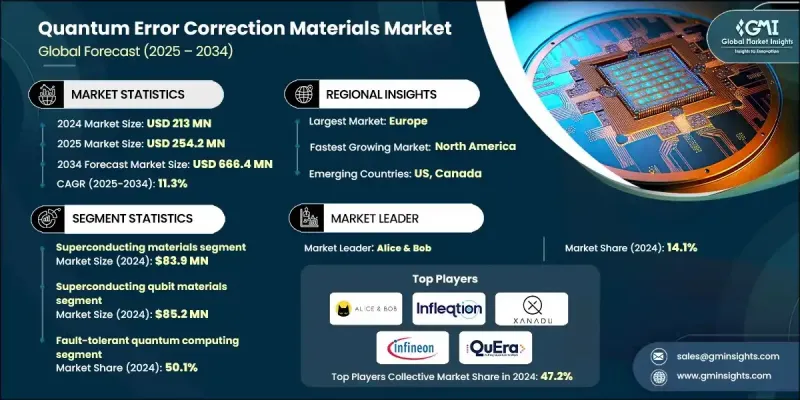
2024 年全球量子纠错材料市场价值为 2.13 亿美元,预计到 2034 年将以 11.3% 的复合年增长率增长至 6.664 亿美元。
量子纠错(QEC)材料旨在保护量子资讯免受杂讯、退相干和操作缺陷的影响,这些因素都会影响量子系统的性能。这些材料构成了量子位元及其相关组件的基础,因为它们必须维持较长的相干时间,提供稳定的量子操作,并支援容错架构所需的演算法。该领域正从小型演示向更大规模、更稳健的量子计算系统过渡,这增加了对能够在较长时间内保持量子位元功能的高级材料的需求。新近改良的QEC材料,包括改良的超导薄膜、高纯度半导体结构和新兴的拓朴材料,不断提高稳定性并降低错误率。它们的进步使得新一代量子装置能够处理比早期原型更复杂的计算任务,从而加速转向能够可靠地执行曾经被认为无法实现的操作的系统。这些进展凸显了QEC材料在量子计算走向更广泛的商业和科学应用过程中所扮演的关键角色。
| 市场范围 | |
|---|---|
| 起始年份 | 2024 |
| 预测年份 | 2025-2034 |
| 起始值 | 2.13亿美元 |
| 预测值 | 6.664亿美元 |
| 复合年增长率 | 11.3% |
2024年,超导材料市场规模达8,390万美元。推动市场成长的因素包括支援量子位元功能的创新材料,其中超导材料正不断优化,以降低能量损耗并提高纯度,从而保持强相干性并支援高阈值量子纠错设计。基于半导体的量子材料采用同位素精炼的硅和先进的异质结构,以降低自旋和电荷相关的噪声,从而提高量子位元行为的可预测性。具有色心结构的钻石基材料在结构控制和光学一致性方面不断取得进步,进一步巩固了其在混合量子纠错和光子使能量子纠错应用中的地位。
到2024年,容错量子运算领域将占据50.1%的市场。对高可靠性运作的需求提升了对能够支援更深层量子电路且不会累积有害误差的材料的需求。量子模拟和专门的材料科学工作负载也高度依赖量子运算,以提供对分子和特殊系统稳定、详细的洞察,这些系统需要相当高的运行深度和精确度。
2024年,美国量子纠错材料市场规模达7,900万美元。北美仍然是全球发展的关键枢纽,其中美国凭藉着许多研究机构、新创公司和科技公司在量子硬体规模化方面的广泛参与,引领着这一领域的发展。区域性措施着重于超导和离子阱平台,而大学和国家实验室则致力于推进长期容错设计的研发。加拿大则透过对光子架构和硅基自旋量子位元的研究,为持续创新做出贡献。
目录
第一章:方法论与范围
第二章:执行概要
第三章:行业洞察
- 产业生态系分析
- 供应商格局
- 利润率
- 每个阶段的价值增加
- 影响价值链的因素
- 中断
- 产业影响因素
- 成长驱动因素
- 对容错量子运算的需求
- 先进量子位元材料
- 材料工程创新
- 产业陷阱与挑战
- 扩展和整合方面的挑战
- 对辐射和杂散讯号高度敏感
- 市场机会
- 材料驱动的量子网络
- 推动新型量子应用
- 支持混合经典-量子系统
- 成长驱动因素
- 成长潜力分析
- 监管环境
- 北美洲
- 欧洲
- 亚太地区
- 拉丁美洲
- 中东和非洲
- 波特的分析
- PESTEL 分析
- 技术与创新格局
- 当前技术趋势
- 新兴技术
- 价格趋势
- 按地区
- 依材料类型
- 未来市场趋势
- 专利格局
- 贸易统计(HS编码)(註:仅提供重点国家的贸易统计资料)
- 主要进口国
- 主要出口国
- 永续性和环境方面
- 永续实践
- 减少废弃物策略
- 生产中的能源效率
- 环保倡议
- 碳足迹考量
第四章:竞争格局
- 介绍
- 公司市占率分析
- 按地区
- 北美洲
- 欧洲
- 亚太地区
- 拉丁美洲
- MEA
- 按地区
- 公司矩阵分析
- 主要市场参与者的竞争分析
- 竞争定位矩阵
- 关键进展
- 併购
- 合作伙伴关係与合作
- 新产品发布
- 扩张计划
第五章:市场估算与预测:依材料类型划分,2021-2034年
- 超导材料
- 半导体量子材料
- 钻石和彩色中心材料
- 基板和介电材料
- 封装和保护材料
第六章:市场估算与预测:基于量子位元平台,2021-2034年
- 超导量子位元材料
- 囚禁离子量子位元材料
- 中性原子量子位元材料
- 猫量子位元材料
- 光子量子位元材料
- 自旋量子位元材料(硅和碳化硅)
- 拓朴量子位元材料
第七章:市场估计与预测:依应用领域划分,2021-2034年
- 容错量子运算
- 量子模拟与材料科学
- 量子密码学
- 量子增强型人工智慧和最佳化
第八章:市场估算与预测:依地区划分,2021-2034年
- 北美洲
- 我们
- 加拿大
- 墨西哥
- 欧洲
- 德国
- 英国
- 法国
- 西班牙
- 义大利
- 欧洲其他地区
- 亚太地区
- 中国
- 印度
- 日本
- 澳洲
- 韩国
- 亚太其他地区
- 拉丁美洲
- 巴西
- 墨西哥
- 阿根廷
- 拉丁美洲其他地区
- 中东和非洲
- 沙乌地阿拉伯
- 南非
- 阿联酋
- 中东和非洲其他地区
第九章:公司简介
- Element Six
- IQM
- Alice & Bob
- SpinQ
- Infineon Technologies
- Oxford Instruments
- Atom Computing
- QuEra Computing
- Xanadu
- PsiQuantum
- Infleqtion
The Global Quantum Error Correction Materials Market was valued at USD 213 million in 2024 and is estimated to grow at a CAGR of 11.3% to reach USD 666.4 million by 2034.
Quantum error correction (QEC) materials are engineered to safeguard quantum information from noise, decoherence, and operational imperfections that impact the performance of quantum systems. These materials form the foundation of qubits and associated components, as they must sustain long coherence times, deliver stable quantum operations, and support the algorithms needed for fault-tolerant architectures. The field is transitioning from small-scale demonstrations to larger, more robust quantum computing systems, increasing demand for advanced materials that maintain qubit functionality over extended timeframes. Newly refined QEC materials, including improved superconducting films, high-purity semiconductor structures, and emerging topological materials, continue to elevate stability and reduce error rates. Their advancement is enabling generations of quantum devices capable of handling more complex computational tasks than earlier prototypes, helping accelerate the shift toward systems that can reliably perform operations once considered unattainable. These developments highlight the critical role of QEC materials as quantum computing moves toward broader commercial and scientific relevance.
| Market Scope | |
|---|---|
| Start Year | 2024 |
| Forecast Year | 2025-2034 |
| Start Value | $213 Million |
| Forecast Value | $666.4 Million |
| CAGR | 11.3% |
The superconducting materials segment generated USD 83.9 million in 2024. Market growth is being shaped by innovations in materials that support qubit function, with superconducting options increasingly optimized for reduced energy loss and enhanced purity to maintain strong coherence and support high-threshold quantum error-correcting designs. Semiconductor-based quantum materials incorporate isotopically refined silicon and advanced heterostructures to reduce both spin and charge-related noise, contributing to more predictable qubit behavior. Diamond-based materials with color-center configurations are achieving improvements in structural control and optical consistency, further reinforcing their position in hybrid and photon-enabled QEC applications.
The fault-tolerant quantum computing segment accounted for a 50.1% share in 2024. Demand for high-reliability operations has elevated the need for materials that can support deeper quantum circuits without accumulating detrimental errors. Quantum simulation and specialized materials-science workloads also rely heavily on QEC to deliver stable, detailed insights into molecular and exotic systems that require substantial operational depth and accuracy.
U.S. Quantum Error Correction Materials Market reached USD 79 million in 2024. North America remains a key hub for global development, with the United States driving momentum through extensive participation from research institutions, startups, and technology companies working to scale quantum hardware. Regional initiatives emphasize superconducting and trapped-ion platforms while universities and national laboratories push forward the development of long-term fault-tolerant designs. Canada contributes to ongoing innovation through research in photonic architectures and silicon-based spin qubits.
Major organizations active in the Global Quantum Error Correction Materials Market include Element Six, IQM, Alice & Bob, SpinQ, Infineon Technologies, Oxford Instruments, Atom Computing, QuEra Computing, Xanadu, PsiQuantum, and Infleqtion. Companies operating in the Quantum Error Correction Materials Market are strengthening their market positions by prioritizing high-purity production methods, advancing cryogenic material performance, and investing in scalable fabrication techniques. Many organizations are forming partnerships with quantum hardware developers to ensure alignment between material design and qubit architecture, enabling more efficient implementation. Firms are also increasing funding for research on low-loss superconductors, refined semiconductor substrates, and stable defect-engineered materials to minimize noise and extend coherence times.
Table of Contents
Chapter 1 Methodology & Scope
- 1.1 Market scope and definition
- 1.2 Research design
- 1.2.1 Research approach
- 1.2.2 Data collection methods
- 1.3 Data mining sources
- 1.3.1 Global
- 1.3.2 Regional/Country
- 1.4 Base estimates and calculations
- 1.4.1 Base year calculation
- 1.4.2 Key trends for market estimation
- 1.5 Primary research and validation
- 1.5.1 Primary sources
- 1.6 Forecast model
- 1.7 Research assumptions and limitations
Chapter 2 Executive Summary
- 2.1 Industry 3600 synopsis
- 2.2 Key market trends
- 2.2.1 Material type
- 2.2.2 Qubit platform
- 2.2.3 Application
- 2.2.4 Regional
- 2.3 TAM Analysis, 2025-2034
- 2.4 CXO perspectives: Strategic imperatives
- 2.4.1 Executive decision points
- 2.4.2 Critical success factors
- 2.5 Future outlook and strategic recommendations
Chapter 3 Industry Insights
- 3.1 Industry ecosystem analysis
- 3.1.1 Supplier landscape
- 3.1.2 Profit margin
- 3.1.3 Value addition at each stage
- 3.1.4 Factor affecting the value chain
- 3.1.5 Disruptions
- 3.2 Industry impact forces
- 3.2.1 Growth drivers
- 3.2.1.1 Demand for fault-tolerant quantum computing
- 3.2.1.2 Advanced qubit materials
- 3.2.1.3 Innovations in material engineering
- 3.2.2 Industry pitfalls and challenges
- 3.2.2.1 Challenges in scaling and integration
- 3.2.2.2 High sensitivity to radiation and stray signals
- 3.2.3 Market opportunities
- 3.2.3.1 Material-driven quantum networking
- 3.2.3.2 Enabling new quantum applications
- 3.2.3.3 Support for hybrid classical-quantum systems
- 3.2.1 Growth drivers
- 3.3 Growth potential analysis
- 3.4 Regulatory landscape
- 3.4.1 North America
- 3.4.2 Europe
- 3.4.3 Asia Pacific
- 3.4.4 Latin America
- 3.4.5 Middle East & Africa
- 3.5 Porter's analysis
- 3.6 PESTEL analysis
- 3.7 Technology and innovation landscape
- 3.7.1 Current technological trends
- 3.7.2 Emerging technologies
- 3.8 Price trends
- 3.8.1 By region
- 3.8.2 By material type
- 3.9 Future market trends
- 3.10 Patent landscape
- 3.11 Trade statistics (HS code) (Note: the trade statistics will be provided for key countries only)
- 3.11.1 Major importing countries
- 3.11.2 Major exporting countries
- 3.12 Sustainability and environmental aspects
- 3.12.1 Sustainable practices
- 3.12.2 Waste reduction strategies
- 3.12.3 Energy efficiency in production
- 3.12.4 Eco-friendly initiatives
- 3.13 Carbon footprint consideration
Chapter 4 Competitive Landscape, 2024
- 4.1 Introduction
- 4.2 Company market share analysis
- 4.2.1 By region
- 4.2.1.1 North America
- 4.2.1.2 Europe
- 4.2.1.3 Asia Pacific
- 4.2.1.4 LATAM
- 4.2.1.5 MEA
- 4.2.1 By region
- 4.3 Company matrix analysis
- 4.4 Competitive analysis of major market players
- 4.5 Competitive positioning matrix
- 4.6 Key developments
- 4.6.1 Mergers & acquisitions
- 4.6.2 Partnerships & collaborations
- 4.6.3 New product launches
- 4.6.4 Expansion plans
Chapter 5 Market Estimates and Forecast, By Material Type, 2021-2034 (USD Million) (Kilo Tons)
- 5.1 Key trends
- 5.2 Superconducting materials
- 5.3 Semiconductor quantum materials
- 5.4 Diamond & color center materials
- 5.5 Substrate & dielectric materials
- 5.6 Encapsulation & protective materials
Chapter 6 Market Estimates and Forecast, By Qubit Platform, 2021-2034 (USD Million) (Kilo Tons)
- 6.1 Key trends
- 6.2 Superconducting qubit materials
- 6.3 Trapped-ion qubit materials
- 6.4 Neutral-atom qubit materials
- 6.5 Cat qubit materials
- 6.6 Photonic qubit materials
- 6.7 Spin qubit materials (silicon & SiC)
- 6.8 Topological qubit materials
Chapter 7 Market Estimates and Forecast, By Application, 2021-2034 (USD Million) (Kilo Tons)
- 7.1 Key trends
- 7.2 Fault-tolerant quantum computing
- 7.3 Quantum simulation and material science
- 7.4 Quantum cryptography
- 7.5 Quantum-enhanced AI and optimization
Chapter 8 Market Estimates and Forecast, By Region, 2021-2034 (USD Million) (Kilo Tons)
- 8.1 Key trends
- 8.2 North America
- 8.2.1 U.S.
- 8.2.2 Canada
- 8.2.3 Mexico
- 8.3 Europe
- 8.3.1 Germany
- 8.3.2 UK
- 8.3.3 France
- 8.3.4 Spain
- 8.3.5 Italy
- 8.3.6 Rest of Europe
- 8.4 Asia Pacific
- 8.4.1 China
- 8.4.2 India
- 8.4.3 Japan
- 8.4.4 Australia
- 8.4.5 South Korea
- 8.4.6 Rest of Asia Pacific
- 8.5 Latin America
- 8.5.1 Brazil
- 8.5.2 Mexico
- 8.5.3 Argentina
- 8.5.4 Rest of Latin America
- 8.6 Middle East and Africa
- 8.6.1 Saudi Arabia
- 8.6.2 South Africa
- 8.6.3 UAE
- 8.6.4 Rest of Middle East and Africa
Chapter 9 Company Profiles
- 9.1 Element Six
- 9.2 IQM
- 9.3 Alice & Bob
- 9.4 SpinQ
- 9.5 Infineon Technologies
- 9.6 Oxford Instruments
- 9.7 Atom Computing
- 9.8 QuEra Computing
- 9.9 Xanadu
- 9.10 PsiQuantum
- 9.11 Infleqtion

 2026年全球播客音讯处理设备市场报告
 数位讯号处理器市场-全球产业规模、份额、趋势、机会、预测:按核心类型、按类型、按最终用户、按地区和竞争对手划分,2021-2031年
 USB数位音讯晶片市场:按通道数、封装、介面、位元深度、取样率、应用和分销管道划分-全球预测,2026-2032年单边带调变器市场按类型、技术类型、应用和最终用户划分,全球预测(2026-2032)数位讯号中继器市场(按最终用户、中继器类型、资料速率、中继器技术和部署类型划分),全球预测(2026-2032年)
 日本数位讯号处理器市场报告(按核心数(单核心、多核心)、最终用户产业(通讯、汽车、消费电子、工业、航太与国防、医疗保健)和地区划分,2026-2034 年)
 数位讯号处理器 (DSP) 市场规模、份额和成长分析(按核心、配置、类型、类别、IC 设计、应用、最终用户产业和地区划分)- 产业预测 (2026-2033)
 DSP(需求端平台):全球市场份额和排名、总收入和需求预测(2025-2031 年)VPX讯号处理平台全球市场报告(2025年)2025年数位讯号处理器全球市场报告