


 |
市场调查报告书
商品编码
1892674
烟草製品市场机会、成长驱动因素、产业趋势分析及预测(2025-2034年)Tobacco Products Market Opportunity, Growth Drivers, Industry Trend Analysis, and Forecast 2025 - 2034 |
||||||

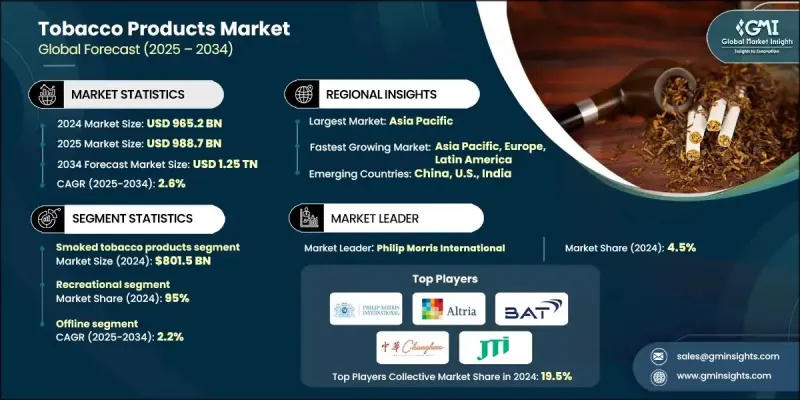
2024 年全球烟草製品市场价值为 9,652 亿美元,预计到 2034 年将以 2.6% 的复合年增长率增长至 1.25 兆美元。
随着消费者行为的转变、监管政策的调整以及产品多元化,烟草产业在多个地区的市场表现持续变化。高端和特色烟草产品的需求保持稳定,调味烟草和现代包装形式越来越受到追求差异化体验的用户的青睐。同时,人们对传统吸烟健康风险的认识不断提高,正在重塑消费模式,并加速对非常规尼古丁输送方式的兴趣。加热烟草、电子烟和尼古丁袋等替代品正保持持续成长势头,因为消费者越来越将其视为低风险的选择。全球监管机构不断加强税收、限制促销活动并扩大无烟政策,这正在重塑製造商的竞争策略。随着注重健康的消费者探索那些被认为更天然的产品,人们对有机和草本烟草配方的兴趣预计将会增长。亚太地区仍是最大的市场贡献者,这得益于其人口稠密和根深蒂固的烟草使用文化习惯,而北美和欧洲的转变则更为缓慢,使用者正在转向更新、低排放的尼古丁产品。
| 市场范围 | |
|---|---|
| 起始年份 | 2024 |
| 预测年份 | 2025-2034 |
| 起始值 | 9652亿美元 |
| 预测值 | 1.25兆美元 |
| 复合年增长率 | 2.6% |
2024年,烟草製品市场规模达到8,015亿美元,预计2025年至2034年将以2.6%的复合年增长率成长。儘管面临日益增多的限制和健康方面的担忧,但由于其庞大的全球用户群和持久的品牌知名度,该品类依然保持强劲增长势头。同时,随着消费者越来越倾向选择危害较小的替代品,无烟烟草产品预计将温和成长。
2024年,休閒电子烟市场占比达到95%,预计2034年将维持2.7%的复合年增长率。消费者对电子烟设备和电子尼古丁输送系统的兴趣持续攀升,这得益于口味选择的日益丰富和产品外观的现代化。生活方式行销策略已成功吸引了不同年龄层的消费者,但更严格的监管和公共卫生宣传活动仍然是重要的影响因素。
2024年,美国烟草产品市场占80%的市场份额,市场规模达989亿美元。成长的主要驱动力是消费者对加热不燃烧烟草製品和电子烟等创新型烟草产品的偏好日益增长,以及现有製造商对新产品研发和精准促销活动的投入。此外,添加调味剂的产品也显着提升了消费者参与度,并促进了市场扩张。
目录
第一章:方法论与范围
第二章:执行概要
第三章:行业洞察
- 产业生态系分析
- 供应商格局
- 利润率
- 每个阶段的价值增加
- 影响价值链的因素
- 中断
- 产业影响因素
- 成长驱动因素
- 产业陷阱与挑战
- 机会
- 成长潜力分析
- 未来市场趋势
- 技术与创新格局
- 当前技术趋势
- 新兴技术
- 价格趋势
- 按地区
- 依产品类型
- 监理框架
- 标准和认证
- 环境法规
- 进出口法规
- 贸易统计(HS编码:2401)
- 主要进口国
- 主要出口国
- 波特五力分析
- PESTEL 分析
- 消费者行为分析
- 购买模式
- 偏好分析
- 消费者行为的区域差异
- 电子商务对购买决策的影响
第四章:竞争格局
- 介绍
- 公司市占率分析
- 按地区
- 公司矩阵分析
- 主要市场参与者的竞争分析
- 竞争定位矩阵
- 关键进展
- 併购
- 合作伙伴关係与合作
- 新产品发布
- 扩张计划
第五章:市场估算与预测:依产品类型划分,2021-2034年
- 烟草製品
- 香烟
- 雪茄和烟斗
- 水烟
- 电子烟
- 其他(比迪烟等)
- 无烟烟草製品
- 嚼烟
- 鼻烟
- 干鼻烟
- 湿鼻烟
- 可溶性烟草
- 其他(鼻烟等)
- 尼古丁产品
- 电子香烟
- 一次性的
- 可充电的
- 尼古丁袋
- 电子香烟
第六章:市场估算与预测:依用途划分,2021-2034年
- 医疗的
- 休閒
第七章:市场估计与预测:依消费族群划分,2021-2034年
- 男人
- 女性
第八章:市场估算与预测:依年龄组别划分,2021-2034年
- 青少年(13-17岁)
- 青年(18-24岁)
- 成年人(25-44岁)
- 老年人(45岁以上)
第九章:市场估计与预测:依价格划分,2021-2034年
- 低的
- 中等的
- 高的
第十章:市场估价与预测:依配销通路划分,2021-2034年
- 在线的
- 电子商务
- 公司网站
- 离线
- 超市/大型超市
- 专营电子烟/烟草的商店
- 便利商店和加油站
- 其他(免税店等)
第十一章:市场估计与预测:按地区划分,2021-2034年
- 北美洲
- 我们
- 加拿大
- 欧洲
- 德国
- 英国
- 法国
- 西班牙
- 义大利
- 荷兰
- 亚太地区
- 中国
- 日本
- 印度
- 澳洲
- 韩国
- 拉丁美洲
- 巴西
- 墨西哥
- 阿根廷
- MEA
- 南非
- 沙乌地阿拉伯
- 阿联酋
第十二章:公司简介
- Altria Group
- British American Tobacco
- Chunghwa
- Imperial Brands
- ITC
- Japan Tobacco International
- KT&G Corp
- Philip Morris International
- Pyxus International
- Reynolds Tobacco
- Scandinavian Tobacco Group
- Smoore International
- US Smokeless Tobacco
- Universal Corp
- Vector Group
The Global Tobacco Products Market was valued at USD 965.2 billion in 2024 and is estimated to grow at a CAGR of 2.6% to reach USD 1.25 trillion by 2034.
The industry continues to evolve as shifting consumer behavior, regulatory adjustments, and product diversification influence market performance across multiple regions. Demand for premium and specialty tobacco items remains steady, with flavored varieties and modern formats gaining traction among users seeking differentiated experiences. At the same time, rising awareness of the health risks tied to traditional smoking is reshaping consumption patterns and accelerating interest in less conventional nicotine delivery methods. Alternatives such as heated tobacco, e-cigarettes, and nicotine pouches are experiencing sustained momentum as consumers increasingly consider them reduced-risk options. Regulatory bodies worldwide continue to impose stricter taxation, limit promotional activities, and expand smoke-free policies, reshaping competitive strategies for manufacturers. Interest in organic and herbal tobacco formulations is expected to grow as wellness-focused consumers explore products perceived to be more natural. The Asia-Pacific region remains the largest contributor due to its dense population and ingrained cultural habits surrounding tobacco use, while North America and Europe see more gradual shifts as users migrate toward newer, lower-emission nicotine products.
| Market Scope | |
|---|---|
| Start Year | 2024 |
| Forecast Year | 2025-2034 |
| Start Value | $965.2 Billion |
| Forecast Value | $1.25 Trillion |
| CAGR | 2.6% |
The smoked tobacco products generated USD 801.5 billion in 2024 and are anticipated to grow at a CAGR of 2.6% from 2025 to 2034. Despite rising restrictions and health concerns, the category continues to perform strongly due to its established global user base and enduring brand recognition. Meanwhile, smokeless tobacco offerings are projected to experience moderate growth as consumers increasingly lean toward alternatives positioned as less harmful.
The recreational segment accounted for a 95% share in 2024 and is expected to register a CAGR of 2.7% through 2034. Consumer interest in vaping devices and electronic nicotine delivery systems continues to climb, supported by expanding flavor availability and modern product aesthetics. Lifestyle marketing strategies have widened appeal across different age groups, although tighter regulations and public health campaigns remain influential factors.
United States Tobacco Products Market held an 80% share and generated USD 98.9 billion in 2024. Growth is largely driven by rising preferences for innovative tobacco formats such as heated devices and e-cigarettes, supported by established manufacturers investing in new product development and targeted promotions. Flavor-infused items also contribute significantly to consumer engagement and market expansion.
Leading companies in the Global Tobacco Products Market include Philip Morris International, Imperial Brands, ITC, Vector Group, U.S. Smokeless Tobacco, Scandinavian Tobacco Group, British American Tobacco, Chunghwa, KT&G Corp, Smoore International, Pyxus International, Universal Corp, Japan Tobacco International, Altria Group, and Reynolds Tobacco. Companies in the global tobacco products market are reinforcing their competitive standing by accelerating innovation in reduced-risk products, expanding their portfolios to include heated tobacco, vaping technologies, and oral nicotine formats. Many firms are investing heavily in research and development to create products with improved delivery systems, refined flavors, and enhanced consumer safety profiles. Global players are also adopting adaptive regulatory strategies by aligning product designs and packaging with shifting compliance standards.
Table of Contents
Chapter 1 Methodology and scope
- 1.1 Market scope and definition
- 1.2 Research design
- 1.2.1 Research approach
- 1.2.2 Data collection methods
- 1.3 Data mining sources
- 1.3.1 Global
- 1.3.2 Regional/country
- 1.4 Base estimates and calculations
- 1.4.1 Base year calculation
- 1.4.2 Key trends for market estimation
- 1.5 Primary research and validation
- 1.5.1 Primary sources
- 1.6 Forecast model
- 1.7 Research assumptions and limitations
Chapter 2 Executive summary
- 2.1 Industry 3600 synopsis
- 2.2 Key market trends
- 2.2.1 Regional trends
- 2.2.2 Product Type trends
- 2.2.3 Usage trends
- 2.2.4 Consumer Group trends
- 2.2.5 Age Group trends
- 2.2.6 Price trends
- 2.2.7 Distribution Channel trends
- 2.3 CXO perspectives: strategic imperatives
- 2.3.1 Key decision points for industry executives
- 2.3.2 Critical success factors for market players
- 2.4 Future outlook and strategic recommendations
Chapter 3 Industry insights
- 3.1 Industry ecosystem analysis
- 3.1.1 Supplier landscape
- 3.1.2 Profit margin
- 3.1.3 Value addition at each stage
- 3.1.4 Factor affecting the value chain
- 3.1.5 Disruptions
- 3.2 Industry impact forces
- 3.2.1 Growth drivers
- 3.2.2 Industry pitfalls & challenges
- 3.2.3 Opportunities
- 3.3 Growth potential analysis
- 3.4 Future market trends
- 3.5 Technology and innovation landscape
- 3.5.1 Current technological trends
- 3.5.2 Emerging technologies
- 3.6 Price trends
- 3.6.1 By region
- 3.6.2 By product type
- 3.7 Regulatory framework
- 3.7.1 Standards and certifications
- 3.7.2 Environmental regulations
- 3.7.3 Import export regulations
- 3.8 Trade statistics (HS code: 2401)
- 3.8.1 Major importing countries
- 3.8.2 Major exporting countries
- 3.9 Porter's five forces analysis
- 3.10 PESTEL analysis
- 3.11 Consumer behavior analysis
- 3.11.1 Purchasing patterns
- 3.11.2 Preference analysis
- 3.11.3 Regional variations in consumer behavior
- 3.11.4 Impact of e-commerce on buying decisions
Chapter 4 Competitive landscape, 2024
- 4.1 Introduction
- 4.2 Company market share analysis
- 4.2.1 By region
- 4.2.1.1 North America
- 4.2.1.2 Europe
- 4.2.1.3 Asia Pacific
- 4.2.1.4 Latin America
- 4.2.1.5 MEA
- 4.2.1 By region
- 4.3 Company matrix analysis
- 4.4 Competitive analysis of major market players
- 4.5 Competitive positioning matrix
- 4.6 Key developments
- 4.6.1 Mergers & acquisitions
- 4.6.2 Partnerships & collaborations
- 4.6.3 New product launches
- 4.6.4 Expansion plans
Chapter 5 Market Estimates & Forecast, By Product Type, 2021 - 2034 ($Billion, Million Units)
- 5.1 Key trends
- 5.2 Smoked tobacco products
- 5.2.1 Cigarettes
- 5.2.2 Cigars and pipes
- 5.2.3 Hookah
- 5.2.4 E-cigarettes
- 5.2.5 Others (bidis etc.)
- 5.3 Smokeless tobacco products
- 5.3.1 Chewing tobacco
- 5.3.2 Snuff
- 5.3.3 Dry snuff
- 5.3.4 Moist snuff
- 5.3.5 Dissolvable tobacco
- 5.3.6 Others (snus etc.)
- 5.4 Nicotine products
- 5.4.1 Electronic cigarette
- 5.4.1.1 Disposable
- 5.4.1.2 Rechargeable
- 5.4.2 Nicotine pouches
- 5.4.1 Electronic cigarette
Chapter 6 Market Estimates & Forecast, By Usage, 2021 - 2034 ($Billion, Million Units)
- 6.1 Key trends
- 6.2 Medical
- 6.3 Recreational
Chapter 7 Market Estimates & Forecast, By Consumer Group, 2021 - 2034 ($Billion, Million Units)
- 7.1 Key trends
- 7.2 Men
- 7.3 Women
Chapter 8 Market Estimates & Forecast, By Age Group, 2021 - 2034 ($Billion, Million Units)
- 8.1 Key trends
- 8.2 Youth (13-17 years)
- 8.3 Young Adults (18-24 years)
- 8.4 Adults (25-44 years)
- 8.5 Older Adults (45+ years)
Chapter 9 Market Estimates & Forecast, By Price, 2021 - 2034 ($Billion, Million Units)
- 9.1 Key trends
- 9.2 Low
- 9.3 Medium
- 9.4 High
Chapter 10 Market Estimates & Forecast, By Distribution Channel, 2021 - 2034 ($Billion, Million Units)
- 10.1 Key trends
- 10.2 Online
- 10.2.1 E-commerce
- 10.2.2 Company websites
- 10.3 Offline
- 10.3.1 Supermarkets/hypermarket
- 10.3.2 Specialty vape/tobacco shops
- 10.3.3 Convenience stores and gas stations
- 10.3.4 Others (duty-free shops etc.)
Chapter 11 Market Estimates & Forecast, By Region, 2021 - 2034 ($Billion, Million Units)
- 11.1 Key trends
- 11.2 North America
- 11.2.1 U.S.
- 11.2.2 Canada
- 11.3 Europe
- 11.3.1 Germany
- 11.3.2 UK
- 11.3.3 France
- 11.3.4 Spain
- 11.3.5 Italy
- 11.3.6 Netherlands
- 11.4 Asia Pacific
- 11.4.1 China
- 11.4.2 Japan
- 11.4.3 India
- 11.4.4 Australia
- 11.4.5 South Korea
- 11.5 Latin America
- 11.5.1 Brazil
- 11.5.2 Mexico
- 11.5.3 Argentina
- 11.6 MEA
- 11.6.1 South Africa
- 11.6.2 Saudi Arabia
- 11.6.3 UAE
Chapter 12 Company Profiles
- 12.1 Altria Group
- 12.2 British American Tobacco
- 12.3 Chunghwa
- 12.4 Imperial Brands
- 12.5 ITC
- 12.6 Japan Tobacco International
- 12.7 KT&G Corp
- 12.8 Philip Morris International
- 12.9 Pyxus International
- 12.10 Reynolds Tobacco
- 12.11 Scandinavian Tobacco Group
- 12.12 Smoore International
- 12.13 U.S. Smokeless Tobacco
- 12.14 Universal Corp
- 12.15 Vector Group

 烟草产业AGV市场规模、份额和成长分析:按产品类型、分销管道、价格范围和地区划分-产业预测(2026-2033年)
 烟草市场分析及预测(至2035年):类型、产品类型、服务、技术、组件、应用、形式、最终使用者、设备
 全球捲烟纸市场规模、份额、趋势和成长分析报告(2026-2034)
 烟草市场-全球产业规模、份额、趋势、机会及预测(依产品类型、通路、地区及竞争格局划分,2021-2031年)
 日本烟草市场报告:按类型和地区划分 2026-2034 年
 烟草市场规模、份额和成长分析(按类型、产品类型、包装类型、分销管道、最终用途和地区划分)-2026-2033年产业预测
 手捲烟产品市场规模、份额及成长分析(按产品、通路及地区划分)-2026-2033年产业预测
 烟草製品市场规模、份额、按产品、分销管道、性别、年龄层和地区分類的成长分析 - 产业预测,2025 年至 2032 年
 全球吸烟配件市场
 2032 年下一代烟草市场预测:按产品类型、设备类型、组件、系统、最终用户和地区进行的全球分析