


 |
市场调查报告书
商品编码
1892694
自动驾驶车队营运市场机会、成长驱动因素、产业趋势分析及预测(2025-2034年)Autonomous Vehicle Fleet Operations Market Opportunity, Growth Drivers, Industry Trend Analysis, and Forecast 2025 - 2034 |
||||||

2024 年全球自动驾驶汽车车队营运市场价值为 5.358 亿美元,预计到 2034 年将以 36.8% 的复合年增长率增长至 128 亿美元。
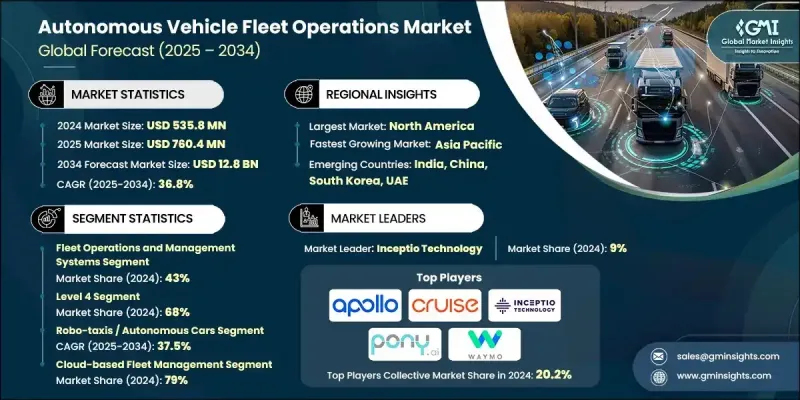
随着企业在客运、配送和无人驾驶计程车营运等领域采用并扩大自动驾驶车辆的应用规模,市场正在迅速扩张。 L4 和 L5 级自动驾驶系统的进步,加上人工智慧驱动的云端车队管理平台和高速 5G 连接,正在变革车队营运模式。美国的监管支援为商业部署提供了一个清晰的框架,使车队营运商有信心在确保安全的前提下扩展服务规模。这一转变正推动该行业从试点项目走向广泛的商业运营,创造了可观的收入,并每天为成千上万的用户提供服务。经济效益、营运效率和技术创新正在推动自动驾驶技术的普及,而城市交通、货运物流和消费者期望也不断重塑市场格局,使自动驾驶车队营运成为现代交通运输的基石。
| 市场范围 | |
|---|---|
| 起始年份 | 2024 |
| 预测年份 | 2025-2034 |
| 起始值 | 5.358亿美元 |
| 预测值 | 128亿美元 |
| 复合年增长率 | 36.8% |
2024年,车队营运和管理系统市占率达到43%,预计2034年将以37.1%的复合年增长率成长。这些系统整合了集中监控、预测性维护、路线优化和即时分析等软体。人工智慧演算法和网路安全协议提高了效率并保护了车队资料。物流、货运和客运产业的应用推动了这一成长,各公司透过自动化调度、远端资讯处理整合和分析来改善平台,从而降低营运成本并提高车队生产力。
2024年,L4级自动驾驶系统占据了68%的市场份额,预计到2034年将以37.2%的复合年增长率成长。 L4级系统可在预设的操作设计范围内实现完全自主运行,使车辆能够在特定区域、路况或环境条件下无需人工干预即可行驶。 L4级技术的广泛商业应用反映了其已获得监管部门的批准、经济可行性和营运效率,因为车队可以在各种地理和气候条件下降低人工成本,同时确保安全。
预计到2024年,北美自动驾驶车队营运市场将占据47%的份额。该地区凭藉着雄厚的创投、企业投资和研发投入,引领全球市场。对主要自动驾驶汽车公司的投资加速了车队扩张和商业化进程。政府机构、州交通部门和产业联盟之间的合作正在增强区域能力,建立安全协议、远端操作标准并进行基础设施升级,从而进一步推动市场成长。
目录
第一章:方法论
第二章:执行概要
第三章:行业洞察
- 产业生态系分析
- 供应商格局
- 利润率分析
- 成本结构
- 每个阶段的价值增加
- 影响价值链的因素
- 中断
- 产业影响因素
- 成长驱动因素
- 4级自动驾驶出行和配送车队的部署日益增多
- 对经济高效且无人驾驶的运输运营的需求日益增长
- 人工智慧、边缘运算、远端资讯处理和 5G 连接方面的进步
- 扩大无人驾驶计程车、自动驾驶接驳车和最后一公里配送服务
- 对即时车队监控、安全和预测性维护的需求日益增长
- 产业陷阱与挑战
- 高昂的基础设施、硬体和后端技术成本
- 互联和远端管理车队的网路安全风险
- 市场机会
- 在城市交通中大规模部署无人驾驶计程车和自动驾驶接驳车
- 最后一公里配送和物流营运的自动化
- 矿业、港口、机场和仓库的工业车队自动化
- 建立用于全球监管的远端舰队营运中心
- 成长驱动因素
- 成长潜力分析
- 监管环境
- 全球监管环境概述
- 联合国欧洲经济委员会规章与国际协调
- 美国联邦管辖权与州管辖权
- 欧盟型式认证框架及实施
- 亚太地区监管碎片化分析
- 各区域的测试和试点计画要求
- 安全认证和验证标准
- 资料隐私和网路安全法规
- 责任与保险框架的演变
- 波特的分析
- PESTEL 分析
- 技术与创新格局
- 当前技术趋势
- 感测器技术发展(光达、雷达、摄影机系统)
- 人工智慧和机器学习在自动驾驶的应用
- 高清地图和定位技术
- V2X通讯标准及部署
- 新兴技术
- 远端操作和遥操作技术
- 边缘运算和车载处理
- 用于车队保护的网路安全技术
- OTA软体更新功能
- 当前技术趋势
- 定价分析与成本结构
- 按类型分類的车辆购置成本
- 改装车辆与专用车辆的经济性比较
- 车队管理技术成本
- 远端营运中心人员配备和基础设施成本
- 维护和营运费用分析
- 保险和责任成本趋势
- 总拥有成本 (TCO) 比较
- 车队服务定价模型
- 专利分析
- 按技术领域分類的专利申请趋势
- 主要专利持有者和创新领导者
- 车队管理技术专利
- 远端操作和调度系统专利
- 永续性和环境方面
- 永续实践
- 减少废弃物策略
- 生产中的能源效率
- 环保倡议
- 碳足迹考量
- 客户采纳与使用者体验分析
- 商业机器人计程车普及率指标
- 公共交通机构的采纳意向
- 使用者体验品质与满意度因素
- 运作可靠度及服务中断分析
- 无障碍与包容性设计使用者体验
- 商业货运及物流用户采纳
- 采矿业的采纳与营运接受度
- 经济影响与产业转型
- 降低劳动成本的潜力
- 资本投资和基础设施需求
- 车队利用率和营运效率经济学
- 产业整合与市场重组
- 公共部门投资与经济发展
- 保险及责任市场转型
- 风险评估与市场逆风
- 安全事故和监管执法行动
- 监管碎片化和合规复杂性
- 技术限制和运行设计领域约束
- 网路安全威胁与资料隐私风险
- 资本密集度和获利路径的不确定性
- 公众接受度与信任度障碍
- 劳动力流失和劳工反对
- 对各业者的关键绩效指标 (KPI) 进行比较分析
- 舰队规模和部署指标
- 营运效率和利用率指标
- 可靠性和服务中断指标
- 安全绩效指标
- 经济绩效指标
- 技术成熟度指标
- 监理合规与审批指标
- 客户采纳率与市场渗透率指标
第四章:竞争格局
- 介绍
- 公司市占率分析
- 北美洲
- 欧洲
- 亚太地区
- 拉丁美洲
- MEA
- 主要市场参与者的竞争分析
- 竞争定位矩阵
- 战略展望矩阵
- 关键进展
- 併购
- 合作伙伴关係与合作
- 新产品发布
- 扩张计划和资金
- 创投与私募股权投资趋势
- 政府拨款项目和公共资金
- OEM对 AV 车队技术的投资
- 併购活动分析
- 资金挑战和资本需求
第五章:市场估计与预测:依技术划分,2021-2034年
- 车队营运和管理系统
- 安全、合规和监控系统
- 连接和通讯系统
- 导航和车辆软体系统
第六章:市场估价与预测:依车辆类型划分,2021-2034年
- 无人驾驶计程车/自动驾驶汽车
- 无人驾驶接驳车
- 自动驾驶卡车
- 无人驾驶送货车
- 送货机器人/人行道机器人
- 自主工业车辆
第七章:市场估计与预测:依自主程度划分,2021-2034年
- 3级
- 4级
- 5级
第八章:市场估算与预测:依部署模式划分,2021-2034年
- 基于云端的车队管理
- 本地部署解决方案
第九章:市场估算与预测:依最终用途划分,2021-2034年
- 乘客出行业者
- 货运和物流运营商
- 工业和非公路运营商
- 商业和机构部门
- 其他的
第十章:市场估计与预测:依地区划分,2021-2034年
- 北美洲
- 我们
- 加拿大
- 欧洲
- 德国
- 英国
- 法国
- 义大利
- 西班牙
- 俄罗斯
- 北欧
- 葡萄牙
- 克罗埃西亚
- 亚太地区
- 中国
- 印度
- 日本
- 澳洲
- 韩国
- 新加坡
- 泰国
- 印尼
- 越南
- 拉丁美洲
- 巴西
- 墨西哥
- 阿根廷
- MEA
- 南非
- 沙乌地阿拉伯
- 阿联酋
- 土耳其
第十一章:公司简介
- 全球参与者
- Aurora Innovation
- AutoX
- Baidu Apollo
- Cruise
- General Motors
- Inceptio Technology
- Mobileye
- Plus.ai
- Pony.ai
- Scania
- Torc Robotics
- Waymo
- Zoox
- 区域玩家
- ComfortDelGro
- Pinellas Suncoast Transit Authority
- Valley Metro (Phoenix)
- WeRide
- Emerging Technology Innovators
- Forterra
- Kodiak Robotics
- LILEE Systems
- Motional
- Perrone Robotics
The Global Autonomous Vehicle Fleet Operations Market was valued at USD 535.8 million in 2024 and is estimated to grow at a CAGR of 36.8% to reach USD 12.8 billion by 2034.
The market is rapidly expanding as companies adopt and scale self-driving vehicles across passenger mobility, delivery services, and robo-taxi operations. Advances in Level 4 and Level 5 autonomous systems, coupled with AI-driven, cloud-based fleet management platforms and high-speed 5G connectivity, are transforming fleet operations. Regulatory support in the U.S. provides clear frameworks for commercial deployments, giving fleet operators confidence to scale services while ensuring safety. This shift is moving the industry from pilot programs to widespread commercial operations, creating substantial revenue and serving thousands daily. Economic benefits, operational efficiency, and technological innovation are driving adoption, while urban mobility, freight logistics, and consumer expectations continue to reshape the market landscape, positioning autonomous fleet operations as a cornerstone of modern transportation.
| Market Scope | |
|---|---|
| Start Year | 2024 |
| Forecast Year | 2025-2034 |
| Start Value | $535.8 Million |
| Forecast Value | $12.8 Billion |
| CAGR | 36.8% |
The fleet operations and management systems segment held a 43% share in 2024 and is expected to grow at a CAGR of 37.1% through 2034. These systems integrate software for centralized monitoring, predictive maintenance, route optimization, and real-time analytics. AI algorithms and cybersecurity protocols enhance efficiency and protect fleet data. Growth is driven by adoption in logistics, freight, and passenger transport, with companies refining platforms through automated scheduling, telematics integration, and analytics to reduce operational costs and increase fleet productivity.
The Level 4 segment held a 68% share in 2024 and is projected to grow at a CAGR of 37.2% through 2034. Level 4 systems deliver full autonomy within defined operational design domains, allowing vehicles to operate without human intervention in specified areas, road types, or environmental conditions. Widespread commercial adoption of Level 4 technology reflects regulatory approvals, economic viability, and operational efficiency, as fleets can reduce labor costs while maintaining safety across varied geographic and weather conditions.
North America Autonomous Vehicle Fleet Operations Market accounted for a 47% share in 2024. The region leads the global market due to significant venture capital, corporate investment, and R&D expenditure. Investments in major AV companies have accelerated fleet expansion and commercialization. Collaboration between government agencies, state transportation departments, and industry consortia is strengthening regional capabilities, establishing safety protocols, teleoperation standards, and infrastructure upgrades, further boosting market growth.
Key players in the Global Autonomous Vehicle Fleet Operations Market include Aurora Innovation, AutoX, Baidu Apollo, Cruise, Inceptio Technology, Mobileye, Plus.ai, Pony.ai, Torc Robotics, and Waymo. Companies in the Autonomous Vehicle Fleet Operations Market are strengthening their presence through heavy investment in R&D to improve autonomy, AI algorithms, and fleet safety systems. Strategic partnerships with governments, regulators, and infrastructure providers help secure regulatory approvals and facilitate large-scale deployment. Firms are expanding pilot programs into commercial operations while integrating cloud-based fleet management platforms for real-time monitoring, predictive maintenance, and route optimization. Investment in high-speed connectivity, including 5G and edge computing, enhances vehicle communication and operational efficiency.
Table of Contents
Chapter 1 Methodology
- 1.1 Market scope and definition
- 1.2 Research design
- 1.2.1 Research approach
- 1.2.2 Data collection methods
- 1.3 Data mining sources
- 1.3.1 Global
- 1.3.2 Regional/Country
- 1.4 Base estimates and calculations
- 1.4.1 Base year calculation
- 1.4.2 Key trends for market estimation
- 1.5 Primary research and validation
- 1.5.1 Primary sources
- 1.6 Forecast model
- 1.7 Research assumptions and limitations
Chapter 2 Executive Summary
- 2.1 Industry 360° synopsis, 2021 - 2034
- 2.2 Key market trends
- 2.2.1 Regional
- 2.2.2 Technology
- 2.2.3 Vehicle
- 2.2.4 Autonomy Level
- 2.2.5 Deployment Mode
- 2.2.6 End Use
- 2.3 TAM Analysis, 2025-2034
- 2.4 CXO perspectives: Strategic imperatives
- 2.4.1 Executive decision points
- 2.4.2 Critical success factors
- 2.5 Future outlook and strategic recommendations
Chapter 3 Industry Insights
- 3.1 Industry ecosystem analysis
- 3.1.1 Supplier landscape
- 3.1.2 Profit margin analysis
- 3.1.3 Cost structure
- 3.1.4 Value addition at each stage
- 3.1.5 Factor affecting the value chain
- 3.1.6 Disruptions
- 3.2 Industry impact forces
- 3.2.1 Growth drivers
- 3.2.1.1 Rising deployment of Level 4 autonomous mobility and delivery fleets
- 3.2.1.2 Growing demand for cost-efficient and driverless transportation operations
- 3.2.1.3 Advancements in AI, edge computing, telematics, and 5G connectivity
- 3.2.1.4 Expansion of robo-taxi, autonomous shuttle, and last-mile delivery services
- 3.2.1.5 Increasing need for real-time fleet monitoring, safety, and predictive maintenance
- 3.2.2 Industry pitfalls and challenges
- 3.2.2.1 High infrastructure, hardware, and backend technology costs
- 3.2.2.2 Cybersecurity risks in connected and remotely managed fleets
- 3.2.3 Market opportunities
- 3.2.3.1 Large-scale deployment of robo-taxis and autonomous shuttles in urban mobility
- 3.2.3.2 Automation of last-mile delivery and logistics operations
- 3.2.3.3 Industrial fleet automation in mining, ports, airports, and warehouses
- 3.2.3.4 Development of remote fleet operations centers for global supervision
- 3.2.1 Growth drivers
- 3.3 Growth potential analysis
- 3.4 Regulatory landscape
- 3.4.1 Global regulatory landscape overview
- 3.4.2 UNECE regulations & international harmonization
- 3.4.3 Federal vs state jurisdiction in the United States
- 3.4.4 EU type-approval framework & implementation
- 3.4.5 Asia-Pacific regulatory fragmentation analysis
- 3.4.6 Testing & pilot program requirements by region
- 3.4.7 Safety certification & validation standards
- 3.4.8 Data privacy & cybersecurity regulations
- 3.4.9 Liability & insurance framework evolution
- 3.5 Porter's analysis
- 3.6 PESTEL analysis
- 3.7 Technology and innovation landscape
- 3.7.1 Current technological trends
- 3.7.1.1 Sensor technology evolution (LiDAR, radar, camera systems)
- 3.7.1.2 AI & machine learning for autonomous driving
- 3.7.1.3 HD mapping & localization technologies
- 3.7.1.4 V2X communication standards & deployment
- 3.7.2 Emerging technologies
- 3.7.2.1 Remote operations & teleoperation technologies
- 3.7.2.2 Edge computing & onboard processing
- 3.7.2.3 Cybersecurity technologies for fleet protection
- 3.7.2.4 OTA software update capabilities
- 3.7.1 Current technological trends
- 3.8 Pricing analysis & cost structure
- 3.8.1 Vehicle acquisition costs by type
- 3.8.2 Retrofitting vs purpose-built vehicle economics
- 3.8.3 Fleet management technology costs
- 3.8.4 Remote operations center staffing & infrastructure costs
- 3.8.5 Maintenance & operating expense analysis
- 3.8.6 Insurance & liability cost trends
- 3.8.7 Total cost of ownership (TCO) comparison
- 3.8.8 Pricing models for fleet services
- 3.9 Patent analysis
- 3.9.1 Patent filing trends by technology area
- 3.9.2 Key patent holders & innovation leaders
- 3.9.3 Fleet management technology patents
- 3.9.4 Remote operations & dispatch system patents
- 3.10 Sustainability and environmental aspects
- 3.10.1 Sustainable practices
- 3.10.2 Waste reduction strategies
- 3.10.3 Energy efficiency in production
- 3.10.4 Eco-friendly Initiatives
- 3.11 Carbon footprint considerations
- 3.12 Customer adoption & user experience analysis
- 3.12.1 Commercial robotaxi adoption metrics
- 3.12.2 Public transit agency adoption intentions
- 3.12.3 User experience quality & satisfaction factors
- 3.12.4 Operational reliability & service disruption analysis
- 3.12.5 Accessibility & inclusive design user experience
- 3.12.6 Commercial freight & logistics user adoption
- 3.12.7 Mining industry adoption & operational acceptance
- 3.13 Economic impact & industry transformation
- 3.13.1 Labor cost reduction potential
- 3.13.2 Capital investment & infrastructure requirements
- 3.13.3 Fleet utilization & operational efficiency economics
- 3.13.4 Industry consolidation & market restructuring
- 3.13.5 Public sector investment & economic development
- 3.13.6 Insurance & liability market transformation
- 3.14 Risk assessment & market headwinds
- 3.14.1 Safety incidents & regulatory enforcement actions
- 3.14.2 Regulatory fragmentation & compliance complexity
- 3.14.3 Technology limitations & operational design domain constraints
- 3.14.4 Cybersecurity threats & data privacy risks
- 3.14.5 Capital intensity & path to profitability uncertainty
- 3.14.6 Public acceptance & trust barriers
- 3.14.7 Workforce displacement & labor opposition
- 3.15 Comparative analysis of key performance indicators (KPIs) across operators
- 3.15.1 Fleet scale & deployment metrics
- 3.15.2 Operational efficiency & utilization metrics
- 3.15.3 Reliability & service disruption metrics
- 3.15.4 Safety performance metrics
- 3.15.5 Economic performance metrics
- 3.15.6 Technology maturity metrics
- 3.15.7 Regulatory compliance & approval metrics
- 3.15.8 Customer adoption & market penetration metrics
Chapter 4 Competitive Landscape, 2024
- 4.1 Introduction
- 4.2 Company market share analysis
- 4.2.1 North America
- 4.2.2 Europe
- 4.2.3 Asia Pacific
- 4.2.4 LATAM
- 4.2.5 MEA
- 4.3 Competitive analysis of major market players
- 4.4 Competitive positioning matrix
- 4.5 Strategic outlook matrix
- 4.6 Key developments
- 4.6.1 Mergers & acquisitions
- 4.6.2 Partnerships & collaborations
- 4.6.3 New Product Launches
- 4.6.4 Expansion Plans and funding
- 4.6.4.1 Venture capital & private equity investment trends
- 4.6.4.2 Government grant programs & public funding
- 4.6.4.3 OEM investment in AV fleet technologies
- 4.6.4.4 Merger & acquisition activity analysis
- 4.6.4.5 Funding challenges & capital requirements
Chapter 5 Market Estimates & Forecast, By Technology, 2021 - 2034 (USD Mn, Units)
- 5.1 Key trends
- 5.2 Fleet operations and management systems
- 5.3 Safety, compliance and monitoring systems
- 5.4 Connectivity and communication systems
- 5.5 Navigation and vehicle software systems
Chapter 6 Market Estimates & Forecast, By Vehicle, 2021 - 2034 (USD Mn, Units)
- 6.1 Key trends
- 6.2 Robo-taxis / autonomous cars
- 6.3 Autonomous shuttles
- 6.4 Autonomous trucks
- 6.5 Autonomous delivery vans
- 6.6 Delivery robots / sidewalk robots
- 6.7 Autonomous industrial vehicles
Chapter 7 Market Estimates & Forecast, By Autonomy Level, 2021 - 2034 (USD Mn, Units)
- 7.1 Key trends
- 7.2 Level 3
- 7.3 Level 4
- 7.4 Level 5
Chapter 8 Market Estimates & Forecast, By Deployment Mode, 2021 - 2034 (USD Mn, Units)
- 8.1 Key trends
- 8.2 Cloud-based fleet management
- 8.3 On-premises solutions
Chapter 9 Market Estimates & Forecast, By End Use, 2021 - 2034 (USD Mn, Units)
- 9.1 Key trends
- 9.2 Passenger mobility operators
- 9.3 Freight and logistics operators
- 9.4 Industrial and off-highway operators
- 9.5 Commercial and institutional sectors
- 9.6 Others
Chapter 10 Market Estimates & Forecast, By Region, 2021 - 2034 (USD Mn, Units)
- 10.1 Key trends
- 10.2 North America
- 10.2.1 US
- 10.2.2 Canada
- 10.3 Europe
- 10.3.1 Germany
- 10.3.2 UK
- 10.3.3 France
- 10.3.4 Italy
- 10.3.5 Spain
- 10.3.6 Russia
- 10.3.7 Nordics
- 10.3.8 Portugal
- 10.3.9 Croatia
- 10.4 Asia Pacific
- 10.4.1 China
- 10.4.2 India
- 10.4.3 Japan
- 10.4.4 Australia
- 10.4.5 South Korea
- 10.4.6 Singapore
- 10.4.7 Thailand
- 10.4.8 Indonesia
- 10.4.9 Vietnam
- 10.5 Latin America
- 10.5.1 Brazil
- 10.5.2 Mexico
- 10.5.3 Argentina
- 10.6 MEA
- 10.6.1 South Africa
- 10.6.2 Saudi Arabia
- 10.6.3 UAE
- 10.6.4 Turkey
Chapter 11 Company Profiles
- 11.1 Global Players
- 11.1.1 Aurora Innovation
- 11.1.2 AutoX
- 11.1.3 Baidu Apollo
- 11.1.4 Cruise
- 11.1.5 General Motors
- 11.1.6 Inceptio Technology
- 11.1.7 Mobileye
- 11.1.8 Plus.ai
- 11.1.9 Pony.ai
- 11.1.10 Scania
- 11.1.11 Torc Robotics
- 11.1.12 Waymo
- 11.1.13 Zoox
- 11.2 Regional Players
- 11.2.1 ComfortDelGro
- 11.2.2 Pinellas Suncoast Transit Authority
- 11.2.3 Valley Metro (Phoenix)
- 11.2.4 WeRide
- 11.3 Emerging Technology Innovators
- 11.3.1 Forterra
- 11.3.2 Kodiak Robotics
- 11.3.3 LILEE Systems
- 11.3.4 Motional
- 11.3.5 Perrone Robotics

 学校交通解决方案市场规模、份额和成长分析(按关键特性、部署模式、平台、应用、客户规模、最终用户和地区划分)-2026-2033年产业预测
 欧洲车队管理市场报告 - 第20版
 2025年全球游戏化驾驶员指导显示市场报告
 车队管理的北美市场 - 第15版
 车队管理市场预测至2032年:按组件、部署模式、车辆类型、车队规模、最终用户和地区分類的全球分析
 车队管理市场:2035年前的产业趋势和全球预测 - 各元件类型,各车队类型,各部署类型,各终端用户类型,各地区
 按动力类型、车辆等级、应用和所有权模式分類的乘用车车队管理市场-全球预测,2025-2032年车队管理市场按产品、动力系统、连接方式、车队类型、部署模式、车队规模、应用、最终用户产业、所有权模式和定价模式划分-2025-2030年全球预测车队管理系统市场按解决方案类型、车辆类型、车队规模、应用、部署方法和最终用户行业划分 - 全球预测 2025-20322025年全球施工机械车队管理软体市场报告