


 |
市场调查报告书
商品编码
1892708
飞机热交换器市场机会、成长驱动因素、产业趋势分析及预测(2026-2035年)Aircraft Heat Exchanger Market Opportunity, Growth Drivers, Industry Trend Analysis, and Forecast 2026 - 2035 |
||||||

2025 年全球飞机热交换器市场价值为 49 亿美元,预计到 2035 年将以 4.3% 的复合年增长率增长至 74 亿美元。
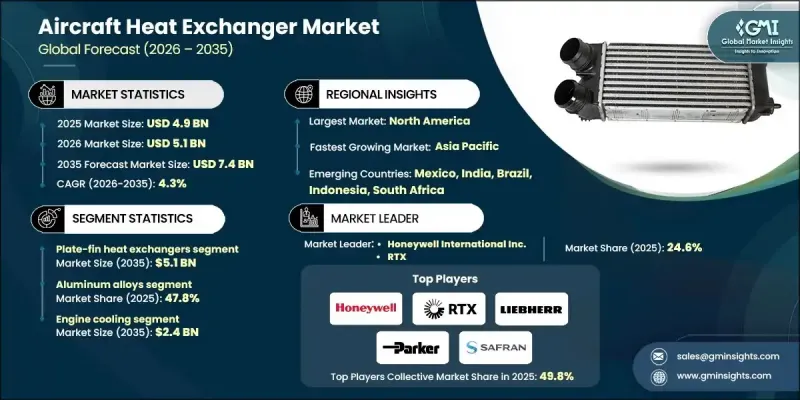
市场成长的驱动力来自不断增长的航空客运量、对燃油效率日益重视、先进空中交通的兴起以及无人机和军用飞机应用的日益广泛。不断增长的客运需求促使航空公司提升飞机的性能、效率和永续性,进而推动了热交换器的应用。电动和氢电推进系统推动了对轻量化、高性能热解决方案的需求,这些解决方案能够处理先进动力系统产生的大量热量。热交换器在维持所有飞机系统(尤其是新一代电动和混合动力平台)的最佳运作性能方面发挥着至关重要的作用,满足了低排放航空和永续飞行倡议的要求。
| 市场范围 | |
|---|---|
| 起始年份 | 2025 |
| 预测年份 | 2026-2035 |
| 起始值 | 49亿美元 |
| 预测值 | 74亿美元 |
| 复合年增长率 | 4.3% |
预计到2035年,板翅式热交换器市场规模将达51亿美元。其结构紧凑、热效率高,且适用于先进轻型飞机设计,这些优势加速了其应用普及。市场成长主要得益于与现代发动机、无人机和电动飞机的集成,这些设备需要在狭小空间内实现高效散热。
到2025年,铝合金市占率将达到47.8%。铝合金製成的热交换器因其优异的强度重量比、易製造性和成本效益而备受青睐。航空公司越来越多地在窄体客机、宽体客机和无人机平台上使用这些材料,以减轻重量并提高燃油效率。预计製造商将专注于高强度、导热性良好的铝合金,以支援下一代飞机的设计。
预计2025年,美国飞机热交换器市场规模将达16亿美元。该地区的成长主要得益于机队现代化、商业和支线航空运输量的扩张,以及混合动力和无人机平台的日益普及。各公司正致力于研发用于下一代飞机的模组化、热优化热交换器,同时投资支援无人机和支线航空发展的技术。
目录
第一章:方法论
第二章:执行概要
第三章:行业洞察
- 产业生态系分析
- 供应商格局
- 利润率分析
- 成本结构
- 每个阶段的价值增加
- 影响价值链的因素
- 中断
- 产业影响因素
- 成长驱动因素
- 航空客运量不断成长
- 对燃油效率的需求不断增长
- 先进空中交通和电气化推进技术的发展
- 模组化和整合式热管理架构
- 无人机和军用飞机应用的兴起
- 产业陷阱与挑战
- 製造流程复杂,认证要求高
- 飞机设计中的重量和空间限制
- 市场机会
- 积层製造技术在复杂几何形状热交换器製造上的应用
- 整合智慧嵌入式感测器进行即时热监测
- 无人机、中空长航时/高空长航时无人机以及国防平台的发展需要先进的冷却技术
- 下一代轻量材料的开发
- 成长驱动因素
- 成长潜力分析
- 监管环境
- 北美洲
- 欧洲
- 亚太地区
- 拉丁美洲
- 中东和非洲
- 波特的分析
- PESTEL 分析
- 技术与创新格局
- 当前技术趋势
- 新兴技术
- 新兴商业模式
- 合规要求
- 供应链韧性
- 地缘政治分析
- 劳动力分析
- 数位转型
- 併购和策略伙伴关係格局
- 风险评估与管理
- 主要合约授予情况(2022-2025 年)
第四章:竞争格局
- 介绍
- 公司市占率分析
- 按地区
- 北美洲
- 欧洲
- 亚太地区
- 拉丁美洲
- 中东和非洲
- 按地区
- 对主要参与者进行竞争基准分析
- 财务绩效比较
- 收入
- 利润率
- 研发
- 产品组合比较
- 产品范围广度
- 科技
- 创新
- 地理位置比较
- 全球足迹分析
- 服务网路覆盖
- 按地区分類的市场渗透率
- 竞争定位矩阵
- 领导人
- 挑战者
- 追踪者
- 小众玩家
- 战略展望矩阵
- 财务绩效比较
- 2021-2024 年主要发展动态
- 併购
- 伙伴关係与合作
- 技术进步
- 扩张和投资策略
- 数位转型计划
- 新兴/新创企业竞争对手格局
第五章:市场估算与预测:依热交换器类型划分,2022-2035年
- 板翅式热交换器
- 管翅式热交换器
第六章:市场估算与预测:依材料类型划分,2022-2035年
- 铝合金
- 不銹钢
- 钛
- 铜
- 其他的
第七章:市场估价与预测:依冷却介质划分,2022-2035年
- 空对空
- 空液
- 液对液
- 液气
第八章:市场估算与预测:依应用领域划分,2022-2035年
- 引擎冷却
- 舱室暖气和冷气 (ECS)
- 航空电子设备冷却
- 液压冷却
- 燃料暖气和冷气
- 其他的
第九章:市场估算与预测:依飞机类型划分,2022-2035年
- 商用飞机
- 窄体飞机
- 宽体飞机
- 支线喷射机
- 军用机
- 战斗机
- 运输机
- 公务航空
- 通用航空
- 直升机和旋翼机
第十章:市场估计与预测:依最终用途划分,2022-2035年
- OEM (生产线适配)
- 售后市场(MRO)
第十一章:市场估计与预测:按地区划分,2021-2034年
- 北美洲
- 我们
- 加拿大
- 欧洲
- 德国
- 英国
- 法国
- 义大利
- 西班牙
- 荷兰
- 亚太地区
- 中国
- 印度
- 日本
- 澳洲
- 韩国
- 拉丁美洲
- 巴西
- 墨西哥
- 阿根廷
- MEA
- 南非
- 沙乌地阿拉伯
- 阿联酋
第十二章:公司简介
- 全球关键参与者
- Honeywell International Inc.
- RTX
- Liebherr Group
- Parker Hannifin Corp
- 区域关键参与者
- 北美洲
- 3D Systems, Inc
- AMETEK Inc.
- Boyd Corporation
- 欧洲
- Safran SA
- Meggitt PLC
- Triumph Group
- 亚太地区
- JAMCO Corporation
- HS-Nauka
- TAT Technologies Ltd
- 北美洲
- 小众玩家/颠覆者
- Conflux Technology
- Essex Industries, Inc.
- ETP Thermal Dynamics
- THERMOVAC AEROSPACE
- Wall Colmonoy
The Global Aircraft Heat Exchanger Market was valued at USD 4.9 billion in 2025 and is estimated to grow at a CAGR of 4.3% to reach USD 7.4 billion by 2035.
Market growth is propelled by rising air passenger traffic, increasing focus on fuel efficiency, the emergence of advanced air mobility, and the growing applications of UAVs and military aircraft. Rising passenger demand is creating pressure on airlines to improve aircraft performance, efficiency, and sustainability, which in turn fuels the adoption of heat exchangers. Electric and hydrogen-electric propulsion systems are driving the need for lightweight, high-performance thermal solutions that can manage substantial heat from advanced powertrains. Heat exchangers play a critical role in maintaining optimal operational performance across all aircraft systems, particularly in new-generation electric and hybrid-electric platforms, meeting the expectations of low-emission aviation and sustainable flight initiatives.
| Market Scope | |
|---|---|
| Start Year | 2025 |
| Forecast Year | 2026-2035 |
| Start Value | $4.9 Billion |
| Forecast Value | $7.4 Billion |
| CAGR | 4.3% |
The plate-fin heat exchangers segment is expected to reach USD 5.1 billion by 2035. Their compact form, high thermal efficiency, and suitability for advanced and lightweight aircraft designs have accelerated adoption. Growth is largely driven by integration with modern engines, UAVs, and electric aircraft, which require efficient heat dissipation within confined spaces.
The aluminum alloys segment held 47.8% share in 2025. Heat exchangers made from aluminum alloys are favored for their superior strength-to-weight ratio, manufacturability, and cost-effectiveness. Airlines increasingly rely on these materials across narrow-body, wide-body, and UAV platforms to reduce weight and enhance fuel efficiency. Manufacturers are expected to focus on high-strength, thermally conductive aluminum grades to support next-generation aircraft designs.
U.S. Aircraft Heat Exchanger Market generated USD 1.6 billion in 2025. Growth in this region is driven by fleet modernization, expanding commercial and regional air traffic, and rising adoption of hybrid-electric and UAV platforms. Companies are concentrating on modular, thermally optimized heat exchangers for next-generation aircraft while investing in technology to support UAVs and regional aviation expansion.
Key players operating in the Global Aircraft Heat Exchanger Market include 3D Systems, Inc., AMETEK Inc., Boyd Corporation, Conflux Technology, Essex Industries, Inc., ETP Thermal Dynamics, Honeywell International Inc., HS-Nauka, JAMCO Corporation, Liebherr Group, and Meggitt PLC. Companies in the Global Aircraft Heat Exchanger Market strengthen their position by focusing on research and development to design high-efficiency, lightweight, and thermally optimized solutions for next-generation aircraft. They are investing in advanced manufacturing techniques such as 3D printing to produce complex geometries with enhanced heat transfer efficiency. Strategic collaborations with aviation OEMs and defense contractors expand market reach and support co-development of electric and hybrid propulsion systems. Firms also emphasize modular product designs for faster integration and cost-effective maintenance, while targeting regional markets with growing air traffic and UAV adoption to secure long-term contracts and boost market presence globally.
Table of Contents
Chapter 1 Methodology
- 1.1 Market scope and definition
- 1.2 Research design
- 1.2.1 Research approach
- 1.2.2 Data collection methods
- 1.3 Data mining sources
- 1.3.1 Global
- 1.3.2 Regional/Country
- 1.4 Base estimates and calculations
- 1.4.1 Base year calculation
- 1.4.2 Key trends for market estimation
- 1.5 Primary research and validation
- 1.5.1 Primary sources
- 1.6 Forecast model
- 1.7 Research assumptions and limitations
Chapter 2 Executive Summary
- 2.1 Industry 360° synopsis, 2022 - 2035
- 2.2 Key market trends
- 2.2.1 Heat exchanger type trends
- 2.2.2 Material type trends
- 2.2.3 Cooling medium trends
- 2.2.4 Application trends
- 2.2.5 Aircraft type trends
- 2.2.6 End use trends
- 2.2.7 Regional trends
- 2.3 TAM analysis, 2026-2035
- 2.4 CXO perspectives: Strategic imperatives
- 2.4.1 Executive decision points
- 2.4.2 Critical success factors
- 2.5 Future outlook and strategic recommendations
Chapter 3 Industry Insights
- 3.1 Industry ecosystem analysis
- 3.1.1 Supplier landscape
- 3.1.2 Profit margin analysis
- 3.1.3 Cost structure
- 3.1.4 Value addition at each stage
- 3.1.5 Factor affecting the value chain
- 3.1.6 Disruptions
- 3.2 Industry impact forces
- 3.2.1 Growth drivers
- 3.2.1.1 Rising air passenger traffic
- 3.2.1.2 Rising demand for fuel efficiency
- 3.2.1.3 Growth of advanced air mobility & electrified propulsion
- 3.2.1.4 Modular & integrated thermal management architectures
- 3.2.1.5 Rise of UAVs & military aircraft applications
- 3.2.2 Industry pitfalls and challenges
- 3.2.2.1 High manufacturing complexity and certification requirements
- 3.2.2.2 Weight and space constraints in aircraft design
- 3.2.3 Market opportunities
- 3.2.3.1 Adoption of additive manufacturing for complex heat exchanger geometries
- 3.2.3.2 Integration of smart and embedded sensors for real-time thermal monitoring
- 3.2.3.3 Expansion in UAV, MALE/HALE, and defense platforms requiring advanced cooling
- 3.2.3.4 Development of next-generation lightweight materials
- 3.2.1 Growth drivers
- 3.3 Growth potential analysis
- 3.4 Regulatory landscape
- 3.4.1 North America
- 3.4.2 Europe
- 3.4.3 Asia Pacific
- 3.4.4 Latin America
- 3.4.5 Middle East & Africa
- 3.5 Porter's analysis
- 3.6 PESTEL analysis
- 3.7 Technology and Innovation landscape
- 3.7.1 Current technological trends
- 3.7.2 Emerging technologies
- 3.8 Emerging business models
- 3.9 Compliance requirements
- 3.10 Supply chain resilience
- 3.11 Geopolitical analysis
- 3.12 Workforce analysis
- 3.13 Digital transformation
- 3.14 Mergers, acquisitions, and strategic partnerships landscape
- 3.15 Risk assessment and management
- 3.16 Major contract awards (2022-2025)
Chapter 4 Competitive Landscape, 2024
- 4.1 Introduction
- 4.2 Company market share analysis
- 4.2.1 By region
- 4.2.1.1 North America
- 4.2.1.2 Europe
- 4.2.1.3 Asia Pacific
- 4.2.1.4 Latin America
- 4.2.1.5 Middle East & Africa
- 4.2.1 By region
- 4.3 Competitive benchmarking of key players
- 4.3.1 Financial performance comparison
- 4.3.1.1 Revenue
- 4.3.1.2 Profit margin
- 4.3.1.3 R&D
- 4.3.2 Product portfolio comparison
- 4.3.2.1 Product range breadth
- 4.3.2.2 Technology
- 4.3.2.3 Innovation
- 4.3.3 Geographic presence comparison
- 4.3.3.1 Global footprint analysis
- 4.3.3.2 Service network coverage
- 4.3.3.3 Market penetration by region
- 4.3.4 Competitive positioning matrix
- 4.3.4.1 Leaders
- 4.3.4.2 Challengers
- 4.3.4.3 Followers
- 4.3.4.4 Niche players
- 4.3.5 Strategic outlook matrix
- 4.3.1 Financial performance comparison
- 4.4 Key developments, 2021-2024
- 4.4.1 Mergers and acquisitions
- 4.4.2 Partnerships and collaborations
- 4.4.3 Technological advancements
- 4.4.4 Expansion and investment strategies
- 4.4.5 Digital transformation initiatives
- 4.5 Emerging/ startup competitors landscape
Chapter 5 Market Estimates and Forecast, By Heat Exchanger Type, 2022 - 2035 (USD Million & Units)
- 5.1 Key trends
- 5.2 Plate-fin heat exchangers
- 5.3 Tube-fin heat exchangers
Chapter 6 Market Estimates and Forecast, By Material Type, 2022 - 2035 (USD Million & Units)
- 6.1 Key trends
- 6.2 Aluminum alloys
- 6.3 Stainless steel
- 6.4 Titanium
- 6.5 Copper
- 6.6 Others
Chapter 7 Market Estimates and Forecast, By Cooling Medium, 2022 - 2035 (USD Million & Units)
- 7.1 Key trends
- 7.2 Air-to-air
- 7.3 Air-to-liquid
- 7.4 Liquid-to-liquid
- 7.5 Liquid-to-air
Chapter 8 Market Estimates and Forecast, By Application, 2022 - 2035 (USD Million & Units)
- 8.1 Key trends
- 8.2 Engine cooling
- 8.3 Cabin heating & cooling (ECS)
- 8.4 Avionics cooling
- 8.5 Hydraulic cooling
- 8.6 Fuel heating & cooling
- 8.7 Others
Chapter 9 Market Estimates and Forecast, By Aircraft Type, 2022 - 2035 (USD Million & Units)
- 9.1 Key trends
- 9.2 Commercial aircraft
- 9.2.1 Narrow-body aircraft
- 9.2.2 Wide-body aircraft
- 9.2.3 Regional jets
- 9.3 Military aircraft
- 9.3.1 Fighter jets
- 9.3.2 Transport aircraft
- 9.4 Business aviation
- 9.5 General aviation
- 9.6 Helicopters & rotorcraft
Chapter 10 Market Estimates and Forecast, By End Use, 2022 - 2035 (USD Million & Units)
- 10.1 Key trends
- 10.2 OEM (Line-Fit)
- 10.3 Aftermarket (MRO)
Chapter 11 Market Estimates & Forecast, By Region, 2021 - 2034 (USD Million & Units)
- 11.1 Key trends
- 11.2 North America
- 11.2.1 U.S.
- 11.2.2 Canada
- 11.3 Europe
- 11.3.1 Germany
- 11.3.2 UK
- 11.3.3 France
- 11.3.4 Italy
- 11.3.5 Spain
- 11.3.6 Netherlands
- 11.4 Asia Pacific
- 11.4.1 China
- 11.4.2 India
- 11.4.3 Japan
- 11.4.4 Australia
- 11.4.5 South Korea
- 11.5 Latin America
- 11.5.1 Brazil
- 11.5.2 Mexico
- 11.5.3 Argentina
- 11.6 MEA
- 11.6.1 South Africa
- 11.6.2 Saudi Arabia
- 11.6.3 UAE
Chapter 12 Company Profiles
- 12.1 Global Key Players
- 12.1.1 Honeywell International Inc.
- 12.1.2 RTX
- 12.1.3 Liebherr Group
- 12.1.4 Parker Hannifin Corp
- 12.2 Regional Key Players
- 12.2.1 North America
- 12.2.1.1 3D Systems, Inc
- 12.2.1.2 AMETEK Inc.
- 12.2.1.3 Boyd Corporation
- 12.2.2 Europe
- 12.2.2.1 Safran S.A
- 12.2.2.2 Meggitt PLC
- 12.2.2.3 Triumph Group
- 12.2.3 APAC
- 12.2.3.1 JAMCO Corporation
- 12.2.3.2 HS-Nauka
- 12.2.3.3 TAT Technologies Ltd
- 12.2.1 North America
- 12.3 Niche Players / Disruptors
- 12.3.1 Conflux Technology
- 12.3.2 Essex Industries, Inc.
- 12.3.3 ETP Thermal Dynamics
- 12.3.4 THERMOVAC AEROSPACE
- 12.3.5 Wall Colmonoy


