


 |
市场调查报告书
商品编码
1892745
农业感测器市场机会、成长驱动因素、产业趋势分析及预测(2026-2035年)Agriculture Sensor Market Opportunity, Growth Drivers, Industry Trend Analysis, and Forecast 2026 - 2035 |
||||||

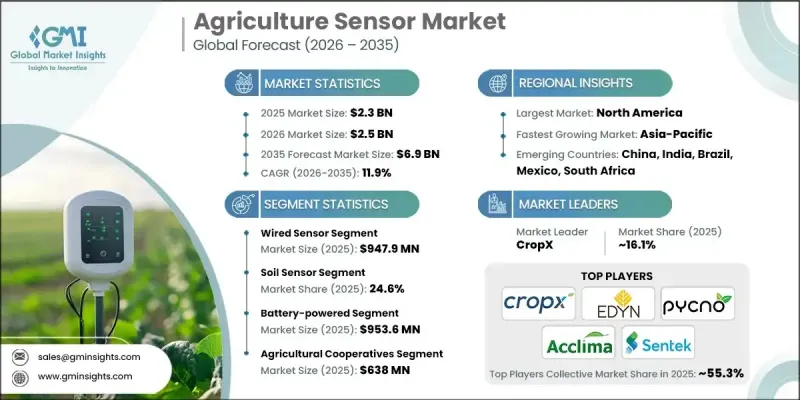
2025 年全球农业感测器市场价值为 23 亿美元,预计到 2035 年将以 11.9% 的复合年增长率增长至 69 亿美元。
精准农业正在改变传统农业,从千篇一律的田间耕作方式转向因地制宜的作物管理。随着全球粮食需求成长和耕地日益稀缺,农民面临着用更少的资源生产更多粮食的巨大压力。这促使数据驱动技术得到广泛应用,从而实现更明智的决策。
| 市场范围 | |
|---|---|
| 起始年份 | 2025 |
| 预测年份 | 2026-2035 |
| 起始值 | 23亿美元 |
| 预测值 | 69亿美元 |
| 复合年增长率 | 11.9% |
无线感测器市场预计在2025年将创造9.479亿美元的市场规模,这主要得益于其易于部署和无需大量布线基础设施即可支援即时资料采集的能力。这些感测器使农民能够远端监测环境状况、作物生长情况和灌溉系统,从而帮助他们更快、更明智地做出决策。随着精准农业和物联网技术的兴起,无论是大型商业农场或小型农户,对无线解决方案的需求都非常强劲。
预计到2025年,土壤感测器市场份额将达到24.6%,这主要得益于其对土壤湿度、温度、盐度和养分含量等关键资讯的精准洞察。农民依靠这些感测器来优化灌溉计划、防止过度施肥并提高作物整体产量。随着节水和永续发展成为全球农业的首要任务,土壤感测器在已开发市场和新兴市场都越来越受欢迎。这些工具在面临干旱或土壤退化的地区尤其有价值。
2024年,北美农业感测器市占率达34.3%。高度机械化、农场规模庞大以及对农业科技的大力投资,使该地区成为精准农业实践的领导者。美国和加拿大的农民正越来越多地采用基于感测器的技术来监测土壤状况、优化灌溉并实现作物管理的自动化。
目录
第一章:方法论与范围
第二章:执行概要
第三章:行业洞察
- 产业生态系分析
- 供应商格局
- 利润率
- 成本结构
- 每个阶段的价值增加
- 影响价值链的因素
- 中断
- 产业影响因素
- 成长驱动因素
- 精准农业和智慧农业的日益普及
- 政府补贴和政策促进数位农业
- 对永续农业实践的需求日益增长
- 物联网、人工智慧和无线连接在农村地区的扩展
- 全球粮食需求不断成长,而耕地面积却在减少
- 产业陷阱与挑战
- 前期成本高昂,小农户难以负担。
- 农村经济中有限的数位基础设施和资料素养
- 市场机会
- 与人工智慧、巨量资料和农场管理软体集成
- 垂直农业和可控制环境农业的发展
- 农业无人机和机器人应用的扩展
- 开发低成本、太阳能供电的无线感测器
- 成长驱动因素
- 成长潜力分析
- 监管环境
- 北美洲
- 欧洲
- 亚太地区
- 拉丁美洲
- 中东和非洲
- 波特的分析
- PESTEL 分析
- 技术与创新格局
- 当前技术趋势
- 新兴技术
- 价格趋势
- 按地区
- 副产品
- 定价策略
- 新兴商业模式
- 合规要求
- 永续性措施
- 消费者情绪分析
- 专利和智慧财产权分析
- 地缘政治与贸易动态
第四章:竞争格局
- 公司市占率分析简介
- 公司市占率分析
- 按地区
- 北美洲
- 欧洲
- 亚太地区
- 市场集中度分析
- 主要参与者的竞争基准化分析
- 财务绩效比较
- 收入
- 利润率
- 研发
- 产品组合比较
- 产品范围广度
- 科技
- 创新
- 地理分布比较
- 全球足迹分析
- 服务网路覆盖范围
- 按地区分類的市场渗透率
- 竞争定位矩阵
- 领导人
- 挑战者
- 追踪者
- 小众玩家
- 战略展望矩阵
- 财务绩效比较
- 2021-2024 年主要发展动态
- 併购
- 伙伴关係与合作
- 技术进步
- 扩张和投资策略
- 永续发展倡议
- 数位转型计划
- 新兴/新创企业竞争对手格局
第五章:市场估算与预测:依感测器类型划分,2022-2035年
- 土壤感测器
- 水感测器
- 气候/天气感测器
- 位置感测器
- 光学感测器
- 机械感测器
- 生物感测器
- 其他专用感测器
第六章:市场估算与预测:以连结方式划分,2022-2035年
- 有线感应器
- 无线感测器
第七章:市场估算与预测:依电源类型划分,2022-2035年
- 电池供电
- 太阳能驱动
- 杂交种
第八章:市场估算与预测:依最终用途划分,2022-2035年
- 农民/个体种植者
- 农业合作社
- 研究机构和大学
- 农业综合企业
- 政府和公共机构
- 其他的
第九章:市场估计与预测:依地区划分,2022-2035年
- 北美洲
- 我们
- 加拿大
- 欧洲
- 德国
- 英国
- 法国
- 义大利
- 西班牙
- 荷兰
- 亚太地区
- 中国
- 印度
- 日本
- 韩国
- 澳洲
- 拉丁美洲
- 巴西
- 墨西哥
- 阿根廷
- 中东和非洲
- 阿联酋
- 沙乌地阿拉伯
- 南非
第十章:公司简介
- Acclima Inc.
- Acquity Agriculture
- Agsmarts Inc.
- Aker Technology Co., Ltd.
- AquaSpy Inc.
- Auroras (Auroras srl)
- Bosch Sensortec
- Caipos GmbH
- Changsha Zoko Link Technology Co., Ltd.
- CropX Inc.
- Decagon Devices (METER Group)
- dol-sensors A/S
- Honde Technology Co., Ltd.
- Hunan Rika Electronic Tech Co., Ltd.
- John Deere
- Libelium Comunicaciones Distribuidas SL
- Lindsay Corporation
- Monnit Corporation
- OMRON Electronic Components
- Pycno
- Sensaphone
- Sensoterra
- Sentek Ltd
- Teralytic
- Texas Instruments Incorporated
- Vegetronix Inc.
- Wevolver
The Global Agriculture Sensor Market was valued at USD 2.3 billion in 2025 and is estimated to grow at a CAGR of 11.9% to reach USD 6.9 billion by 2035.
Precision farming is transforming traditional agriculture by shifting from uniform field practices to site-specific crop management. As global food demand rises and arable land becomes more limited, farmers are under increasing pressure to produce more with fewer resources. This has led to the widespread adoption of data-driven technologies, enabling smarter decision-making.
| Market Scope | |
|---|---|
| Start Year | 2025 |
| Forecast Year | 2026-2035 |
| Start Value | $2.3 Billion |
| Forecast Value | $6.9 Billion |
| CAGR | 11.9% |
The wireless sensors segment generated USD 947.9 million in 2025, driven by its ease of deployment and ability to support real-time data collection without the need for extensive cabling infrastructure. These sensors enable farmers to monitor environmental conditions, crop status, and irrigation systems remotely, helping them make faster and more informed decisions. With the rise of precision farming and IoT integration, wireless solutions are in high demand across both large-scale commercial farms and smallholder operations.
The soil sensors segment held a significant share of 24.6% in 2025, driven by vital insights into soil moisture, temperature, salinity, and nutrient content. Farmers rely on these sensors to fine-tune irrigation schedules, prevent over-fertilization, and enhance overall crop productivity. As water conservation and sustainability become top priorities across global agriculture, soil sensors are gaining traction in both developed and emerging markets. These tools are especially valuable in regions facing drought or soil degradation.
North America Agriculture Sensor Market held a 34.3% share in 2024. High levels of mechanization, large farm sizes, and strong investment in agri-tech have made the region a leader in adopting precision farming practices. Farmers in the United States and Canada are increasingly integrating sensor-based technologies to monitor soil conditions, optimize irrigation, and automate crop management.
Major players in the Global Agriculture Sensor Market are Libelium Comunicaciones Distribuidas SL, Acuity Agriculture, Pycno, Caipos GmbH, dol-sensors A/S, Monnit Corporation, Wevolver, Changsha Zoko Link Technology Co., Ltd., Bosch Sensortec, Sensoterra, CropX Inc., Auroras (Auroras s.r.l.), Sensaphone, John Deere, Aker Technology Co., Ltd., Texas Instruments Incorporated, AquaSpy Inc., Sentek Ltd, Lindsay Corporation, Hunan Rika Electronic Tech Co., Ltd., Acclima Inc., Decagon Devices (METER Group), AgSmarts Inc., OMRON Electronic Components, Teralytic, Honde Technology Co., Ltd. To strengthen their position, companies in the agriculture sensor market are focusing on product innovation, affordability, and data integration. Many are investing in R&D to develop multi-functional sensors that can track multiple variables simultaneously while minimizing energy consumption. Strategic partnerships with agri-tech startups, irrigation system manufacturers, and agri-software providers are helping companies offer end-to-end solutions.
Table of Contents
Chapter 1 Methodology and Scope
- 1.1 Market scope and definition
- 1.2 Research design
- 1.2.1 Research approach
- 1.2.2 Data collection methods
- 1.3 Data mining sources
- 1.3.1 Global
- 1.3.2 Regional/Country
- 1.4 Base estimates and calculations
- 1.4.1 Base year calculation
- 1.4.2 Key trends for market estimation
- 1.5 Primary research and validation
- 1.5.1 Primary sources
- 1.6 Forecast model
- 1.7 Research assumptions and limitations
Chapter 2 Executive Summary
- 2.1 Industry 3600 synopsis
- 2.2 Key market trends
- 2.2.1 Sensor Type Trends
- 2.2.2 Connectivity Trends
- 2.2.3 Power Source Trends
- 2.2.4 End use Trends
- 2.2.5 Region
- 2.3 TAM Analysis, 2025-2034 (USD Million)
- 2.4 CXO perspectives: Strategic imperatives
- 2.5 Executive decision points
- 2.6 Critical Success Factors
- 2.7 Future Outlook and Strategic Recommendations
Chapter 3 Industry Insights
- 3.1 Industry ecosystem analysis
- 3.1.1 Supplier Landscape
- 3.1.2 Profit Margin
- 3.1.3 Cost structure
- 3.1.4 Value addition at each stage
- 3.1.5 Factor affecting the value chain
- 3.1.6 Disruptions
- 3.2 Industry impact forces
- 3.2.1 Growth drivers
- 3.2.1.1 Rising adoption of precision agriculture and smart farming
- 3.2.1.2 Government subsidies & policies promoting digital agriculture
- 3.2.1.3 Growing need for sustainable farming practices
- 3.2.1.4 Expansion of IoT, AI, and wireless connectivity in rural areas
- 3.2.1.5 Rising global food demand with shrinking arable land
- 3.2.2 Industry pitfalls and challenges
- 3.2.2.1 High upfront costs and lack of affordability for smallholder farmers
- 3.2.2.2 Limited digital infrastructure and data literacy in rural economies
- 3.2.3 Market Opportunities
- 3.2.3.1 Integration with AI, big data, and farm management software
- 3.2.3.2 Growth of vertical farming and controlled-environment agriculture
- 3.2.3.3 Expansion of agricultural drone and robotics applications
- 3.2.3.4 Development of low-cost, solar-powered and wireless sensors
- 3.2.1 Growth drivers
- 3.3 Growth potential analysis
- 3.4 Regulatory landscape
- 3.4.1 North America
- 3.4.2 Europe
- 3.4.3 Asia Pacific
- 3.4.4 Latin America
- 3.4.5 Middle East & Africa
- 3.5 Porter's analysis
- 3.6 PESTEL analysis
- 3.7 Technological and Innovation landscape
- 3.7.1 Current technological trends
- 3.7.2 Emerging technologies
- 3.8 Price Trends
- 3.8.1 By region
- 3.8.2 By product
- 3.9 Pricing strategies
- 3.10 Emerging business models
- 3.11 Compliance requirements
- 3.12 Sustainability measures
- 3.13 Consumer sentiment analysis
- 3.14 Patent and IP analysis
- 3.15 Geopolitical and trade dynamics
Chapter 4 Competitive Landscape, 2025
- 4.1 Introduction Company market share analysis
- 4.2 Company market share analysis
- 4.2.1 By region
- 4.2.1. North America
- 4.2.2. Europe
- 4.2.3. Asia Pacific
- 4.2.2 Market concentration analysis
- 4.3 Competitive Benchmarking of key Players
- 4.3.1 Financial Performance Comparison
- 4.3.1.1. Revenue
- 4.3.1.2. Profit Margin
- 4.3.1.3. R&D
- 4.3.2 Product Portfolio Comparison
- 4.3.2.1. Product Range Breadth
- 4.3.2.2. Technology
- 4.3.2.3. Innovation
- 4.3.3 Geographic Presence Comparison
- 4.3.3.1. Global Footprint Analysis
- 4.3.3.2. Service Network Coverage
- 4.3.3.3. Market Penetration by Region
- 4.3.4 Competitive Positioning Matrix
- 4.3.4.1. Leaders
- 4.3.4.2. Challengers
- 4.3.4.3. Followers
- 4.3.4.4. Niche Players
- 4.3.5 Strategic outlook matrix
- 4.3.1 Financial Performance Comparison
- 4.4 Key developments, 2021-2024
- 4.4.1 Mergers and Acquisitions
- 4.4.2 Partnerships and Collaborations
- 4.4.3 Technological Advancements
- 4.4.4 Expansion and Investment Strategies
- 4.4.5 Sustainability Initiatives
- 4.4.6 Digital Transformation Initiatives
- 4.5 Emerging/ Startup Competitors Landscape
Chapter 5 Market Estimates & Forecast, By Sensor Type, 2022 - 2035 (USD Million & Units)
- 5.1 Key trends
- 5.2 Soil sensors
- 5.3 Water sensors
- 5.4 Climate/weather sensors
- 5.5 Location sensors
- 5.6 Optical sensors
- 5.7 Mechanical sensors
- 5.8 Biosensors
- 5.9 Other specialized sensors
Chapter 6 Market estimates & forecast, By Connectivity, 2022 - 2035 (USD Million & Units)
- 6.1 Key trends
- 6.2 Wired sensors
- 6.3 Wireless sensors
Chapter 7 Market estimates & forecast, By Power Source, 2022 - 2035 (USD Million & Units)
- 7.1 Key trends
- 7.2 Battery-powered
- 7.3 Solar-powered
- 7.4 Hybrid
Chapter 8 Market estimates & forecast, By End Use, 2022-2035 (USD Million & Units)
- 8.1 Key trends
- 8.2 Farmers/individual growers
- 8.3 Agricultural cooperatives
- 8.4 Research institutes & universities
- 8.5 Agribusiness corporations
- 8.6 Government & public agencies
- 8.7 Others
Chapter 9 Market Estimates and Forecast, By Region, 2022 - 2035 (USD Million & Units)
- 9.1 Key trends
- 9.2 North America
- 9.2.1 U.S.
- 9.2.2 Canada
- 9.3 Europe
- 9.3.1 Germany
- 9.3.2 U.K.
- 9.3.3 France
- 9.3.4 Italy
- 9.3.5 Spain
- 9.3.6 Netherlands
- 9.4 Asia Pacific
- 9.4.1 China
- 9.4.2 India
- 9.4.3 Japan
- 9.4.4 South Korea
- 9.4.5 Australia
- 9.5 Latin America
- 9.5.1 Brazil
- 9.5.2 Mexico
- 9.5.3 Argentina
- 9.6 Middle East & Africa
- 9.6.1 UAE
- 9.6.2 Saudi Arabia
- 9.6.3 South Africa
Chapter 10 Company Profile
- 10.1 Acclima Inc.
- 10.2 Acquity Agriculture
- 10.3 Agsmarts Inc.
- 10.4 Aker Technology Co., Ltd.
- 10.5 AquaSpy Inc.
- 10.6 Auroras (Auroras s.r.l.)
- 10.7 Bosch Sensortec
- 10.8 Caipos GmbH
- 10.9 Changsha Zoko Link Technology Co., Ltd.
- 10.10 CropX Inc.
- 10.11 Decagon Devices (METER Group)
- 10.12 dol-sensors A/S
- 10.13 Honde Technology Co., Ltd.
- 10.14 Hunan Rika Electronic Tech Co., Ltd.
- 10.15 John Deere
- 10.16 Libelium Comunicaciones Distribuidas SL
- 10.17 Lindsay Corporation
- 10.18 Monnit Corporation
- 10.19 OMRON Electronic Components
- 10.20 Pycno
- 10.21 Sensaphone
- 10.22 Sensoterra
- 10.23 Sentek Ltd
- 10.24 Teralytic
- 10.25 Texas Instruments Incorporated
- 10.26 Vegetronix Inc.
- 10.27 Wevolver

 全球农业感测器市场:按类型、应用、连接方式、国家和地区划分-产业分析、市场规模、份额及未来预测(2025-2032年)
 以半导体为基础的害虫侦测系统市场分析及预测(至2035年):依类型、产品类型、服务、技术、组件、应用、设备、最终用户及功能划分
 2026年全球农业感测器市场报告
 农业感测器市场按类型、应用、技术和地区划分
 2032 年农业感测器市场预测:按感测器类型、连接性、电源、农场规模、应用和地区进行的全球分析
 农业感测器市场按产品、感测器类型、连接类型、应用、最终用户和部署模式划分 - 全球预测,2025-20322032 年农业感测器市场预测:按类型、农场类型、应用、最终用户和地区进行的全球分析
 全球农业感测器市场
 农业感测器市场规模、份额、趋势分析报告:按类型、应用、地区、细分市场预测,2025-2030 年农场感测设备的全球市场