


 |
市场调查报告书
商品编码
1892770
心臟心律不整监测设备市场机会、成长驱动因素、产业趋势分析及预测(2026-2035年)Cardiac Arrhythmia Monitoring Devices Market Opportunity, Growth Drivers, Industry Trend Analysis, and Forecast 2026 - 2035 |
||||||

2025 年全球心臟心律不整监测设备市场价值为 85 亿美元,预计到 2035 年将以 6.7% 的复合年增长率成长至 163 亿美元。
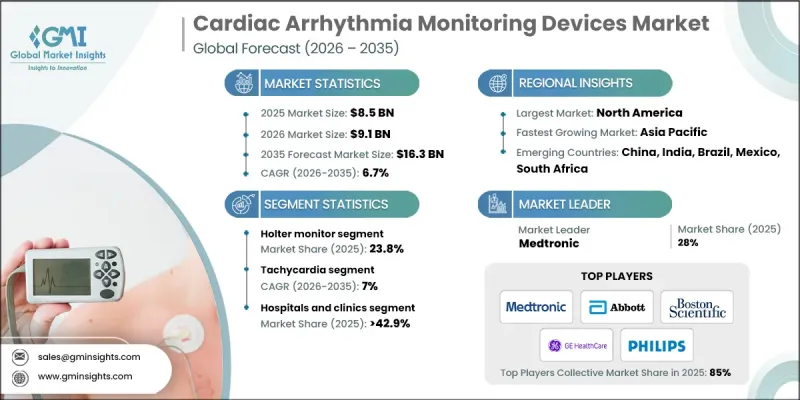
市场成长的驱动力来自心血管疾病盛行率的上升以及对早期检测和持续心律监测日益增长的重视。随着人口老化和慢性心臟病负担的加重,这些设备已成为改善患者预后和预防住院治疗的重要工具。心律不整监测解决方案透过实现即时监测、及时介入和个人化治疗策略,正在重塑心臟护理。与行动应用程式、云端平台和远距医疗系统的集成,使临床医生能够更有效地管理慢性疾病。这些设备对于心律不整高风险患者尤其重要,它们能够提供准确的诊断并辅助治疗决策,最终降低与心臟疾病相关的死亡率。
| 市场范围 | |
|---|---|
| 起始年份 | 2025 |
| 预测年份 | 2026-2035 |
| 起始值 | 85亿美元 |
| 预测值 | 163亿美元 |
| 复合年增长率 | 6.7% |
预计2025年,动态心电图监测仪市占率将达到23.8%。动态心电图监测仪长期以来一直用于在日常活动中持续监测心电图,帮助临床医生发现标准心电图检查可能无法检测到的心律不整。无线连接、紧凑型设计和基于云端的资料共享等创新技术提高了患者的便利性和可及性,推动了该细分市场的成长。
预计2025年至2035年间,心动过速监测设备市场将以7%的复合年增长率成长。该市场涵盖房性心动过速和室性心动过速监测设备。先进疾病监测解决方案的日益普及推动了市场需求,尤其是在老年人群和存在生活方式相关风险因素的人群中,房颤和室性心动过速的病例不断增加。持续监测对于预防中风或心臟骤停等併发症至关重要。
预计2025年,美国心臟心律不整监测设备市场规模将达30亿美元。美国仍然是全球最先进、最成熟的市场之一,这得益于其强大的医疗基础设施、广泛的保险覆盖以及对心血管疾病管理的重视。美国在数位化医疗应用方面的领先地位,包括远距医疗、远距患者监测和整合式医疗模式,加速了心律不整监测设备在临床和居家护理环境中的应用。
目录
第一章:方法论与范围
第二章:执行概要
第三章:行业洞察
- 产业生态系分析
- 供应商格局
- 影响价值链的因素
- 产业影响因素
- 成长驱动因素
- 全球心血管疾病盛行率不断上升,心臟健康支出也不断增加。
- 技术进步和创新心臟节律监测设备的引入
- 行动和遥测式心臟监视器的应用日益普及
- 老年人口基数不断扩大,加上肥胖症盛行率日益上升。
- 产业陷阱与挑战
- 缺乏熟练专业人员
- 植入式和先进监测设备成本高昂
- 市场机会
- 将心臟监测设备与数位健康生态系统整合
- 成长驱动因素
- 成长潜力分析
- 监管环境
- 北美洲
- 欧洲
- 亚太地区
- 技术格局
- 当前技术趋势
- 新兴技术
- 未来市场趋势
- 定价分析
- 专利分析
- 波特的分析
- PESTEL 分析
第四章:竞争格局
- 介绍
- 公司市占率分析
- 全球的
- 北美洲
- 欧洲
- 公司矩阵分析
- 主要市场参与者的竞争分析
- 竞争定位矩阵
- 关键进展
- 併购
- 伙伴关係与合作
- 新产品发布
- 扩张计划
第五章:市场估算与预测:依设备类型划分,2021-2034年
- 动态心电图监测
- 事件记录器
- 移动心臟遥测
- 植入式心臟监测器
- 心电图(ECG)监视器
- 其他设备
第六章:市场估算与预测:依应用领域划分,2021-2034年
- 心跳过速
- 房性心搏过速
- 室性心搏过速
- 心搏过缓
- 早搏
- 其他应用
第七章:市场估算与预测:依最终用途划分,2021-2034年
- 医院和诊所
- 诊断中心
- 门诊手术中心
- 家庭护理机构
- 其他最终用途
第八章:市场估算与预测:依地区划分,2021-2034年
- 北美洲
- 我们
- 加拿大
- 欧洲
- 德国
- 英国
- 法国
- 西班牙
- 义大利
- 荷兰
- 亚太地区
- 中国
- 印度
- 日本
- 澳洲
- 韩国
- 拉丁美洲
- 巴西
- 墨西哥
- 阿根廷
- 中东和非洲
- 南非
- 沙乌地阿拉伯
- 阿联酋
第九章:公司简介
- Abbott Laboratories
- AliveCor
- Applied Cardiac Systems
- Baxter International
- Biotronik
- Biotricity
- Boston Scientific
- FUKUDA DENSHI
- GE Healthcare
- iRhythm Technologies
- Koninklijke Philips
- Medtronic
- Mindray
- Nihon Kohden
- Spacelabs Healthcare
The Global Cardiac Arrhythmia Monitoring Devices Market was valued at USD 8.5 billion in 2025 and is estimated to grow at a CAGR of 6.7% to reach USD 16.3 billion by 2035.
The market is driven by the rising prevalence of cardiovascular disorders and a growing emphasis on early detection and continuous heart rhythm monitoring. With aging populations and the increasing burden of chronic cardiac conditions, these devices have become essential tools for improving patient outcomes and preventing hospitalizations. Cardiac arrhythmia monitoring solutions are reshaping cardiac care by enabling real-time monitoring, timely interventions, and personalized treatment strategies. Integration with mobile apps, cloud platforms, and telehealth systems allows clinicians to manage chronic conditions more effectively. These devices are especially important for patients at higher risk of arrhythmias, providing accurate diagnosis and aiding in treatment decisions, ultimately reducing mortality rates associated with cardiac disorders.
| Market Scope | |
|---|---|
| Start Year | 2025 |
| Forecast Year | 2026-2035 |
| Start Value | $8.5 Billion |
| Forecast Value | $16.3 Billion |
| CAGR | 6.7% |
The Holter monitor segment held a 23.8% share in 2025. Holter monitors have long been used for continuous ECG tracking during daily activities, helping clinicians detect arrhythmias that might not appear in standard ECG tests. Innovations such as wireless connectivity, compact designs, and cloud-based data sharing have improved patient convenience and accessibility, driving growth in this segment.
The tachycardia segment is expected to grow at a CAGR of 7% during 2025-2035. This segment includes atrial tachycardia and ventricular tachycardia monitoring devices. Rising adoption of advanced disease monitoring solutions is fueling demand, particularly due to increasing cases of atrial fibrillation and ventricular tachycardia among elderly populations and individuals with lifestyle-related risk factors. Continuous monitoring is critical for preventing complications such as stroke or sudden cardiac arrest.
U.S. Cardiac Arrhythmia Monitoring Devices Market was valued at USD 3 billion in 2025. The country remains one of the most advanced and mature markets, driven by strong healthcare infrastructure, extensive insurance coverage, and a focus on cardiovascular disease management. Leadership in digital health adoption, including telehealth, remote patient monitoring, and integrated care models, has accelerated the use of arrhythmia monitoring devices in clinical and home-care settings.
Key players in the Global Cardiac Arrhythmia Monitoring Devices Market include AliveCor, Biotricity, FUKUDA DENSHI, Boston Scientific, Medtronic, Applied Cardiac Systems, Nihon Kohden, Spacelabs Healthcare, Abbott Laboratories, GE Healthcare, Biotronik, Koninklijke Philips, Baxter International, iRhythm Technologies, and Mindray. Companies are strengthening their Cardiac Arrhythmia Monitoring Devices Market presence by investing in advanced technology integration, such as wireless connectivity, AI-assisted analytics, and cloud-based monitoring solutions. Strategic collaborations with healthcare providers and telehealth platforms expand market reach and ensure device adoption in both hospital and home settings. Continuous R&D for compact, user-friendly, and highly accurate devices enhances competitiveness. Firms are also focusing on regulatory compliance and certification to facilitate global market entry, while digital marketing and patient education campaigns help drive awareness and adoption of arrhythmia monitoring solutions worldwide.
Table of Contents
Chapter 1 Methodology and Scope
- 1.1 Market scope and definition
- 1.2 Research design
- 1.2.1 Research approach
- 1.2.2 Data collection methods
- 1.3 Data mining sources
- 1.3.1 Global
- 1.3.2 Regional/country
- 1.4 Base estimates and calculations
- 1.4.1 Base year calculation
- 1.4.2 Key trends for market estimation
- 1.5 Primary research and validation
- 1.5.1 Primary sources
- 1.6 Forecast model
- 1.7 Research assumptions and limitations
Chapter 2 Executive Summary
- 2.1 Industry 3600 synopsis
- 2.2 Key market trends
- 2.2.1 Regional trends
- 2.2.2 Device trends
- 2.2.3 Application trends
- 2.2.4 End use trends
- 2.3 CXO perspectives: Strategic imperatives
- 2.3.1 Key decision points for industry executives
- 2.3.2 Critical success factors for market players
- 2.4 Future outlook and strategic recommendations
Chapter 3 Industry Insights
- 3.1 Industry ecosystem analysis
- 3.1.1 Supplier landscape
- 3.1.2 Factors affecting the value chain
- 3.2 Industry impact forces
- 3.2.1 Growth drivers
- 3.2.1.1 Growing prevalence of cardiovascular diseases and expenditure on cardiac health globally
- 3.2.1.2 Technological advancements and introduction of innovative devices for cardiac rhythm monitoring
- 3.2.1.3 Increasing adoption of mobile and telemetry cardiac monitors
- 3.2.1.4 Expanding geriatric population base coupled with growing prevalence of obesity
- 3.2.2 Industry pitfalls and challenges
- 3.2.2.1 Lack of skilled professionals
- 3.2.2.2 High cost of implantable and advanced monitoring devices
- 3.2.3 Market opportunities
- 3.2.3.1 Integration of cardiac monitoring devices with digital health ecosystems
- 3.2.1 Growth drivers
- 3.3 Growth potential analysis
- 3.4 Regulatory landscape
- 3.4.1 North America
- 3.4.2 Europe
- 3.4.3 Asia Pacific
- 3.5 Technology landscape
- 3.5.1 Current technological trends
- 3.5.2 Emerging technologies
- 3.6 Future market trends
- 3.7 Pricing analysis
- 3.8 Patent analysis
- 3.9 Porter's analysis
- 3.10 PESTEL analysis
Chapter 4 Competitive Landscape, 2024
- 4.1 Introduction
- 4.2 Company market share analysis
- 4.2.1 Global
- 4.2.2 North America
- 4.2.3 Europe
- 4.3 Company matrix analysis
- 4.4 Competitive analysis of major market players
- 4.5 Competitive positioning matrix
- 4.6 Key developments
- 4.6.1 Merger and acquisition
- 4.6.2 Partnership and collaboration
- 4.6.3 New product launches
- 4.6.4 Expansion plans
Chapter 5 Market Estimates and Forecast, By Device Type, 2021 - 2034 ($ Mn)
- 5.1 Key trends
- 5.2 Holter monitor
- 5.3 Event recorder
- 5.4 Mobile cardiac telemetry
- 5.5 Implantable cardiac monitor
- 5.6 Electrocardiogram (ECG) monitor
- 5.7 Other devices
Chapter 6 Market Estimates and Forecast, By Application, 2021 - 2034 ($ Mn)
- 6.1 Key trends
- 6.2 Tachycardia
- 6.2.1 Atrial tachycardia
- 6.2.2 Ventricular tachycardia
- 6.3 Bradycardia
- 6.4 Premature contraction
- 6.5 Other applications
Chapter 7 Market Estimates and Forecast, By End Use, 2021 - 2034 ($ Mn)
- 7.1 Key trends
- 7.2 Hospitals and clinics
- 7.3 Diagnostic centers
- 7.4 Ambulatory surgical centers
- 7.5 Homecare settings
- 7.6 Other end use
Chapter 8 Market Estimates and Forecast, By Region, 2021 - 2034 ($ Mn)
- 8.1 Key trends
- 8.2 North America
- 8.2.1 U.S.
- 8.2.2 Canada
- 8.3 Europe
- 8.3.1 Germany
- 8.3.2 UK
- 8.3.3 France
- 8.3.4 Spain
- 8.3.5 Italy
- 8.3.6 Netherlands
- 8.4 Asia Pacific
- 8.4.1 China
- 8.4.2 India
- 8.4.3 Japan
- 8.4.4 Australia
- 8.4.5 South Korea
- 8.5 Latin America
- 8.5.1 Brazil
- 8.5.2 Mexico
- 8.5.3 Argentina
- 8.6 Middle East and Africa
- 8.6.1 South Africa
- 8.6.2 Saudi Arabia
- 8.6.3 UAE
Chapter 9 Company Profiles
- 9.1 Abbott Laboratories
- 9.2 AliveCor
- 9.3 Applied Cardiac Systems
- 9.4 Baxter International
- 9.5 Biotronik
- 9.6 Biotricity
- 9.7 Boston Scientific
- 9.8 FUKUDA DENSHI
- 9.9 GE Healthcare
- 9.10 iRhythm Technologies
- 9.11 Koninklijke Philips
- 9.12 Medtronic
- 9.13 Mindray
- 9.14 Nihon Kohden
- 9.15 Spacelabs Healthcare

 2026年全球心臟心律不整监测设备市场报告2026年全球心臟心律不整监测设备市场报告
 便携式心律不整监测设备市场规模、占有率、成长、全球产业分析:依类型、应用、区域洞察、预测(2026-2034 年)
 心臟心律不整监测设备-市场趋势、竞争格局及至2032年预测
 心臟心律不整监测设备市场依产品类型、最终用户、通路、连接方式、技术和价格分布范围划分-2025年至2032年全球预测
 心律不整监测设备市场预测(至 2032 年):按产品类型、应用、最终用户和地区进行的全球分析全球心律不整治疗设备市场研究报告 - 产业分析、规模、份额、成长、趋势及预测(2025 年至 2033 年)
 心律不整监测设备市场(依产品类型、应用、最终用户和地区)
 心臟心律不整监测设备的全球市场:产业分析,规模,占有率,成长,趋势,预测(2024年~2031年)
 心律不整监测设备市场规模、份额、趋势分析报告:按产品、应用、最终用途、地区和细分市场预测,2024-2030 年