


 |
市场调查报告书
商品编码
1892804
直升机市场机会、成长驱动因素、产业趋势分析及预测(2026-2035年)Helicopter Market Opportunity, Growth Drivers, Industry Trend Analysis, and Forecast 2026 - 2035 |
||||||

2025年全球直升机市场价值为343亿美元,预计到2035年将以7%的复合年增长率增长至665亿美元。
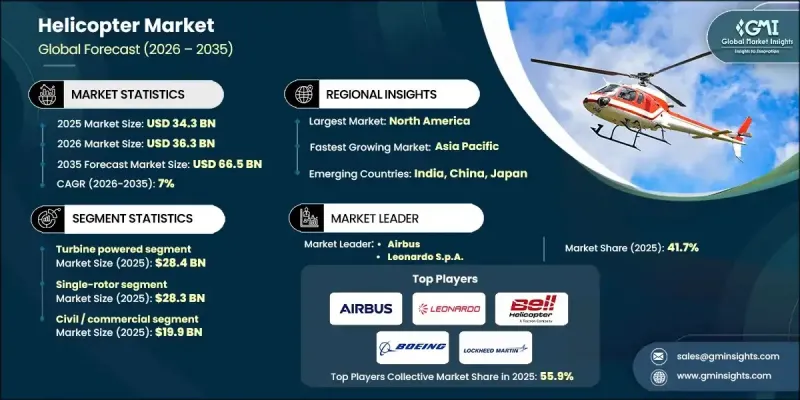
市场扩张的驱动力包括不断增长的军事费用和国防预算、直升机设计和技术的进步,以及空中救护服务的日益普及。休閒飞行和直升机观光需求的成长也进一步促进了市场发展。直升机在紧急医疗运输中发挥着至关重要的作用,能够将患者快速转运到其他方式难以及时获得医疗救助的地区。全球对紧急应变和时间紧迫的医疗干预的重视,使得直升机变得不可或缺。製造商正致力于开发高性能、高效率、高可靠性的直升机,以满足商业、军事和医疗领域的需求,同时,材料和燃油效率的创新也不断塑造着产业的未来。
| 市场范围 | |
|---|---|
| 起始年份 | 2025 |
| 预测年份 | 2026-2035 |
| 起始值 | 343亿美元 |
| 预测值 | 665亿美元 |
| 复合年增长率 | 7% |
2024年,涡轮动力领域市场规模将达284亿美元。涡轮发动机的需求主要源自于其可靠性、高效性和高功率输出,尤其是在军事、商业和紧急行动领域。製造商正致力于提高涡轮引擎的效率、优化燃油消耗,并采用先进材料来提升性能,同时控製成本。
预计2025年,单旋翼直升机市场规模将达283亿美元。卓越的燃油效率、灵活性和整体性能是推动其普及的关键因素。製造商正致力于整合先进材料、优化旋翼设计并采用经济高效的解决方案,以提高单旋翼直升机的营运效率和性能。
预计2025年,美国直升机市场规模将达到120亿美元。航空领域的技术领先优势、能源产业海上作业的日益增长以及私人直升机在个人用途中的普及,都将推动市场成长。各公司正致力于研发自主飞行技术、提升海上作业的燃油效率,并设计性能、安全性和豪华配置更优的客製化直升机,以满足美国市场的需求。
目录
第一章:方法论与范围
第二章:执行概要
第三章:行业洞察
- 产业生态系分析
- 供应商格局
- 利润率
- 成本结构
- 每个阶段的价值增加
- 影响价值链的因素
- 中断
- 产业影响因素
- 成长驱动因素
- 增加军事和国防开支
- 直升机设计和系统的技术进步
- 紧急医疗服务的重要性日益凸显
- 城市空中交通(UAM)的兴起
- 人们对直升机观光和休閒飞行越来越感兴趣
- 产业陷阱与挑战
- 直升机营运成本高
- 短途运输能力有限
- 市场机会
- 自主技术的集成
- 电动直升机技术的进步
- 成长驱动因素
- 成长潜力分析
- 监管环境
- 北美洲
- 欧洲
- 亚太地区
- 拉丁美洲
- 中东和非洲
- 波特的分析
- PESTEL 分析
- 技术与创新格局
- 当前技术趋势
- 新兴技术
- 新兴商业模式
- 合规要求
- 国防预算分析
- 全球国防开支趋势
- 区域国防预算分配
- 北美洲
- 欧洲
- 亚太地区
- 中东和非洲
- 拉丁美洲
- 关键国防现代化项目
- 预算预测(2025-2034 年)
- 对产业成长的影响
- 各国国防预算
- 供应链韧性
- 地缘政治分析
- 劳动力分析
- 数位转型
- 併购和策略合作格局
- 风险评估与管理
- 主要合约授予情况(2021-2024 年)
第四章:竞争格局
- 介绍
- 公司市占率分析
- 按地区
- 北美洲
- 欧洲
- 亚太地区
- 拉丁美洲
- 中东和非洲
- 市场集中度分析
- 按地区
- 对主要参与者进行竞争基准分析
- 财务绩效比较
- 收入
- 利润率
- 研发
- 产品组合比较
- 产品范围广度
- 科技
- 创新
- 地理位置比较
- 全球足迹分析
- 服务网路覆盖
- 按地区分類的市场渗透率
- 竞争定位矩阵
- 领导人
- 挑战者
- 追踪者
- 小众玩家
- 战略展望矩阵
- 财务绩效比较
- 2021-2024 年主要发展动态
- 併购
- 伙伴关係与合作
- 技术进步
- 扩张和投资策略
- 永续发展倡议
- 数位转型计划
- 新兴/新创企业竞争对手格局
第五章:市场估算与预测:依引擎类型划分,2022-2035年
- 活塞式动力
- 涡轮动力
第六章:市场估算与预测:依转子类型划分,2022-2035年
- 单转子
- 双旋翼/同轴
- 倾转旋翼机
第七章:市场估算与预测:以重量计,2022-2035年
- 轻型直升机(≤3,000公斤)
- 中型直升机(3,001-7,000公斤)
- 重型直升机(>7,000公斤)
第八章:市场估算与预测:依推进类型划分,2022-2035年
- 传统燃料动力
- 混合动力/电动
第九章:市场估算与预测:依区间划分,2022-2035年
- 短程(≤300公里)
- 中程(301-800公里)
- 远程(>800公里)
第十章:市场估价与预测:依销售管道划分,2022-2035年
- OEM (原始设备製造商)
- 维护、修理和大修 (MRO)
第十一章:市场估计与预测:依最终用途产业划分,2022-2035年
- 民/商事
- 运输/客运服务
- 医疗服务/搜救(EMS/SAR)
- 海上作业
- 旅游休閒
- 其他的
- 军队
- 侦察
- 海上监视
- 攻击/战斗
- 运输/部队调动
- 其他的
第十二章:市场估算与预测:依地区划分,2022-2035年
- 北美洲
- 我们
- 加拿大
- 欧洲
- 德国
- 英国
- 法国
- 西班牙
- 义大利
- 荷兰
- 亚太地区
- 中国
- 印度
- 日本
- 澳洲
- 韩国
- 拉丁美洲
- 巴西
- 墨西哥
- 阿根廷
- 中东和非洲
- 沙乌地阿拉伯
- 南非
- 阿联酋
第十三章:公司简介
- 全球关键参与者
- Airbus
- Boeing
- Lockheed Martin Corporation (Sikorsky brand)
- Textron, Inc. (Bell Helicopter)
- 区域关键参与者
- 北美洲
- Columbia Helicopters, LLC
- Kaman Corporation
- MD Helicopters LLC
- Robinson Helicopter Company
- 欧洲
- Leonardo SpA
- Enstrom Helicopter Corporation
- Helicopteres Guimbal SAS
- Asia-Pacific
- Hindustan Aeronautics Limited (HAL)
- Mitsubishi Heavy Industries, Ltd.
- Kawasaki Heavy Industries, Ltd.
- 北美洲
- 颠覆者/小众玩家
- Korea Aerospace Industries, Ltd.
- Subaru Corporation
- Alpi Aviation SRL
- DB Aerocopter Ltd.
- Schweizer
- Hiller Aircraft Corporation
- Karem Aircraft, Inc.
The Global Helicopter Market was valued at USD 34.3 billion in 2025 and is estimated to grow at a CAGR of 7% to reach USD 66.5 billion by 2035.
The expansion of the market is driven by rising military and defense budgets, advancements in helicopter design and technology, and the growing availability of air ambulance services. Increased demand for leisure flights and helicopter tours is further contributing to market growth. Helicopters play a critical role in emergency medical transport, enabling rapid patient transfer to locations where timely medical care is otherwise inaccessible. The global emphasis on emergency response and time-sensitive medical interventions has made helicopters indispensable. Manufacturers are focusing on developing high-performance, efficient, and reliable helicopters to meet the needs of commercial, military, and medical sectors, while innovations in materials and fuel efficiency continue to shape the industry's future.
| Market Scope | |
|---|---|
| Start Year | 2025 |
| Forecast Year | 2026-2035 |
| Start Value | $34.3 Billion |
| Forecast Value | $66.5 Billion |
| CAGR | 7% |
The turbine-powered segment generated USD 28.4 billion in 2024. The demand for turbine engines is fueled by their reliability, efficiency, and high power output, particularly in military, commercial, and emergency operations. Manufacturers are emphasizing turbine engine efficiency, fuel consumption optimization, and the use of advanced materials to enhance performance while managing costs.
The single-rotor segment generated USD 28.3 billion in 2025. Superior fuel efficiency, flexibility, and overall performance drive its adoption. Manufacturers are prioritizing the integration of advanced materials, optimized rotor designs, and cost-effective solutions to improve both operational efficiency and performance in single-rotor helicopters.
U.S. Helicopter Market reached USD 12 billion in 2025. Market growth is supported by technological leadership in aviation, rising offshore operations for energy sectors, and the increasing adoption of private helicopters for personal use. Companies are focusing on autonomous flight technologies, fuel efficiency for offshore missions, and designing customized helicopters with enhanced performance, safety, and luxury features to cater to U.S. demand.
Key players in the Global Helicopter Market include Karem Aircraft, Inc., Leonardo S.p.A., Alpi Aviation SRL, MD Helicopters LLC, Hindustan Aeronautics Limited (HAL), Columbia Helicopters, LLC, KOREA AEROSPACE INDUSTRIES, LTD., Textron, Inc. (Bell Helicopter), Robinson Helicopter Company, Airbus, Hiller Aircraft Corporation, Lockheed Martin Corporation (Sikorsky brand), Enstrom Helicopter Corporation, Mitsubishi Heavy Industries, Ltd., Kaman Corporation, DB Aerocopter Ltd., Schweizer, Helicopteres Guimbal S.A.S, Kawasaki Heavy Industries, Ltd., and Subaru Corporation. Companies in the Global Helicopter Market are strengthening their position through a combination of strategies focused on innovation, operational efficiency, and market expansion. Key approaches include investing heavily in research and development to enhance turbine engine performance, fuel efficiency, and safety systems. Manufacturers are exploring lightweight, high-strength materials and integrating advanced avionics and autonomous flight technologies. Strategic partnerships with military, emergency, and commercial operators help expand market reach, while tailored offerings for private and luxury helicopter segments enhance brand differentiation.
Table of Contents
Chapter 1 Methodology and scope
- 1.1 Market scope and definition
- 1.2 Research design
- 1.2.1 Research approach
- 1.2.2 Data collection methods
- 1.3 Data mining sources
- 1.3.1 Global
- 1.3.2 Regional/Country
- 1.4 Base estimates and calculations
- 1.4.1 Base year calculation
- 1.4.2 Key trends for market estimation
- 1.5 Primary research and validation
- 1.5.1 Primary sources
- 1.6 Forecast model
- 1.7 Research assumptions and limitations
Chapter 2 Executive Summary
- 2.1 Industry snapshot
- 2.2 Key market trends
- 2.2.1 Engine type trends
- 2.2.2 Rotor type trends
- 2.2.3 Weight trends
- 2.2.4 Propulsion type trends
- 2.2.5 Range trends
- 2.2.6 Sales channel trends
- 2.2.7 End use trends
- 2.2.8 Regional
- 2.3 TAM Analysis, 2025-2034 (USD Million)
- 2.4 CXO perspectives: Strategic imperatives
- 2.4.1 Executive decision points
- 2.4.2 critical success factors
- 2.5 Future outlook and strategic recommendations
Chapter 3 Industry Insights
- 3.1 Industry ecosystem analysis
- 3.1.1 Supplier landscape
- 3.1.2 Profit margin
- 3.1.3 Cost structure
- 3.1.4 Value addition at each stage
- 3.1.5 Factor affecting the value chain
- 3.1.6 Disruptions
- 3.2 Industry impact forces
- 3.2.1 Growth drivers
- 3.2.1.1 Increasing military and defense expenditures
- 3.2.1.2 Technological advancements in helicopter design and systems
- 3.2.1.3 Growing importance of emergency medical services
- 3.2.1.4 Rising urban air mobility (UAM)
- 3.2.1.5 Growing interest in helicopter tours and leisure flights
- 3.2.2 Industry pitfalls and challenges
- 3.2.2.1 High operational cost of helicopters
- 3.2.2.2 Limited short-range transportation
- 3.2.3 Market opportunities
- 3.2.3.1 Integration of autonomous technology
- 3.2.3.2 Advancements in electric helicopters
- 3.2.1 Growth drivers
- 3.3 Growth potential analysis
- 3.4 Regulatory landscape
- 3.4.1 North America
- 3.4.2 Europe
- 3.4.3 Asia Pacific
- 3.4.4 Latin America
- 3.4.5 Middle East & Africa
- 3.5 Porter's analysis
- 3.6 PESTEL analysis
- 3.7 Technology and innovation landscape
- 3.7.1 Current technological trends
- 3.7.2 Emerging technologies
- 3.8 Emerging business models
- 3.9 Compliance requirements
- 3.10 Defense Budget Analysis
- 3.11 Global Defense Spending Trends
- 3.12 Regional Defense Budget Allocation
- 3.12.1 North America
- 3.12.2 Europe
- 3.12.3 Asia Pacific
- 3.12.4 Middle East and Africa
- 3.12.5 Latin America
- 3.13 Key Defense Modernization Programs
- 3.14 Budget Forecast (2025-2034)
- 3.14.1 Impact on Industry Growth
- 3.14.2 Defense Budgets by Country
- 3.15 Supply Chain Resilience
- 3.16 Geopolitical Analysis
- 3.17 Workforce Analysis
- 3.18 Digital Transformation
- 3.19 Mergers, Acquisitions, and Strategic Partnerships Landscape
- 3.20 Risk Assessment and Management
- 3.21 Major Contract Awards (2021-2024)
Chapter 4 Competitive Landscape, 2024
- 4.1 Introduction
- 4.2 Company market share analysis
- 4.2.1 By region
- 4.2.1.1 North America
- 4.2.1.2 Europe
- 4.2.1.3 Asia Pacific
- 4.2.1.4 Latin America
- 4.2.1.5 Middle East & Africa
- 4.2.2 Market Concentration Analysis
- 4.2.1 By region
- 4.3 Competitive benchmarking of key players
- 4.3.1 Financial performance comparison
- 4.3.1.1 Revenue
- 4.3.1.2 Profit margin
- 4.3.1.3 R&D
- 4.3.2 Product portfolio comparison
- 4.3.2.1 Product range breadth
- 4.3.2.2 Technology
- 4.3.2.3 Innovation
- 4.3.3 Geographic presence comparison
- 4.3.3.1 Global footprint analysis
- 4.3.3.2 Service network coverage
- 4.3.3.3 Market penetration by region
- 4.3.4 Competitive positioning matrix
- 4.3.4.1 Leaders
- 4.3.4.2 Challengers
- 4.3.4.3 Followers
- 4.3.4.4 Niche players
- 4.3.5 Strategic outlook matrix
- 4.3.1 Financial performance comparison
- 4.4 Key developments, 2021-2024
- 4.4.1 Mergers and acquisitions
- 4.4.2 Partnerships and collaborations
- 4.4.3 Technological advancements
- 4.4.4 Expansion and investment strategies
- 4.4.5 Sustainability initiatives
- 4.4.6 Digital transformation initiatives
- 4.5 Emerging/ startup competitors landscape
Chapter 5 Market estimates and forecast, by Engine Type, 2022 - 2035 (USD Million)
- 5.1 Key trends
- 5.2 Piston-powered
- 5.3 Turbine-powered
Chapter 6 Market estimates and forecast, By Rotor Type, 2022 - 2035 (USD Million)
- 6.1 Key trends
- 6.2 Single rotor
- 6.3 Twin-rotor / coaxial
- 6.4 Tiltrotor
Chapter 7 Market estimates and forecast, By Weight, 2022 - 2035 (USD Million)
- 7.1 Key trends
- 7.2 Light helicopters (≤3,000 kg)
- 7.3 Medium helicopters (3,001-7,000 kg)
- 7.4 Heavy helicopters (>7,000 kg)
Chapter 8 Market estimates and forecast, By Propulsion Type, 2022 - 2035 (USD Million)
- 8.1 Key trends
- 8.2 Conventional fuel-powered
- 8.3 Hybrid-electric / electric
Chapter 9 Market estimates and forecast, By Range, 2022 - 2035 (USD Million)
- 9.1 Key trends
- 9.2 Short-range (≤300 km)
- 9.3 Medium-range (301-800 km)
- 9.4 Long-range (>800 km)
Chapter 10 Market estimates and forecast, By Sales Channel, 2022 - 2035 (USD Million)
- 10.1 Key trends
- 10.2 OEM (original equipment manufacturer)
- 10.3 Maintenance, repair, and overhaul (MRO)
Chapter 11 Market estimates and forecast, By End Use Industry, 2022 - 2035 (USD Million)
- 11.1 Key trends
- 11.2 Civil / commercial
- 11.2.1 Transport / passenger services
- 11.2.2 Medical services / search & rescue (EMS/SAR)
- 11.2.3 Offshore operations
- 11.2.4 Tourism & leisure
- 11.2.5 Others
- 11.3 Military
- 11.3.1 Reconnaissance
- 11.3.2 Maritime surveillance
- 11.3.3 Attack / combat
- 11.3.4 Transport / troop movement
- 11.3.5 Others
Chapter 12 Market estimates and forecast, By Region, 2022 - 2035 (USD Million)
- 12.1 Key trends
- 12.2 North America
- 12.2.1 U.S.
- 12.2.2 Canada
- 12.3 Europe
- 12.3.1 Germany
- 12.3.2 UK
- 12.3.3 France
- 12.3.4 Spain
- 12.3.5 Italy
- 12.3.6 Netherlands
- 12.4 Asia Pacific
- 12.4.1 China
- 12.4.2 India
- 12.4.3 Japan
- 12.4.4 Australia
- 12.4.5 South Korea
- 12.5 Latin America
- 12.5.1 Brazil
- 12.5.2 Mexico
- 12.5.3 Argentina
- 12.6 Middle East and Africa
- 12.6.1 Saudi Arabia
- 12.6.2 South Africa
- 12.6.3 UAE
Chapter 13 Company profiles
- 13.1 Global Key Players
- 13.1.1 Airbus
- 13.1.2 Boeing
- 13.1.3 Lockheed Martin Corporation (Sikorsky brand)
- 13.1.4 Textron, Inc. (Bell Helicopter)
- 13.2 Regional Key Players
- 13.2.1 North America
- 13.2.1.1 Columbia Helicopters, LLC
- 13.2.1.2 Kaman Corporation
- 13.2.1.3 MD Helicopters LLC
- 13.2.1.4 Robinson Helicopter Company
- 13.2.2 Europe
- 13.2.2.1 Leonardo S.p.A.
- 13.2.2.2 Enstrom Helicopter Corporation
- 13.2.2.3 Helicopteres Guimbal S.A.S
- 13.2.3 Asia-Pacific
- 13.2.3.1 Hindustan Aeronautics Limited (HAL)
- 13.2.3.2 Mitsubishi Heavy Industries, Ltd.
- 13.2.3.3 Kawasaki Heavy Industries, Ltd.
- 13.2.1 North America
- 13.3 Disruptors / Niche Players
- 13.3.1 Korea Aerospace Industries, Ltd.
- 13.3.2 Subaru Corporation
- 13.3.3 Alpi Aviation SRL
- 13.3.4 DB Aerocopter Ltd.
- 13.3.5 Schweizer
- 13.3.6 Hiller Aircraft Corporation
- 13.3.7 Karem Aircraft, Inc.

 直升机市场:依型号、零件、推进系统、重量等级及应用划分-2026-2032年全球市场预测
 2026年全球电网模拟器市场报告2026年全球民用涡流直升机市场报告
 直升机市场规模、份额、成长及全球产业分析:按类型、应用和地区划分-2026-2034年洞察与预测直升机服务市场规模、份额、成长及全球产业分析:按类型、应用和地区划分,并预测至2026-2034年商用直升机市场规模、份额、成长率及全球产业分析:按类型、应用和地区划分,并预测至2026-2034年
 民用直升机市场 - 全球产业规模、份额、趋势、机会、预测:按重量类型、发动机类型、应用类型、地区和竞争格局划分,2021-2031年直升机市场-全球产业规模、份额、趋势、机会、预测:按类型、发动机类型、重量、应用、地区和竞争格局划分,2021-2031年
 民用直升机市场规模、份额和成长分析(按类型、发动机类型、应用、最终用户和地区划分)—产业预测,2026-2033年
 直升机服务市场规模、份额和成长分析(按服务类型、应用、最终用户、负载容量和地区划分)-2026-2033年产业预测