


 |
市场调查报告书
商品编码
1892816
充血性心臟衰竭药物市场机会、成长驱动因素、产业趋势分析及预测(2025-2034年)Congestive Heart Failure Drugs Market Opportunity, Growth Drivers, Industry Trend Analysis, and Forecast 2025 - 2034 |
||||||

2024 年全球充血性心臟衰竭药物市场价值为 180 亿美元,预计到 2034 年将以 10.5% 的复合年增长率增长至 539 亿美元。
市场成长主要受心臟衰竭盛行率上升、药物研发进展以及指南指导的药物治疗推广的推动。 SGLT2抑制剂和ARNI等新型药物的日益普及,以及ACE抑制剂、β受体阻断剂和利尿剂等成熟疗法的应用,正在改善患者的生存预后并减少住院次数,从而扩大潜在患者群体。远距医疗和远距监测的日益普及,使得早期介入、更精准的治疗方案优化和更好的长期依从性成为可能,进而提升了药物在急性和慢性照护中的利用率。此外,製药公司正大力推动在研药物创新、联合疗法以及扩大适应症范围(涵盖更广泛的心臟衰竭表型)等方面的研发,这将进一步推动市场在预测期内持续成长。
| 市场范围 | |
|---|---|
| 起始年份 | 2024 |
| 预测年份 | 2025-2034 |
| 起始值 | 180亿美元 |
| 预测值 | 539亿美元 |
| 复合年增长率 | 10.5% |
充血性心臟衰竭药物市场主要依给药途径划分,其中口服药物在2024年占76.3%的市占率。口服疗法因其便利性、易于自我给药、给药成本较低以及适合长期居家管理慢性心臟衰竭等优点而备受青睐。缓释製剂、每日一次製剂和固定剂量复方製剂简化了复杂的治疗方案,提高了合併多种疾病患者的依从性和治疗效果。此外,ACE抑制剂、β受体阻断剂和SGLT2抑制剂等强效口服药物的日益普及,进一步巩固了该细分市场在门诊和远距医疗模式下的主导地位。
按配销通路,医院药房在2024年创造了312亿美元的收入,这主要得益于大量需要强化、标准化治疗的急性失代偿性心臟衰竭病例。这些场所需要管理复杂的静脉注射正性肌力药物、利尿剂以及血管紧张素受体-脑啡肽酶抑制剂(ARNI)和SGLT2抑制剂等先进疗法,从而导致大量的药物消耗,并使医院药房成为启动和优化治疗的关键节点。
2024 年,北美充血性心臟衰竭药物市场占 53.9% 的份额。这一主导地位得益于庞大的确诊患者群体、创新疗法的早期应用、强有力的报销框架以及强大的临床研究基础设施,这些都加速了指南的更新和新分子的应用。
目录
第一章:方法论与范围
第二章:执行概要
第三章:行业洞察
- 产业生态系分析
- 产业影响因素
- 成长驱动因素
- 心臟衰竭盛行率上升
- 药物研发进展
- 提高意识和筛检
- 产业陷阱与挑战
- 严格的监管审批
- 先进药物价格昂贵
- 产业陷阱与挑战
- 新药类别的开发
- 远距医疗和远端监测在充血性心臟衰竭管理中的整合
- 成长驱动因素
- 成长潜力分析
- 监管环境
- 北美洲
- 我们
- 加拿大
- 欧洲
- 亚太地区
- 拉丁美洲
- 中东和非洲
- 北美洲
- 技术格局
- 当前技术趋势
- 新兴技术
- 管道分析
- 未来市场趋势
- 波特的分析
- PESTEL 分析
第四章:竞争格局
- 介绍
- 公司市占率分析
- 全球的
- 北美洲
- 欧洲
- 亚太地区
- 公司矩阵分析
- 主要市场参与者的竞争分析
- 竞争定位矩阵
- 关键进展
第五章:市场估计与预测:依药物类别划分,2021-2034年
- ACE抑制剂
- β受体阻断剂
- 利尿剂
- 血管张力素II受体阻断剂
- 盐皮质激素受体拮抗剂(MRA)
- 血管张力素受体脑啡肽酶抑制剂 (ARNI)
- 正性肌力药
- SGLT2抑制剂
- 其他药物类别
第六章:市场估计与预测:依给药途径划分,2021-2034年
- 口服
- 肠外
第七章:市场估算与预测:依类型划分,2021-2034年
- 品牌
- 通用的
第八章:市场估算与预测:依配销通路划分,2021-2034年
- 医院药房
- 零售药局
- 网路药局
第九章:市场估计与预测:依地区划分,2021-2034年
- 北美洲
- 我们
- 加拿大
- 欧洲
- 德国
- 英国
- 法国
- 义大利
- 西班牙
- 荷兰
- 亚太地区
- 中国
- 日本
- 印度
- 澳洲
- 韩国
- 拉丁美洲
- 巴西
- 墨西哥
- 阿根廷
- 中东和非洲
- 南非
- 沙乌地阿拉伯
- 阿联酋
第十章:公司简介
- Alnylam Pharmaceuticals
- Amgen
- AstraZeneca
- Bayer
- Boehringer Ingelheim International
- Bristol-Myers Squibb Company
- Eli Lilly and Company
- GlaxoSmithKline
- Johnson & Johnson
- Merck
- Novartis
- Otsuka Pharmaceutical
- Pfizer
- Sanofi
- Teva Pharmaceutical Industries
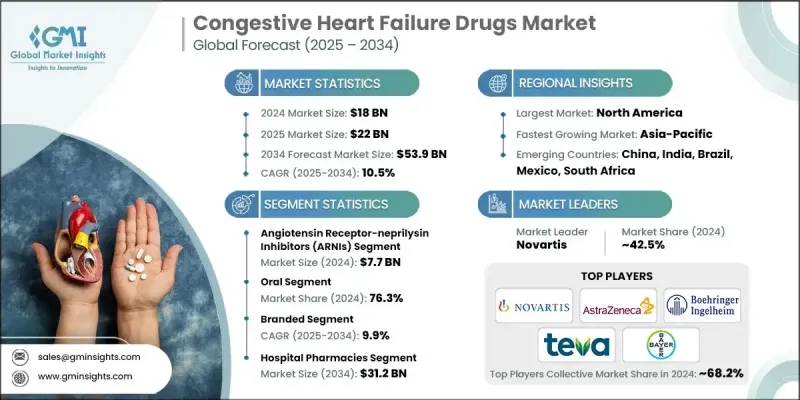
The Global Congestive Heart Failure Drugs Market was valued at USD 18 billion in 2024 and is estimated to grow at a CAGR of 10.5% to reach USD 53.9 billion by 2034.
Market growth is driven by the rising prevalence of heart failure, advances in drug development, and the expansion of guideline-directed medical therapy. Growing adoption of novel classes such as SGLT2 inhibitors and ARNIs, alongside established therapies like ACE inhibitors, beta-blockers, and diuretics, is improving survival outcomes and reducing hospitalizations, thereby expanding the addressable patient pool. Increasing integration of telemedicine and remote monitoring is enabling earlier intervention, tighter therapy optimization, and better long-term adherence, which in turn is boosting drug utilization across acute and chronic care settings. Pharmaceutical companies are also focusing heavily on pipeline innovation, combination therapies, and label expansions into broader heart failure phenotypes, further accelerating market momentum over the forecast horizon.
| Market Scope | |
|---|---|
| Start Year | 2024 |
| Forecast Year | 2025-2034 |
| Start Value | $18 Billion |
| Forecast Value | $53.9 Billion |
| CAGR | 10.5% |
The Congestive Heart Failure Drugs Market is primarily segmented by route of administration, where the oral segment held 76.3% in 2024. Oral therapies are preferred due to their convenience, ease of self-administration, lower administration costs, and suitability for long-term, home-based management of chronic heart failure. Extended-release, once-daily, and fixed-dose combination formulations simplify complex regimens, improving adherence and outcomes for patients managing multiple comorbidities. In addition, the expanding availability of potent oral agents such as ACE inhibitors, beta-blockers, and SGLT2 inhibitors reinforces the dominance of this segment in both outpatient and telemedicine-enabled care models.
By distribution channel, the hospital pharmacies segment generated USD 31.2 billion in 2024, underpinned by the high burden of acute decompensated heart failure cases requiring intensive, protocol-driven therapy. These settings manage complex combinations of intravenous inotropes, diuretics, and advanced therapies like ARNIs and SGLT2 inhibitors, driving substantial drug consumption and positioning hospital pharmacies as a critical node in treatment initiation and optimization.
North America Congestive Heart Failure Drugs Market held a 53.9% share in 2024. This dominance is supported by a high diagnosed patient base, early adoption of innovative therapies, strong reimbursement frameworks, and robust clinical research infrastructure that accelerates guideline updates and uptake of new molecules.
Key companies operating in the Global Congestive Heart Failure Drugs Market include Novartis, AstraZeneca, Boehringer Ingelheim, Bayer, Teva Pharmaceutical, Pfizer, Sanofi, Johnson & Johnson, GlaxoSmithKline, Merck & Co., Merck KGaA, Lexicon Pharmaceuticals, Zensun Sci & Tech, Amgen, and AdvaCare Pharma, which collectively shape the competitive landscape through extensive portfolios, global commercial footprints, and active R&D strategies. In the Congestive Heart Failure Drugs Market, leading companies are adopting a mix of product innovation, lifecycle management, strategic collaborations, and geographic expansion to strengthen their market foothold. Many players are investing heavily in R&D for novel mechanisms of action, including SGLT2 inhibitors, ARNI-based combinations, vasodilators, and other advanced drug classes, while also pursuing label expansions into broader heart failure populations such as HFpEF and patients with comorbid diabetes or chronic kidney disease.
Table of Contents
Chapter 1 Methodology and Scope
- 1.1 Market scope and definition
- 1.2 Research design
- 1.2.1 Research approach
- 1.2.2 Data collection methods
- 1.3 Data mining sources
- 1.3.1 Global
- 1.3.2 Regional/Country
- 1.4 Base estimates and calculations
- 1.4.1 Base year calculation
- 1.4.2 Key trends for market estimation
- 1.5 Primary research and validation
- 1.5.1 Primary sources
- 1.6 Forecast model
- 1.7 Research assumptions and limitations
Chapter 2 Executive Summary
- 2.1 Industry 360° synopsis
- 2.2 Key market trends
- 2.2.1 Regional trends
- 2.2.2 Drug class trends
- 2.2.3 Route of administration trends
- 2.2.4 Type trends
- 2.2.5 Distribution channel trends
- 2.3 CXO perspectives: Strategic imperatives
- 2.3.1 Key decision points for industry executives
- 2.3.2 Critical success factors for market players
- 2.4 Future outlook and strategic recommendations
Chapter 3 Industry Insights
- 3.1 Industry ecosystem analysis
- 3.2 Industry impact forces
- 3.2.1 Growth drivers
- 3.2.1.1 Rising prevalence of heart failure
- 3.2.1.2 Advancements in drug development
- 3.2.1.3 Increasing awareness and screening
- 3.2.2 Industry pitfalls and challenges
- 3.2.2.1 Stringent regulatory approval
- 3.2.2.2 High cost of advanced medications
- 3.2.3 Industry pitfalls and challenges
- 3.2.3.1 Development of novel drug classes
- 3.2.3.2 Integration of telemedicine and remote monitoring for CHF management
- 3.2.1 Growth drivers
- 3.3 Growth potential analysis
- 3.4 Regulatory landscape
- 3.4.1 North America
- 3.4.1.1 U.S.
- 3.4.1.2 Canada
- 3.4.2 Europe
- 3.4.3 Asia Pacific
- 3.4.4 Latin America
- 3.4.5 Middle East and Africa
- 3.4.1 North America
- 3.5 Technology landscape
- 3.5.1 Current technological trends
- 3.5.2 Emerging technologies
- 3.6 Pipeline analysis
- 3.7 Future market trends
- 3.8 Porter's analysis
- 3.9 PESTEL analysis
Chapter 4 Competitive Landscape, 2024
- 4.1 Introduction
- 4.2 Company market share analysis
- 4.2.1 Global
- 4.2.2 North America
- 4.2.3 Europe
- 4.2.4 Asia Pacific
- 4.3 Company matrix analysis
- 4.4 Competitive analysis of major market players
- 4.5 Competitive positioning matrix
- 4.6 Key developments
Chapter 5 Market Estimates and Forecast, By Drug Class, 2021 - 2034 ($ Mn)
- 5.1 Key trends
- 5.2 ACE inhibitors
- 5.3 Beta blockers
- 5.4 Diuretics
- 5.5 Angiotensin 2 receptor blockers
- 5.6 Mineralocorticoid receptor antagonists (MRAs)
- 5.7 Angiotensin receptor-neprilysin inhibitors (ARNIs)
- 5.8 Inotropes
- 5.9 SGLT2 inhibitors
- 5.10 Other drug classes
Chapter 6 Market Estimates and Forecast, By Route of Administration, 2021 - 2034 ($ Mn)
- 6.1 Key trends
- 6.2 Oral
- 6.3 Parenteral
Chapter 7 Market Estimates and Forecast, By Type, 2021 - 2034 ($ Mn)
- 7.1 Key trends
- 7.2 Branded
- 7.3 Generic
Chapter 8 Market Estimates and Forecast, By Distribution Channel, 2021 - 2034 ($ Mn)
- 8.1 Key trends
- 8.2 Hospital pharmacies
- 8.3 Retail pharmacies
- 8.4 Online pharmacies
Chapter 9 Market Estimates and Forecast, By Region, 2021 - 2034 ($ Mn)
- 9.1 Key trends
- 9.2 North America
- 9.2.1 U.S.
- 9.2.2 Canada
- 9.3 Europe
- 9.3.1 Germany
- 9.3.2 UK
- 9.3.3 France
- 9.3.4 Italy
- 9.3.5 Spain
- 9.3.6 Netherlands
- 9.4 Asia Pacific
- 9.4.1 China
- 9.4.2 Japan
- 9.4.3 India
- 9.4.4 Australia
- 9.4.5 South Korea
- 9.5 Latin America
- 9.5.1 Brazil
- 9.5.2 Mexico
- 9.5.3 Argentina
- 9.6 Middle East and Africa
- 9.6.1 South Africa
- 9.6.2 Saudi Arabia
- 9.6.3 UAE
Chapter 10 Company Profiles
- 10.1 Alnylam Pharmaceuticals
- 10.2 Amgen
- 10.3 AstraZeneca
- 10.4 Bayer
- 10.5 Boehringer Ingelheim International
- 10.6 Bristol-Myers Squibb Company
- 10.7 Eli Lilly and Company
- 10.8 GlaxoSmithKline
- 10.9 Johnson & Johnson
- 10.10 Merck
- 10.11 Novartis
- 10.12 Otsuka Pharmaceutical
- 10.13 Pfizer
- 10.14 Sanofi
- 10.15 Teva Pharmaceutical Industries


