


 |
市场调查报告书
商品编码
1892822
住宅锅炉市场机会、成长驱动因素、产业趋势分析及预测(2026-2035年)Residential Boiler Market Opportunity, Growth Drivers, Industry Trend Analysis, and Forecast 2026 - 2035 |
||||||

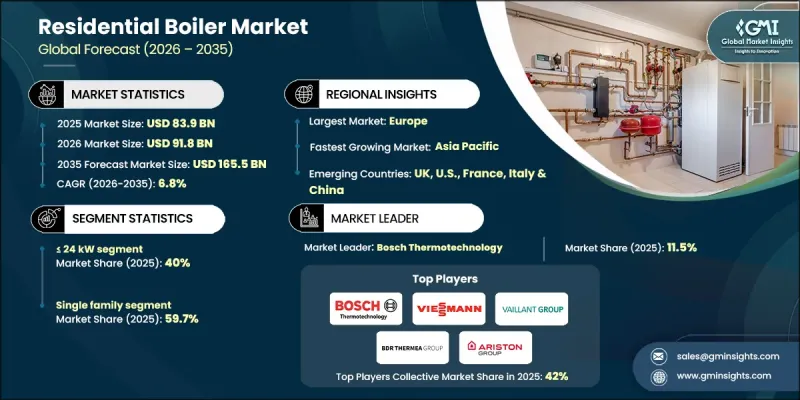
2025年全球住宅锅炉市场价值为839亿美元,预计到2035年将以6.8%的复合年增长率增长至1655亿美元。
极端天气、城市化进程加快以及智慧家居技术的日益普及推动了市场成长。业主们正在寻求高效的空间供暖解决方案,以在漫长的寒冷季节保持舒适的居住环境,而持续的基础设施升级也进一步刺激了市场需求。家用锅炉为整个住宅提供集中式暖气和热水,确保室内温度稳定可靠。其能源效率高、经久耐用且操作简便是促进普及的关键因素。先进的型号现在整合了自动温度控制、安全机制和智慧电网相容性,从而实现了能源消耗的最佳化。政府补贴、环保激励措施以及适用于公寓的紧凑型锅炉设计也在刺激市场成长方面发挥重要作用。人们对节能和低排放技术的日益关注正在塑造未来对现代高性能家用锅炉的需求。
| 市场范围 | |
|---|---|
| 起始年份 | 2025 |
| 预测年份 | 2026-2035 |
| 起始值 | 839亿美元 |
| 预测值 | 1655亿美元 |
| 复合年增长率 | 6.8% |
2025年,功率≤24千瓦的锅炉市占率占比达到40%,预计到2035年将以6.5%的复合年增长率成长。此细分市场的成长主要得益于小型住宅和公寓对紧凑、节能型暖气解决方案的需求。城市化进程、经济实惠的安装以及对能源效率标准的遵守进一步加速了这个细分市场的普及。这些锅炉凭藉其可靠的性能、紧凑的体积和经济的价格,仍然广受欢迎。
2025年,独栋住宅市场占据59.7%的市场份额,预计到2035年将达到950亿美元。业主越来越倾向于选择高效可靠、能够同时提供暖气和热水的锅炉。易于安装、节省空间的设计和节能性能持续推动此类锅炉的普及,而智慧控制系统和低排放技术的进步也影响着消费者的偏好。城市化进程的加速、环保意识的增强以及对永续生活方式的重视,进一步促进了该领域的成长。
北美住宅锅炉市场占据80%的市场份额,预计2025年市场规模将达24亿美元。推动该市场成长的因素包括:政府为减少碳排放而製定的严格法规、居民可支配收入的增加以及消费者对先进节能供暖系统日益增长的需求。高生活水平和对智慧供暖技术的广泛认知也为该行业的稳步发展做出了贡献。
目录
第一章:方法论与范围
研究方法
- 资料收集方法
- 基准估算和计算
- 基准年计算
- 市场估计和预测参数
- 预报
- 市场估算
- 量化市场影响分析
- 成长参数对预测的数学影响
- 情境分析框架
- 量化市场影响分析
- 初步研究和验证
- 部分主要资料来源(但不限于)
- 资料探勘来源
- 付费资源
- 按地区分類的资料来源
- 研究路径和评分组件
- 研究路径组成部分
- 评分组成部分
- 研究透明度附录
- 来源归属框架
- 品质保证指标
- 我们对信任的承诺
- 市场定义
第二章:执行概要
第三章:行业洞察
- 产业生态系分析
- 原物料供应及采购分析
- 製造能力评估
- 供应链韧性与风险因素
- 配电网路分析
- 监管环境
- 产业影响因素
- 成长驱动因素
- 产业陷阱与挑战
- 成长潜力分析
- 波特的分析
- PESTEL 分析
- 住宅锅炉成本结构分析
- 价格趋势分析(美元/单位)
- 按地区
- 按产能
- 市场机会与发展趋势
- 投资洞察与未来展望
- 数位化和工业4.0的采用
- 永续发展实践与监理合规
第四章:竞争格局
- 介绍
- 按地区分類的公司市占率分析
- 北美洲
- 欧洲
- 亚太地区
- 中东和非洲
- 拉丁美洲
- 战略仪錶板
- 策略倡议
- 重要伙伴关係与合作
- 主要併购活动
- 产品创新与发布
- 市场扩张策略
- 竞争性标竿分析
- 创新与永续发展格局
第五章:市场规模及预测:依燃料类型划分,2022-2035年
- 天然气
- 油
- 电的
- 其他的
第六章:市场规模及预测:依技术划分,2022-2035年
- 冷凝
- 天然气
- 油
- 电的
- 其他的
- 非冷凝式
- 天然气
- 油
- 电的
- 其他的
第七章:市场规模及预测:依应用领域划分,2022-2035年
- 单户住宅
- 多户住宅
第八章:市场规模及预测:依安装量划分,2022-2035年
- 壁挂式
- 落地式
第九章:市场规模及预测:依产能划分,2022-2035年
- ≤ 24 千瓦
- 24千瓦至35千瓦
- 35千瓦至100千瓦
- 大于 100 千瓦
第十章:市场规模及预测:依地区划分,2022-2035年
- 北美洲
- 我们
- 加拿大
- 欧洲
- 丹麦
- 芬兰
- 挪威
- 瑞典
- 英国
- 俄罗斯
- 罗马尼亚
- 波兰
- 奥地利
- 比利时
- 法国
- 德国
- 荷兰
- 瑞士
- 希腊
- 义大利
- 葡萄牙
- 西班牙
- 亚太地区
- 中国
- 日本
- 韩国
- 澳洲
- 中东和非洲
- 沙乌地阿拉伯
- 阿联酋
- 卡达
- 南非
- 拉丁美洲
- 巴西
- 阿根廷
- 墨西哥
第十一章:公司简介
- ACV International
- Ariston Holding
- AO Smith
- BDR Thermea Group
- Bradford White Corporation
- Bosch Thermotechnology Corp.
- Carrier
- Ferroli
- Hoval
- Laars Boilers
- Lennox International
- Lochinvar
- Navien
- NTI Boilers
- Noritz America Corp.
- PB Heat
- Rinnai America Corporation
- Smith Boilers
- Thermona
- US Boiler Company
- Viessmann
- Vaillant Group
- WM Technologies
- Wolf
The Global Residential Boiler Market was valued at USD 83.9 billion in 2025 and is estimated to grow at a CAGR of 6.8% to reach USD 165.5 billion by 2035.
Market growth is fueled by extreme weather conditions, rising urbanization, and the increasing integration of smart home technologies. Homeowners are seeking efficient space heating solutions to maintain comfort during extended cold seasons, while ongoing infrastructure upgrades further drive demand. Residential boilers provide centralized heating and hot water throughout homes, delivering consistent indoor temperatures and a reliable water supply. Their energy efficiency, durability, and user-friendly operation are key factors boosting adoption. Advanced models now incorporate automated temperature control, safety mechanisms, and smart grid compatibility, enabling optimized energy consumption. Government subsidies, environmental incentives, and compact boiler designs for apartments are also playing a pivotal role in stimulating market growth. Rising awareness of energy conservation and low-emission technologies is shaping future demand for modern, high-performance residential boilers.
| Market Scope | |
|---|---|
| Start Year | 2025 |
| Forecast Year | 2026-2035 |
| Start Value | $83.9 Billion |
| Forecast Value | $165.5 Billion |
| CAGR | 6.8% |
The <= 24 kW segment accounted for a 40% share in 2025 and is expected to grow at a CAGR of 6.5% through 2035. Growth in this segment is supported by demand for compact, energy-efficient heating solutions suitable for small homes and apartments. Urbanization, cost-effective installation, and adherence to energy-efficiency standards are further accelerating adoption. These boilers remain popular due to their reliable performance, compact form factor, and affordability.
The single-family home segment held a 59.7% share in 2025 and is expected to reach USD 95 billion by 2035. Homeowners increasingly prefer efficient, dependable boilers that provide both heating and hot water. Easy installation, space-saving designs, and energy-efficient performance continue to drive adoption, while advancements in smart control systems and low-emission technologies are influencing buyer preferences. Rising urban development, environmental awareness, and emphasis on sustainable living further support growth in this segment.
North America Residential Boiler Market held 80% share, generating USD 2.4 billion in 2025. Growth in this market is propelled by strict government regulations targeting carbon emission reduction, rising disposable incomes, and increasing consumer demand for advanced, energy-efficient heating systems. High living standards and strong awareness of smart heating technologies contribute to steady industry momentum.
Key players in the Global Residential Boiler Market include ACV International, A.O. Smith, Ariston Holding, BDR Thermea Group, Bradford White Corporation, Bosch Thermotechnology Corp., Carrier, Ferroli, Hoval, Laars Boilers, Lennox International, Lochinvar, Navien, NTI Boilers, Noritz America Corp., PB Heat, Rinnai America Corporation, Smith Boilers, Thermona, U.S. Boiler Company, Viessmann, Vaillant Group, WM Technologies, and Wolf. Companies in the Global Residential Boiler Market are strengthening their foothold through multiple strategies. They focus on product innovation, introducing energy-efficient, compact, and smart-grid-compatible boilers tailored to urban homes. Expansion into emerging markets, strategic acquisitions, and collaborations allows firms to broaden distribution networks and capture new customer segments. Investments in research and development aim to enhance product reliability, low-emission performance, and integration with home automation systems.
Table of Contents
Chapter 1 Methodology & Scope
- 1.1 Research design
Research approach
- 1.1.1 Data collection methods
- 1.2 Base estimates and calculations
- 1.2.1 Base year calculation
- 1.2.2 Market estimates & forecast parameters
- 1.3 Forecast
- 1.3.1 Key trends for market estimates
- 1.3.2 Quantified market impact analysis
- 1.3.2.1 Mathematical impact of growth parameters on forecast
- 1.3.3 Scenario analysis framework
- 1.4 Primary research and validation
- 1.4.1 Some of the primary sources (but not limited to)
- 1.5 Data mining sources
- 1.5.1 Paid Sources
- 1.5.2 Sources, by region
- 1.6 Research trail & scoring components
- 1.6.1 Research trail components
- 1.6.2 Scoring components
- 1.7 Research transparency addendum
- 1.7.1 Source attribution framework
- 1.7.2 Quality assurance metrics
- 1.7.3 Our commitment to trust
- 1.8 Market definitions
Chapter 2 Executive Summary
- 2.1 Industry synopsis, 2022 - 2035
- 2.1.1 Business trends
- 2.1.2 Fuel trends
- 2.1.3 Technology trends
- 2.1.4 Application trends
- 2.1.5 Installation trends
- 2.1.6 Capacity trends
- 2.1.7 Regional trends
Chapter 3 Industry Insights
- 3.1 Industry ecosystem analysis
- 3.1.1 Raw material availability & sourcing analysis
- 3.1.2 Manufacturing capacity assessment
- 3.1.3 Supply chain resilience & risk factors
- 3.1.4 Distribution network analysis
- 3.2 Regulatory landscape
- 3.3 Industry impact forces
- 3.3.1 Growth drivers
- 3.3.2 Industry pitfalls & challenges
- 3.4 Growth potential analysis
- 3.5 Porter's analysis
- 3.5.1 Bargaining power of suppliers
- 3.5.2 Bargaining power of buyers
- 3.5.3 Threat of new entrants
- 3.5.4 Threat of substitutes
- 3.6 PESTEL analysis
- 3.6.1 Political factors
- 3.6.2 Economic factors
- 3.6.3 Social factors
- 3.6.4 Technological factors
- 3.6.5 Legal factors
- 3.6.6 Environmental factors
- 3.7 Cost structure analysis of residential boilers
- 3.8 Price trend analysis (USD/Unit)
- 3.8.1 By region
- 3.8.2 By capacity
- 3.9 Market opportunities & evolving trends
- 3.10 Investment insights & future outlook
- 3.11 Digitalization & industry 4.0 adoption
- 3.12 Sustainability practices & regulatory compliance
Chapter 4 Competitive Landscape, 2025
- 4.1 Introduction
- 4.2 Company market share analysis, by region, 2025
- 4.2.1 North America
- 4.2.2 Europe
- 4.2.3 Asia Pacific
- 4.2.4 Middle East & Africa
- 4.2.5 Latin America
- 4.3 Strategic dashboard
- 4.4 Strategic initiatives
- 4.4.1 Key partnerships & collaborations
- 4.4.2 Major M&A activities
- 4.4.3 Product innovations & launches
- 4.4.4 Market expansion strategies
- 4.5 Competitive benchmarking
- 4.6 Innovation & sustainability landscape
Chapter 5 Market Size and Forecast, By Fuel, 2022 - 2035 (USD Million & '000 Units)
- 5.1 Key trends
- 5.2 Natural gas
- 5.3 Oil
- 5.4 Electric
- 5.5 Others
Chapter 6 Market Size and Forecast, By Technology, 2022 - 2035 (USD Million & '000 Units)
- 6.1 Key trends
- 6.2 Condensing
- 6.2.1 Natural gas
- 6.2.2 Oil
- 6.2.3 Electric
- 6.2.4 Others
- 6.3 Non-condensing
- 6.3.1 Natural gas
- 6.3.2 Oil
- 6.3.3 Electric
- 6.3.4 Others
Chapter 7 Market Size and Forecast, By Application, 2022 - 2035 (USD Million & '000 Units)
- 7.1 Key trends
- 7.2 Single family
- 7.3 Multi family
Chapter 8 Market Size and Forecast, By Installation, 2022 - 2035 (USD Million & '000 Units)
- 8.1 Key trends
- 8.2 Wall-mounted
- 8.3 Floor-standing
Chapter 9 Market Size and Forecast, By Capacity, 2022 - 2035 (USD Million & '000 Units)
- 9.1 Key trends
- 9.2 ≤ 24 kW
- 9.3 > 24 kW - 35 kW
- 9.4 > 35 kW - 100 kW
- 9.5 > 100 kW
Chapter 10 Market Size and Forecast, By Region, 2022 - 2035 (USD Million & '000 Units)
- 10.1 Key trends
- 10.2 North America
- 10.2.1 U.S.
- 10.2.2 Canada
- 10.3 Europe
- 10.3.1 Denmark
- 10.3.2 Finland
- 10.3.3 Norway
- 10.3.4 Sweden
- 10.3.5 UK
- 10.3.6 Russia
- 10.3.7 Romania
- 10.3.8 Poland
- 10.3.9 Austria
- 10.3.10 Belgium
- 10.3.11 France
- 10.3.12 Germany
- 10.3.13 Netherlands
- 10.3.14 Switzerland
- 10.3.15 Greece
- 10.3.16 Italy
- 10.3.17 Portugal
- 10.3.18 Spain
- 10.4 Asia Pacific
- 10.4.1 China
- 10.4.2 Japan
- 10.4.3 South Korea
- 10.4.4 Australia
- 10.5 Middle East & Africa
- 10.5.1 Saudi Arabia
- 10.5.2 UAE
- 10.5.3 Qatar
- 10.5.4 South Africa
- 10.6 Latin America
- 10.6.1 Brazil
- 10.6.2 Argentina
- 10.6.3 Mexico
Chapter 11 Company Profiles
- 11.1 ACV International
- 11.2 Ariston Holding
- 11.3 A.O. Smith
- 11.4 BDR Thermea Group
- 11.5 Bradford White Corporation
- 11.6 Bosch Thermotechnology Corp.
- 11.7 Carrier
- 11.8 Ferroli
- 11.9 Hoval
- 11.10 Laars Boilers
- 11.11 Lennox International
- 11.12 Lochinvar
- 11.13 Navien
- 11.14 NTI Boilers
- 11.15 Noritz America Corp.
- 11.16 PB Heat
- 11.17 Rinnai America Corporation
- 11.18 Smith Boilers
- 11.19 Thermona
- 11.20 U.S. Boiler Company
- 11.21 Viessmann
- 11.22 Vaillant Group
- 11.23 WM Technologies
- 11.24 Wolf


