


 |
市场调查报告书
商品编码
1892824
浴室家具市场机会、成长驱动因素、产业趋势分析及预测(2026-2035年)Bathroom Furniture Market Opportunity, Growth Drivers, Industry Trend Analysis, and Forecast 2026 - 2035 |
||||||

2025 年全球浴室家具市场价值为 237 亿美元,预计到 2035 年将以 6.9% 的复合年增长率增长至 458 亿美元。
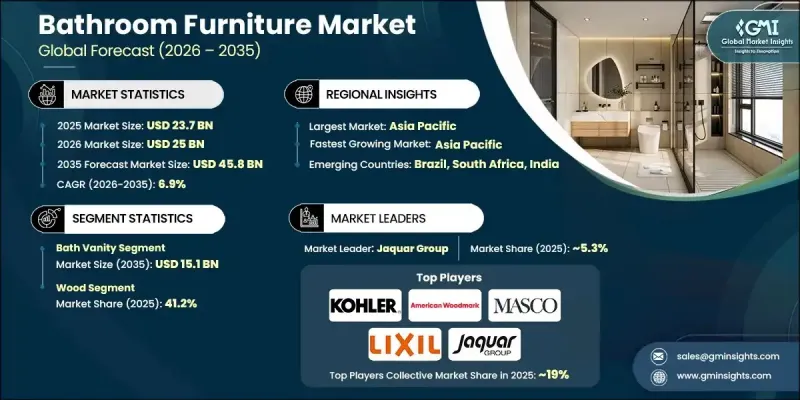
市场成长主要受房屋翻新量不断攀升的影响,越来越多的房主希望为自己的私人空间创造更现代、更时尚的设计。浴室逐渐被视为起居空间的延伸,而不仅仅是功能性的房间,这促使消费者购买现代化的盥洗台、模组化储物方案以及兼具美观性和实用性的家具。这种转变与更广泛的生活方式变化密切相关,舒适性和个性化装饰正成为家居设计中不可或缺的元素。随着房主在更高品质的材料、符合人体工学的布局和更大的储物空间方面的投入,对浴室家具的需求持续增长。此外,人们对永续性的日益关注也发挥着关键作用,消费者对符合环保理念的家具表现出浓厚的兴趣。
| 市场范围 | |
|---|---|
| 起始年份 | 2025 |
| 预测年份 | 2026-2035 |
| 起始值 | 237亿美元 |
| 预测值 | 458亿美元 |
| 复合年增长率 | 6.9% |
2024年,浴室盥洗台市场规模达77亿美元,预计2035年将达到151亿美元。盥洗台既是现代浴室的视觉焦点,也是其主要功能部件,将储物和洗手盆功能融为一体。它们在浴室改造专案中的重要性使其始终处于市场需求的前沿。从悬挂式盥洗台到独立式盥洗台,丰富的款式选择让顾客可以根据个人喜好订製浴室,进一步巩固了该品类的市场主导地位。
预计到2025年,木材市场规模将达到97亿美元,占市场份额的41.2%。木材因其能够完美融入各种室内风格(无论是传统还是现代)而继续成为浴室家具的首选材料。木材天然的温暖质感、奢华的触感以及在饰面和纹理方面的灵活性,使其成为寻求客製化解决方案的房主的理想之选。
2025年美国浴室家具市场价值44亿美元,预计从2026年到2035年将以7.1%的复合年增长率成长。住宅开发扩张和强劲的改造活动正在巩固需求,而城市发展也增加了新建房屋和翻新房屋对时尚、节省空间的家具的需求。
目录
第一章:方法论与范围
第二章:执行概要
第三章:行业洞察
- 产业生态系分析
- 供应商格局
- 利润率
- 每个阶段的价值增加
- 影响价值链的因素
- 产业影响因素
- 成长驱动因素
- 产业陷阱与挑战
- 机会
- 成长潜力分析
- 未来市场趋势
- 价格趋势
- 地区和产品类型
- 原料成本
- 原物料供应中的实际产能限制与感知产能限制
- 供应商价格上涨验证
- 监理框架
- 按地区
- 贸易统计
- 主要进口国
- 主要出口国
- 消费者购买行为分析
- 人口趋势
- 影响购买决策的因素
- 消费者产品采纳
- 首选配销通路
- 理想价格范围
- 波特五力分析
- PESTEL 分析
第四章:竞争格局
- 介绍
- 公司市占率分析
- 按地区
- 公司矩阵分析
- 主要市场参与者的竞争分析
- 竞争定位矩阵
- 产品组合基准测试
- 关键进展
- 併购
- 合作伙伴关係与合作
- 新产品发布
- 扩张计划
第五章:市场估算与预测:依产品类型划分,2022-2035年
- 浴室梳妆台
- 控制台梳妆台
- 梳妆台
- 浴室镜子
- 其他的
第六章:市场估算与预测:依材料划分,2022-2035年
- 玻璃
- 陶瓷製品
- 结石
- 木头
第七章:市场估计与预测:依价格区间划分,2022-2035年
- 低的
- 中等的
- 高的
第八章:市场估算与预测:依应用领域划分,2022-2035年
- 住宅
- 商业的
- 其他的
第九章:市场估算与预测:依配销通路划分,2022-2035年
- 在线的
- 离线
第十章:市场估计与预测:依地区划分,2022-2035年
- 北美洲
- 我们
- 加拿大
- 欧洲
- 德国
- 英国
- 法国
- 义大利
- 西班牙
- 亚太地区
- 中国
- 印度
- 日本
- 韩国
- 澳洲
- 拉丁美洲
- 巴西
- 墨西哥
- 阿根廷
- MEA
- 阿联酋
- 沙乌地阿拉伯
- 南非
第十一章:公司简介
- American Woodmark Corporation
- Duravit AG
- Geberit Group
- Hansgrohe SE
- Ideal Standard International
- Jaquar Group
- Kohler Co.
- LIXIL Corporation
- Masco Corporation
- Porcelanosa Group
- Roca Group
- Roper Rhodes Ltd.
- ROYO Group
- TOTO Ltd.
- Villeroy & Boch
The Global Bathroom Furniture Market was valued at USD 23.7 billion in 2025 and is estimated to grow at a CAGR of 6.9% to reach USD 45.8 billion by 2035.
Market growth is heavily shaped by the rising volume of home renovations, with more homeowners seeking updated, contemporary designs for their personal spaces. Bathrooms are increasingly viewed as extensions of living areas rather than purely functional rooms, which is driving consumers to purchase modern vanities, modular storage options, and furniture that enhances both aesthetics and practicality. This shift is tied to a broader lifestyle change, where comfort and personalized decor are becoming essential elements of home design. As homeowners invest in higher-quality materials, ergonomic layouts, and expanded storage capabilities, the demand for bathroom furnishings continues to strengthen. Growing attention to sustainability also plays a key role, with consumers showing strong interest in furniture that aligns with environmentally conscious living.
| Market Scope | |
|---|---|
| Start Year | 2025 |
| Forecast Year | 2026-2035 |
| Start Value | $23.7 Billion |
| Forecast Value | $45.8 Billion |
| CAGR | 6.9% |
The bath vanity segment generated USD 7.7 billion in 2024 and is forecasted to reach USD 15.1 billion by 2035. Vanities serve as both the visual anchor and the primary functional component of contemporary bathrooms, combining storage and sink integration in a single feature. Their importance in remodeling projects keeps them at the forefront of product demand. A wide range of styles from floating vanities to freestanding designs allows customers to tailor their bathrooms to individual preferences, reinforcing this category's dominant position.
The wood segment generated USD 9.7 billion in 2025, holding 41.2% share. Wood continues to be the preferred material for bathroom furniture due to its ability to fit seamlessly into various interior themes, whether traditional or modern. Its natural warmth, luxurious feel, and adaptability in finishes and textures make it highly desirable for homeowners seeking customizable solutions.
U.S. Bathroom Furniture Market was valued at USD 4.4 billion in 2025 and is expected to grow at a CAGR of 7.1% from 2026 to 2035. Expanding residential development and strong remodeling activity are reinforcing demand, while urban growth increases the need for stylish, space-efficient furniture in both new builds and renovated homes.
Key players in the Global Bathroom Furniture Market include LIXIL Corporation, Villeroy & Boch, Duravit AG, Hansgrohe SE, Porcelanosa Group, Ideal Standard International, Roper Rhodes Ltd., ROYO Group, Jaquar Group, Kohler Co., Masco Corporation, TOTO Ltd., Roca Group, American Woodmark Corporation, and Geberit Group. Companies in the Bathroom Furniture Market strengthen their position by investing in innovative materials, expanding product customization options, and diversifying style portfolios to meet evolving consumer preferences. Many manufacturers prioritize sustainable sourcing and eco-friendly production methods to appeal to environmentally aware buyers. Digital visualization tools, modular product lines, and space-saving designs are increasingly emphasized to support both luxury and compact layouts. Firms also enhance distribution through e-commerce channels, partnerships with home improvement retailers, and designer-focused networks.
Table of Contents
Chapter 1 Methodology & Scope
- 1.1 Market scope and definition
- 1.2 Research design
- 1.2.1 Research approach
- 1.2.2 Data collection methods
- 1.3 Data mining sources
- 1.3.1 Global
- 1.3.2 Regional/Country
- 1.4 Base estimates and calculations
- 1.4.1 Base year calculation
- 1.4.2 Key trends for market estimation
- 1.5 Primary research and validation
- 1.5.1 Primary sources
- 1.6 Forecast model
- 1.7 Research assumptions and limitations
Chapter 2 Executive Summary
- 2.1 Industry 360° synopsis
- 2.2 Key market trends
- 2.2.1 Regional trends
- 2.2.2 Product type trends
- 2.2.3 Material trends
- 2.2.4 Price range trends
- 2.2.5 Application trends
- 2.2.6 Distribution channel trends
- 2.3 CXO perspective: Strategic imperatives
- 2.3.1 Key decision points for industry executives
- 2.3.2 Critical success factors for market players
- 2.4 Future outlook and strategic recommendations
- 2.5 Strategic recommendations
- 2.5.1 Supply chain diversification strategy
- 2.5.2 Product portfolio enhancement
- 2.5.3 Partnership and alliance opportunities
- 2.5.4 Cost management and pricing strategy
- 2.6 Decision framework
- 2.6.1 Investment priority matrix
- 2.6.2 ROI analysis
Chapter 3 Industry Insights
- 3.1 Industry ecosystem analysis
- 3.1.1 Supplier landscape
- 3.1.2 Profit margin
- 3.1.3 Value addition at each stage
- 3.1.4 Factor affecting the value chain
- 3.2 Industry impact forces
- 3.2.1 Growth drivers
- 3.2.2 Industry pitfalls & challenges
- 3.2.3 Opportunities
- 3.3 Growth potential analysis
- 3.4 Future market trends
- 3.5 Price trends
- 3.5.1 Region and Product Type
- 3.5.2 Raw material cost
- 3.5.3 Real vs. perceived capacity constraints in supply of raw materials
- 3.5.4 Supplier price increase validation
- 3.6 Regulatory framework
- 3.6.1 By region
- 3.7 Trade statistics
- 3.7.1 Major importing countries
- 3.7.2 Major exporting countries
- 3.8 Consumer buying behavior analysis
- 3.8.1 Demographic trends
- 3.8.2 Factors affecting buying decisions
- 3.8.3 Consumer product adoption
- 3.8.4 Preferred distribution channel
- 3.8.5 Preferred price range
- 3.9 Porter's five forces analysis
- 3.10 PESTEL analysis
Chapter 4 Competitive Landscape, 2025
- 4.1 Introduction
- 4.2 Company market share analysis
- 4.2.1 By Region
- 4.3 Company matrix analysis
- 4.4 Competitive analysis of major market players
- 4.5 Competitive positioning matrix
- 4.6 Product portfolio benchmarking
- 4.7 Key developments
- 4.7.1 Mergers & acquisitions
- 4.7.2 Partnerships & collaborations
- 4.7.3 New product launches
- 4.7.4 Expansion Plans
Chapter 5 Market Estimates & Forecast, By Product Type, 2022 - 2035 (USD Billion) (Million Units)
- 5.1 Key trends
- 5.2 Bath Vanity
- 5.3 Console Vanity
- 5.4 Vanity Tops
- 5.5 Bathroom Mirrors
- 5.6 Others
Chapter 6 Market Estimates & Forecast, By Material, 2022 - 2035 (USD Billion) (Million Units)
- 6.1 Key trends
- 6.2 Glass
- 6.3 Ceramic
- 6.4 Stone
- 6.5 Wood
Chapter 7 Market Estimates & Forecast, By Price Range, 2022 - 2035 (USD Billion) (Million Units)
- 7.1 Key trends
- 7.2 Low
- 7.3 Medium
- 7.4 High
Chapter 8 Market Estimates & Forecast, By Application, 2022 - 2035 (USD Billion) (Million Units)
- 8.1 Key trends
- 8.2 Residential
- 8.3 Commercial
- 8.4 Others
Chapter 9 Market Estimates & Forecast, By Distribution Channel, 2022 - 2035, (USD Billion) (Million Units)
- 9.1 Key trends
- 9.2 Online
- 9.3 Offline
Chapter 10 Market Estimates & Forecast, By Region, 2022 - 2035, (USD Billion) (Million Units)
- 10.1 Key trends
- 10.2 North America
- 10.2.1 U.S.
- 10.2.2 Canada
- 10.3 Europe
- 10.3.1 Germany
- 10.3.2 U.K.
- 10.3.3 France
- 10.3.4 Italy
- 10.3.5 Spain
- 10.4 Asia Pacific
- 10.4.1 China
- 10.4.2 India
- 10.4.3 Japan
- 10.4.4 South Korea
- 10.4.5 Australia
- 10.5 Latin America
- 10.5.1 Brazil
- 10.5.2 Mexico
- 10.5.3 Argentina
- 10.6 MEA
- 10.6.1 UAE
- 10.6.2 Saudi Arabia
- 10.6.3 South Africa
Chapter 11 Company Profiles (Business Overview, Financial Data, Product Landscape, Strategic Outlook, SWOT Analysis)
- 11.1 American Woodmark Corporation
- 11.2 Duravit AG
- 11.3 Geberit Group
- 11.4 Hansgrohe SE
- 11.5 Ideal Standard International
- 11.6 Jaquar Group
- 11.7 Kohler Co.
- 11.8 LIXIL Corporation
- 11.9 Masco Corporation
- 11.10 Porcelanosa Group
- 11.11 Roca Group
- 11.12 Roper Rhodes Ltd.
- 11.13 ROYO Group
- 11.14 TOTO Ltd.
- 11.15 Villeroy & Boch


