


 |
市场调查报告书
商品编码
1892832
收割机市场机会、成长驱动因素、产业趋势分析及预测(2026-2035年)Harvester Market Opportunity, Growth Drivers, Industry Trend Analysis, and Forecast 2026 - 2035 |
||||||

2025 年全球收割机市场价值为 412 亿美元,预计到 2035 年将以 7.5% 的复合年增长率增长至 846 亿美元。
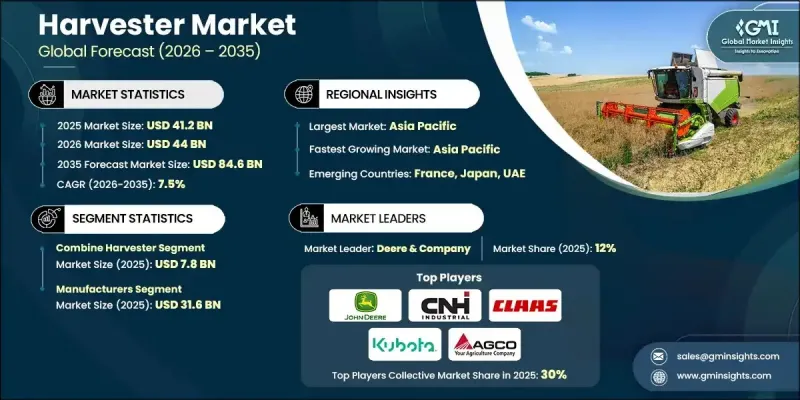
人们日益关注永续农业实践,这推动了配备节能引擎和低排放技术的环保收割机的普及。包括精准农业工具和智慧收割系统在内的持续技术进步,正在提升生产力、燃油效率和作业效率。製造商正积极推出新型号,以满足现代农业不断变化的需求,而全球粮食需求的成长正在重塑现代农业。大型商业农场和合约农业供应商正在投资高产能机械,以确保快速且有效率的收割,减少因天气变化造成的损失,并维持主粮作物的品质。创新、技术整合以及对新鲜农产品日益增长的需求,共同推动全球市场的扩张。
| 市场范围 | |
|---|---|
| 起始年份 | 2025 |
| 预测年份 | 2026-2035 |
| 起始值 | 412亿美元 |
| 预测值 | 846亿美元 |
| 复合年增长率 | 7.5% |
2025年,联合收割机市场规模预计将达78亿美元。联合收割机仍然是商业粮食生产中最有价值、最不可或缺的机械,能够在一次作业中完成收割、脱粒和扬谷。其高效快速的特性使大型农场能够迅速完成收割,最大限度地降低天气风险,并保持最佳的粮食品质。
到 2025 年,製造商部门的规模将达到 316 亿美元。製造商对定价、售后支援和专有精准农业技术的整合保持着强大的控制力,从而培养品牌忠诚度,提供融资方案,并为复杂的大马力机器提供专业的操作员培训。
预计到2025年,亚太地区收割机市占率将达到36.9%。该地区的成长得益于快速的机械化进程、政府对小型机械的补贴以及对高效收割主要粮食作物的需求。中国、印度和日本等国正在投资现代化农业设备,包括履带式联合收割机、小型动力耕耘机和先进的电动机械,这些投资也得到了政府旨在推动农业现代化的各项倡议的支持。
目录
第一章:方法论与范围
第二章:执行概要
第三章:行业洞察
- 产业生态系分析
- 供应商格局
- 利润率
- 每个阶段的价值增加
- 影响价值链的因素
- 产业影响因素
- 成长驱动因素
- 电子商务拓展与仓储自动化
- 全球人口成长与粮食需求
- 劳动成本上升和劳动短缺
- 精准农业(农业4.0)的进展
- 产业陷阱与挑战
- 初始投资成本高
- 缺乏熟练的操作人员/技术人员
- 机会
- 租赁模式的拓展
- 特种/电动能量采集器的开发
- 成长驱动因素
- 成长潜力分析
- 未来市场趋势
- 技术与创新格局
- 当前技术趋势
- 新兴技术
- 价格趋势
- 按地区
- 按类型
- 监管环境
- 标准和合规要求
- 区域监理框架
- 认证标准
- 波特的分析
- PESTEL 分析
第四章:竞争格局
- 介绍
- 公司市占率分析
- 按地区
- 公司矩阵分析
- 主要市场参与者的竞争分析
- 竞争定位矩阵
- 关键进展
- 併购
- 合作伙伴关係与合作
- 新产品发布
- 扩张计划
第五章:市场估算与预测:依类型划分,2022-2035年
- 联合收割机
- 饲料收割机
- 拖曳式青贮收割机
- 自走式青贮饲料收割机
- 拖曳式青贮收割机
- 悬挂式青贮收割机
- 悬挂式青贮收割机
- 甜菜收割机
- 马铃薯收割机
- 酿酒葡萄收割机
- 牧草收割机
- 市政割草机
第六章:市场估算与预测:依销售管道划分,2022-2035年
- 製造商
- 经销商
第七章:市场估计与预测:依地区划分,2022-2035年
- 北美洲
- 我们
- 加拿大
- 欧洲
- 德国
- 英国
- 法国
- 义大利
- 西班牙
- 亚太地区
- 中国
- 日本
- 印度
- 澳洲
- 韩国
- 拉丁美洲
- 巴西
- 墨西哥
- 阿根廷
- 中东和非洲
- 南非
- 沙乌地阿拉伯
- 阿联酋
第八章:公司简介
- Anhui Heli
- BYD Company
- Clark Material Handling Company
- Combilift
- Crown Equipment
- Doosan Corporation Industrial Vehicle
- Hangcha Group
- Hyster-Yale Materials Handling
- Hyundai Heavy Industries
- Jungheinrich AG
- KION Group AG
- Komatsu
- Manitou Group
- Mitsubishi Logisnext
- Toyota Industries
The Global Harvester Market was valued at USD 41.2 billion in 2025 and is estimated to grow at a CAGR of 7.5% to reach USD 84.6 billion by 2035.
The increasing focus on sustainable farming practices is driving the adoption of eco-friendly harvesters with energy-efficient engines and low-emission technologies. Continuous technological advancements, including precision agriculture tools and smart harvesting systems, are enhancing productivity, fuel efficiency, and operational effectiveness. Manufacturers are actively launching new models to meet the evolving needs of modern agriculture, which is being reshaped by rising global food demand. Large-scale commercial farms and contract farming providers are investing in high-capacity machines to ensure rapid and efficient harvesting, reducing losses caused by unpredictable weather and maintaining the quality of staple crops. This combination of innovation, technological integration, and growing demand for fresh produce is propelling market expansion globally.
| Market Scope | |
|---|---|
| Start Year | 2025 |
| Forecast Year | 2026-2035 |
| Start Value | $41.2 Billion |
| Forecast Value | $84.6 Billion |
| CAGR | 7.5% |
In 2025, the combine harvesters segment generated USD 7.8 billion. Combine harvesters remain the most valuable and essential machinery for commercial grain production, capable of reaping, threshing, and winnowing crops in a single operation. Their efficiency and speed allow large farms to complete harvests promptly, minimizing weather-related risks and maintaining optimal grain quality.
The manufacturers segment reached USD 31.6 billion in 2025. Manufacturers maintain strong control over pricing, after-sales support, and the integration of proprietary precision farming technologies, fostering brand loyalty, providing financing options, and offering specialized operator training for complex, high-horsepower machines.
Asia Pacific Harvester Market held a 36.9% share in 2025. The region's growth is fueled by rapid mechanization, government subsidies for small machinery, and the need for efficient harvesting of key staple crops. Countries like China, India, and Japan are investing in modernized farming equipment, including track-based combinations, compact power tillers, and advanced electric machinery, supported by government initiatives aimed at farm modernization.
Key players in the Global Harvester Market include Komatsu, Clark Material Handling Company, Crown Equipment, Mitsubishi Logisnext, Anhui Heli, Toyota Industries, Jungheinrich AG, KION Group AG, Doosan Corporation Industrial Vehicle, Hangcha Group, Hyster-Yale Materials Handling, Manitou Group, BYD Company, and Combilift. Companies in the Global Harvester Market are strengthening their position through continuous innovation, launching energy-efficient and technologically advanced machines that meet modern agriculture demands. Strategic R&D investments enable the development of precision farming solutions, smart harvesting systems, and electric-powered machinery. Firms are expanding their global distribution networks, providing financing solutions, after-sales support, and operator training programs to enhance customer loyalty. Collaborations with governments and agricultural agencies help promote mechanization and the adoption of eco-friendly harvesters.
Table of Contents
Chapter 1 Methodology and Scope
- 1.1 Market scope and definition
- 1.2 Research design
- 1.2.1 Research approach
- 1.2.2 Data collection methods
- 1.3 Data mining sources
- 1.3.1 Global
- 1.3.2 Regional/Country
- 1.4 Base estimates and calculations
- 1.4.1 Base year calculation
- 1.4.2 Key trends for market estimation
- 1.5 Primary research and validation
- 1.5.1 Primary sources
- 1.6 Forecast model
- 1.7 Research assumptions and limitations
Chapter 2 Executive Summary
- 2.1 Industry 3600 synopsis
- 2.2 Key market trends
- 2.2.1 Regional
- 2.2.2 Type
- 2.2.3 Sales channel
- 2.3 CXO perspectives: Strategic imperatives
- 2.3.1 Key decision points for industry executives
- 2.3.2 Critical success factors for market players
- 2.4 Future outlook and strategic recommendations
Chapter 3 Industry Insights
- 3.1 Industry ecosystem analysis
- 3.1.1 Supplier landscape
- 3.1.2 Profit margin
- 3.1.3 Value addition at each stage
- 3.1.4 Factor affecting the value chain
- 3.2 Industry impact forces
- 3.2.1 Growth drivers
- 3.2.1.1 E-commerce expansion & warehouse automation
- 3.2.1.2 Global population growth & food demand
- 3.2.1.3 Rising labor costs and shortages
- 3.2.1.4 Advancements in precision agriculture (Ag 4.0)
- 3.2.2 Industry pitfalls & challenges
- 3.2.2.1 High initial investment cost
- 3.2.2.2 Lack of skilled operators/technicians
- 3.2.3 Opportunities
- 3.2.3.1 Expansion of leasing & rental models
- 3.2.3.2 Development of specialty/electric harvesters
- 3.2.1 Growth drivers
- 3.3 Growth potential analysis
- 3.4 Future market trends
- 3.5 Technology and innovation landscape
- 3.5.1 Current technological trends
- 3.5.2 Emerging technologies
- 3.6 Price trends
- 3.6.1 By region
- 3.6.2 By type
- 3.7 Regulatory landscape
- 3.7.1 Standards and compliance requirements
- 3.7.2 Regional regulatory frameworks
- 3.7.3 Certification standards
- 3.8 Porter's analysis
- 3.9 PESTEL analysis
Chapter 4 Competitive Landscape, 2025
- 4.1 Introduction
- 4.2 Company market share analysis
- 4.2.1 By region
- 4.2.1.1 North America
- 4.2.1.2 Europe
- 4.2.1.3 Asia Pacific
- 4.2.1.4 Latin America
- 4.2.1.5 Middle East and Africa
- 4.2.1 By region
- 4.3 Company matrix analysis
- 4.4 Competitive analysis of major market players
- 4.5 Competitive positioning matrix
- 4.6 Key developments
- 4.6.1 Mergers & acquisitions
- 4.6.2 Partnerships & collaborations
- 4.6.3 New product launches
- 4.6.4 Expansion plans
Chapter 5 Market Estimates and Forecast, By Type, 2022 - 2035 (USD Billion) (Thousand Units)
- 5.1 Key trends
- 5.2 Combine harvester
- 5.3 Forage harvester
- 5.4 Trailed silage harvester
- 5.5 Self-propelled forage harvester
- 5.6 Trailed forage harvester
- 5.7 Mounted forage harvester
- 5.8 Mounted silage harvester
- 5.9 Surgarbeet harvester
- 5.10 Potato harvester
- 5.11 Wine grape harvester
- 5.12 Forage mowers
- 5.13 Municipal mowers
Chapter 6 Market Estimates and Forecast, By Sales Channel, 2022 - 2035 (USD Billion) (Thousand Units)
- 6.1 Key trends
- 6.2 Manufacturers
- 6.3 Distributors
Chapter 7 Market Estimates and Forecast, By Region, 2022 - 2035 (USD Billion) (Thousand Units)
- 7.1 Key trends
- 7.2 North America
- 7.2.1 U.S.
- 7.2.2 Canada
- 7.3 Europe
- 7.3.1 Germany
- 7.3.2 UK
- 7.3.3 France
- 7.3.4 Italy
- 7.3.5 Spain
- 7.4 Asia Pacific
- 7.4.1 China
- 7.4.2 Japan
- 7.4.3 India
- 7.4.4 Australia
- 7.4.5 South Korea
- 7.5 Latin America
- 7.5.1 Brazil
- 7.5.2 Mexico
- 7.5.3 Argentina
- 7.6 Middle East and Africa
- 7.6.1 South Africa
- 7.6.2 Saudi Arabia
- 7.6.3 UAE
Chapter 8 Company Profiles
- 8.1 Anhui Heli
- 8.2 BYD Company
- 8.3 Clark Material Handling Company
- 8.4 Combilift
- 8.5 Crown Equipment
- 8.6 Doosan Corporation Industrial Vehicle
- 8.7 Hangcha Group
- 8.8 Hyster-Yale Materials Handling
- 8.9 Hyundai Heavy Industries
- 8.10 Jungheinrich AG
- 8.11 KION Group AG
- 8.12 Komatsu
- 8.13 Manitou Group
- 8.14 Mitsubishi Logisnext
- 8.15 Toyota Industries

 胡萝卜收割机市场:依机器类型、技术、动力来源、作物类型和应用划分-2026-2032年全球预测
 全球收割设备市场规模、份额、趋势和成长分析报告(2026-2034年)全球棉花收割机市场规模、份额、趋势和成长分析报告(2026-2034年)
 2026年全球甘蔗收割机市场报告2026年全球自动化收割系统市场报告
 2026-2030年全球棉花收割机市场按类型、容量、分销通路、应用程式和最终用户分類的收割车市场,全球预测,2026-2032年
 收割机械市场规模、份额和成长分析(按产品类型、形式、类别、应用和地区划分)—产业预测(2026-2033 年)
 棉花收割机市场规模、份额及成长分析(依棉花收割机类型、收割技术、产能及尺寸、最终用户及地区划分)-2026-2033年产业预测
 收割机市场规模、份额和成长分析(按机制、功率、等级、类型、自动化程度、推进类型和地区划分)—产业预测(2026-2033 年)