


 |
市场调查报告书
商品编码
1892834
折迭式充气船市场机会、成长驱动因素、产业趋势分析及预测(2026-2035年)Foldable Inflatable Boats Market Opportunity, Growth Drivers, Industry Trend Analysis, and Forecast 2026 - 2035 |
||||||

2025 年全球可折迭充气船市场价值为 8.513 亿美元,预计到 2035 年将以 6.6% 的复合年增长率增长至 16 亿美元。
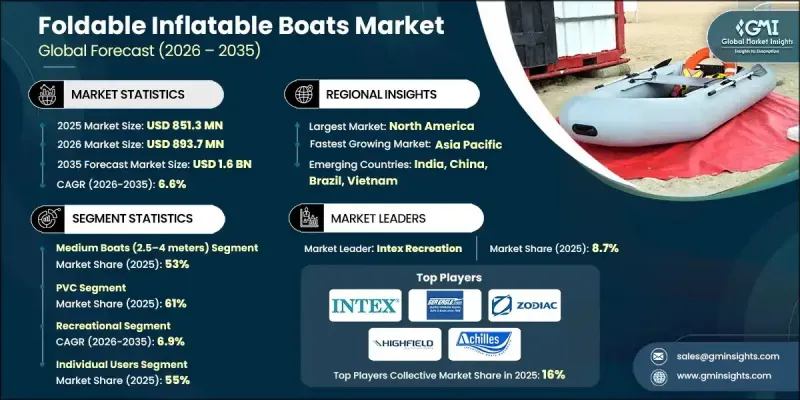
由于其便携性、耐用性和易于存放的特点,这些船艇在休閒、专业和紧急应变等领域的需求持续增长。它们兼具硬壳船的坚固性和紧凑的折迭性,因此在休閒出游、商业运营和救援任务中得到了更广泛的应用。材料创新正在重塑市场格局,製造商正在采用聚氨酯涂层织物,与早期材料相比,这种织物具有更高的耐磨性。改进的製造流程和先进复合材料的应用提高了产品的使用寿命,并减少了长期维护成本。日益增强的环保意识也影响设计选择,企业开始采用可回收材料、低影响生产方式和更清洁的推进系统。随着海洋永续发展标准的不断发展,折迭充气船产业也在快速转型,以更高的性能、更强的耐用性和消费者对环保船舶解决方案日益增长的期望为特征。
| 市场范围 | |
|---|---|
| 起始年份 | 2025 |
| 预测年份 | 2026-2035 |
| 起始值 | 8.513亿美元 |
| 预测值 | 16亿美元 |
| 复合年增长率 | 6.6% |
中型船艇(尺寸介于 2.5 公尺至 4 公尺之间)在 2025 年占据了 53% 的市场份额,预计到 2035 年将以 6.9% 的复合年增长率增长。该细分市场受益于其在休閒巡航、钓鱼、旅游和紧急活动等方面的广泛用途,在各种应用领域都提供了稳定的需求。
2025年,PVC材料市占率达到61%,预计2026年至2035年将以5.9%的复合年增长率成长。现代船用级PVC织物采用改良的紫外线防护技术和特殊涂层,并提供长达十年的保固。这些材料以高强度聚酯纤维为基材,覆以PVC层压涂层,兼具耐用性、防水性和可靠的气密性。其成本效益、可製造性以及成熟的全球供应链进一步巩固了其市场领先地位。
2025年,北美折迭充气船市场份额占全球34%,预计在2025年至2034年间将以5.3%的复合年增长率增长,这主要得益于强大的码头网络、广泛的船舶参与度和有利的海洋法规。该地区的基础设施和活跃的经销商网路持续巩固其在全球产业中的地位。
目录
第一章:方法论
第二章:执行概要
第三章:行业洞察
- 产业生态系分析
- 供应商格局
- 利润率分析
- 成本结构
- 每个阶段的价值增加
- 影响价值链的因素
- 中断
- 产业影响因素
- 成长驱动因素
- 休閒划船和水上运动越来越受欢迎
- 对便携式且价格适中的水上交通工具的需求
- 在紧急救援行动中得到更广泛的应用
- 不断扩大的海洋旅游与探险运动产业
- 耐用性和磨损问题
- 消费者群体的价格敏感度
- 产业陷阱与挑战
- 耐用性和磨损问题
- 消费者群体的价格敏感度
- 市场机会
- 休閒划船和探险旅游的需求不断增长
- 新兴市场(亚太和拉丁美洲)具有很高的成长潜力
- 救援、灾害应变和政府机构的采用率不断提高
- 人们对环保和电动推进式船艇的兴趣日益浓厚
- 利用先进、耐用、轻巧的材料进行产品创新的机会
- 成长潜力分析
- 监管环境
- 国际海事法规
- 尺寸特定规定(16 英尺以下与 16 英尺以上)
- NMMA认证要求
- ABYC标准合规性
- 美国海岸防卫队装备条例(33 CFR 第 175、183 部分)
- 欧盟CE标誌要求
- 波特的分析
- PESTEL 分析
- 技术与创新格局
- 当前技术趋势
- 材料创新趋势
- 折迭机构技术
- 新兴技术
- 便携性工程发展
- 电力推进集成
- 当前技术趋势
- 生产统计
- 生产中心
- 消费中心
- 进出口
- 定价分析
- 价格点细分
- 区域价格差异
- 成本細項分析
- 专利分析
- 充气技术专利
- 材料涂层专利
- 折迭机构专利
- 永续性和环境方面
- 永续实践
- 减少废弃物策略
- 生产中的能源效率
- 环保倡议
- 碳足迹考量
- 未来展望及投资机会
- 新兴市场和高潜力地区
- 科技和基础设施领域的投资机会
- 电动和环保推动系统的机会
- 策略伙伴关係和合资企业
- 对利害关係人和投资者的建议
- 消费者行为与终端用户洞察
- 船主和使用者的统计分析
- 使用模式(休閒、商业、紧急)
- 对尺寸、材质和便携性的偏好
- 价格敏感度和购买行为
- 生活方式趋势和旅游业对采纳的影响
- 品牌认知与忠诚度分析
第四章:竞争格局
- 介绍
- 公司市占率分析
- 北美洲
- 欧洲
- 亚太地区
- 拉丁美洲
- MEA
- 主要市场参与者的竞争分析
- 竞争定位矩阵
- 战略展望矩阵
- 关键进展
- 併购
- 合作伙伴关係与合作
- 新产品发布
- 扩张计划和资金
第五章:市场估算与预测:依材料划分,2022-2035年
- PVC
- 海帕隆
- 聚氨酯涂层织物
- 其他的
第六章:市场估算与预测:依长度划分,2022-2035年
- 小型船隻(<2.5公尺)
- 中型船(2.5-4公尺)
- 大型船隻(>4公尺)
第七章:市场估算与预测:依应用领域划分,2022-2035年
- 休閒
- 救援与应急
- 旅游与探险运动
- 商业用途
- 其他的
第八章:市场估算与预测:依最终用途划分,2022-2035年
- 个人用户
- 商业营运商
- 政府和非政府组织
第九章:市场估算与预测:依配销通路划分,2022-2035年
- OEM/直销
- 船舶经销商和零售商
- 电子商务/线上
- 经销商
第十章:市场估计与预测:依地区划分,2022-2035年
- 北美洲
- 我们
- 加拿大
- 欧洲
- 德国
- 英国
- 法国
- 义大利
- 西班牙
- 俄罗斯
- 北欧
- 比荷卢经济联盟
- 亚太地区
- 中国
- 印度
- 日本
- 澳洲
- 韩国
- 新加坡
- 泰国
- 印尼
- 越南
- 拉丁美洲
- 巴西
- 墨西哥
- 阿根廷
- 哥伦比亚
- MEA
- 南非
- 沙乌地阿拉伯
- 阿联酋
第十一章:公司简介
- 全球参与者
- AB Inflatables
- Achilles Inflatable Boats
- BRIS USA
- Highfield Boats
- Intex Recreation
- Mercury Marine (Inflatable Division)
- Sevylor
- Willard Marine
- Zodiac Nautic
- 区域玩家
- ASIS Boats
- Kolibri Boats
- Sea Eagle Boats
- 新兴参与者
- Galaxy Pro Boats
- Outborn Watercraft
- Stryker Boats
- Walker Bay Boats
The Global Foldable Inflatable Boats Market was valued at USD 851.3 million in 2025 and is estimated to grow at a CAGR of 6.6% to reach USD 1.6 billion by 2035.
Demand for these boats continues to rise across recreational, professional, and emergency response settings due to their portability, durability, and easy storage. Their ability to combine the resilience of rigid vessels with compact foldability has expanded their adoption for leisure outings, commercial operations, and rescue missions. Material innovation is reshaping the market, with manufacturers integrating polyurethane-coated fabrics that offer significantly higher abrasion resistance compared to earlier materials. Enhanced construction methods and the shift toward advanced composites are improving product longevity and reducing long-term maintenance. Growing environmental awareness is also influencing design choices, with companies adopting recyclable materials, low-impact production practices, and cleaner propulsion systems. As marine sustainability standards evolve, the foldable inflatable boats sector is adapting rapidly, supporting a market landscape defined by improved performance, greater durability, and rising customer expectations for environmentally conscious boating solutions.
| Market Scope | |
|---|---|
| Start Year | 2025 |
| Forecast Year | 2026-2035 |
| Start Value | $851.3 Million |
| Forecast Value | $1.6 Billion |
| CAGR | 6.6% |
The medium boats category, sized between 2.5 and 4 meters, held a 53% share in 2025 and is expected to grow at a CAGR of 6.9% through 2035. This segment benefits from broad utility across recreational cruising, fishing, tourism, and emergency activities, offering steady demand across varied applications.
The PVC material segment held a 61% share in 2025 and is projected to grow at a CAGR of 5.9% from 2026 to 2035. Modern marine-grade PVC fabrics incorporate improved UV protection and specialized coating layers, supported by warranties extending up to a decade. These materials feature laminated PVC coatings over high-strength polyester scrim, providing durability, watertight integrity, and reliable air retention. Their cost efficiency, manufacturability, and established global supply base reinforce their leadership in the market.
North America Foldable Inflatable Boats Market accounted for a 34% share in 2025 and is anticipated to grow at a CAGR of 5.3% during 2025-2034, supported by strong marina networks, widespread boating participation, and supportive marine regulations. The region's infrastructure and active dealer networks continue to strengthen its position in the global industry.
Major companies active in the Foldable Inflatable Boats Market include AB Inflatables, Achilles Inflatable Boats, BRIS, Highfield Boats, Intex Recreation Corp., Sea Eagle Boats, Sevylor, Walker Bay, and Zodiac Nautic. Companies in the Foldable Inflatable Boats Market are using a range of strategic initiatives to reinforce their market positions. Many manufacturers are expanding their portfolios with lightweight, high-strength fabrics to improve durability while keeping boats easy to transport. Investments in eco-friendly materials and electric-ready designs reflect growing sustainability priorities. Several brands are also enhancing manufacturing efficiency through advanced welding and lamination technologies to boost product consistency and reduce waste. Strengthening dealer partnerships, expanding global distribution channels, and offering customizable boat configurations help companies improve accessibility and cater to diverse end-user needs.
Table of Contents
Chapter 1 Methodology
- 1.1 Market scope and definition
- 1.2 Research design
- 1.2.1 Research approach
- 1.2.2 Data collection methods
- 1.3 Data mining sources
- 1.3.1 Global
- 1.3.2 Regional/Country
- 1.4 Base estimates and calculations
- 1.4.1 Base year calculation
- 1.4.2 Key trends for market estimation
- 1.5 Primary research and validation
- 1.5.1 Primary sources
- 1.6 Forecast model
- 1.7 Research assumptions and limitations
Chapter 2 Executive Summary
- 2.1 Industry 3600 synopsis, 2022 - 2035
- 2.2 Key market trends
- 2.2.1 Regional
- 2.2.2 Material
- 2.2.3 Length
- 2.2.4 Application
- 2.2.5 End Use
- 2.2.6 Distribution Channel
- 2.3 TAM Analysis, 2026-2035
- 2.4 CXO perspectives: Strategic imperatives
- 2.4.1 Executive decision points
- 2.4.2 Critical success factors
- 2.5 Future outlook and strategic recommendations
Chapter 3 Industry Insights
- 3.1 Industry ecosystem analysis
- 3.1.1 Supplier landscape
- 3.1.2 Profit margin analysis
- 3.1.3 Cost structure
- 3.1.4 Value addition at each stage
- 3.1.5 Factor affecting the value chain
- 3.1.6 Disruptions
- 3.2 Industry impact forces
- 3.2.1.1 Growth drivers
- 3.2.1.2 Growing popularity of recreational boating and water sports
- 3.2.1.3 Demand for portable and affordable watercraft
- 3.2.1.4 Increased use in emergency and rescue operations
- 3.2.1.5 Expanding marine tourism and adventure sports industry
- 3.2.1.6 Durability and wear-and-tear issues
- 3.2.1.7 Price sensitivity in the consumer segment
- 3.2.2 Industry pitfalls and challenges
- 3.2.2.1 Durability & wear-and-tear issues
- 3.2.2.2 Price sensitivity in the consumer segment
- 3.2.3 Market opportunities
- 3.2.3.1 Rising demand from recreational boating and adventure tourism
- 3.2.3.2 High growth potential in emerging markets (Asia-Pacific & Latin America)
- 3.2.3.3 Increasing adoption by rescue, disaster-response, and government agencies
- 3.2.3.4 Growing interest in eco-friendly and electric-propulsion boating options
- 3.2.3.5 Opportunity for product innovation using advanced, durable, lightweight materials
- 3.3 Growth potential analysis
- 3.4 Regulatory landscape
- 3.4.1 International Maritime Regulations
- 3.4.2 Size-Specific Regulations (Under 16ft vs Over 16ft)
- 3.4.3 NMMA Certification Requirements
- 3.4.4 ABYC Standards Compliance
- 3.4.5 U.S. Coast Guard Equipment Regulations (33 CFR Part 175, 183)
- 3.4.6 EU CE Marking Requirements
- 3.5 Porter's analysis
- 3.6 PESTEL analysis
- 3.7 Technology and innovation landscape
- 3.7.1 Current technological trends
- 3.7.1.1 Material innovation trends
- 3.7.1.2 Folding mechanism technologies
- 3.7.2 Emerging technologies
- 3.7.2.1 Portability engineering developments
- 3.7.2.2 Electric propulsion integration
- 3.7.1 Current technological trends
- 3.8 Production statistics
- 3.8.1 Production hubs
- 3.8.2 Consumption hubs
- 3.8.3 Export and import
- 3.9 Pricing analysis
- 3.9.1 Price point segmentation
- 3.9.2 Regional price variations
- 3.10 Cost breakdown analysis
- 3.11 Patent analysis
- 3.11.1 Inflatable Technology Patents
- 3.11.2 Material Coating Patents
- 3.11.3 Folding Mechanism Patents
- 3.12 Sustainability and environmental aspects
- 3.12.1 Sustainable practices
- 3.12.2 Waste reduction strategies
- 3.12.3 Energy efficiency in production
- 3.12.4 Eco-friendly Initiatives
- 3.12.5 Carbon footprint considerations
- 3.13 Future outlook & investment opportunities
- 3.13.1 Emerging markets and high-potential regions
- 3.13.2 Investment opportunities in technology and infrastructure
- 3.13.3 Opportunities in electric and eco-friendly propulsion systems
- 3.13.4 Strategic partnerships and joint ventures
- 3.13.5 Recommendations for stakeholders and investors
- 3.14 Consumer behavior & End use insights
- 3.14.1 Demographic analysis of boat owners and users
- 3.14.2 Usage patterns (recreational, commercial, emergency)
- 3.14.3 Preferences in size, material, and portability
- 3.14.4 Price sensitivity and purchasing behavior
- 3.14.5 Influence of lifestyle trends and tourism on adoption
- 3.14.6 Brand perception and loyalty analysis
Chapter 4 Competitive Landscape, 2025
- 4.1 Introduction
- 4.2 Company market share analysis
- 4.2.1 North America
- 4.2.2 Europe
- 4.2.3 Asia Pacific
- 4.2.4 LATAM
- 4.2.5 MEA
- 4.3 Competitive analysis of major market players
- 4.4 Competitive positioning matrix
- 4.5 Strategic outlook matrix
- 4.6 Key developments
- 4.6.1 Mergers & acquisitions
- 4.6.2 Partnerships & collaborations
- 4.6.3 New Product Launches
- 4.6.4 Expansion Plans and funding
Chapter 5 Market Estimates & Forecast, By Material, 2022 - 2035 ($Bn, Units)
- 5.1 Key trends
- 5.2 PVC
- 5.3 Hypalon
- 5.4 Polyurethane-coated fabrics
- 5.5 Others
Chapter 6 Market Estimates & Forecast, By Length, 2022 - 2035 ($Bn, Units)
- 6.1 Key trends
- 6.2 Small boats (<2.5 meters)
- 6.3 Medium boats (2.5-4 meters)
- 6.4 Large boats (>4 meters)
Chapter 7 Market Estimates & Forecast, By Application, 2022 - 2035 ($Bn, Units)
- 7.1 Key trends
- 7.2 Recreational
- 7.3 Rescue & emergency
- 7.4 Tourism & adventure sports
- 7.5 Commercial use
- 7.6 Others
Chapter 8 Market Estimates & Forecast, By End Use, 2022 - 2035 ($Bn, Units)
- 8.1 Key trends
- 8.2 Individual users
- 8.3 Commercial operators
- 8.4 Government & NGO agencies
Chapter 9 Market Estimates & Forecast, By Distribution Channel, 2022 - 2035 ($Bn, Units)
- 9.1 Key trends
- 9.2 OEM/direct sales
- 9.3 Marine dealers & retailers
- 9.4 E-commerce/online
- 9.5 Distributors
Chapter 10 Market Estimates & Forecast, By Region, 2022 - 2035 ($Bn, Units)
- 10.1 Key trends
- 10.2 North America
- 10.2.1 US
- 10.2.2 Canada
- 10.3 Europe
- 10.3.1 Germany
- 10.3.2 UK
- 10.3.3 France
- 10.3.4 Italy
- 10.3.5 Spain
- 10.3.6 Russia
- 10.3.7 Nordics
- 10.3.8 Benelux
- 10.4 Asia Pacific
- 10.4.1 China
- 10.4.2 India
- 10.4.3 Japan
- 10.4.4 Australia
- 10.4.5 South Korea
- 10.4.6 Singapore
- 10.4.7 Thailand
- 10.4.8 Indonesia
- 10.4.9 Vietnam
- 10.5 Latin America
- 10.5.1 Brazil
- 10.5.2 Mexico
- 10.5.3 Argentina
- 10.5.4 Colombia
- 10.6 MEA
- 10.6.1 South Africa
- 10.6.2 Saudi Arabia
- 10.6.3 UAE
Chapter 11 Company Profiles
- 11.1 Global Players
- 11.1.1 AB Inflatables
- 11.1.2 Achilles Inflatable Boats
- 11.1.3 BRIS USA
- 11.1.4 Highfield Boats
- 11.1.5 Intex Recreation
- 11.1.6 Mercury Marine (Inflatable Division)
- 11.1.7 Sevylor
- 11.1.8 Willard Marine
- 11.1.9 Zodiac Nautic
- 11.2 Regional Players
- 11.2.1 ASIS Boats
- 11.2.2 Kolibri Boats
- 11.2.3 Sea Eagle Boats
- 11.3 Emerging Players
- 11.3.1 Galaxy Pro Boats
- 11.3.2 Outborn Watercraft
- 11.3.3 Stryker Boats
- 11.3.4 Walker Bay Boats


