


 |
市场调查报告书
商品编码
1892840
货运卡车运输市场机会、成长驱动因素、产业趋势分析及预测(2026-2035年)Freight Trucking Market Opportunity, Growth Drivers, Industry Trend Analysis, and Forecast 2026 - 2035 |
||||||

2025 年全球货运卡车市场价值 2.67 兆美元,预计到 2035 年将以 4.1% 的复合年增长率增长至 3.98 兆美元。
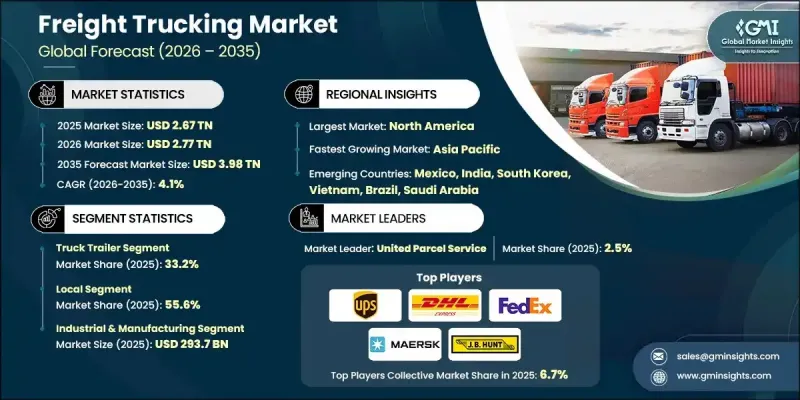
公路仍是全球物流的支柱,卡车运输占全球货运量的60%以上。製药、食品饮料和化学等行业高度依赖卡车运输来确保产品品质、新鲜度和安全性。透过卡车拓展国内和国际货运服务已成为寻求可靠和高效运输方式的企业的首选方案。每年物流新创企业数量的成长凸显了投资者对儘早抢占市场份额、提供国内和跨境货运解决方案的信心。多个地区的政府倡议,包括建造专用车道和为液化天然气或电动卡车提供激励措施,正在提高效率并促进可持续卡车运输方式的采用,从而塑造该行业的未来。
| 市场范围 | |
|---|---|
| 起始年份 | 2025 |
| 预测年份 | 2026-2035 |
| 起始值 | 2.67兆美元 |
| 预测值 | 3.98兆美元 |
| 复合年增长率 | 4.1% |
预计到2025年,卡车拖车市占率将达到33.2%。卡车拖车主要用于运输不易腐烂的货物,因此在零售、消费品和电子商务领域至关重要。全球註册的卡车拖车超过一千万辆,凸显了它们在工业和商业货运运作中的关键作用。
预计2026年至2035年间,零售和电子商务领域的复合年增长率将达到5.9%。线上购物的成长、末端配送网路的扩张以及消费者对当日达或隔日达服务日益增长的期望,都在推动市场需求。全通路零售趋势、频繁的小包裹运输以及对快速物流解决方案的需求,正促使卡车运输成为市场扩张的关键驱动力。
2025年,美国货运卡车市场规模预计将达8,303亿美元。强劲的国内製造业、高消费驱动的货运量以及广泛的州际公路网络支撑了市场成长。卡车仍然是货物运输的主要方式,这反映了物流模式的转变以及有利于公路运输的经济因素。
目录
第一章:方法论
第二章:执行概要
第三章:行业洞察
- 产业生态系分析
- 供应商格局
- 利润率
- 成本结构
- 每个阶段的价值增加
- 影响价值链的因素
- 中断
- 产业影响因素
- 成长驱动因素
- 全球电子商务与全通路零售成长
- 全球贸易协定与伙伴关係拓展
- 基础建设投资
- 车队更新和更严格的排放标准
- 产业陷阱与挑战
- 各国/各地区监管体系碎片化
- 道路拥挤和城市交通状况恶化
- 市场机会
- 电气化和零排放卡车普及
- 货运卡车的自动驾驶系统
- 数位货运平台快速扩张
- 加值物流
- 成长驱动因素
- 成长潜力分析
- 监管环境
- 北美洲
- 美国企业平均燃油经济性(CAFE)标准
- 加拿大重型车辆温室气体排放法规
- 欧洲
- 德国联邦公路货运法(GuKG)
- 法国道路货运交通导引法(LOM)
- 英国重型货车(HGV)道路使用者征费规定
- 西班牙道路运输法规(ROTT)
- 亚太地区
- 中国第六阶段重型卡车排放标准
- 日本机车废气排放标准
- 印度商用车辆的Bharat阶段排放标准
- 拉丁美洲
- 巴西 PROCONVE P8 重型卡车排放标准
- 阿根廷国家公路货运法规
- 墨西哥NOM-044重型柴油排放标准
- 中东和非洲
- 阿联酋联邦运输管理局商业运输法规
- 南非国家道路交通法(NRTA)货运车辆
- 沙乌地阿拉伯SASO燃油经济性与排放标准
- 北美洲
- 波特的分析
- PESTEL 分析
- 技术与创新格局
- 当前技术趋势
- 新兴技术
- 价格趋势
- 按地区
- 副产品
- 成本細項分析
- 永续性和环境影响
- 环境影响评估
- 社会影响与社区效益
- 公司治理与企业责任
- 永续金融与投资趋势
- 跨境贸易与国际货运
- 主要跨境贸易走廊的成长
- 海关手续和边境延误
- 双边协议
- 国际货运许可证和过境限制
- 道路基础设施和货运走廊评估
- 国道和高速公路状况
- 扩建专用货运走廊及物流走廊
- 卡车停车场、休息区和司机安全基础设施
- 收费系统、道路使用费及对承运人的成本影响
- 基础建设投资、公私合作
- 未来展望与机会
第四章:竞争格局
- 介绍
- 公司市占率分析
- 北美洲
- 欧洲
- 亚太地区
- 拉丁美洲
- MEA
- 主要市场参与者的竞争分析
- 竞争定位矩阵
- 战略展望矩阵
- 关键进展
- 併购
- 合作伙伴关係与合作
- 新产品发布
- 扩张计划和资金
第五章:市场估算与预测:依卡车划分,2022-2035年
- 卡车油罐
- 卡车拖车
- 冷藏车
- 平板车
- 其他的
第六章:市场估算与预测:依距离划分,2022-2035年
- 当地的
- 长途
第七章:市场估计与预测:依服务模式划分,2022-2035年
- 整车运输 (FTL)
- 零担货运 (LTL)
第八章:市场估算与预测:依卡车尺寸划分,2022-2035年
- 轻型卡车(LDT)
- 中型卡车(MDT)
- 重型卡车(HDT)
第九章:市场估算与预测:依企业规模划分,2022-2035年
- 中小企业
- 大型企业
第十章:市场估价与预测:依货物类型划分,2022-2035年
- 干货
- 易腐品
- 危险物质
- 其他的
第十一章:市场估计与预测:依产业划分,2022-2035年
- 食品和饮料
- 零售与电子商务
- 工业与製造业
- 能源和采矿
- 石油和天然气
- 医药与医疗保健
- 化学
- 其他的
第十二章:市场估算与预测:依地区划分,2022-2035年
- 北美洲
- 我们
- 加拿大
- 欧洲
- 德国
- 英国
- 法国
- 义大利
- 西班牙
- 俄罗斯
- 北欧
- 比荷卢经济联盟
- 亚太地区
- 中国
- 印度
- 日本
- 韩国
- 澳新银行
- 新加坡
- 马来西亚
- 印尼
- 越南
- 泰国
- 拉丁美洲
- 巴西
- 墨西哥
- 阿根廷
- 哥伦比亚
- MEA
- 南非
- 沙乌地阿拉伯
- 阿联酋
第十三章:公司简介
- 全球公司
- United Parcel Service
- FedEx
- DHL
- AP Moller - Maersk
- XPO Logistics
- DB Schenker
- Kuehne + Nagel
- Nippon Express
- Ryder System
- CH Robinson
- 区域公司
- JB Hunt Transport
- Schneider National
- Knight-Swift Transportation
- Old Dominion Freight Line
- Werner Enterprises
- Yamato Transport
- DSV Road
- GEFCO
- Sagawa Express
- CJ Logistics
- 新兴公司
- Convoy
- Full Truck Alliance
- CargoX
- BlackBuck
- Sennder
The Global Freight Trucking Market was valued at USD 2.67 trillion in 2025 and is estimated to grow at a CAGR of 4.1% to reach USD 3.98 trillion by 2035.
Roadways remain the backbone of global logistics, with trucks accounting for more than 60% of worldwide freight movement. Industries such as pharmaceuticals, food and beverages, and chemicals rely heavily on trucking to preserve product quality, freshness, and safety. Expanding domestic and international freight services through trucks has become a preferred solution for businesses seeking reliable and efficient transportation. The rising number of logistics startups each year highlights investor confidence in capturing market share early, providing both domestic and cross-border freight solutions. Government initiatives in multiple regions, including the construction of dedicated lanes and incentives for LNG or electric trucks, are boosting efficiency and promoting the adoption of sustainable trucking practices, shaping the future of the industry.
| Market Scope | |
|---|---|
| Start Year | 2025 |
| Forecast Year | 2026-2035 |
| Start Value | $2.67 Trillion |
| Forecast Value | $3.98 Trillion |
| CAGR | 4.1% |
The truck trailer segment held a 33.2% share in 2025. Truck trailers are primarily utilized for transporting non-perishable goods, making them essential in retail, consumer goods, and e-commerce sectors. Globally, over ten million truck trailers are registered, underscoring their critical role in industrial and commercial freight operations.
The retail and e-commerce segment is projected to grow at a CAGR of 5.9% between 2026 and 2035. Increasing online shopping, expanding last-mile delivery networks, and growing consumer expectations for same-day or next-day delivery are driving demand. The omnichannel retail trend, frequent small-parcel shipments, and the need for rapid logistics solutions are pushing trucking to the forefront as a key driver of market expansion.
U.S. Freight Trucking Market was valued at USD 830.3 billion in 2025. The market growth is supported by strong domestic manufacturing, high consumer-driven freight volumes, and an extensive interstate network. Trucks remain the primary mode for transporting goods, reflecting changing logistics patterns and economic factors that favor road transportation.
Major players in the Global Freight Trucking Market include DHL Express, United Parcel Service, J.B. Hunt Transport, FedEx, A.P. Moller - Maersk, Nippon Express, Schneider National, XPO Logistics, C.H. Robinson, and Kuehne + Nagel. Companies in the Freight Trucking Market are strengthening their market position through several strategic approaches. They are investing in fleet modernization, adopting electric and LNG trucks to meet sustainability targets, and expanding regional and international networks. Firms are also leveraging technology such as route optimization software, real-time tracking, and data analytics to improve operational efficiency. Strategic partnerships and acquisitions enhance market penetration and service coverage. Additionally, companies focus on specialized freight solutions for sectors like pharmaceuticals, retail, and e-commerce, while developing robust last-mile delivery capabilities to meet rising consumer expectations and maintain competitive advantage.
Table of Contents
Chapter 1 Methodology
- 1.1 Market scope and definition
- 1.2 Research design
- 1.2.1 Research approach
- 1.2.2 Data collection methods
- 1.3 Data mining sources
- 1.3.1 Global
- 1.3.2 Regional/Country
- 1.4 Base estimates and calculations
- 1.4.1 Base year calculation
- 1.4.2 Key trends for market estimation
- 1.5 Primary research and validation
- 1.5.1 Primary sources
- 1.6 Forecast
- 1.7 Research assumptions and limitations
Chapter 2 Executive Summary
- 2.1 Industry 360° synopsis
- 2.2 Key market trends
- 2.2.1 Regional
- 2.2.2 Truck
- 2.2.3 Distance
- 2.2.4 Service Model
- 2.2.5 Truck Size
- 2.2.6 Cargo
- 2.2.7 Enterprise Size
- 2.2.8 Industry
- 2.3 TAM analysis, 2026-2035
- 2.4 CXO perspectives: Strategic imperatives
- 2.4.1 Executive decision points
- 2.4.2 Critical success factors
- 2.5 Future outlook and recommendations
Chapter 3 Industry Insights
- 3.1 Industry ecosystem analysis
- 3.1.1 Supplier landscape
- 3.1.2 Profit margin
- 3.1.3 Cost structure
- 3.1.4 Value addition at each stage
- 3.1.5 Factor affecting the value chain
- 3.1.6 Disruptions
- 3.2 Industry impact forces
- 3.2.1 Growth drivers
- 3.2.1.1 Global e-commerce and omnichannel retail growth
- 3.2.1.2 Global trade deals and partnership expansion
- 3.2.1.3 Infrastructure investment
- 3.2.1.4 Fleet renewal and stricter emissions standards
- 3.2.2 Industry pitfalls and challenges
- 3.2.2.1 Regulatory fragmentation across countries/regions
- 3.2.2.2 Road congestion and deteriorating urban access
- 3.2.3 Market opportunities
- 3.2.3.1 Electrification & zero-emission truck adoption
- 3.2.3.2 Automated Driving Systems in Freight Trucks
- 3.2.3.3 Rapid expansion of digital freight platforms
- 3.2.3.4 Value-added logistics
- 3.2.1 Growth drivers
- 3.3 Growth potential analysis
- 3.4 Regulatory landscape
- 3.4.1 North America
- 3.4.1.1 U.S. corporate average fuel economy (CAFE) standards
- 3.4.1.2 Canadian heavy-duty vehicle greenhouse gas emissions regulations
- 3.4.2 Europe
- 3.4.2.1 German federal road freight transport act (GuKG)
- 3.4.2.2 French mobility orientation law (LOM) for road freight
- 3.4.2.3 UK heavy goods vehicle (HGV) road user levy regulations
- 3.4.2.4 Spanish road transport regulation (ROTT)
- 3.4.3 Asia Pacific
- 3.4.3.1 China VI emission standards for heavy-duty trucks
- 3.4.3.2 Japan motor vehicle exhaust emissions standards
- 3.4.3.3 Bharat stage emission standards for commercial vehicles in India
- 3.4.4 Latin America
- 3.4.4.1 Brazil PROCONVE P8 emission standards for heavy trucks
- 3.4.4.2 Argentine national road freight transport regulations
- 3.4.4.3 Mexican NOM-044 heavy-duty diesel emission standards
- 3.4.5 Middle East & Africa
- 3.4.5.1 UAE federal transport authority commercial transport regulations
- 3.4.5.2 South African national road traffic act (NRTA) for freight vehicles
- 3.4.5.3 Saudi Arabian SASO fuel economy & emission standards
- 3.4.1 North America
- 3.5 Porter's analysis
- 3.6 PESTEL analysis
- 3.7 Technology and innovation landscape
- 3.7.1 Current technological trends
- 3.7.2 Emerging technologies
- 3.8 Price trends
- 3.8.1 By region
- 3.8.2 By product
- 3.9 Cost breakdown analysis
- 3.10 Sustainability and environmental impact
- 3.10.1 Environmental impact assessment
- 3.10.2 Social Impact & community benefits
- 3.10.3 Governance & corporate responsibility
- 3.10.4 Sustainable finance & investment trends
- 3.11 Cross-Border Trade & International Freight Movements
- 3.11.1 Growth of major cross-border trade corridors
- 3.11.2 Customs procedures & border delays
- 3.11.3 Bilateral agreements
- 3.11.4 International trucking permits & transit restrictions
- 3.12 Road infrastructure & freight corridor assessment
- 3.12.1 Condition of national highways and expressways
- 3.12.2 Expansion of dedicated freight corridors and logistics corridors
- 3.12.3 Truck parking, rest areas & safety infrastructure for drivers
- 3.12.4 Tolling systems, road user charges & cost implications for carriers
- 3.12.5 Infrastructure investments, public-private partnerships
- 3.13 Future outlook & opportunities
Chapter 4 Competitive Landscape, 2025
- 4.1 Introduction
- 4.2 Company market share analysis
- 4.2.1 North America
- 4.2.2 Europe
- 4.2.3 Asia Pacific
- 4.2.4 LATAM
- 4.2.5 MEA
- 4.3 Competitive analysis of major market players
- 4.4 Competitive positioning matrix
- 4.5 Strategic outlook matrix
- 4.6 Key developments
- 4.6.1 Mergers & acquisitions
- 4.6.2 Partnerships & collaborations
- 4.6.3 New product launches
- 4.6.4 Expansion plans and funding
Chapter 5 Market Estimates & Forecast, By Truck, 2022 - 2035 ($Bn, fleet size)
- 5.1 Key trends
- 5.2 Lorry tank
- 5.3 Truck trailer
- 5.4 Refrigerated truck
- 5.5 Flatbed truck
- 5.6 Others
Chapter 6 Market Estimates & Forecast, By Distance, 2022 - 2035 ($Bn, fleet size)
- 6.1 Key trends
- 6.2 Local
- 6.3 Long haul
Chapter 7 Market Estimates & Forecast, By Service Model, 2022 - 2035 ($Bn, fleet size)
- 7.1 Key trends
- 7.2 Full Truckload (FTL)
- 7.3 Less Than Truckload (LTL)
Chapter 8 Market Estimates & Forecast, By Truck Size, 2022 - 2035 ($Bn, fleet size)
- 8.1 Key trends
- 8.2 Light-duty trucks (LDTs)
- 8.3 Medium-duty trucks (MDTs)
- 8.4 Heavy-duty trucks (HDTs)
Chapter 9 Market Estimates & Forecast, By Enterprise Size, 2022 - 2035 ($Bn, fleet size)
- 9.1 Key trends
- 9.2 SMEs
- 9.3 Large Enterprises
Chapter 10 Market Estimates & Forecast, By Cargo, 2022 - 2035 ($Bn, fleet size)
- 10.1 Key trends
- 10.2 Dry Goods
- 10.3 Perishables
- 10.4 Hazardous materials
- 10.5 Others
Chapter 11 Market Estimates & Forecast, By Industry, 2022 - 2035 ($Bn, fleet size)
- 11.1 Key trends
- 11.2 Food & beverages
- 11.3 Retail & e-commerce
- 11.4 Industrial & manufacturing
- 11.5 Energy and mining
- 11.6 Oil & gas
- 11.7 Pharmaceutical & healthcare
- 11.8 Chemical
- 11.9 Others
Chapter 12 Market Estimates & Forecast, By Region, 2022 - 2035 ($Bn, fleet size)
- 12.1 Key trends
- 12.2 North America
- 12.2.1 US
- 12.2.2 Canada
- 12.3 Europe
- 12.3.1 Germany
- 12.3.2 UK
- 12.3.3 France
- 12.3.4 Italy
- 12.3.5 Spain
- 12.3.6 Russia
- 12.3.7 Nordics
- 12.3.8 Benelux
- 12.4 Asia Pacific
- 12.4.1 China
- 12.4.2 India
- 12.4.3 Japan
- 12.4.4 South Korea
- 12.4.5 ANZ
- 12.4.6 Singapore
- 12.4.7 Malaysia
- 12.4.8 Indonesia
- 12.4.9 Vietnam
- 12.4.10 Thailand
- 12.5 Latin America
- 12.5.1 Brazil
- 12.5.2 Mexico
- 12.5.3 Argentina
- 12.5.4 Colombia
- 12.6 MEA
- 12.6.1 South Africa
- 12.6.2 Saudi Arabia
- 12.6.3 UAE
Chapter 13 Company Profiles
- 13.1 Global companies
- 13.1.1 United Parcel Service
- 13.1.2 FedEx
- 13.1.3 DHL
- 13.1.4 A.P. Moller - Maersk
- 13.1.5 XPO Logistics
- 13.1.6 DB Schenker
- 13.1.7 Kuehne + Nagel
- 13.1.8 Nippon Express
- 13.1.9 Ryder System
- 13.1.10 C.H. Robinson
- 13.2 Regional companies
- 13.2.1 J.B. Hunt Transport
- 13.2.2 Schneider National
- 13.2.3 Knight-Swift Transportation
- 13.2.4 Old Dominion Freight Line
- 13.2.5 Werner Enterprises
- 13.2.6 Yamato Transport
- 13.2.7 DSV Road
- 13.2.8 GEFCO
- 13.2.9 Sagawa Express
- 13.2.10 CJ Logistics
- 13.3 Emerging companies
- 13.3.1 Convoy
- 13.3.2 Full Truck Alliance
- 13.3.3 CargoX
- 13.3.4 BlackBuck
- 13.3.5 Sennder

 货运卡车运输市场:2026-2032年全球市场预测(依服务类型、车辆类型、营运模式、运输距离、最终用户产业和预订管道划分)
 2026年全球普通货物运输市场报告2026年全球本地普通货运卡车运输市场报告2026年全球特种货物运输市场报告2026年全球长途普通货物运输市场报告
 货运卡车市场分析及预测(至2035年):依类型、产品类型、服务、技术、组件、应用、流程、最终使用者、设备及运输方式划分
 全球货运卡车市场规模、份额、趋势和成长分析报告(2026-2034)货运卡车市场规模、份额、成长及全球产业分析:按类型、应用和地区划分,并预测至2026-2034年货运卡车市场-2026-2031年预测
 货运卡车市场规模、份额和成长分析(按卡车类型、货物类型、最终用户和地区划分)-2026-2033年产业预测