


 |
市场调查报告书
商品编码
1892857
数位纺织印花机市场机会、成长驱动因素、产业趋势分析及预测(2026-2035年)Digital Textile Printer Market Opportunity, Growth Drivers, Industry Trend Analysis, and Forecast 2026 - 2035 |
||||||

2025年全球数位纺织印表机市场价值为29亿美元,预计2035年将以5.7%的复合年增长率成长至50亿美元。
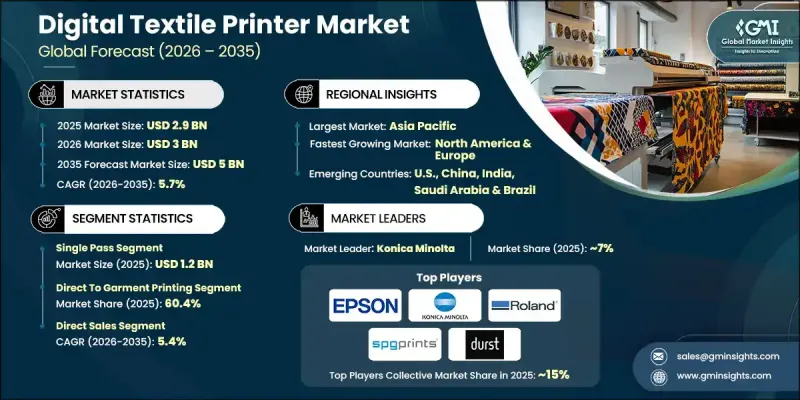
这一成长是由几个关键趋势推动的,这些趋势正在改变纺织业。消费者对按需客製化和个人化纺织品的需求日益增长,促使製造商采用更快、更灵活的生产方式。快时尚、线上购物平台和社群媒体驱动的趋势的兴起,正推动纺织企业生产更小批量、高度客製化的产品。与传统印刷方式相比,数位纺织印花技术使品牌能够以更短的设定时间、更快的周转速度和更低的库存成本交付这些产品。单程列印头、人工智慧驱动的色彩管理系统和自动化工作流程等技术的进步,进一步提高了效率、精确度和生产力。高解析度印刷技术能够覆盖各种纺织品类型,同时最大限度地减少停机时间和生产成本,这使得数位纺织印表机对于现代服装和家居装饰行业日益重要。
| 市场范围 | |
|---|---|
| 起始年份 | 2025 |
| 预测年份 | 2026-2035 |
| 起始值 | 29亿美元 |
| 预测值 | 50亿美元 |
| 复合年增长率 | 5.7% |
2025年,单程印表机市场规模达到12亿美元,预计2026年至2035年将以5.7%的复合年增长率成长。这些印表机一次即可完成整个设计,大幅缩短生产时间,使製造商能够满足快速週转的时尚产品和大量订单的需求,因此非常适合电子商务和个人化服装生产。
至2025年,直喷印花(DTG)市占率达到60.4%,预计2026年至2035年将以6%的复合年增长率成长。 DTG技术无需复杂的设定即可将高品质、全彩图案直接印製到成衣上,从而支援按需生产和电子商务驱动的商业模式。其适应性强,吸引了众多中小企业、订製服装企业以及提供个人化服装的线上平台。
2025年美国数位纺织印花市场规模为3.7亿美元,预计2026年至2035年将以4.6%的复合年增长率成长。时尚、家居装饰和产业用纺织品行业的强劲需求推动了对先进印花技术的需求,这些技术能够支援大规模客製化和快速设计迭代。按需生产模式、微型工厂建设以及包括无水印花和低影响油墨在内的永续发展倡议,进一步促进了市场成长。
目录
第一章:方法论与范围
第二章:执行概要
第三章:行业洞察
- 产业生态系分析
- 供应商格局
- 利润率
- 每个阶段的价值增加
- 影响价值链的因素
- 产业影响因素
- 成长驱动因素
- 消费者对个人化和按需生产的需求
- 省水环保油墨
- 技术进步
- 产业陷阱与挑战
- 高昂的初始投资和营运成本
- 油墨品质、耐久性和可持续性方面的挑战
- 成长驱动因素
- 成长潜力分析
- 未来市场趋势
- 技术与创新格局
- 当前技术趋势
- 新兴技术
- 价格趋势
- 按地区
- 按机器类型
- 监管环境
- 标准和合规要求
- 区域监理框架
- 认证标准
- 波特的分析
- PESTEL 分析
第四章:竞争格局
- 介绍
- 公司市占率分析
- 按地区
- 北美洲
- 欧洲
- 亚太地区
- 拉丁美洲
- 中东和非洲
- 按地区
- 公司矩阵分析
- 主要市场参与者的竞争分析
- 竞争定位矩阵
- 关键进展
- 併购
- 合作伙伴关係与合作
- 新产品发布
- 扩张计划
第五章:市场估算与预测:依机器类型划分,2022-2035年
- 绘图仪
- 扫描器
- 单次通过
第六章:市场估算与预测:依油墨类型划分,2022-2035年
- 活性油墨
- 酸性墨水
- 分散油墨
- 颜料墨水
- 其他
第七章:市场估计与预测:依材料划分,2022-2035年
- 棉布
- 聚酯纤维
- 丝绸
- 混纺织物
第八章:市场估算与预测:依技术划分,2022-2035年
- 热喷墨
- 压电喷墨
- 连续喷墨
- 热传递
- 静电
- 静电照相术
- 其他的
第九章:市场估价与预测:依印刷流程划分,2022-2035年
- 直接服装印花
- 直接印製于织物上
第十章:市场估计与预测:依应用领域划分,2022-2035年
- 时尚和服装业
- 家居用品
- 汽车和运输
- 医疗保健
- 运动健身产业
- 广告与行销
- 其他(航太、教育、建筑)
第十一章:市场估价与预测:依配销通路划分,2022-2035年
- 直销
- 间接销售
第十二章:市场估算与预测:依地区划分,2022-2035年
- 北美洲
- 我们
- 加拿大
- 欧洲
- 德国
- 英国
- 法国
- 义大利
- 西班牙
- 亚太地区
- 中国
- 印度
- 日本
- 韩国
- 澳洲
- 印尼
- 马来西亚
- 拉丁美洲
- 巴西
- 墨西哥
- 阿根廷
- MEA
- 沙乌地阿拉伯
- 阿联酋
- 南非
第十三章:公司简介
- Aleph Srl
- Durst Group
- EFI (Electronics For Imaging)
- Epson
- Hollanders Printing Systems
- JK Group
- Konica Minolta
- Kornit Digital
- Mimaki Engineering
- MS Printing Solutions
- Mutoh
- Reggiani Machine
- Roland DG
- Seiko Epson Corporation
- SPGPrints
The Global Digital Textile Printer Market was valued at USD 2.9 billion in 2025 and is estimated to grow at a CAGR of 5.7% to reach USD 5 billion by 2035.
This growth is driven by several key trends transforming the textile industry. Consumers increasingly demand on-demand and personalized textiles, prompting manufacturers to adopt faster, more flexible production methods. The rise of fast fashion, online shopping platforms, and social media-driven trends is pushing textile companies to produce smaller, highly customized batches. Digital textile printing enables brands to deliver these products with reduced setup times, faster turnaround, and lower inventory costs compared to traditional printing methods. Advancements in technology, including single-pass print heads, AI-driven color management systems, and automated workflows, further boost efficiency, precision, and productivity. High-resolution printing across diverse textile types while minimizing downtime and production costs makes digital textile printers increasingly essential for the modern apparel and home decor sectors.
| Market Scope | |
|---|---|
| Start Year | 2025 |
| Forecast Year | 2026-2035 |
| Start Value | $2.9 Billion |
| Forecast Value | $5 Billion |
| CAGR | 5.7% |
The single-pass printers segment generated USD 1.2 billion in 2025 and is expected to grow at a CAGR of 5.7% from 2026 to 2035. These printers complete entire designs in a single pass, dramatically reducing production time and allowing manufacturers to meet demand for rapid-turnaround fashion and bulk orders, making them ideal for e-commerce and personalized apparel production.
The direct-to-garment (DTG) printing segment held a 60.4% share in 2025 and is projected to grow at a CAGR of 6% from 2026 to 2035. DTG technology allows high-quality, full-color designs to be printed directly onto finished garments without complex setups, supporting on-demand production and e-commerce-driven business models. Its adaptability attracts small and medium enterprises, custom apparel businesses, and online platforms offering personalized clothing.
U.S. Digital Textile Printer Market was valued at USD 370 million in 2025 and is expected to grow at a CAGR of 4.6% from 2026 to 2035. Strong fashion, home decor, and technical textile industries drive demand for advanced printing technologies that support mass customization and rapid design turnaround. On-demand production models, micro-factory setups, and sustainability initiatives, including waterless printing and low-impact inks, further fuel market growth.
Key players in the Global Digital Textile Printer Market include Aleph S.r.l., Durst Group, EFI (Electronics For Imaging), Epson, Hollanders Printing Systems, JK Group, Konica Minolta, Kornit Digital, Mimaki Engineering, MS Printing Solutions, Mutoh, Reggiani Machine, Roland DG, Seiko Epson Corporation, and SPGPrints. Companies in the Global Digital Textile Printer Market are expanding their footprint by investing in advanced printing technologies, such as AI-assisted color management, single-pass printing, and automated workflow systems, to increase efficiency and precision. Strategic partnerships with textile manufacturers, fashion brands, and e-commerce platforms enable wider adoption of digital printing solutions. Firms are also focusing on sustainable and eco-friendly printing methods to meet environmental regulations and consumer demand. Expanding global distribution networks, enhancing after-sales support, and offering training programs help strengthen market presence.
Table of Contents
Chapter 1 Methodology & Scope
- 1.1 Market scope and definition
- 1.2 Research design
- 1.2.1 Research approach
- 1.2.2 Data collection methods
- 1.3 Data mining sources
- 1.3.1 Global
- 1.3.2 Regional/Country
- 1.4 Base estimates and calculations
- 1.4.1 Base year calculation
- 1.4.2 Key trends for market estimation
- 1.5 Primary research and validation
- 1.5.1 Primary sources
- 1.6 Forecast model
- 1.7 Research assumptions and limitations
Chapter 2 Executive Summary
- 2.1 Industry 360° synopsis
- 2.2 Key market trends
- 2.2.1 Regional
- 2.2.2 Machine type
- 2.2.3 Ink type
- 2.2.4 Material
- 2.2.5 Technology
- 2.2.6 Printing process
- 2.2.7 Application
- 2.2.8 Distribution channel
- 2.3 CXO perspectives: Strategic imperatives
- 2.3.1 Key decision points for industry executives
- 2.3.2 Critical success factors for market players
- 2.4 Future outlook and strategic recommendations
Chapter 3 Industry Insights
- 3.1 Industry ecosystem analysis
- 3.1.1 Supplier landscape
- 3.1.2 Profit margin
- 3.1.3 Value addition at each stage
- 3.1.4 Factor affecting the value chain
- 3.2 Industry impact forces
- 3.2.1 Growth drivers
- 3.2.1.1 Consumer demand for personalization & on-demand production
- 3.2.1.2 Water-saving and eco-friendly inks
- 3.2.1.3 Technological advancements
- 3.2.2 Industry pitfalls & challenges
- 3.2.2.1 High initial investments & operating costs
- 3.2.2.2 Ink quality, durability & sustainability hurdles
- 3.2.1 Growth drivers
- 3.3 Growth potential analysis
- 3.4 Future market trends
- 3.5 Technology and innovation landscape
- 3.5.1 Current technological trends
- 3.5.2 Emerging technologies
- 3.6 Price trends
- 3.6.1 By region
- 3.6.2 By machine type
- 3.7 Regulatory landscape
- 3.7.1 Standards and compliance requirements
- 3.7.2 Regional regulatory frameworks
- 3.7.3 Certification standards
- 3.8 Porter's analysis
- 3.9 PESTEL analysis
Chapter 4 Competitive Landscape, 2025
- 4.1 Introduction
- 4.2 Company market share analysis
- 4.2.1 By Region
- 4.2.1.1 North America
- 4.2.1.2 Europe
- 4.2.1.3 Asia Pacific
- 4.2.1.4 Latin America
- 4.2.1.5 Middle East & Africa
- 4.2.1 By Region
- 4.3 Company matrix analysis
- 4.4 Competitive analysis of major market players
- 4.5 Competitive positioning matrix
- 4.6 Key developments
- 4.6.1 Mergers & acquisitions
- 4.6.2 Partnerships & collaborations
- 4.6.3 New product launches
- 4.6.4 Expansion plans
Chapter 5 Market Estimates & Forecast, By Machine Type, 2022 - 2035, (USD Billion) (Thousand Units)
- 5.1 Key trends
- 5.2 Plotter
- 5.3 Scanner
- 5.4 Single pass
Chapter 6 Market Estimates & Forecast, By Ink Type, 2022 - 2035, (USD Billion) (Thousand Units)
- 6.1 Key trends
- 6.2 Reactive ink
- 6.3 Acid ink
- 6.4 Disperse ink
- 6.5 Pigment ink
- 6.6 Other
Chapter 7 Market Estimates & Forecast, By Material, 2022 - 2035, (USD Billion) (Thousand Units)
- 7.1 Key trends
- 7.2 Cotton
- 7.3 Polyester
- 7.4 Silk
- 7.5 Blended fabrics
Chapter 8 Market Estimates & Forecast, By Technology, 2022 - 2035, (USD Billion) (Thousand Units)
- 8.1 Key trends
- 8.2 Thermal inkjet
- 8.3 Piezoelectric inkjet
- 8.4 Continuous inkjet
- 8.5 Thermal transfer
- 8.6 Electrostatic
- 8.7 Electrophotography
- 8.8 Others
Chapter 9 Market Estimates & Forecast, By Printing Process, 2022 - 2035, (USD Billion) (Thousand Units)
- 9.1 Key trends
- 9.2 Direct to garment printing
- 9.3 Direct to fabrics
Chapter 10 Market Estimates & Forecast, By Application, 2022 - 2035, (USD Billion) (Thousand Units)
- 10.1 Key trends
- 10.2 Fashion and clothing industry
- 10.3 Home furnishing
- 10.4 Automotive and transportation
- 10.5 Healthcare and medical
- 10.6 Sports and fitness industry
- 10.7 Advertising and marketing
- 10.8 Others (aerospace, education, construction)
Chapter 11 Market Estimates & Forecast, By Distribution Channel, 2022 - 2035, (USD Billion) (Thousand Units)
- 11.1 Key trends
- 11.2 Direct sales
- 11.3 Indirect sales
Chapter 12 Market Estimates & Forecast, By Region, 2022 - 2035, (USD Billion) (Thousand Units)
- 12.1 Key trends
- 12.2 North America
- 12.2.1 U.S.
- 12.2.2 Canada
- 12.3 Europe
- 12.3.1 Germany
- 12.3.2 UK
- 12.3.3 France
- 12.3.4 Italy
- 12.3.5 Spain
- 12.4 Asia Pacific
- 12.4.1 China
- 12.4.2 India
- 12.4.3 Japan
- 12.4.4 South Korea
- 12.4.5 Australia
- 12.4.6 Indonesia
- 12.4.7 Malaysia
- 12.5 Latin America
- 12.5.1 Brazil
- 12.5.2 Mexico
- 12.5.3 Argentina
- 12.6 MEA
- 12.6.1 Saudi Arabia
- 12.6.2 UAE
- 12.6.3 South Africa
Chapter 13 Company Profiles
- 13.1 Aleph S.r.l.
- 13.2 Durst Group
- 13.3 EFI (Electronics For Imaging)
- 13.4 Epson
- 13.5 Hollanders Printing Systems
- 13.6 JK Group
- 13.7 Konica Minolta
- 13.8 Kornit Digital
- 13.9 Mimaki Engineering
- 13.10 MS Printing Solutions
- 13.11 Mutoh
- 13.12 Reggiani Machine
- 13.13 Roland DG
- 13.14 Seiko Epson Corporation
- 13.15 SPGPrints

 纺织品印花市场:依印花技术、油墨类型、承印物、产量及应用划分-2026-2032年全球预测
 日本数位纺织印花市场规模、份额、趋势及预测(按印花方法、承印物类型、油墨类型、应用及地区划分,2026-2034年)
 2026年全球数位纺织印花市场报告
 全球数位纺织印花机市场:按印花机类型、印花机技术、墨水类型、材料类型、应用、国家和地区划分-产业分析、市场规模、份额及未来预测(2025-2032)大幅面纺织品直喷印表机市场:按墨水类型、印表机技术、印表机幅宽和应用划分 - 全球预测(2026-2032 年)宽幅直喷式织物印表机市场:按列印技术、印表机类型、应用和最终用户划分 - 全球预测(2026-2032 年)按技术、织物材料、墨水类型、最终用户和应用分類的直接织物纺织印表机市场—2026-2032年全球预测
 数位纺织印花:市场占有率分析、产业趋势与统计、成长预测(2026-2031)
 数位纺织印花市场规模、份额及成长分析(按纺织品、印花製程、油墨类型、操作方式、承印物、应用及地区划分)-产业预测:2026-2033年
 纺织品印花市场规模、份额和趋势分析报告:按印花技术、应用、地区和细分市场预测(2025-2033 年)