


 |
市场调查报告书
商品编码
1892916
穿戴式生物电子皮肤贴片市场机会、成长驱动因素、产业趋势分析及预测(2025-2034年)Wearable Bioelectronic Skin Patches Market Opportunity, Growth Drivers, Industry Trend Analysis, and Forecast 2025 - 2034 |
||||||

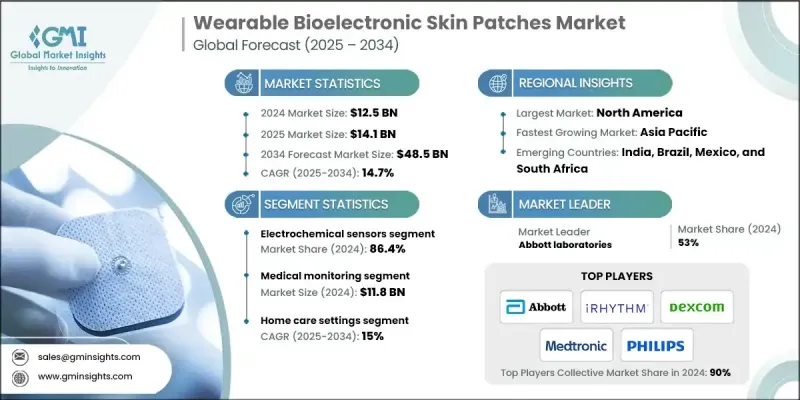
2024 年全球穿戴式生物电子皮肤贴片市场价值为 125 亿美元,预计到 2034 年将以 14.7% 的复合年增长率增长至 485 亿美元。
市场成长的驱动力来自于即时健康监测的日益普及、慢性病盛行率的上升以及柔性生物感测技术的快速发展。这些新一代贴片整合了多感测器系统、无线连接和人工智慧分析功能,能够持续提供心血管、代谢和生理参数的数据。随着医疗保健系统向预防性和远距医疗模式转型,穿戴式生物电子贴片在长期监测、早期诊断和个人化治疗管理方面变得不可或缺。全球对远距医疗的日益重视,以及病患对非侵入性解决方案的偏好,进一步加速了市场普及。随着可拉伸电子装置和生物相容性材料研发的不断深入,这些贴片正在发展成为能够与数位健康生态系统无缝整合的先进平台,从而改善临床疗效并减轻患者负担。
| 市场范围 | |
|---|---|
| 起始年份 | 2024 |
| 预测年份 | 2025-2034 |
| 起始值 | 125亿美元 |
| 预测值 | 485亿美元 |
| 复合年增长率 | 14.7% |
市场主要按类型划分,其中电化学感测器细分市场预计在2024年将占据86.4%的市场份额,成为全球市场收入最高的细分市场。电化学感测器之所以占据主导地位,是因为其在生化监测方面具有极高的精度,尤其是在血糖追踪、电解质评估和乳酸分析方面。由于其高灵敏度、成本效益以及与柔性基材的兼容性,电化学感测器整合到可穿戴贴片中,可支援从糖尿病管理到运动表现等广泛的应用。这些感测器将化学反应转化为电讯号,从而能够透过汗液和组织液进行精确且连续的监测。
就应用领域而言,医疗监测领域在2024年创造了1,180万美元的市场规模,使其成为全球最大的应用领域。该领域的成长动力源于对慢性疾病(例如心律不整、糖尿病、高血压和术后恢復)进行不间断监测的需求。医疗监测贴片可在临床环境之外提供持续、高品质的资料,从而减少患者的再次入院率并实现併发症的早期发现。随着医疗机构越来越多地采用远距患者监测平台和混合护理模式,医疗监测贴片的应用正在迅速扩展。随着医院和临床医生将精准诊断、降低成本和改善患者预后作为优先事项,生物电子皮肤贴片正成为现代化医疗服务的核心。
预计到2024年,北美穿戴式生物电子皮肤贴片市场占有率将达到44.4%。强大的医疗基础设施、数位健康工具的高普及率以及远端监测系统的广泛应用是推动市场成长的关键因素。该地区受益于生物感测器技术快速融入临床工作流程、慢性病负担日益加重以及远端监测设备报销范围的扩大。此外,总部位于北美的主要产业参与者,如雅培、德康医疗和iRhythm,持续增加对研发、产品创新和大规模商业化的投入。远距医疗平台的蓬勃发展,以及消费者对持续健康追踪意识的不断提高,使北美成为穿戴式生物电子皮肤贴片领域的长期领导者。
目录
第一章:方法论与范围
第二章:执行概要
第三章:行业洞察
- 产业生态系分析
- 产业影响因素
- 成长驱动因素
- 对非侵入式和即时健康监测解决方案的需求日益增长
- 柔性可拉伸电子技术的进步
- 慢性病盛行率不断上升
- 提高健康意识和健身意识
- 产业陷阱与挑战
- 高昂的研发和製造成本
- 对资料隐私和安全的担忧
- 市场机会
- 远端健康监测
- 结合人工智慧和物联网技术实现个人化医疗
- 成长驱动因素
- 成长潜力分析
- 监管环境
- 北美洲
- 亚太地区
- 欧洲
- 技术格局
- 当前技术趋势
- 新兴技术
- 未来市场趋势
- 差距分析
- 波特的分析
- PESTEL 分析
第四章:竞争格局
- 介绍
- 公司市占率分析
- 公司矩阵分析
- 主要市场参与者的竞争分析
- 竞争定位矩阵
- 战略仪錶板
- 关键进展
- 併购
- 伙伴关係与合作
- 新产品发布
- 扩张计划
第五章:市场估算与预测:依产品划分,2021-2034年
- 电化学感测器
- 心电图感测器
- 温度感测器
- 肌电感测器
- 其他类型
第六章:市场估算与预测:依应用领域划分,2021-2034年
- 健身与健康
- 医疗监测
- 其他应用
第七章:市场估算与预测:依最终用途划分,2021-2034年
- 医院和诊所
- 家庭护理机构
- 其他最终用途
第八章:市场估算与预测:依地区划分,2021-2034年
- 北美洲
- 我们
- 加拿大
- 欧洲
- 德国
- 英国
- 法国
- 西班牙
- 义大利
- 荷兰
- 亚太地区
- 中国
- 日本
- 印度
- 澳洲
- 韩国
- 拉丁美洲
- 巴西
- 墨西哥
- 阿根廷
- 中东和非洲
- 南非
- 沙乌地阿拉伯
- 阿联酋
第九章:公司简介
- 2M Engineering
- Abbott Laboratories
- Biolinq
- Baxter International
- Boston Scientific
- Dexcom
- Epicore Biosystems, Inc.
- GE Healthcare Technologies Inc.
- GENTAG, Inc.
- Insulet Corporation
- iRhythm Technologies, Inc.
- Koninklijke Philips NV
- LifeSignals, Inc.
- Medtronic plc
- Sinocare
- SmartCardia Inc.
- VitalConnect
- VivaLNK, Inc.
The Global Wearable Bioelectronic Skin Patches Market was valued at USD 12.5 billion in 2024 and is estimated to grow at a CAGR of 14.7% to reach USD 48.5 billion by 2034.
Market growth is driven by rising adoption of real-time health monitoring, increasing prevalence of chronic diseases, and rapid advancements in flexible biosensing technologies. These next-generation patches integrate multi-sensor systems, wireless connectivity, and AI-enabled analytics, offering continuous insights into cardiovascular, metabolic, and physiological parameters. As healthcare systems shift toward preventive and remote care models, wearable bioelectronic patches are becoming indispensable for long-term monitoring, early diagnosis, and personalized therapy management. The growing global focus on telehealth, combined with patient preference for non-invasive solutions, further accelerates market uptake. With expanding R&D in stretchable electronics and biocompatible materials, these patches are evolving into advanced platforms that seamlessly integrate with digital health ecosystems, enhancing clinical outcomes and reducing patient burden.
| Market Scope | |
|---|---|
| Start Year | 2024 |
| Forecast Year | 2025-2034 |
| Start Value | $12.5 Billion |
| Forecast Value | $48.5 billion |
| CAGR | 14.7% |
The market is primarily segmented by type, with the electrochemical sensors segment holding 86.4% share in 2024, making it the highest revenue segment in the global market. Electrochemical sensors dominate due to their precision in biochemical monitoring, especially in glucose tracking, electrolyte assessment, and lactate analysis. Their integration within wearable patches supports a wide range of applications from diabetes management to sports performance, owing to high sensitivity, cost-effectiveness, and compatibility with flexible substrates. These sensors transform chemical reactions into electrical signals, enabling accurate and continuous monitoring through sweat and interstitial fluids.
In terms of application, the medical monitoring segment generated USD 11.8 million in 2024, making it the dominant application segment globally. This segment is driven by the need for uninterrupted monitoring of chronic conditions such as arrhythmia, diabetes, hypertension, and post-surgical recovery. Medical monitoring patches provide continuous, high-quality data outside clinical environments, reducing hospital readmissions and enabling early detection of complications. Their use is expanding rapidly as healthcare providers increasingly adopt remote patient monitoring platforms and hybrid care models. As hospitals and clinicians prioritize precision diagnostics, cost reduction, and improved patient outcomes, bioelectronic skin patches are becoming central to modernized care delivery.
North America Wearable Bioelectronic Skin Patches Market held 44.4% share in 2024. Strong healthcare infrastructure, high adoption of digital health tools, and widespread use of remote monitoring systems are key growth drivers. The region benefits from rapid integration of biosensor technologies into clinical workflows, rising chronic disease burden, and expanding reimbursement for remote monitoring devices. Additionally, major industry players headquartered in North America, such as Abbott, Dexcom, and iRhythm, continue to invest in R&D, product innovation, and large-scale commercialization. The strong presence of telehealth platforms, combined with increasing consumer awareness of continuous health tracking, positions North America as a long-term leader in wearable bioelectronic skin patches.
Key players in the Global Wearable Bioelectronic Skin Patches Market include 2M Engineering, Abbott Laboratories, Baxter International, Biolinq, Boston Scientific, Dexcom, Epicore Biosystems, GE Healthcare Technologies, GENTAG, Insulet Corporation, iRhythm Technologies, Koninklijke Philips, LifeSignals, Medtronic, Sinocare, SmartCardia, VitalConnect, and VivaLNK Companies. The wearable bioelectronic skin patches market is focusing on multi-layered strategies to strengthen its market foothold. Leading players are investing heavily in R&D to develop flexible, biocompatible materials, advanced electrochemical and ECG sensor platforms, and AI-driven analytics that enhance clinical accuracy and user comfort. Strategic partnerships with hospitals, digital health platforms, and research institutions are accelerating the integration of patches into remote patient monitoring and telehealth ecosystems.
Table of Contents
Chapter 1 Methodology and Scope
- 1.1 Market scope and definitions
- 1.2 Research design
- 1.2.1 Research approach
- 1.2.2 Data collection methods
- 1.3 Data mining sources
- 1.3.1 Global
- 1.3.2 Regional/Country
- 1.4 Base estimates and calculations
- 1.4.1 Base year calculation
- 1.4.2 Key trends for market estimation
- 1.5 Primary research and validation
- 1.5.1 Primary sources
- 1.6 Forecast model
- 1.7 Research assumptions and limitations
Chapter 2 Executive Summary
- 2.1 Industry 3600 synopsis
- 2.2 Key market trends
- 2.2.1 Regional trends
- 2.2.2 Production trends
- 2.2.3 Application trends
- 2.2.4 End use trends
- 2.3 CXO perspectives: Strategic imperatives
- 2.3.1 Key decision points for industry executives
- 2.3.2 Critical success factors for market players
- 2.4 Future outlook and strategic recommendations
Chapter 3 Industry Insights
- 3.1 Industry ecosystem analysis
- 3.2 Industry impact forces
- 3.2.1 Growth drivers
- 3.2.1.1 Rising demand for non-invasive and real-time health monitoring solutions
- 3.2.1.2 Technological advancements in flexible and stretchable electronics
- 3.2.1.3 Growing prevalence of chronic diseases
- 3.2.1.4 Increasing health awareness and fitness consciousness
- 3.2.2 Industry pitfalls and challenges
- 3.2.2.1 High development and manufacturing costs
- 3.2.2.2 Concerns regarding data privacy and the security
- 3.2.3 Market opportunities
- 3.2.4 Remote health monitoring
- 3.2.5 Integration with AI and IoT for personalized healthcare
- 3.2.1 Growth drivers
- 3.3 Growth potential analysis
- 3.4 Regulatory landscape
- 3.4.1 North America
- 3.4.2 Asia Pacific
- 3.4.3 Europe
- 3.5 Technology landscape
- 3.5.1 Current technological trends
- 3.5.2 Emerging technologies
- 3.6 Future market trends
- 3.7 Gap analysis
- 3.8 Porter's analysis
- 3.9 PESTEL analysis
Chapter 4 Competitive Landscape, 2024
- 4.1 Introduction
- 4.2 Company market share analysis
- 4.3 Company matrix analysis
- 4.4 Competitive analysis of major market players
- 4.5 Competitive positioning matrix
- 4.6 Strategy dashboard
- 4.7 Key developments
- 4.7.1 Mergers and acquisitions
- 4.7.2 Partnerships and collaborations
- 4.7.3 New product launches
- 4.7.4 Expansion plans
Chapter 5 Market Estimates and Forecast, By Product, 2021 - 2034 ($ Mn)
- 5.1 Key trends
- 5.2 Electrochemical sensors
- 5.3 ECG sensors
- 5.4 Temperature sensors
- 5.5 EMG sensors
- 5.6 Other types
Chapter 6 Market Estimates and Forecast, By Application, 2021 - 2034 ($ Mn)
- 6.1 Key trends
- 6.2 Fitness and wellness
- 6.3 Medical monitoring
- 6.4 Other applications
Chapter 7 Market Estimates and Forecast, By End Use, 2021 - 2034 ($ Mn)
- 7.1 Key trends
- 7.2 Hospitals and clinics
- 7.3 Home care settings
- 7.4 Other end use
Chapter 8 Market Estimates and Forecast, By Region, 2021 - 2034 ($ Mn)
- 8.1 Key trends
- 8.2 North America
- 8.2.1 U.S.
- 8.2.2 Canada
- 8.3 Europe
- 8.3.3 Germany
- 8.3.4 UK
- 8.3.5 France
- 8.3.6 Spain
- 8.3.7 Italy
- 8.3.8 Netherlands
- 8.4 Asia Pacific
- 8.4.1 China
- 8.4.2 Japan
- 8.4.3 India
- 8.4.4 Australia
- 8.4.5 South Korea
- 8.5 Latin America
- 8.5.1 Brazil
- 8.5.2 Mexico
- 8.5.3 Argentina
- 8.6 Middle East and Africa
- 8.6.1 South Africa
- 8.6.2 Saudi Arabia
- 8.6.3 UAE
Chapter 9 Company Profiles
- 9.1 2M Engineering
- 9.2 Abbott Laboratories
- 9.3 Biolinq
- 9.4 Baxter International
- 9.5 Boston Scientific
- 9.6 Dexcom
- 9.7 Epicore Biosystems, Inc.
- 9.8 GE Healthcare Technologies Inc.
- 9.9 GENTAG, Inc.
- 9.10 Insulet Corporation
- 9.11 iRhythm Technologies, Inc.
- 9.12 Koninklijke Philips N.V.
- 9.13 LifeSignals, Inc.
- 9.14 Medtronic plc
- 9.15 Sinocare
- 9.16 SmartCardia Inc.
- 9.17 VitalConnect
- 9.18 VivaLNK, Inc.


