


 |
市场调查报告书
商品编码
1913290
血友病治疗市场机会、成长要素、产业趋势分析及2026年至2035年预测Hemophilia Treatment Market Opportunity, Growth Drivers, Industry Trend Analysis, and Forecast 2026 - 2035 |
||||||

全球血友病治疗市场预计到 2025 年将达到 152 亿美元,到 2035 年将达到 272 亿美元,年复合成长率为 6.1%。
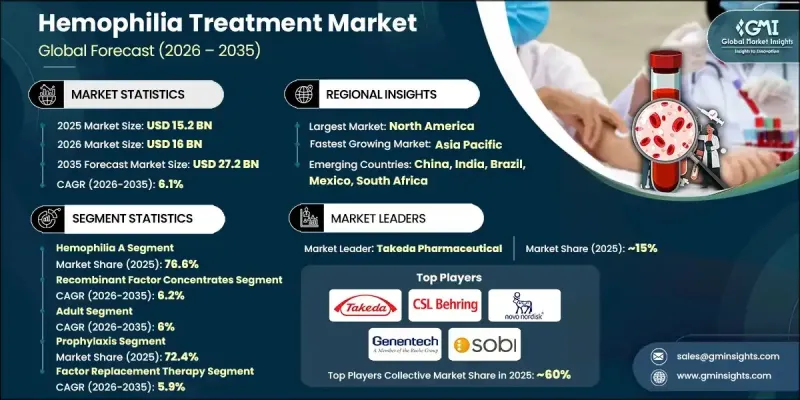
由于A型血友病率不断上升、预防性治疗方法被广泛接受以及先进治疗创新技术的加速应用,市场持续扩张。血友病治疗的重点在于控制凝血因子缺乏引起的出血性疾病,以维持稳定的凝血功能并最大限度地降低出血风险。从被动治疗转向以预防为主的长期疾病管理模式也是推动市场成长的因素之一。治疗持久性、剂量准确性和患者便利性的不断改进正在提高治疗依从性和疗效。人们日益关注提高生活品质和减少长期併发症,这进一步增强了已开发国家和新兴国家医疗保健系统的需求。此外,能够提供持续治疗益处并减轻治疗负担的创新技术正在重塑治疗方法选择,并推动全球市场成长。
| 市场覆盖范围 | |
|---|---|
| 开始年份 | 2025 |
| 预测年份 | 2026-2035 |
| 起始值 | 152亿美元 |
| 预测金额 | 272亿美元 |
| 复合年增长率 | 6.1% |
预计到2025年, A型血友病市场将占76.6%的市场份额,并在2034年之前以6%的复合年增长率成长。该细分市场之所以能保持主导地位,是因为其在全球范围内的高发病率催生了对先进治疗方案的巨大需求,治疗方法方案旨在解决凝血因子缺乏问题。大规模的患者群体持续推动现有疗法和新兴治疗方法的广泛应用,从而促进了该细分市场收入的持续成长。
预计到2025年,重组凝血因子疗法市场规模将达到71亿美元,到2035年将以6.2%的复合年增长率成长。这些治疗方法因其稳定的供应、不断提高的安全标准和改善的治疗效果而持续广泛认可。持续的创新,例如延长产品作用时间和减少给药频率,进一步巩固了其强大的市场地位。
预计到2025年,北美血友病治疗市场份额将达到44.2%,这主要得益于先进的医疗基础设施、高诊断率、新型治疗方法的早期应用以及健全的医保报销体系。此外,该地区也受惠于广泛的临床研究活动和完善的患者支持体系。
目录
第一章调查方法和范围
第二章执行摘要
第三章业界考察
- 生态系分析
- 产业影响因素
- 司机
- 血友病和出血性疾病的盛行率不断上升
- 转向预防性和个人化治疗
- 非因子和基因治疗的进展
- 改善新兴市场的医疗服务取得和诊断
- 产业潜在风险与挑战
- 高成本和负担能力障碍
- 复杂的监管和生产要求
- 市场机会
- 拓展基因治疗和根治性方法
- 数位健康整合与居家照护
- 司机
- 成长潜力分析
- 科技趋势
- 当前技术趋势
- 新兴技术
- 监管环境
- 北美洲
- 欧洲
- 亚太地区
- 未来市场趋势
- 管道分析
- 波特五力分析
- PESTEL 分析
第四章 竞争情势
- 介绍
- 公司市占率分析
- 企业矩阵分析
- 主要市场公司的竞争分析
- 竞争定位矩阵
- 重大进展
- 併购
- 伙伴关係与合作
- 新产品发布
- 扩张计划
第五章 依疾病类型分類的市场估计与预测,2022-2035年
- A型血友病A
- 严重
- 缓和
- 温和的
- B型血友病
- 严重
- 缓和
- 温和的
- 其他疾病类型
第六章 2022-2035年按产品分類的市场估算与预测
- 重组凝血因子
- 因子 VIII
- 因子九
- 血浆来源的凝血因子
- 因子 VIII
- 因子九
- 延长半衰期产物
- 因子 VIII
- 因子九
- 去氨加压素
- 抗纤溶
- 基因治疗产品
- 其他产品
7. 按病患类型分類的市场估计与预测,2022-2035 年
- 儿童
- 0至4岁
- 5至13岁
- 14至18岁
- 成人版
- 19至44岁
- 45岁或以上
8. 按治疗方法的市场估计与预测,2022-2035 年
- 预防性给药
- 一经请求
9. 按治疗方法的市场估算和预测,2022-2035 年
- 因子替代疗法
- 非因子替代疗法
第十章 依行政途径分類的市场估计与预测,2022-2035年
- 注射
- 滴鼻剂
- 口服
第十一章 依最终用途分類的市场估计与预测,2022-2035年
- 医院
- 诊所
- 血友病治疗中心
- 其他最终用户
第十二章 2022-2035年各地区市场估算与预测
- 北美洲
- 美国
- 加拿大
- 欧洲
- 德国
- 英国
- 法国
- 西班牙
- 义大利
- 荷兰
- 亚太地区
- 中国
- 印度
- 日本
- 澳洲
- 韩国
- 拉丁美洲
- 巴西
- 墨西哥
- 阿根廷
- 中东和非洲
- 南非
- 沙乌地阿拉伯
- 阿拉伯聯合大公国
第十三章:公司简介
- Bayer Healthcare
- Biogen
- BioMarin Pharmaceutical
- Biotest
- CSL Behring
- Ferring
- Genentech
- Kedrion
- Novo Nordisk
- Octapharma
- Pfizer
- Sanofi
- Swedish Orphan Biovitrum
- Takeda Pharmaceutical
The Global Hemophilia Treatment Market was valued at USD 15.2 billion in 2025 and is estimated to grow at a CAGR of 6.1% to reach USD 27.2 billion by 2035.
The market continues to expand as a result of the rising incidence of hemophilia A and B, broader acceptance of preventive treatment approaches, and accelerating adoption of advanced therapeutic innovations. Hemophilia treatments focus on managing bleeding disorders caused by deficiencies in clotting factors by supporting stable coagulation and minimizing bleeding risks. Market growth is also being shaped by the transition toward long-term disease management models that prioritize prevention over reactive care. Continuous improvements in treatment durability, dosing precision, and patient convenience are enhancing adherence and outcomes. The growing focus on improving daily quality of life and reducing long-term complications is further strengthening demand across developed and emerging healthcare systems. Additionally, innovations aimed at reducing treatment burden while delivering sustained therapeutic protection are reshaping treatment preferences and reinforcing market momentum globally.
| Market Scope | |
|---|---|
| Start Year | 2025 |
| Forecast Year | 2026-2035 |
| Start Value | $15.2 Billion |
| Forecast Value | $27.2 Billion |
| CAGR | 6.1% |
The hemophilia A segment accounted for a 76.6% share in 2025 and is expected to grow at a CAGR of 6% through 2034. This segment maintains leadership due to its significantly higher prevalence worldwide and the substantial demand generated for advanced therapeutic solutions addressing clotting factor deficiencies. The large patient base continues to support strong uptake of established and emerging treatment options, contributing to sustained revenue growth within this segment.
The recombinant factor concentrates segment generated USD 7.1 billion in 2025 and is anticipated to grow at a CAGR of 6.2% through 2035. These therapies remain widely preferred due to consistent supply reliability, enhanced safety standards, and improved treatment outcomes. Ongoing innovation focused on extending product longevity and reducing administration frequency continues to reinforce their strong market position.
North America Hemophilia Treatment Market held 44.2% share in 2025, supported by advanced healthcare infrastructure, high diagnosis rates, early adoption of novel therapies, and strong reimbursement frameworks. The region also benefits from extensive clinical research activity and well-established patient support ecosystems.
Key companies active in the Global Hemophilia Treatment Market include Takeda Pharmaceutical, Novo Nordisk, CSL Behring, Pfizer, Sanofi, Genentech, Bayer Healthcare, Swedish Orphan Biovitrum, Octapharma, BioMarin Pharmaceutical, Biogen, Kedrion, Biotest, and Ferring. Companies operating in the Global Hemophilia Treatment Market are strengthening their market position through sustained investment in research and development, with a strong focus on next-generation therapies that improve durability and patient convenience. Strategic collaborations and licensing agreements are being used to accelerate innovation pipelines and expand geographic reach. Manufacturers are also enhancing patient engagement through education initiatives, treatment support programs, and digital adherence tools. Expansion of manufacturing capabilities and optimization of supply chains ensure consistent product availability.
Table of Contents
Chapter 1 Methodology and Scope
- 1.1 Market scope and definition
- 1.2 Research design
- 1.2.1 Research approach
- 1.2.2 Data collection methods
- 1.3 Data mining sources
- 1.3.1 Global
- 1.3.2 Regional/Country
- 1.4 Base estimates and calculations
- 1.4.1 Base year calculation
- 1.4.2 Key trends for market estimation
- 1.5 Primary research and validation
- 1.5.1 Primary sources
- 1.6 Forecast model
- 1.7 Research assumptions and limitations
Chapter 2 Executive Summary
- 2.1 Industry 360° synopsis
- 2.2 Key market trends
- 2.2.1 Regional trends
- 2.2.2 Disease type trends
- 2.2.3 Product trends
- 2.2.4 Patient trends
- 2.2.5 Treatment regime trends
- 2.2.6 Therapy trends
- 2.2.7 Route of administration trends
- 2.2.8 End Use trends
- 2.3 CXO perspectives: Strategic imperatives
- 2.3.1 Key decision points for industry executives
- 2.3.2 Critical success factors for market players
- 2.4 Future outlook and strategic recommendations
Chapter 3 Industry Insights
- 3.1 Industry ecosystem analysis
- 3.2 Industry impact forces
- 3.2.1 Growth drivers
- 3.2.1.1 Increasing prevalence of hemophilia and bleeding disorders
- 3.2.1.2 Shift toward prophylactic and personalized therapies
- 3.2.1.3 Advancements in non-factor and gene therapies
- 3.2.1.4 Improved access and diagnosis in emerging markets
- 3.2.2 Industry pitfalls and challenges
- 3.2.2.1 High cost and affordability barriers
- 3.2.2.2 Complex regulatory and manufacturing requirements
- 3.2.3 Market opportunities
- 3.2.3.1 Expansion of gene therapy and curative approaches
- 3.2.3.2 Digital health integration and home-based care
- 3.2.1 Growth drivers
- 3.3 Growth potential analysis
- 3.4 Technology landscape
- 3.4.1 Current technological trends
- 3.4.2 Emerging technologies
- 3.5 Regulatory landscape
- 3.5.1 North America
- 3.5.2 Europe
- 3.5.3 Asia Pacific
- 3.6 Future market trends
- 3.7 Pipeline analysis
- 3.8 Porter's analysis
- 3.9 PESTEL analysis
Chapter 4 Competitive Landscape, 2025
- 4.1 Introduction
- 4.2 Company market share analysis
- 4.3 Company matrix analysis
- 4.4 Competitive analysis of major market players
- 4.5 Competitive positioning matrix
- 4.6 Key developments
- 4.6.1 Merger and acquisition
- 4.6.2 Partnership and collaboration
- 4.6.3 New product launches
- 4.6.4 Expansion plans
Chapter 5 Market Estimates and Forecast, By Disease Type, 2022 - 2035 ($ Mn)
- 5.1 Key trends
- 5.2 Hemophilia A
- 5.2.1 Severe
- 5.2.2 Moderate
- 5.2.3 Mild
- 5.3 Hemophilia B
- 5.3.1 Severe
- 5.3.2 Moderate
- 5.3.3 Mild
- 5.4 Other disease types
Chapter 6 Market Estimates and Forecast, By Product, 2022 - 2035 ($ Mn)
- 6.1 Key trends
- 6.2 Recombinant factor concentrates
- 6.2.1 Factor VIII
- 6.2.2 Factor IX
- 6.3 Plasma-derived factor concentrates
- 6.3.1 Factor VIII
- 6.3.2 Factor IX
- 6.4 Extended half-life products
- 6.4.1 Factor VIII
- 6.4.2 Factor IX
- 6.5 Desmopressin
- 6.6 Antifibrinolytic agents
- 6.7 Gene therapy products
- 6.8 Other products
Chapter 7 Market Estimates and Forecast, By Patient, 2022 - 2035 ($ Mn)
- 7.1 Key trends
- 7.2 Pediatric
- 7.2.1 0 to 4
- 7.2.2 5 to 13
- 7.2.3 14 to18
- 7.3 Adult
- 7.3.1 19-44
- 7.3.2 45+
Chapter 8 Market Estimates and Forecast, By Treatment Regime, 2022 - 2035 ($ Mn)
- 8.1 Key trends
- 8.2 Prophylaxis
- 8.3 On demand
Chapter 9 Market Estimates and Forecast, By Therapy, 2022 - 2035 ($ Mn)
- 9.1 Key trends
- 9.2 Factor replacement therapy
- 9.3 Non-factor replacement therapy
Chapter 10 Market Estimates and Forecast, By Route of Administration, 2022 - 2035 ($ Mn)
- 10.1 Key trends
- 10.2 Injectable
- 10.3 Nasal spray
- 10.4 Oral
Chapter 11 Market Estimates and Forecast, By End Use, 2022 - 2035 ($ Mn)
- 11.1 Key trends
- 11.2 Hospitals
- 11.3 Clinics
- 11.4 Hemophilia treatment centers
- 11.5 Other end users
Chapter 12 Market Estimates and Forecast, By Region, 2022 - 2035 ($ Mn)
- 12.1 Key trends
- 12.2 North America
- 12.2.1 U.S.
- 12.2.2 Canada
- 12.3 Europe
- 12.3.1 Germany
- 12.3.2 UK
- 12.3.3 France
- 12.3.4 Spain
- 12.3.5 Italy
- 12.3.6 Netherlands
- 12.4 Asia Pacific
- 12.4.1 China
- 12.4.2 India
- 12.4.3 Japan
- 12.4.4 Australia
- 12.4.5 South Korea
- 12.5 Latin America
- 12.5.1 Brazil
- 12.5.2 Mexico
- 12.5.3 Argentina
- 12.6 Middle East and Africa
- 12.6.1 South Africa
- 12.6.2 Saudi Arabia
- 12.6.3 UAE
Chapter 13 Company Profiles
- 13.1 Bayer Healthcare
- 13.2 Biogen
- 13.3 BioMarin Pharmaceutical
- 13.4 Biotest
- 13.5 CSL Behring
- 13.6 Ferring
- 13.7 Genentech
- 13.8 Kedrion
- 13.9 Novo Nordisk
- 13.10 Octapharma
- 13.11 Pfizer
- 13.12 Sanofi
- 13.13 Swedish Orphan Biovitrum
- 13.14 Takeda Pharmaceutical

 血友病治疗市场-全球产业规模、份额、趋势、机会及预测(按类型、产品、治疗方法、疗法、地区和竞争格局划分),2021-2031年
 血友病市场-2026-2031年预测
 日本血友病市场报告:按类型、治疗方法、疗法和地区划分(2026-2034 年)
 血友病市场规模、份额和成长分析(按类型、产品、疗法、治疗方法和地区划分)—2026-2033年产业预测
 血友病治疗市场规模、份额和成长分析(按类型、药物类别、疗法、患者类型、治疗方法、给药途径、最终用途和地区划分)—产业预测(2026-2033 年)血友病市场规模、份额、趋势及预测(按类型、治疗、疗法和地区划分),2025 年至 2033 年
 A型血友病 A市场 - 全球和区域分析:按治疗类型和区域 - 分析和预测(2025-2035 年)
 B型血友病市场 - 全球和区域分析:按区域 - 分析和预测(2025-2035 年)
 血友病治疗市场按产品类型、通路和地区划分
 血友病市场规模、份额、趋势分析报告:按疾病类型、治疗类型、治疗方法、分销管道、地区和细分市场进行预测,2025 年至 2030 年