


 |
市场调查报告书
商品编码
1913300
硫酸钠市场机会、成长要素、产业趋势分析及预测(2026年至2035年)Sodium Sulphate Market Opportunity, Growth Drivers, Industry Trend Analysis, and Forecast 2026 - 2035 |
||||||

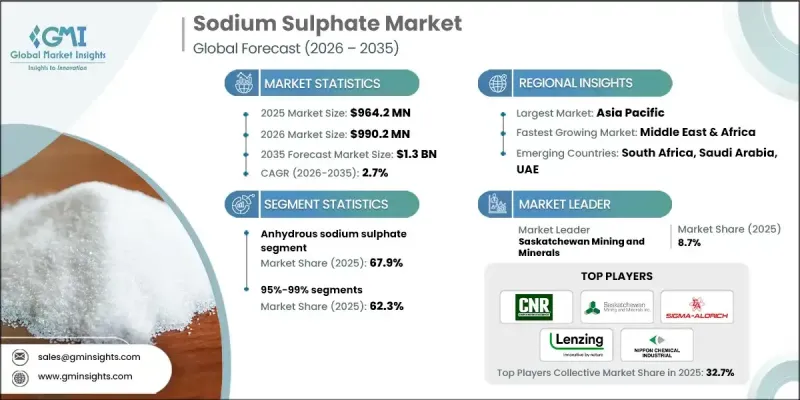
预计到 2025 年,全球硫酸钠市场价值将达到 9.642 亿美元,到 2035 年将达到 13 亿美元,年复合成长率为 2.7%。
硫酸钠是一种用途广泛的无机化合物,广泛应用于玻璃製造、清洁剂和製药等众多行业。其化学性质对于玻璃净化和结肠清洁产品的生产至关重要。由于永续建筑和工业能源管理中热能能源储存系统的日益普及,硫酸钠优异的热稳定性和保温性能推动了市场需求。随着能源效率成为全球优先事项,对储能技术的投资正在加速成长。此外,包装和绿色生产实践(尤其是在玻璃产业)的永续性倡议也推动了市场成长。该化合物在减少碳足迹和支持新兴技术方面发挥的作用,凸显了其在工业应用中日益增长的重要性。
| 市场覆盖范围 | |
|---|---|
| 开始年份 | 2025 |
| 预测年份 | 2026-2035 |
| 起始值 | 9.642亿美元 |
| 预测金额 | 13亿美元 |
| 复合年增长率 | 2.7% |
无水硫酸钠市场占有率占 67.9%,预计到 2035 年将以 2.7% 的复合年增长率成长。它广泛应用于洗涤剂清洁剂、纺织品染色、玻璃精製和牛皮纸浆生产等领域,工业和出口导向活动确保了稳定的需求。
由于其杂质含量均衡且用途广泛,预计到2025年,纯度为95-99%的玻璃将占据62.3%的市场份额。此等级的玻璃杂质含量品管,在容器玻璃和平板玻璃生产中至关重要。此外,在全球纺织业现代化进程的推动下,该等级的玻璃也为大规模纺织印染产业提供了支持。
预计2026年至2035年,北美硫酸钠市场将以2.6%的复合年增长率成长。这一成长主要得益于工业流程、污水回收利用和循环经济措施的技术创新。消费者对环保产品的需求不断增长,以及生质能源和可生物降解包装等领域的新兴应用,正在推动各行业,尤其是清洁和个人护理行业,对硫酸钠的采用。
目录
第一章调查方法和范围
第二章执行摘要
第三章业界考察
- 生态系分析
- 供应商情况
- 利润率
- 每个阶段的附加价值
- 影响价值链的因素
- 中断
- 产业影响因素
- 司机
- 新兴热能储存应用领域的需求日益增长
- 扩大玻璃生产,实现永续包装
- 医药界对结肠清洁产品的需求不断增长
- 产业潜在风险与挑战
- 粉状清洁剂需求结构性下降(转向液体清洁剂)
- 高昂的运输成本是市场扩张的障碍。
- 市场机会
- 相变材料市场在建筑节能领域的成长
- 扩大钠离子电池生产
- 司机
- 成长潜力分析
- 监管环境
- 北美洲
- 欧洲
- 亚太地区
- 拉丁美洲
- 中东和非洲
- 波特五力分析
- PESTEL 分析
- 价格趋势
- 按地区
- 按产品形式
- 未来市场趋势
- 科技与创新趋势
- 当前技术趋势
- 新兴技术
- 专利状态
- 贸易统计(HS编码)
(註:贸易统计数据仅涵盖主要国家。)
- 主要进口国
- 主要出口国
- 永续性和环境方面
- 永续努力
- 减少废弃物策略
- 生产中的能源效率
- 环保倡议
- 考虑到碳足迹
第四章 竞争情势
- 介绍
- 公司市占率分析
- 按地区
- 北美洲
- 欧洲
- 亚太地区
- 拉丁美洲
- 中东和非洲
- 按地区
- 企业矩阵分析
- 主要市场公司的竞争分析
- 竞争定位矩阵
- 重大进展
- 併购
- 伙伴关係与合作
- 新产品发布
- 业务拓展计划
第五章 依产品类型分類的市场估算与预测,2022-2035年
- 无水硫酸钠
- 十水合物
- 七水合物
第六章 依纯度等级分類的市场估算与预测,2022-2035年
- 95%
- 95%~99%
- >=99.5%
7. 2022-2035年按最终用途产业分類的市场估算与预测
- 居家及个人护理
- 清洁剂和清洁用品
- 化妆品和个人保健产品
- 地毯清新剂和除臭剂
- 其他的
- 建材
- 玻璃製造
- 混凝土添加剂
- 能源储存系统
- 其他的
- 纸浆和造纸
- 纺织服装
- 食品/饮料
- 食品加工
- 饮料包装
- 其他的
- 製药和医疗保健
- 製药生产
- 医疗设备和实验室应用
- 其他的
- 其他的
第八章 2022-2035年各地区市场估算与预测
- 北美洲
- 美国
- 加拿大
- 欧洲
- 德国
- 英国
- 法国
- 西班牙
- 义大利
- 其他欧洲地区
- 亚太地区
- 中国
- 印度
- 日本
- 澳洲
- 韩国
- 亚太其他地区
- 拉丁美洲
- 巴西
- 墨西哥
- 阿根廷
- 其他拉丁美洲地区
- 中东和非洲
- 沙乌地阿拉伯
- 南非
- 阿拉伯聯合大公国
- 其他中东和非洲地区
第九章:公司简介
- Atul Limited
- Cooper Natural Resources Inc.
- Hemadri Chemicals
- Lenzing Group
- Nikunj Chemicals
- Nippon Chemical Industrial Co., Ltd.
- Saltex LLC
- Saskatchewan Mining and Minerals
- Shikoku Chemicals Corporation
- Sigma-Aldrich
- TCI Chemicals
The Global Sodium Sulphate Market was valued at USD 964.2 million in 2025 and is estimated to grow at a CAGR of 2.7% to reach USD 1.3 billion by 2035.
Sodium sulphate is a versatile inorganic compound widely used across industries, including glass manufacturing, detergents, and pharmaceuticals. Its chemical properties are essential for purifying glass and producing colon-cleansing products. The rising adoption of thermal energy storage systems in sustainable construction and industrial energy management is driving demand, as sodium sulphate offers excellent thermal stability and heat retention. With energy efficiency becoming a global priority, investments in storage technologies are accelerating, while sustainability initiatives in packaging and green production practices, particularly in glass, are further boosting market growth. The compound's role in minimizing carbon footprints and supporting emerging technologies highlights its increasing relevance across industrial applications.
| Market Scope | |
|---|---|
| Start Year | 2025 |
| Forecast Year | 2026-2035 |
| Start Value | $964.2 Million |
| Forecast Value | $1.3 billion |
| CAGR | 2.7% |
The anhydrous sodium sulphate segment held 67.9% share and is expected to grow at a CAGR of 2.7% through 2035. Its widespread application in powdered detergents, textile dyeing, glass fining, and kraft pulping ensures steady demand, driven by both industrial and export-oriented activities.
The 95-99% purity segment held a 62.3% share in 2025, owing to its balanced impurity levels and versatility. This grade is crucial in container and flat glass production, providing controlled impurities for quality output. It also supports large-scale textile dyeing and printing, benefiting from modernization in textile industries worldwide.
North America Sodium Sulphate Market is anticipated to grow at a CAGR of 2.6% between 2026 and 2035. Growth is fueled by innovations in industrial processes, wastewater recycling, and circular economy initiatives. Emerging applications in bioenergy and biodegradable packaging, combined with rising consumer demand for environmentally friendly products, are driving the adoption of sodium sulphate across industries, particularly in cleaning and personal care sectors.
Key players in the Global Sodium Sulphate Market include Nippon Chemical Industrial Co., Ltd., Sigma-Aldrich, Shikoku Chemicals Corporation, Lenzing Group, Atul Limited, Saltex LLC, Hemadri Chemicals, Cooper Natural Resources Inc., Nikunj Chemicals, Saskatchewan Mining and Minerals, and TCI Chemicals. Companies in the Global Sodium Sulphate Market are employing a mix of strategies to enhance their presence and market share. They are investing heavily in R&D to develop high-purity and application-specific products, expanding production capacities to meet rising global demand, and entering strategic partnerships with industrial end-users. Additionally, firms are emphasizing sustainable sourcing and eco-friendly processes to align with global environmental regulations.
Table of Contents
Chapter 1 Methodology & Scope
- 1.1 Market scope and definition
- 1.2 Research design
- 1.2.1 Research approach
- 1.2.2 Data collection methods
- 1.3 Data mining sources
- 1.3.1 Global
- 1.3.2 Regional/Country
- 1.4 Base estimates and calculations
- 1.4.1 Base year calculation
- 1.4.2 Key trends for market estimation
- 1.5 Primary research and validation
- 1.5.1 Primary sources
- 1.6 Forecast model
- 1.7 Research assumptions and limitations
Chapter 2 Executive Summary
- 2.1 Industry 360° synopsis
- 2.2 Key market trends
- 2.2.1 Regional
- 2.2.2 Product form
- 2.2.3 Purity grade
- 2.2.4 End use industry
- 2.3 TAM Analysis, 2026-2035
- 2.4 CXO perspectives: Strategic imperatives
- 2.4.1 Executive decision points
- 2.4.2 Critical success factors
- 2.5 Future Outlook and Strategic Recommendations
Chapter 3 Industry Insights
- 3.1 Industry ecosystem analysis
- 3.1.1 Supplier landscape
- 3.1.2 Profit margin
- 3.1.3 Value addition at each stage
- 3.1.4 Factor affecting the value chain
- 3.1.5 Disruptions
- 3.2 Industry impact forces
- 3.2.1 Growth drivers
- 3.2.1.1 Growing demand from emerging thermal energy storage applications
- 3.2.1.2 Increasing glass production for sustainable packaging
- 3.2.1.3 Rising pharmaceutical demand for colon cleansing products
- 3.2.2 Industry pitfalls and challenges
- 3.2.2.1 Structural decline in powdered detergent demand (shift to liquids)
- 3.2.2.2 High transportation costs limiting market expansion
- 3.2.3 Market opportunities
- 3.2.3.1 Phase change material market growth for building energy efficiency
- 3.2.3.2 Expansion in sodium-ion battery production
- 3.2.1 Growth drivers
- 3.3 Growth potential analysis
- 3.4 Regulatory landscape
- 3.4.1 North America
- 3.4.2 Europe
- 3.4.3 Asia Pacific
- 3.4.4 Latin America
- 3.4.5 Middle East & Africa
- 3.5 Porter's analysis
- 3.6 PESTEL analysis
- 3.7 Price trends
- 3.7.1 By region
- 3.7.2 By product form
- 3.8 Future market trends
- 3.9 Technology and innovation landscape
- 3.9.1 Current technological trends
- 3.9.2 Emerging technologies
- 3.10 Patent Landscape
- 3.11 Trade statistics (HS code)
( Note: the trade statistics will be provided for key countries only)
- 3.11.1 Major importing countries
- 3.11.2 Major exporting countries
- 3.12 Sustainability and environmental aspects
- 3.12.1 Sustainable practices
- 3.12.2 Waste reduction strategies
- 3.12.3 Energy efficiency in production
- 3.12.4 Eco-friendly initiatives
- 3.13 Carbon footprint consideration
Chapter 4 Competitive Landscape, 2025
- 4.1 Introduction
- 4.2 Company market share analysis
- 4.2.1 By region
- 4.2.1.1 North America
- 4.2.1.2 Europe
- 4.2.1.3 Asia Pacific
- 4.2.1.4 LATAM
- 4.2.1.5 MEA
- 4.2.1 By region
- 4.3 Company matrix analysis
- 4.4 Competitive analysis of major market players
- 4.5 Competitive positioning matrix
- 4.6 Key developments
- 4.6.1 Mergers & acquisitions
- 4.6.2 Partnerships & collaborations
- 4.6.3 New Product Launches
- 4.6.4 Expansion Plans
Chapter 5 Market Estimates and Forecast, By Product Form, 2022-2035 (USD Billion) (Kilo Tons)
- 5.1 Key trends
- 5.2 Anhydrous sodium sulphate
- 5.3 Decahydrate
- 5.4 Heptahydrate
Chapter 6 Market Estimates and Forecast, By Purity Grade, 2022-2035 (USD Billion) (Kilo Tons)
- 6.1 Key trends
- 6.2 95%
- 6.3 95%-99%
- 6.4 ≥ 99.5%
Chapter 7 Market Estimates and Forecast, By End Use Industry, 2022-2035 (USD Billion) (Kilo Tons)
- 7.1 Key trends
- 7.2 Household & personal care
- 7.2.1 Detergents & cleaning products
- 7.2.2 Cosmetics & personal care products
- 7.2.3 Carpet fresheners & deodorizers
- 7.2.4 Others
- 7.3 Construction & building materials
- 7.3.1 Glass manufacturing
- 7.3.2 Concrete additives
- 7.3.3 Thermal energy storage systems
- 7.3.4 Others
- 7.4 Pulp & paper
- 7.5 Textile & apparel
- 7.6 Food & beverage
- 7.6.1 Food processing
- 7.6.2 Beverage packaging
- 7.6.3 Others
- 7.7 Pharmaceutical & healthcare
- 7.7.1 Pharmaceutical manufacturing
- 7.7.2 Medical device & laboratory applications
- 7.7.3 Others
- 7.8 Others
Chapter 8 Market Estimates and Forecast, By Region, 2022-2035 (USD Billion) (Kilo Tons)
- 8.1 Key trends
- 8.2 North America
- 8.2.1 U.S.
- 8.2.2 Canada
- 8.3 Europe
- 8.3.1 Germany
- 8.3.2 UK
- 8.3.3 France
- 8.3.4 Spain
- 8.3.5 Italy
- 8.3.6 Rest of Europe
- 8.4 Asia Pacific
- 8.4.1 China
- 8.4.2 India
- 8.4.3 Japan
- 8.4.4 Australia
- 8.4.5 South Korea
- 8.4.6 Rest of Asia Pacific
- 8.5 Latin America
- 8.5.1 Brazil
- 8.5.2 Mexico
- 8.5.3 Argentina
- 8.5.4 Rest of Latin America
- 8.6 Middle East and Africa
- 8.6.1 Saudi Arabia
- 8.6.2 South Africa
- 8.6.3 UAE
- 8.6.4 Rest of Middle East and Africa
Chapter 9 Company Profiles
- 9.1 Atul Limited
- 9.2 Cooper Natural Resources Inc.
- 9.3 Hemadri Chemicals
- 9.4 Lenzing Group
- 9.5 Nikunj Chemicals
- 9.6 Nippon Chemical Industrial Co., Ltd.
- 9.7 Saltex LLC
- 9.8 Saskatchewan Mining and Minerals
- 9.9 Shikoku Chemicals Corporation
- 9.10 Sigma-Aldrich
- 9.11 TCI Chemicals

 全球硫酸钠市场报告、表现及预测(2021-2032年)
 全球硫酸钠市场规模、份额、趋势和成长分析报告(2026-2034年)
 日本硫酸钠市场规模、份额、趋势和预测:按性质、应用和地区划分,2026-2034年
 硫酸钠市场规模、份额及成长分析(按应用、产品、形态及地区划分)-2026-2033年产业预测
 硫酸钠:全球市占率及排名、总收入及需求预测(2025-2031 年)全球硫酸钠市场规模(按产品、应用、地区和预测)
 全球硫酸钠市场:市场规模、份额、趋势分析(按特点、最终用途和地区)、细分市场预测(2025-2030 年)
 硫酸钠市场报告:2031 年趋势、预测与竞争分析
 硫酸钠市场规模、份额和成长分析(按类型、特性、最终用户和地区)- 产业预测 2025-2032
 2030 年硫酸钠市场预测:按产品、形式、等级、应用和地区进行的全球分析