


 |
市场调查报告书
商品编码
1913306
管理系统认证市场机会、成长要素、产业趋势分析及预测(2026-2035年)Management System Certification Market Opportunity, Growth Drivers, Industry Trend Analysis, and Forecast 2026 - 2035 |
||||||

全球管理系统认证市场预计到 2025 年将达到 276 亿美元,到 2035 年将达到 608 亿美元,年复合成长率为 8.6%。
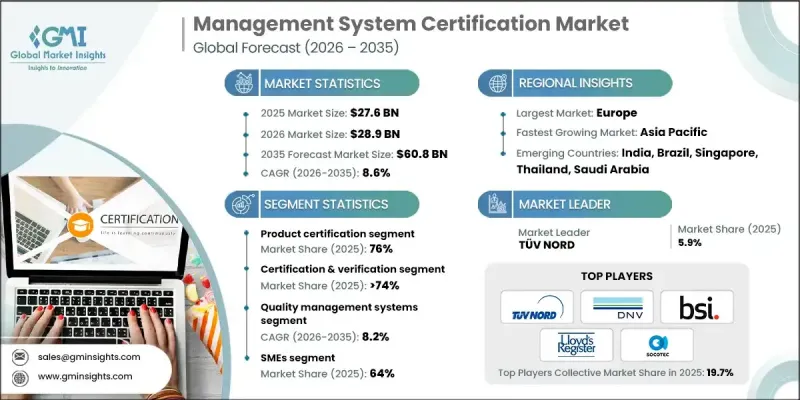
这一成长的驱动力来自日益增长的监管压力、对品质和永续性的日益重视以及全球合规性的需求。企业寻求认证不仅是为了满足监管要求,更是为了提升信誉、管理风险并在国际贸易中获得竞争优势。受监管产业的企业越来越要求供应商提供经认证的管理体系,以确保品质、安全性和可靠性。认证能够增强市场进入、降低营运和法律风险、保障职场安全、保护资料并维护客户信任。快速的数位转型和日益严峻的网路威胁也在推动资讯安全和网路安全认证的需求。诸如基于区块链的认证平台等创新技术简化了认证数据的管理、检验和确认流程,从而实现了全球供应链的即时合规性保障。
| 市场覆盖范围 | |
|---|---|
| 开始年份 | 2025 |
| 预测年份 | 2026-2035 |
| 起始值 | 276亿美元 |
| 预测金额 | 608亿美元 |
| 复合年增长率 | 8.6% |
产品认证领域占了76%的市场份额,预计2026年至2035年将以8.3%的复合年增长率成长。产品认证与永续性、可追溯性、绩效基准和数位化合规工具的结合日益紧密,帮助企业实现产品差异化,并在满足监管要求之外展现可衡量的价值。在出口导向和监管严格的市场中,对产品认证的需求特别强劲,因为这些市场需要透明度、安全保障和生命週期影响检验。
到2025年,认证和检验领域将占市场规模(约205亿美元)的74%。第三方认证和检验服务对于希望满足监管要求、提高供应链可靠性并建立客户信任的企业仍然至关重要。包括远端和混合方法在内的技术赋能型审核,在保持合规性严谨性的同时,提高了检验服务的效率、扩充性和一致性。
预计2025年,美国管理体系认证市场规模将达92亿美元。法律规范加大、网路安全风险日益增加以及ESG合规压力是推动市场成长的主要因素。医疗保健、国防、科技和关键基础设施等产业对第三方检验和合规保证的需求日益增长,因此这些产业对认证的需求也显着增加。为了应对联邦法规、资料隐私法以及企业、国防和云端营运中不断增长的网路威胁,资讯安全和网路安全认证正被各组织机构迅速采用。
目录
第一章调查方法
第二章执行摘要
第三章业界考察
- 生态系分析
- 供应商情况
- 利润率分析
- 成本结构
- 每个阶段的附加价值
- 影响价值链的因素
- 中断
- 产业影响因素
- 司机
- 监理合规要求
- 供应链资质认证压力
- 网路安全和资料保护风险日益加剧
- 专注于营运效率和风险管理
- 人们越来越关注ESG和永续性。
- 产业潜在风险与挑战
- 高昂的认证和审核成本
- 身份验证过程的复杂性
- 市场机会
- 为中小企业拓展身份验证解决方案
- 综合管理体系认证的发展
- 新兴经济体需求不断成长
- 审核和远端审核模式
- 成长潜力分析
- 监管环境
- 北美洲
- 美国- ISO 9001 品质管理体系
- 加拿大 - ISO 45001 职业健康与安全
- 欧洲
- 英国- ISO/IEC 27001资讯安全管理
- 德国 - ISO 50001 能源管理体系
- 法国 - ISO 45001 职业健康与安全
- 义大利 - ISO 14001 环境管理体系
- 西班牙 - ISO 22000 食品安全管理体系
- 亚太地区
- 中国-ISO/IEC 27001资讯安全管理体系
- 日本 - ISO 14001 环境管理体系
- 印度 - ISO 45001 职业健康与安全
- 拉丁美洲
- 巴西 - ISO 14001 环境管理体系
- 墨西哥 - ISO 45001 职业健康与安全
- 阿根廷 - ISO 14001 环境管理体系
- 中东和非洲
- 阿联酋-ISO 14001环境管理体系
- 南非 - ISO 45001 职业健康与安全
- 沙乌地阿拉伯 - ISO 14001 环境管理体系
- 北美洲
- 波特五力分析
- PESTEL 分析
- 科技与创新趋势
- 当前技术趋势
- 新兴技术
- 成本細項分析
- 开发成本结构
- 研发成本分析
- 行销和销售成本
- 专利分析
- 永续性和环境方面
- 永续实践
- 减少废弃物策略
- 生产中的能源效率
- 环保倡议
- 未来市场展望与机会
- 认证和管治生态系统
- 认证机构(IAF、ANAB、UKAS、DAkkS、NABCB)的作用
- ISO、认可机构和认证机构之间的关係
- 认证政策对市场进入与定价的影响
- 买方决策和认证选择标准
- 价格与品牌可靠性之间的权衡
- 认证认可的重要性
- 各行业的认证偏好
- 切换行为并使用多个凭证授权单位
- 认证生命週期和收入模式的发展趋势
- 审核能力、素质与劳动力动态
第四章 竞争情势
- 介绍
- 公司市占率分析
- 北美洲
- 欧洲
- 亚太地区
- 拉丁美洲
- 中东和非洲
- 主要市场公司的竞争分析
- 竞争定位矩阵
- 战略展望矩阵
- 重大进展
- 併购
- 伙伴关係与合作
- 新产品发布
- 企业扩张计画和资金筹措
第五章 依认证类型分類的市场估算与预测,2022-2035年
- 产品认证
- 系统认证
第六章 依服务分類的市场估计与预测,2022-2035年
- 身份验证和检验
- 培训及业务保障
第七章 依公司规模分類的市场估计与预测,2022-2035年
- 小型企业
- 大公司
第八章 按应用领域分類的市场估算与预测,2022-2035年
- 品质管理体系
- 职业安全与健康
- 网路安全
- 资讯安全
- 食品安全
- 环境管理
- 其他的
第九章 2022-2035年各产业市场估算与预测
- 航太/国防
- 汽车/运输设备
- 建设业
- 消费品和零售
- 能源与公共产业
- 医学与生命科学
- 资讯科技与通讯
- 製造业
- 其他的
第十章 2022-2035年各地区市场估计与预测
- 北美洲
- 美国
- 加拿大
- 欧洲
- 德国
- 英国
- 法国
- 义大利
- 西班牙
- 俄罗斯
- 北欧国家
- 葡萄牙
- 克罗埃西亚
- 比荷卢经济联盟
- 亚太地区
- 中国
- 印度
- 日本
- 澳洲
- 韩国
- 新加坡
- 泰国
- 印尼
- 越南
- 拉丁美洲
- 巴西
- 墨西哥
- 阿根廷
- 哥伦比亚
- 中东和非洲
- 南非
- 沙乌地阿拉伯
- 阿拉伯聯合大公国
- 土耳其
第十一章 公司简介
- 世界玩家
- TUV NORD
- DNV
- The British Standards Institution BSI
- Lloyd's Register Group Services
- RINA
- ASTM
- SGS
- Bureau Veritas
- Intertek
- TUV Rheinland
- DEKRA
- UL
- Applus+
- 区域玩家
- Holding Socotec
- DQS
- IMQ
- IRCLASS
- SIS Certifications
- LL-C Certification
- GCL International
- Aurion International
- AL BORJ Facility Management
- Emerging/Disruptor Players
- Drata
- Vanta
- Bluestar Management Systems
- Finecert
The Global Management System Certification Market was valued at USD 27.6 billion in 2025 and is estimated to grow at a CAGR of 8.6% to reach USD 60.8 billion by 2035.
Growth is fueled by rising regulatory pressures, increasing focus on quality, sustainability, and the need for global compliance. Companies pursue certification not only to meet regulatory mandates but also to enhance credibility, manage risk, and gain a competitive edge in international trade. Organizations operating in regulated industries increasingly require certified management systems from suppliers to assure quality, safety, and reliability. Certification strengthens market access, reduces operational and legal risks, ensures workplace safety, protects data, and maintains customer trust. Rapid digital transformation and rising cyber threats are also driving demand for information security and cybersecurity certifications. Innovations such as blockchain-enabled certification platforms are streamlining the management, verification, and validation of certification data, enabling real-time compliance assurance across global supply chains.
| Market Scope | |
|---|---|
| Start Year | 2025 |
| Forecast Year | 2026-2035 |
| Start Value | $27.6 Billion |
| Forecast Value | $60.8 Billion |
| CAGR | 8.6% |
The product certification segment held a 76% share and is expected to grow at a CAGR of 8.3% from 2026 to 2035. Product certifications are increasingly aligned with sustainability, traceability, performance benchmarks, and digital compliance tools, helping organizations differentiate their offerings while demonstrating measurable value beyond regulatory requirements. Demand is particularly strong in export-oriented and regulated markets that require transparency, safety assurances, and lifecycle impact validation.
The certification & verification segment accounted for 74% share in 2025, valued at around USD 20.5 billion. Third-party certification and verification services remain critical for companies seeking to satisfy regulatory requirements, enhance supply chain credibility, and build customer confidence. Technology-enabled audits, including remote and hybrid approaches, are enhancing the efficiency, scalability, and consistency of verification services while maintaining compliance rigor.
U.S. Management System Certification Market was valued at USD 9.2 billion in 2025. Growth is driven by regulatory oversight, increasing cybersecurity risks, and ESG compliance pressures. Adoption is strong in healthcare, defense, technology, and critical infrastructure sectors, where third-party validation and compliance assurance are essential. Information security and cybersecurity certifications are experiencing rapid uptake as organizations respond to federal regulations, data privacy laws, and escalating cyber threats across enterprise, defense, and cloud-based operations.
Key players in the Global Management System Certification Market include DNV, TUV NORD, Lloyd's Register Group Services, The British Standards Institution, Holding Socotec, DQS, RINA, Drata, and SIS Certifications. Companies in the Management System Certification Market are leveraging multiple strategies to expand their market presence. They are investing in technology-driven audit solutions, including remote and hybrid verification platforms, to increase efficiency and scalability. Expanding service portfolios to include cybersecurity, ESG, and sustainability certifications helps cater to evolving regulatory and corporate governance needs. Strategic partnerships with industry associations, technology providers, and multinational enterprises strengthen client acquisition and retention. Firms are enhancing digital platforms for real-time certificate management, data analytics, and compliance reporting.
Table of Contents
Chapter 1 Methodology
- 1.1 Market scope and definition
- 1.2 Research design
- 1.2.1 Research approach
- 1.2.2 Data collection methods
- 1.3 Data mining sources
- 1.3.1 Global
- 1.3.2 Regional/Country
- 1.4 Base estimates and calculations
- 1.4.1 Base year calculation
- 1.4.2 Key trends for market estimation
- 1.5 Primary research and validation
- 1.5.1 Primary sources
- 1.6 Forecast
- 1.7 Research assumptions and limitations
Chapter 2 Executive Summary
- 2.1 Industry 360° synopsis, 2022 - 2035
- 2.2 Key market trends
- 2.2.1 Regional
- 2.2.2 Certification
- 2.2.3 Service
- 2.2.4 Organization size
- 2.2.5 Application
- 2.2.6 Industry vertical
- 2.3 TAM Analysis, 2026-2035
- 2.4 CXO perspectives: Strategic imperatives
- 2.4.1 Executive decision points
- 2.4.2 Critical success factors
- 2.5 Future outlook & strategic recommendations
Chapter 3 Industry Insights
- 3.1 Industry ecosystem analysis
- 3.1.1 Supplier landscape
- 3.1.2 Profit margin analysis
- 3.1.3 Cost structure
- 3.1.4 Value addition at each stage
- 3.1.5 Factor affecting the value chain
- 3.1.6 Disruptions
- 3.2 Industry impact forces
- 3.2.1.1 Growth drivers
- 3.2.1.2 Regulatory compliance requirements
- 3.2.1.3 Supply chain qualification pressure
- 3.2.1.4 Rising cybersecurity and data protection risks
- 3.2.1.5 Focus on operational efficiency and risk management
- 3.2.1.6 Growing emphasis on ESG and sustainability
- 3.2.2 Industry pitfalls and challenges
- 3.2.2.1 High certification and audit costs
- 3.2.2.2 Complexity of certification processes
- 3.2.3 Market opportunities
- 3.2.3.1 Expansion of SME-focused certification solutions
- 3.2.3.2 Growth of integrated management system certifications
- 3.2.3.3 Rising demand in emerging economies
- 3.2.3.4 Digital and remote auditing models
- 3.3 Growth potential analysis
- 3.4 Regulatory landscape
- 3.4.1 North America
- 3.4.1.1 U.S. - ISO 9001 Quality Management Systems
- 3.4.1.2 Canada - ISO 45001 Occupational Health and Safety
- 3.4.2 Europe
- 3.4.2.1 UK - ISO/IEC 27001 Information Security Management
- 3.4.2.2 Germany - ISO 50001 Energy Management Systems
- 3.4.2.3 France - ISO 45001 Occupational Health and Safety
- 3.4.2.4 Italy - ISO 14001 Environmental Management Systems
- 3.4.2.5 Spain - ISO 22000 Food Safety Management Systems
- 3.4.3 Asia Pacific
- 3.4.3.1 China - ISO/IEC 27001 Information Security Management
- 3.4.3.2 Japan - ISO 14001 Environmental Management Systems
- 3.4.3.3 India - ISO 45001 Occupational Health and Safety
- 3.4.4 Latin America
- 3.4.4.1 Brazil - ISO 14001 Environmental Management Systems
- 3.4.4.2 Mexico - ISO 45001 Occupational Health and Safety
- 3.4.4.3 Argentina - ISO 14001 Environmental Management Systems
- 3.4.5 Middle East & Africa
- 3.4.5.1 UAE - ISO 14001 Environmental Management Systems
- 3.4.5.2 South Africa - ISO 45001 Occupational Health and Safety
- 3.4.5.3 Saudi Arabia - ISO 14001 Environmental Management Systems
- 3.4.1 North America
- 3.5 Porter's analysis
- 3.6 PESTEL analysis
- 3.7 Technology and innovation landscape
- 3.7.1 Current technological trends
- 3.7.2 Emerging technologies
- 3.8 Cost breakdown analysis
- 3.8.1 Development cost structure
- 3.8.2 R&D cost analysis
- 3.8.3 Marketing & sales costs
- 3.9 Patent analysis
- 3.10 Sustainability and environmental aspects
- 3.10.1 Sustainable practices
- 3.10.2 Waste reduction strategies
- 3.10.3 Energy efficiency in production
- 3.10.4 Eco-friendly Initiatives
- 3.11 Future market outlook & opportunities
- 3.12 Accreditation & governance ecosystem
- 3.12.1 Role of accreditation bodies (IAF, ANAB, UKAS, DAkkS, NABCB)
- 3.12.2 Relationship between ISO, accreditation bodies & certification bodies
- 3.12.3 Impact of accreditation policies on market access and pricing
- 3.13 Buyer decision-making & certification selection criteria
- 3.13.1 Price vs brand credibility trade-offs
- 3.13.2 Importance of accreditation recognition
- 3.13.3 Industry-specific certification preferences
- 3.13.4 Switching behavior and multi-certifier usage
- 3.14 Certification lifecycle & revenue model dynamics
- 3.15 Auditor capacity, competency & workforce dynamics
Chapter 4 Competitive Landscape, 2025
- 4.1 Introduction
- 4.2 Company market share analysis
- 4.2.1 North America
- 4.2.2 Europe
- 4.2.3 Asia Pacific
- 4.2.4 LATAM
- 4.2.5 MEA
- 4.3 Competitive analysis of major market players
- 4.4 Competitive positioning matrix
- 4.5 Strategic outlook matrix
- 4.6 Key developments
- 4.6.1 Mergers & acquisitions
- 4.6.2 Partnerships & collaborations
- 4.6.3 New Product Launches
- 4.6.4 Expansion Plans and funding
Chapter 5 Market Estimates & Forecast, By Certification, 2022 - 2035 ($Bn)
- 5.1 Key trends
- 5.2 Product certification
- 5.3 System certification
Chapter 6 Market Estimates & Forecast, By Service, 2022 - 2035 ($Bn)
- 6.1 Key trends
- 6.2 Certification & Verification
- 6.3 Training & Business Assurance
Chapter 7 Market Estimates & Forecast, By Organization size, 2022 - 2035 ($Bn)
- 7.1 Key trends
- 7.2 SMEs
- 7.3 Large Enterprises
Chapter 8 Market Estimates & Forecast, By Application, 2022 - 2035 ($Bn)
- 8.1 Key trends
- 8.2 Quality Management Systems
- 8.3 Occupational Health and Safety
- 8.4 Cyber Security
- 8.5 Information Security
- 8.6 Food Safety
- 8.7 Environmental Management
- 8.8 Others
Chapter 9 Market Estimates & Forecast, By Industry vertical, 2022 - 2035 ($Bn)
- 9.1 Key trends
- 9.2 Aerospace & Defense
- 9.3 Automotive & Transportation
- 9.4 Construction
- 9.5 Consumer Goods & Retail
- 9.6 Energy & Utilities
- 9.7 Healthcare & Life Sciences
- 9.8 Information Technology & Telecommunication
- 9.9 Manufacturing
- 9.10 Others
Chapter 10 Market Estimates & Forecast, By Region, 2022 - 2035 ($Bn)
- 10.1 Key trends
- 10.2 North America
- 10.2.1 US
- 10.2.2 Canada
- 10.3 Europe
- 10.3.1 Germany
- 10.3.2 UK
- 10.3.3 France
- 10.3.4 Italy
- 10.3.5 Spain
- 10.3.6 Russia
- 10.3.7 Nordics
- 10.3.8 Portugal
- 10.3.9 Croatia
- 10.3.10 Benelux
- 10.4 Asia Pacific
- 10.4.1 China
- 10.4.2 India
- 10.4.3 Japan
- 10.4.4 Australia
- 10.4.5 South Korea
- 10.4.6 Singapore
- 10.4.7 Thailand
- 10.4.8 Indonesia
- 10.4.9 Vietnam
- 10.5 Latin America
- 10.5.1 Brazil
- 10.5.2 Mexico
- 10.5.3 Argentina
- 10.5.4 Colombia
- 10.6 MEA
- 10.6.1 South Africa
- 10.6.2 Saudi Arabia
- 10.6.3 UAE
- 10.6.4 Turkey
Chapter 11 Company Profiles
- 11.1 Global Players
- 11.1.1 TUV NORD
- 11.1.2 DNV
- 11.1.3 The British Standards Institution BSI
- 11.1.4 Lloyd's Register Group Services
- 11.1.5 RINA
- 11.1.6 ASTM
- 11.1.7 SGS
- 11.1.8 Bureau Veritas
- 11.1.9 Intertek
- 11.1.10 TUV Rheinland
- 11.1.11 DEKRA
- 11.1.12 UL
- 11.1.13 Applus+
- 11.2 Regional Players
- 11.2.1 Holding Socotec
- 11.2.2 DQS
- 11.2.3 IMQ
- 11.2.4 IRCLASS
- 11.2.5 SIS Certifications
- 11.2.6 LL-C Certification
- 11.2.7 GCL International
- 11.2.8 Aurion International
- 11.2.9 AL BORJ Facility Management
- 11.3 Emerging / Disruptor Players
- 11.3.1 Drata
- 11.3.2 Vanta
- 11.3.3 Bluestar Management Systems
- 11.3.4 Finecert

 管理系统认证市场分析及预测(至2035年):类型、产品类型、技术、组件、应用、流程、部署模式、最终用户、解决方案
 2026年全球管理体系认证市场报告
 管理系统认证市场规模、份额、成长及全球产业分析:按类型、应用和地区划分,并预测至2026-2034年
 管理系统认证市场按服务类型、认证类型、组织规模、部署类型、应用和最终用户行业划分 - 全球预测 2025-2032
 全球管理体系认证市场
 全球管理系统认证市场:品管、环境管理、职业健康与安全、资讯安全、IT与通讯、消费品与零售、医疗保健与生命科学-预测至2030年
 2030 年管理系统认证市场预测:按认证、服务、应用、产业和地区进行的全球分析