


 |
市场调查报告书
商品编码
1913341
预拌粉市场机会、成长要素、产业趋势分析及预测(2026-2035年)Prepared Flour Mixes Market Opportunity, Growth Drivers, Industry Trend Analysis, and Forecast 2026 - 2035 |
||||||

全球已烹调麵粉混合物市场预计到 2025 年将达到 206 亿美元,到 2035 年将达到 314 亿美元,年复合成长率为 4.3%。
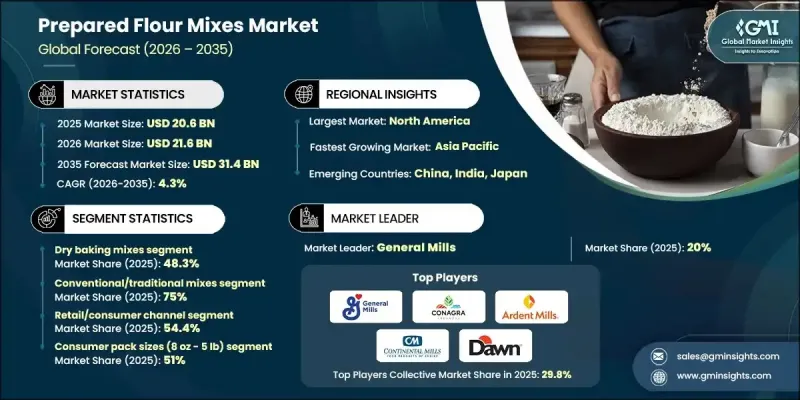
市场扩张反映了预拌粉作为现代食品生产体系基础解决方案的作用日益增强。这些预拌粉有助于提高生产商、餐饮服务商和零售商的营运效率、产品一致性和规模化生产。消费者对便利性的需求不断增长,同时对产品多样性和品质的期望也在不断提高,这正在重塑整个产业的研发策略。製造商正不断调整产品,以适应不断变化的食品偏好、健康意识增强的消费模式以及对透明度的要求。产品创新受到简化成分錶、提高营养价值和符合监管要求的驱动。永续性考量在整个价值链中也日益重要,影响着采购惯例、配方决策和包装策略。企业优先考虑负责任的生产方式,以减少对环境的影响,同时增强品牌信誉。便利性、健康意识和永续性的融合,使预拌粉成为全球食品产业的策略性品类,支撑着零售和商用通路的稳定需求。
| 市场覆盖范围 | |
|---|---|
| 开始年份 | 2025 |
| 预测年份 | 2026-2035 |
| 起始值 | 206亿美元 |
| 预测金额 | 314亿美元 |
| 复合年增长率 | 4.3% |
预计到 2025 年,干烘焙混合料市场份额将达到 48.3%,到 2035 年将以 4.2% 的复合年增长率成长。其持续受欢迎的原因在于使用方便、效果可靠,以及越来越多注重健康、兼顾便利性和营养价值的配方。
预计到 2025 年,传统混合饮料市占率将达到 75%,并在 2026 年至 2035 年间以 3.8% 的复合年增长率成长。这些混合饮料因其熟悉度和广泛适用性而保持强劲的需求,但不断变化的消费者偏好正在加速创新,推动更透明、更合规的替代方案的出现。
到 2025 年,北美已烹调麵粉混合物市场将占据 56.2% 的份额,这得益于对便捷食品解决方案的强劲需求,以及成熟的生产和分销基础设施,从而能够快速开发产品并渗透市场。
目录
第一章调查方法和范围
第二章执行摘要
第三章业界考察
- 生态系分析
- 供应商情况
- 利润率
- 每个阶段的附加价值
- 影响价值链的因素
- 中断
- 产业影响因素
- 司机
- 消费者对方便食品的需求不断成长
- 疫情后家庭烘焙趋势
- 餐饮和快餐业的扩张
- 产业潜在风险与挑战
- 商品价格波动和通货膨胀
- 供应链中断
- 市场机会
- 新兴饮食趋势(生酮饮食、原始人饮食、高蛋白饮食)
- 单件/份量控制格式
- 司机
- 成长潜力分析
- 监管环境
- 北美洲
- 欧洲
- 亚太地区
- 拉丁美洲
- 中东和非洲
- 波特五力分析
- PESTEL 分析
- 价格趋势
- 按地区
- 依产品类型
- 未来市场趋势
- 科技与创新趋势
- 当前技术趋势
- 新兴技术
- 专利状态
- 贸易统计(HS编码)(註:仅提供主要国家的贸易统计)
- 主要进口国
- 主要出口国
- 永续性和环境方面
- 永续努力
- 减少废弃物策略
- 生产中的能源效率
- 环保倡议
- 考虑到碳足迹
第四章 竞争情势
- 介绍
- 公司市占率分析
- 按地区
- 北美洲
- 欧洲
- 亚太地区
- 拉丁美洲
- 中东和非洲
- 按地区
- 企业矩阵分析
- 主要市场公司的竞争分析
- 竞争定位矩阵
- 重大进展
- 併购
- 伙伴关係与合作
- 新产品发布
- 业务拓展计划
第五章 依产品类型分類的市场估算与预测,2022-2035年
- 干烘焙粉
- 蛋糕粉
- 布朗尼和培根
- 煎饼和华夫饼混合粉
- 麵包粉
- 鬆饼和麵包烘焙粉
- 饼干和司康饼混合料
- 甜甜圈粉
- 饼干粉
- 混合小麦粉和自发粉
- 自种麵粉
- 蛋糕粉
- 通用烘焙混合粉
- 已烹调的麵团/麵糊
第六章 依专业领域分類的市场估计与预测,2022-2035年
- 传统/传统混合
- 经认证的无麸质混合物
- 认证有机混合物
- 高蛋白质和全谷谷物
- 适合生酮饮食和低碳水化合物饮食
- 纯素食和植物来源
- 无脂肪低盐型
- 非基因改造
7. 2022-2035年按分销管道分類的市场估算与预测
- 零售/消费者通路
- 超级市场和大卖场
- 杂货店和便利商店
- 特色食品店
- 餐饮业及设施的管道
- 餐厅和快餐店
- 饭店及餐饮服务
- 小学和国中
- 医疗设施
- 学院和高等教育机构
- 老人住家周边设施
- 商用烘焙频道
- 店内烘焙坊
- 特色麵包店
- 工业麵包店
- 自有品牌和契约製造
- 零售商自有品牌计划
- 联合製造伙伴关係
第八章 按包装类型分類的市场估算与预测,2022-2035年
- 小份消费者食用规格(8盎司-5磅)
- 散装/商用规格(5磅-50磅)
- 单份包装
- 套装形式(混合料+麵包/配料)
第九章 2022-2035年各地区市场估算与预测
- 北美洲
- 美国
- 加拿大
- 欧洲
- 德国
- 英国
- 法国
- 西班牙
- 义大利
- 其他欧洲地区
- 亚太地区
- 中国
- 印度
- 日本
- 澳洲
- 韩国
- 亚太其他地区
- 拉丁美洲
- 巴西
- 墨西哥
- 阿根廷
- 其他拉丁美洲地区
- 中东和非洲
- 沙乌地阿拉伯
- 南非
- 阿拉伯聯合大公国
- 其他中东和非洲地区
第十章:公司简介
- General Mills, Inc.
- Conagra Brands, Inc.(Duncan Hines)
- Ardent Mills
- Continental Mills(Krusteaz)
- Dawn Foods(Global)
- King Arthur Baking Company
- Bob's Red Mill Natural Foods
- Chelsea Milling Company(JIFFY Mix)
- AB Mauri(北美及全球)
- 柏拉图(欧洲和北美洲)
- 泽兰迪亚(欧洲和亚洲)
- Goodman Fielder(Asia-Pacific)
- Les Afres(北美及全球)
- ADM(Archer Daniels Midland)
- Bay State Milling Company
The Global Prepared Flour Mixes Market was valued at USD 20.6 billion in 2025 and is estimated to grow at a CAGR of 4.3% to reach USD 31.4 billion by 2035.
Market expansion reflects the growing role of prepared flour mixes as a foundational solution within modern food production systems. These mixes support operational efficiency, product uniformity, and scalable manufacturing for producers, foodservice operators, and retailers. Rising consumer demand for convenience, coupled with expectations for variety and quality, is reshaping product development strategies across the industry. Manufacturers are increasingly aligning offerings with evolving dietary preferences, wellness-oriented consumption patterns, and transparency requirements. Product innovation is being guided by demand for simplified ingredient profiles, improved nutritional value, and regulatory compliance. Sustainability considerations are also gaining prominence throughout the value chain, influencing sourcing practices, formulation decisions, and packaging strategies. Companies are emphasizing responsible production methods to reduce environmental impact while strengthening brand credibility. As convenience, health awareness, and sustainability converge, prepared flour mixes are becoming a strategic category within the global food landscape, supporting steady demand across both retail and commercial channels.
| Market Scope | |
|---|---|
| Start Year | 2025 |
| Forecast Year | 2026-2035 |
| Start Value | $20.6 Billion |
| Forecast Value | $31.4 Billion |
| CAGR | 4.3% |
The dry baking mixes segment accounted for 48.3% share in 2025 and is forecast to grow at a CAGR of 4.2% through 2035. Their continued popularity is driven by ease of use, reliable results, and growing incorporation of health-oriented formulations that balance convenience with nutritional expectations.
The conventional and traditional mixes segment held 75% share in 2025 and is expected to grow at a CAGR of 3.8% between 2026 and 2035. These mixes maintain strong demand due to familiarity and broad applicability, although innovation is accelerating toward more transparent and regulation-aligned alternatives as consumer preferences evolve.
North America Prepared Flour Mixes Market held a 56.2% share in 2025, supported by strong demand for convenience-focused food solutions and a well-established production and distribution infrastructure that enables rapid product development and market penetration.
Key companies operating in the Global Prepared Flour Mixes Market include General Mills, Inc., ADM, Ardent Mills, Dawn Foods, King Arthur Baking Company, Conagra Brands, Inc., Bob's Red Mill Natural Foods, Puratos, AB Mauri, Bay State Milling Company, Zeelandia, Continental Mills, Chelsea Milling Company, Lesaffre, and Goodman Fielder. Companies in the Global Prepared Flour Mixes Market are strengthening their competitive position through product innovation, brand differentiation, and supply chain optimization. Manufacturers are investing in research to develop mixes aligned with wellness trends, clean labeling, and evolving regulatory standards. Portfolio diversification allows companies to address varied consumer preferences across retail and foodservice channels. Strategic partnerships with distributors and retailers help expand market reach and improve shelf visibility. Sustainability initiatives focused on responsible sourcing and eco-conscious packaging are enhancing brand perception. Geographic expansion into high-growth regions supports revenue diversification.
Table of Contents
Chapter 1 Methodology & Scope
- 1.1 Market scope and definition
- 1.2 Research design
- 1.2.1 Research approach
- 1.2.2 Data collection methods
- 1.3 Data mining sources
- 1.3.1 Global
- 1.3.2 Regional/Country
- 1.4 Base estimates and calculations
- 1.4.1 Base year calculation
- 1.4.2 Key trends for market estimation
- 1.5 Primary research and validation
- 1.5.1 Primary sources
- 1.6 Forecast model
- 1.7 Research assumptions and limitations
Chapter 2 Executive Summary
- 2.1 Industry 3600 synopsis
- 2.2 Key market trends
- 2.2.1 Regional
- 2.2.2 Product type
- 2.2.3 Dietary & specialty type
- 2.2.4 Distribution channel
- 2.2.5 Packaging format
- 2.3 TAM Analysis, 2025-2035
- 2.4 CXO perspectives: Strategic imperatives
- 2.4.1 Executive decision points
- 2.4.2 Critical success factors
- 2.5 Future Outlook and Strategic Recommendations
Chapter 3 Industry Insights
- 3.1 Industry ecosystem analysis
- 3.1.1 Supplier landscape
- 3.1.2 Profit margin
- 3.1.3 Value addition at each stage
- 3.1.4 Factor affecting the value chain
- 3.1.5 Disruptions
- 3.2 Industry impact forces
- 3.2.1 Growth drivers
- 3.2.1.1 Rising consumer demand for convenience foods
- 3.2.1.2 Growth in home baking trends post-pandemic
- 3.2.1.3 Expansion of food service & QSR sectors
- 3.2.2 Industry pitfalls and challenges
- 3.2.2.1 Commodity price volatility & inflation
- 3.2.2.2 Supply chain disruptions
- 3.2.3 Market opportunities
- 3.2.3.1 Emerging dietary trends (keto, paleo, protein-enriched)
- 3.2.3.2 Single-serve & portion-controlled formats
- 3.2.1 Growth drivers
- 3.3 Growth potential analysis
- 3.4 Regulatory landscape
- 3.4.1 North America
- 3.4.2 Europe
- 3.4.3 Asia Pacific
- 3.4.4 Latin America
- 3.4.5 Middle East & Africa
- 3.5 Porter's analysis
- 3.6 PESTEL analysis
- 3.7 Price trends
- 3.7.1 By region
- 3.7.2 By product type
- 3.8 Future market trends
- 3.9 Technology and Innovation landscape
- 3.9.1 Current technological trends
- 3.9.2 Emerging technologies
- 3.10 Patent Landscape
- 3.11 Trade statistics (HS code) ( Note: the trade statistics will be provided for key countries only)
- 3.11.1 Major importing countries
- 3.11.2 Major exporting countries
- 3.12 Sustainability and environmental aspects
- 3.12.1 Sustainable practices
- 3.12.2 Waste reduction strategies
- 3.12.3 Energy efficiency in production
- 3.12.4 Eco-friendly initiatives
- 3.13 Carbon footprint consideration
Chapter 4 Competitive Landscape, 2025
- 4.1 Introduction
- 4.2 Company market share analysis
- 4.2.1 By region
- 4.2.1.1 North America
- 4.2.1.2 Europe
- 4.2.1.3 Asia Pacific
- 4.2.1.4 LATAM
- 4.2.1.5 MEA
- 4.2.1 By region
- 4.3 Company matrix analysis
- 4.4 Competitive analysis of major market players
- 4.5 Competitive positioning matrix
- 4.6 Key developments
- 4.6.1 Mergers & acquisitions
- 4.6.2 Partnerships & collaborations
- 4.6.3 New Product Launches
- 4.6.4 Expansion Plans
Chapter 5 Market Estimates and Forecast, By Product Type, 2022-2035 (USD Million) (Kilo Tons)
- 5.1 Key trends
- 5.2 Dry baking mixes
- 5.2.1 Cake mixes
- 5.2.2 Brownie & bar mixes
- 5.2.3 Pancake & waffle mixes
- 5.2.4 Bread mixes
- 5.2.5 Muffin & cornbread mixes
- 5.2.6 Biscuit & scone mixes
- 5.2.7 Doughnut mixes
- 5.2.8 Cookie mixes
- 5.3 Blended & self-rising flours
- 5.3.1 Self-rising flour
- 5.3.2 Cake flour
- 5.3.3 All-purpose baking mix
- 5.4 Prepared doughs & batters
Chapter 6 Market Estimates and Forecast, By Specialty Type, 2022-2035 (USD Billion) (Kilo Tons)
- 6.1 Key trends
- 6.2 Conventional/traditional mixes
- 6.3 Gluten-free certified mixes
- 6.4 Organic certified mixes
- 6.5 Protein-enriched & whole grain
- 6.6 Keto-friendly & low-carb
- 6.7 Vegan & plant-based
- 6.8 Fat-free & reduced sodium
- 6.9 Non-GMO
Chapter 7 Market Estimates and Forecast, By Distribution Channel, 2022-2035 (USD Billion) (Kilo Tons)
- 7.1 Key trends
- 7.2 Retail/consumer channel
- 7.2.1 Supermarkets & hypermarkets
- 7.2.2 Grocery stores & convenience stores
- 7.2.3 Specialty food stores
- 7.3 Food service/institutional channel
- 7.3.1 Restaurants & qsrs
- 7.3.2 Hotels & catering services
- 7.3.3 K-12 schools
- 7.3.4 Healthcare facilities
- 7.3.5 Colleges & universities
- 7.3.6 Retirement living facilities
- 7.4 Commercial bakery channel
- 7.4.1 In-store bakeries
- 7.4.2 Specialty bakeries
- 7.4.3 Industrial bakeries
- 7.5 Private label & contract manufacturing
- 7.5.1 Retailer private label programs
- 7.5.2 Co-manufacturing partnerships
Chapter 8 Market Estimates and Forecast, By Packaging Format, 2022-2035 (USD Billion) (Kilo Tons)
- 8.1 Key trends
- 8.2 Consumer pack sizes (8 oz - 5 lb)
- 8.3 Bulk/institutional sizes (5 lb - 50 lb)
- 8.4 Single-serve formats
- 8.5 Kit formats (mix + pan/ingredients)
Chapter 9 Market Estimates and Forecast, By Region, 2022-2035 (USD Million) (Kilo Tons)
- 9.1 Key trends
- 9.2 North America
- 9.2.1 U.S.
- 9.2.2 Canada
- 9.3 Europe
- 9.3.1 Germany
- 9.3.2 UK
- 9.3.3 France
- 9.3.4 Spain
- 9.3.5 Italy
- 9.3.6 Rest of Europe
- 9.4 Asia Pacific
- 9.4.1 China
- 9.4.2 India
- 9.4.3 Japan
- 9.4.4 Australia
- 9.4.5 South Korea
- 9.4.6 Rest of Asia Pacific
- 9.5 Latin America
- 9.5.1 Brazil
- 9.5.2 Mexico
- 9.5.3 Argentina
- 9.5.4 Rest of Latin America
- 9.6 Middle East and Africa
- 9.6.1 Saudi Arabia
- 9.6.2 South Africa
- 9.6.3 UAE
- 9.6.4 Rest of Middle East and Africa
Chapter 10 Company Profiles
- 10.1 General Mills, Inc.
- 10.2 Conagra Brands, Inc. (Duncan Hines)
- 10.3 Ardent Mills
- 10.4 Continental Mills (Krusteaz)
- 10.5 Dawn Foods (Global)
- 10.6 King Arthur Baking Company
- 10.7 Bob's Red Mill Natural Foods
- 10.8 Chelsea Milling Company (JIFFY Mix)
- 10.9 AB Mauri (North America & Global)
- 10.10 Puratos (Europe & North America)
- 10.11 Zeelandia (Europe & Asia)
- 10.12 Goodman Fielder (Asia-Pacific)
- 10.13 Lesaffre (North America & Global)
- 10.14 ADM (Archer Daniels Midland)
- 10.15 Bay State Milling Company


