


 |
市场调查报告书
商品编码
1913356
碳酸二甲酯市场机会、成长要素、产业趋势分析及预测(2026年至2035年)Dimethyl Carbonate Market Opportunity, Growth Drivers, Industry Trend Analysis, and Forecast 2026 - 2035 |
||||||

全球碳酸二甲酯市场预计到 2025 年将达到 13 亿美元,到 2035 年将达到 23 亿美元,年复合成长率为 5.8%。
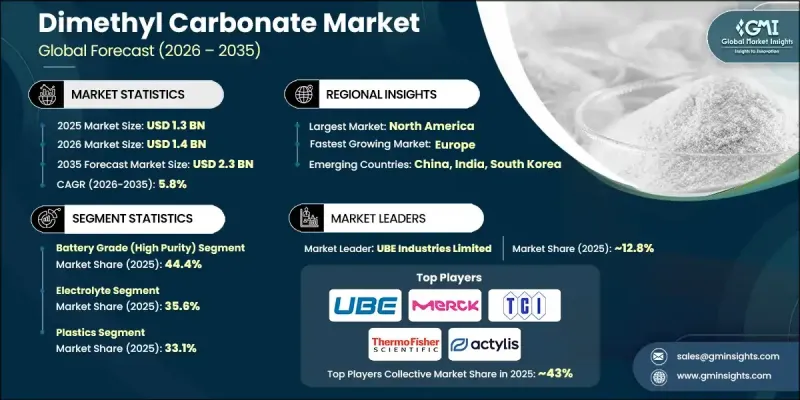
碳酸二甲酯 (C3H6O3) 是一种用途广泛的有机碳酸酯,可透过光气化、酯交换和氧化羰基化等製程製备。该产品有电池级、医药级和工业级三种规格,纯度范围从 98% 到 99.9% 以上。这种环境永续化学品是锂离子电池电解液、药物合成、聚碳酸酯製造、环保溶剂替代品的重要原料。电动车的快速普及、储能设施的不断扩建以及医药应用的日益广泛,正推动全球市场对碳酸二甲酯的强劲需求。为了满足高纯度电池级碳酸二甲酯的激增需求,製造商正投资于先进的提纯方法、永续的生产流程以及扩大产能。超高纯度生产技术的创新使得产品品质稳定可靠,纯度可达 99.95% 以上,含水量低于 20 ppm,满足锂离子电池的严格规格要求,从而提升电化学性能并减少杂质造成的劣化。
| 市场覆盖范围 | |
|---|---|
| 开始年份 | 2025 |
| 预测年份 | 2026-2035 |
| 起始值 | 13亿美元 |
| 预测金额 | 23亿美元 |
| 复合年增长率 | 5.8% |
2025年,电池级碳酸二甲酯市占率为44.4%,预计2026年至2035年将以5.5%的复合年增长率成长。其市场主导地位得益于其在锂离子电池电解配方中的关键作用、优异的电化学稳定性以及超过99.9%的高纯度标准,从而确保了其在储能和电动汽车应用中的可靠性能。
预计到2025年,电解液应用领域将占据35.6%的市场份额,并在2035年之前以6.3%的复合年增长率成长。 DMC是锂离子电池电解中的关键助溶剂,它能够平衡介电常数、黏度和电化学稳定性,从而使电池在宽温度范围内有效运作。随着电动车、家用电子电器和电网储能係统的日益普及,该领域受益匪浅,DMC通常占电解液溶剂混合物的20%至40%。
预计到 2025 年,美国碳酸二甲酯市场规模将达到 2.962 亿美元。北美强劲的需求得益于锂离子电池製造的扩张、使用碳酸二甲酯作为绿色甲基化剂和溶剂的製药生产,以及积极采用永续实践的成熟化学工业。
目录
第一章调查方法和范围
第二章执行摘要
第三章业界考察
- 生态系分析
- 供应商情况
- 利润率
- 每个阶段的附加价值
- 影响价值链的因素
- 中断
- 产业影响因素
- 司机
- 产业潜在风险与挑战
- 市场机会
- 成长潜力分析
- 监管环境
- 北美洲
- 欧洲
- 亚太地区
- 拉丁美洲
- 中东和非洲
- 波特五力分析
- PESTEL 分析
- 科技与创新趋势
- 当前技术趋势
- 新兴技术
- 价格趋势
- 按地区
- 按年级
- 未来市场趋势
- 科技与创新趋势
- 当前技术趋势
- 新兴技术
- 专利趋势
- 贸易统计(HS编码)(註:仅提供主要国家的贸易统计)
- 主要进口国
- 主要出口国
- 永续性和环境方面
- 永续努力
- 减少废弃物策略
- 生产中的能源效率
- 环保倡议
- 考虑到碳足迹
第四章 竞争情势
- 介绍
- 公司市占率分析
- 按地区
- 北美洲
- 欧洲
- 亚太地区
- 拉丁美洲
- 中东和非洲
- 按地区
- 企业矩阵分析
- 主要市场公司的竞争分析
- 竞争定位矩阵
- 重大进展
- 併购
- 伙伴关係与合作
- 新产品发布
- 扩张计划
第五章 各等级市场估算与预测,2022-2035年
- 电池等级(高纯度)
- 医药级
- 工业级
第六章 按应用领域分類的市场估算与预测,2022-2035年
- 电解质
- 溶剂
- 聚碳酸酯合成
- 燃油添加剂
- 杀虫剂
- 其他的
7. 依最终用途分類的市场估计与预测,2022-2035 年
- 电池
- 製药
- 塑胶
- 电子设备
- 杀虫剂
- 油漆和涂料
- 黏合剂和密封剂
- 其他的
第八章 2022-2035年各地区市场估算与预测
- 北美洲
- 美国
- 加拿大
- 欧洲
- 德国
- 英国
- 法国
- 西班牙
- 义大利
- 其他欧洲地区
- 亚太地区
- 中国
- 印度
- 日本
- 澳洲
- 韩国
- 亚太其他地区
- 拉丁美洲
- 巴西
- 墨西哥
- 阿根廷
- 其他拉丁美洲地区
- 中东和非洲
- 沙乌地阿拉伯
- 南非
- 阿拉伯聯合大公国
- 其他中东和非洲地区
第九章:公司简介
- Thermo Fisher Scientific Inc.
- Tokyo Chemical Industry Co., Ltd.
- UBE Industries Limited
- Merck KGaA
- Aarsha Chemicals Private Limited
- Actylis
- Cymit Quimica SL
- Dongying City Longxing
- Emco Dyestuff Pvt Ltd
- Hefei TNJ Chemical Industry Co., Ltd.
- Jinan Qinmu Fine Chemical Co., Ltd.
- SHANTI CHEMICAL WORKS
- SMC GLOBAL
The Global Dimethyl Carbonate Market was valued at USD 1.3 billion in 2025 and is estimated to grow at a CAGR of 5.8% to reach USD 2.3 billion by 2035.
Dimethyl carbonate is a versatile organic carbonate (C3H6O3) produced through processes such as phosgenation, transesterification, and oxidative carbonylation. Available in battery-grade, pharmaceutical-grade, and industrial-grade variants with purity levels ranging from 98% to above 99.9%, this environmentally sustainable chemical is essential in lithium-ion battery electrolytes, pharmaceutical synthesis, polycarbonate production, and as a green solvent alternative. The rapid growth of electric vehicle adoption, expanding energy storage installations, and rising pharmaceutical applications are creating strong demand across global markets. Manufacturers are investing in advanced purification methods, sustainable production processes, and capacity expansion to meet the surging need for high-purity battery-grade DMC. Innovations in ultra-high purity production now allow purity levels exceeding 99.95%, moisture content below 20 ppm, and consistent quality that meets stringent specifications for lithium-ion batteries, enhancing electrochemical performance and reducing impurity-related degradation.
| Market Scope | |
|---|---|
| Start Year | 2025 |
| Forecast Year | 2026-2035 |
| Start Value | $1.3 Billion |
| Forecast Value | $2.3 Billion |
| CAGR | 5.8% |
The battery-grade dimethyl carbonate segment held 44.4% share in 2025 and is expected to grow at a CAGR of 5.5% from 2026 to 2035. Its dominance is driven by its essential role in lithium-ion battery electrolyte formulations, superior electrochemical stability, and high purity standards above 99.9%, ensuring reliable performance in energy storage and electric vehicle applications.
The electrolyte applications segment held 35.6% share in 2025 and is projected to grow at a CAGR of 6.3% through 2035. DMC is a critical co-solvent in lithium-ion battery electrolytes, balancing dielectric constant, viscosity, and electrochemical stability for efficient battery operation across temperature ranges. This segment benefits from the rising adoption of electric vehicles, consumer electronics, and grid storage systems, with DMC typically comprising 20-40% of electrolyte solvent mixtures.
U.S. Dimethyl Carbonate Market accounted for USD 296.2 million in 2025. Strong demand in North America is fueled by expanding lithium-ion battery manufacturing, pharmaceutical production utilizing DMC as a green methylating agent and solvent, and a well-established chemical industry increasingly adopting sustainable practices.
Key players in the Global Dimethyl Carbonate Market include Thermo Fisher Scientific Inc., Tokyo Chemical Industry Co., Ltd., UBE Industries Limited, Merck KGaA, Aarsha Chemicals Private Limited, Actylis, Cymit Quimica S.L., Dongying City Longxing, Emco Dyestuff Pvt Ltd, Hefei TNJ Chemical Industry Co., Ltd., Jinan Qinmu Fine Chemical Co., Ltd., SHANTI CHEMICAL WORKS, and SMC GLOBAL. Companies in the Global Dimethyl Carbonate Market are strengthening their positions by investing in high-purity production technologies, expanding manufacturing capacities, and enhancing R&D for sustainable solutions. Strategic partnerships and acquisitions are being leveraged to access new geographic markets and industrial applications. Businesses focus on marketing initiatives that highlight eco-friendly properties and regulatory compliance, while continuous process innovation ensures cost efficiency and product consistency, helping them maintain a competitive advantage and meet growing demand in battery, pharmaceutical, and chemical sectors.
Table of Contents
Chapter 1 Methodology & Scope
- 1.1 Market scope and definition
- 1.2 Research design
- 1.2.1 Research approach
- 1.2.2 Data collection methods
- 1.3 Data mining sources
- 1.3.1 Global
- 1.3.2 Regional/Country
- 1.4 Base estimates and calculations
- 1.4.1 Base year calculation
- 1.4.2 Key trends for market estimation
- 1.5 Primary research and validation
- 1.5.1 Primary sources
- 1.6 Forecast model
- 1.7 Research assumptions and limitations
Chapter 2 Executive Summary
- 2.1 Industry 360° synopsis
- 2.2 Key market trends
- 2.2.1 Grade
- 2.2.2 Application
- 2.2.3 End use
- 2.2.4 Regional
- 2.3 TAM Analysis, 2025-2035
- 2.4 CXO perspectives: Strategic imperatives
- 2.4.1 Executive decision points
- 2.4.2 Critical success factors
- 2.5 Future outlook and strategic recommendations
Chapter 3 Industry Insights
- 3.1 Industry ecosystem analysis
- 3.1.1 Supplier landscape
- 3.1.2 Profit margin
- 3.1.3 Value addition at each stage
- 3.1.4 Factor affecting the value chain
- 3.1.5 Disruptions
- 3.2 Industry impact forces
- 3.2.1 Growth drivers
- 3.2.2 Industry pitfalls and challenges
- 3.2.3 Market opportunities
- 3.3 Growth potential analysis
- 3.4 Regulatory landscape
- 3.4.1 North America
- 3.4.2 Europe
- 3.4.3 Asia Pacific
- 3.4.4 Latin America
- 3.4.5 Middle East & Africa
- 3.5 Porter's analysis
- 3.6 PESTEL analysis
- 3.7 Technology and innovation landscape
- 3.7.1 Current technological trends
- 3.7.2 Emerging technologies
- 3.8 Price trends
- 3.8.1 By region
- 3.8.2 By grade
- 3.9 Future market trends
- 3.10 Technology and innovation landscape
- 3.10.1 Current technological trends
- 3.10.2 Emerging technologies
- 3.11 Patent landscape
- 3.12 Trade statistics (HS code) (Note: the trade statistics will be provided for key countries only)
- 3.12.1 Major importing countries
- 3.12.2 Major exporting countries
- 3.13 Sustainability and environmental aspects
- 3.13.1 Sustainable practices
- 3.13.2 Waste reduction strategies
- 3.13.3 Energy efficiency in production
- 3.13.4 Eco-friendly initiatives
- 3.14 Carbon footprint consideration
Chapter 4 Competitive Landscape, 2025
- 4.1 Introduction
- 4.2 Company market share analysis
- 4.2.1 By region
- 4.2.1.1 North America
- 4.2.1.2 Europe
- 4.2.1.3 Asia Pacific
- 4.2.1.4 LATAM
- 4.2.1.5 MEA
- 4.2.1 By region
- 4.3 Company matrix analysis
- 4.4 Competitive analysis of major market players
- 4.5 Competitive positioning matrix
- 4.6 Key developments
- 4.6.1 Mergers & acquisitions
- 4.6.2 Partnerships & collaborations
- 4.6.3 New product launches
- 4.6.4 Expansion plans
Chapter 5 Market Estimates and Forecast, By Grade, 2022-2035 (USD Million) (Kilo Tons)
- 5.1 Key trends
- 5.2 Battery grade (high purity)
- 5.3 Pharmaceutical grade
- 5.4 Industrial grade
Chapter 6 Market Estimates and Forecast, By Application, 2022-2035 (USD Million) (Kilo Tons)
- 6.1 Key trends
- 6.2 Electrolyte
- 6.3 Solvent
- 6.4 Polycarbonate synthesis
- 6.5 Fuel additives
- 6.6 Pesticide
- 6.7 Others
Chapter 7 Market Estimates and Forecast, By End Use, 2022-2035 (USD Million) (Kilo Tons)
- 7.1 Key trends
- 7.2 Battery
- 7.3 Pharmaceutical
- 7.4 Plastics
- 7.5 Electronics
- 7.6 Agrochemicals
- 7.7 Paints & coating
- 7.8 Adhesives & sealants
- 7.9 Others
Chapter 8 Market Estimates and Forecast, By Region, 2022-2035 (USD Million) (Kilo Tons)
- 8.1 Key trends
- 8.2 North America
- 8.2.1 U.S.
- 8.2.2 Canada
- 8.3 Europe
- 8.3.1 Germany
- 8.3.2 UK
- 8.3.3 France
- 8.3.4 Spain
- 8.3.5 Italy
- 8.3.6 Rest of Europe
- 8.4 Asia Pacific
- 8.4.1 China
- 8.4.2 India
- 8.4.3 Japan
- 8.4.4 Australia
- 8.4.5 South Korea
- 8.4.6 Rest of Asia Pacific
- 8.5 Latin America
- 8.5.1 Brazil
- 8.5.2 Mexico
- 8.5.3 Argentina
- 8.5.4 Rest of Latin America
- 8.6 Middle East and Africa
- 8.6.1 Saudi Arabia
- 8.6.2 South Africa
- 8.6.3 UAE
- 8.6.4 Rest of Middle East and Africa
Chapter 9 Company Profiles
- 9.1 Thermo Fisher Scientific Inc.
- 9.2 Tokyo Chemical Industry Co., Ltd.
- 9.3 UBE Industries Limited
- 9.4 Merck KGaA
- 9.5 Aarsha Chemicals Private Limited
- 9.6 Actylis
- 9.7 Cymit Quimica S.L.
- 9.8 Dongying City Longxing
- 9.9 Emco Dyestuff Pvt Ltd
- 9.10 Hefei TNJ Chemical Industry Co., Ltd.
- 9.11 Jinan Qinmu Fine Chemical Co., Ltd.
- 9.12 SHANTI CHEMICAL WORKS
- 9.13 SMC GLOBAL

 2026年全球碳酸二甲酯市场报告
 日本碳酸二甲酯市场报告:依等级、应用、终端用户产业及地区划分(2026-2034年)
 碳酸二甲酯市场-2025-2030年预测
 全球碳酸二甲酯 (DMC) 市场规模 (2025-2034)
 碳酸二甲酯 (DMC) - 全球市场份额和排名、总收入和需求预测(2025-2031 年)
 碳酸二甲酯市场(依合成方法、等级、最终用途产业及通路)-2025-2030 年全球预测
 全球碳酸二甲酯 (DMC) 市场(按应用、最终用途产业、等级和地区划分)- 预测至 2030 年
 2025-2029年全球碳酸二甲酯市场全球碳酸二甲酯市场规模(依等级、应用、最终用户产业、生产方法、地区、范围和预测)
 碳酸二甲酯 (DMC) 市场规模、份额、成长分析、按等级、按应用、按最终用途、按地区 - 行业预测,2025-2032 年