


 |
市场调查报告书
商品编码
1913369
中风管理市场:市场机会、成长驱动因素、产业趋势分析及预测(2026-2035 年)Stroke Management Market Opportunity, Growth Drivers, Industry Trend Analysis, and Forecast 2026 - 2035 |
||||||

全球中风管理市场预计到 2025 年将达到 446 亿美元,到 2035 年将达到 885 亿美元,年复合成长率为 7.2%。
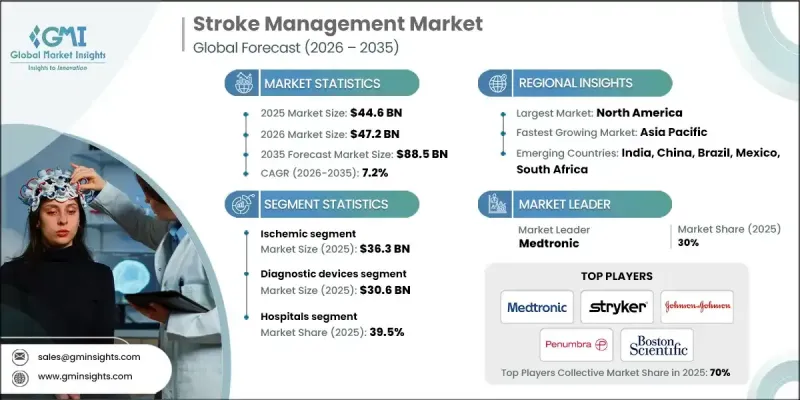
微创治疗方法的日益普及、全球卒中相关疾病发病率的上升以及卒中诊断、治疗和卒中后护理技术的不断进步,共同推动了市场增长。世界各地的医疗卫生系统越来越重视早期发现、快速反应和协调的照护路径,以降低长期残疾和死亡率。远端医疗平台和行动医疗服务模式的投资不断增加,有助于改善服务不足地区和农村地区获得卒中照护的机会。随着预防策略和及时临床干预日益成为公共卫生部门的优先事项,对先进解决方案和综合中风护理系统的需求持续增长,为整个市场创造了持续增长的机会。
| 市场覆盖范围 | |
|---|---|
| 开始年份 | 2025 |
| 预测期 | 2026-2035 |
| 初始市场规模 | 446亿美元 |
| 市场规模预测 | 885亿美元 |
| 复合年增长率 | 7.2% |
全球心血管疾病盛行率的不断上升持续推动着市场扩张。心臟相关疾病与中风风险的密切关联,促使人们需要能够支持快速诊断和及时介入的先进中风诊疗方案。为了应对这些相互交织的疾病,医疗系统日益重视协调的疾病管理方法,旨在透过早期疗育和优化治疗流程来提高存活率和改善患者的长期预后。
预计到2025年,缺血性中风市场规模将达到363亿美元,占总市场的81.4%。由于需要即时诊断、快速治疗和製定结构化的復健方案,缺血性中风仍然是卒中管理的核心。这种卒中类型的高度时效性持续推动着对专业护理解决方案和先进临床基础设施的投资。
预计到2025年,诊断设备市场规模将达到306亿美元,这反映出其在早期识别中风类型和严重程度方面发挥着至关重要的作用。准确快速的诊断能够指导临床决策,并直接影响治疗效果,因此,该领域是整个中风管理系统的关键组成部分。
2025年,美国中风治疗市值将达374亿美元。市场成长与心臟相关疾病发生率的上升以及对先进医疗技术的持续投资密切相关,这些技术能够实现更快的干预、改善治疗效果和减少併发症。
目录
第一章:分析方法和范围
第二章执行摘要
第三章业界考察
- 生态系分析
- 产业影响因素
- 司机
- 人们越来越倾向微创手术
- 全球中风和心血管疾病的发生率不断上升。
- 中风管理的技术进步
- 人口老化加剧
- 产业潜在风险与挑战
- 严格的法规结构
- 医疗成本不断上涨
- 市场机会
- 远端医疗和远距中风服务
- 司机
- 成长潜力分析
- 监管环境
- 技术进步
- 当前技术趋势
- 新兴技术
- 价格分析(2024)
- 未来市场趋势
- 波特五力分析
- PESTEL 分析
第四章 竞争情势
- 介绍
- 企业矩阵分析
- 公司市占率分析
- 主要企业的竞争分析
- 竞争定位矩阵
- 主要趋势
- 企业合併(M&A)
- 合伙/合资企业
- 新产品发布
- 扩张计划
第五章 按类型分類的市场估算与预测(2022-2035 年)
- 缺血性
- 出血性
- 短暂性脑缺血发作(TIA)
- 其他类型
第六章 按产品分類的市场估算与预测(2022-2035 年)
- 诊断设备
- 磁振造影(MRI)
- 电脑断层扫描(电脑断层扫描)
- 心电图
- 颈动脉超音波
- 脑血管造影术
- 其他的
- 治疗设备
- 磁振造影(MRI)
- 电脑断层扫描(电脑断层扫描)
- 心电图
- 颈动脉超音波
- 脑血管造影术
- 其他的
7. 依最终用途分類的市场估计与预测(2022-2035 年)
- 医院
- 门诊手术中心
- 诊断中心
- 其他最终用途
第八章 各地区市场估算与预测(2021-2034 年)
- 北美洲
- 美国
- 加拿大
- 欧洲
- 德国
- 英国
- 法国
- 西班牙
- 义大利
- 荷兰
- 亚太地区
- 中国
- 印度
- 日本
- 澳洲
- 韩国
- 拉丁美洲
- 巴西
- 墨西哥
- 阿根廷
- 中东和非洲
- 沙乌地阿拉伯
- 南非
- 阿拉伯聯合大公国
第九章:公司简介
- Medtronic
- Abbott laboratories
- GE HealthCare
- Siemens Healthineers
- Philips Healthcare
- Stryker Corporation
- Johnson &Johnson
- Penumbra
- Boston Scientific
- Imperative Care
- NeuroVasc Technologies
- Kaneka Medix Corp
The Global Stroke Management Market was valued at USD 44.6 billion in 2025 and is estimated to grow at a CAGR of 7.2% to reach USD 88.5 billion by 2035.
Market growth is supported by a rising shift toward less invasive treatment approaches, the increasing global incidence of stroke-related conditions, and continuous technological progress across diagnosis, treatment, and post-stroke care. Health systems worldwide are placing stronger emphasis on early detection, faster response times, and coordinated care pathways to reduce long-term disability and mortality. Growing investments in remote care platforms and mobile healthcare delivery models are helping improve access to stroke services in underserved and rural regions. As prevention strategies and timely clinical intervention become higher priorities for public health authorities, demand for advanced solutions and integrated stroke care frameworks continues to increase, creating sustained growth opportunities across the market.
| Market Scope | |
|---|---|
| Start Year | 2025 |
| Forecast Year | 2026-2035 |
| Start Value | $44.6 Billion |
| Forecast Value | $88.5 Billion |
| CAGR | 7.2% |
The rising global prevalence of cardiovascular conditions remains a major contributor to market expansion. The close relationship between heart-related disorders and stroke risk has intensified the need for advanced stroke care solutions that support rapid diagnosis and timely intervention. Health systems are increasingly prioritizing coordinated disease management approaches to address these overlapping conditions, aiming to improve survival rates and long-term patient outcomes through early intervention and optimized treatment workflows.
The ischemic stroke segment accounted for USD 36.3 billion in 2025 and represented 81.4% share. This segment remains central to stroke management due to the urgent need for immediate diagnosis, fast therapeutic response, and structured rehabilitation pathways. The high time sensitivity associated with this stroke type continues to drive investment in specialized care solutions and advanced clinical infrastructure.
The diagnostic devices segment generated USD 30.6 billion in 2025, reflecting their essential role in identifying stroke type and severity at early stages. Accurate and rapid diagnostics guide clinical decision-making and directly influence treatment effectiveness, making this segment a critical component of the overall stroke management ecosystem.
U.S. Stroke Management Market was valued at USD 37.4 billion in 2025. Market growth is strongly linked to increasing rates of cardiac-related conditions and continued investment in advanced care technologies that enable faster intervention, improved outcomes, and reduced complications.
Key companies active in the Global Stroke Management Market include Medtronic, Siemens Healthineers, Abbott Laboratories, GE HealthCare, Philips Healthcare, Stryker Corporation, Boston Scientific, Penumbra, Johnson & Johnson, Imperative Care, Kaneka Medix Corp, and NeuroVasc Technologies. Companies in the Global Stroke Management Market are strengthening their market position through continuous innovation, strategic collaborations, and expansion of comprehensive care portfolios. Many players are investing heavily in research and development to enhance diagnostic accuracy, treatment efficiency, and post-stroke recovery solutions. Partnerships with healthcare providers and academic institutions are helping accelerate technology adoption and clinical validation. Firms are also expanding geographically to tap into underserved markets while aligning products with evolving regulatory requirements. Integration of digital health platforms and data-driven decision support tools is being prioritized to improve care coordination.
Table of Contents
Chapter 1 Methodology and Scope
- 1.1 Market scope and definition
- 1.2 Research design
- 1.2.1 Research approach
- 1.2.2 Data collection methods
- 1.3 Data mining sources
- 1.3.1 Global
- 1.3.2 Regional/Country
- 1.4 Base estimates and calculations
- 1.4.1 Base year calculation
- 1.4.2 Key trends for market estimation
- 1.5 Primary research and validation
- 1.5.1 Primary sources
- 1.6 Forecast model
- 1.7 Research assumptions and limitations
Chapter 2 Executive Summary
- 2.1 Industry 360° synopsis
- 2.2 Key market trends
- 2.2.1 Regional trends
- 2.2.2 Type trends
- 2.2.3 Product trends
- 2.2.4 End use trends
- 2.3 CXO perspectives: Strategic imperatives
- 2.3.1 Key decision points for industry executives
- 2.3.2 Critical success factors for market players
- 2.4 Future outlook and strategic recommendations
Chapter 3 Industry Insights
- 3.1 Industry ecosystem analysis
- 3.2 Industry impact forces
- 3.2.1 Growth drivers
- 3.2.1.1 Growing preference for minimally invasive procedures
- 3.2.1.2 Increasing prevalence of stroke and cardiovascular diseases worldwide
- 3.2.1.3 Technological advancement in stroke management
- 3.2.1.4 Rising geriatric population
- 3.2.2 Industry pitfalls and challenges
- 3.2.2.1 Stringent regulatory framework
- 3.2.2.2 High cost of procedures
- 3.2.3 Market opportunities
- 3.2.3.1 Telemedicine and telestroke services
- 3.2.1 Growth drivers
- 3.3 Growth potential analysis
- 3.4 Regulatory landscape
- 3.4.1 North America
- 3.4.2 Europe
- 3.4.3 Asia Pacific
- 3.4.4 Latin America
- 3.4.5 Middle East and Africa
- 3.5 Technological advancements
- 3.5.1 Current technological trends
- 3.5.2 Emerging technologies
- 3.6 Pricing analysis, 2024
- 3.7 Future market trends
- 3.8 Porter's analysis
- 3.9 PESTEL analysis
Chapter 4 Competitive Landscape, 2024
- 4.1 Introduction
- 4.2 Company market share analysis
- 4.3 Company matrix analysis
- 4.4 Competitive analysis of major market players
- 4.5 Competitive positioning matrix
- 4.6 Key developments
- 4.6.1 Mergers and acquisitions
- 4.6.2 Partnerships and collaborations
- 4.6.3 New product launches
- 4.6.4 Expansion plans
Chapter 5 Market Estimates and Forecast, By Type, 2022 - 2035 ($ Mn)
- 5.1 Key trends
- 5.2 Ischemic
- 5.3 Hemorrhagic
- 5.4 Transient Ischemic Attack (TIA)
- 5.5 Other types
Chapter 6 Market Estimates and Forecast, By Product, 2022 - 2035 ($ Mn)
- 6.1 Key trends
- 6.2 Diagnostic devices
- 6.2.1 Magnetic Resonance Imaging (MRI)
- 6.2.2 Computed Tomography Scan (CT scan)
- 6.2.3 Electrocardiography
- 6.2.4 Carotid Ultrasound
- 6.2.5 Cerebral Angiography
- 6.2.6 Other
- 6.3 Therapeutic devices
- 6.3.1 Magnetic Resonance Imaging (MRI)
- 6.3.2 Computed Tomography Scan (CT scan)
- 6.3.3 Electrocardiography
- 6.3.4 Carotid Ultrasound
- 6.3.5 Cerebral Angiography
- 6.3.6 Other
Chapter 7 Market Estimates and Forecast, By End Use, 2022 - 2035 ($ Mn)
- 7.1 Key trends
- 7.2 Hospitals
- 7.3 Ambulatory Surgery Centers
- 7.4 Diagnostic Centers
- 7.5 Other end use
Chapter 8 Market Estimates and Forecast, By Region, 2021 - 2034 ($ Mn)
- 8.1 Key trends
- 8.2 North America
- 8.2.1 U.S.
- 8.2.2 Canada
- 8.3 Europe
- 8.3.1 Germany
- 8.3.2 UK
- 8.3.3 France
- 8.3.4 Spain
- 8.3.5 Italy
- 8.3.6 Netherlands
- 8.4 Asia Pacific
- 8.4.1 China
- 8.4.2 India
- 8.4.3 Japan
- 8.4.4 Australia
- 8.4.5 South Korea
- 8.5 Latin America
- 8.5.1 Brazil
- 8.5.2 Mexico
- 8.5.3 Argentina
- 8.6 Middle East and Africa
- 8.6.1 Saudi Arabia
- 8.6.2 South Africa
- 8.6.3 UAE
Chapter 9 Company Profiles
- 9.1 Medtronic
- 9.2 Abbott laboratories
- 9.3 GE HealthCare
- 9.4 Siemens Healthineers
- 9.5 Philips Healthcare
- 9.6 Stryker Corporation
- 9.7 Johnson & Johnson
- 9.8 Penumbra
- 9.9 Boston Scientific
- 9.10 Imperative Care
- 9.11 NeuroVasc Technologies
- 9.12 Kaneka Medix Corp

 中风治疗市场报告:按类型、应用、最终用户和地区划分(2026-2034 年)
 急性缺血性脑中风诊断市场:按产品类型、检测类型、疾病类型、技术和最终用户划分-2026-2032年全球市场预测
 全球卒中管理市场规模、份额、趋势和成长分析报告(2026-2034年)
 中风管理市场规模、份额和成长分析(按类型、产品类型、最终用户和地区划分)-2026-2033年产业预测
 2032 年急性缺血性脑中风诊断和治疗市场预测:按药物类型、诊断方法、疗法、最终用户和地区进行的全球分析
 全球移动卒中单元市场(按类型、产品、应用和地区)
 中风管理市场规模、份额、成长分析,按类型、按产品、最终用户、按地区 - 行业预测,2024-2031 年
 行动中风设备市场规模、份额和趋势分析报告:按产品、按国家/地区、细分市场预测,2024-2030 年全球中风辅助设备市场规模(按产品、应用、地区、范围和预测)