


 |
市场调查报告书
商品编码
1913374
奈米银线市场:市场机会、成长驱动因素、产业趋势分析及预测(2026-2035)Silver Nanowires Market Opportunity, Growth Drivers, Industry Trend Analysis, and Forecast 2026 - 2035 |
||||||

全球奈米银线市场预计到 2025 年将达到 18 亿美元,到 2035 年将达到 210 亿美元,年复合成长率为 27.9%。
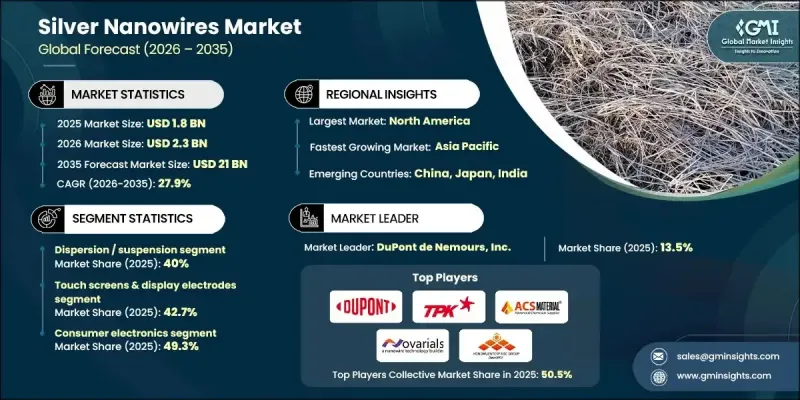
市场成长的驱动力在于下一代电子系统中对先进导电材料的日益广泛应用,这些系统需要柔软性、轻量化结构和高性能。奈米银线因其优异的导电性、高光学透明度和机械适应性,正日益成为支持创新装置架构开发的首选材料。对紧凑型、多功能和便携式电子解决方案日益增长的需求,正在加速可印刷涂层和导电油墨的研究,从而强化奈米银线在新兴应用中的作用。製造商正在扩大产能,以满足不断增长的产量需求,同时保持材料的一致性和成本效益。同时,对永续能源基础设施的持续投资,也推动了对透明、柔性导电材料的需求,这些材料能够提高性能效率和耐久性。这些趋势共同促成了奈米银线在快速发展的技术生态系统中的关键地位,而持续的创新有望进一步巩固其长期市场成长。
| 市场覆盖范围 | |
|---|---|
| 开始年份 | 2025 |
| 预测期 | 2026-2035 |
| 初始市场规模 | 18亿美元 |
| 市场规模预测 | 210亿美元 |
| 复合年增长率 | 27.9% |
预计到 2025 年,油墨/浆料业务的收入将达到 5 亿美元。随着精密沉积技术和印刷电子製造技术的广泛应用,该业务的重要性日益凸显,这些技术能够实现可扩展、经济高效的生产,同时保持高导电性和均匀性。
预计到 2035 年,医疗和医疗设备领域将以 26.5% 的复合年增长率成长。奈米银线因其兼具机械柔软性和稳定的电气性能,使其适用于复杂的设备设计,因此越来越多地被整合到先进的感测和诊断平台中。
预计到2025年,北美奈米银线市场规模将达到8.652亿美元,并在整个预测期内保持强劲成长动能。该地区的主导地位得益于对先进製造技术、材料科学研究和技术商业化的大力投资,以及有利的政策框架和创新驱动的供应链。
目录
第一章:分析方法和范围
第二章执行摘要
第三章业界考察
- 产业生态系分析
- 供应商情况
- 利润率
- 每个阶段的附加价值
- 影响价值链的因素
- 中断
- 产业影响因素
- 司机
- 对触控萤幕和显示器的需求不断增长
- 柔性印刷电子技术的扩展
- 扩大可再生能源和储能应用
- 产业潜在风险与挑战
- 奈米银线製造成本高昂
- 来自其他透明导电材料的竞争
- 耐久性和氧化问题
- 市场机会
- 汽车智慧电子产品的发展
- 生物医学和医疗设备领域的扩张
- 亚太新兴市场
- 司机
- 成长潜力分析
- 监管环境
- 北美洲
- 欧洲
- 亚太地区
- 拉丁美洲
- 中东和非洲
- 波特五力分析
- PESTEL 分析
- 价格趋势
- 按地区
- 按产品形状
- 未来市场趋势
- 科技与创新趋势
- 当前技术趋势
- 新兴技术
- 专利状态
- 贸易统计(HS编码)(註:仅提供主要国家的贸易统计)
- 主要进口国
- 主要出口国
- 永续性和环境方面
- 永续努力
- 减少废弃物策略
- 生产中的能源效率
- 环保倡议
- 考虑到碳足迹
第四章 竞争情势
- 介绍
- 公司市占率分析
- 按地区
- 北美洲
- 欧洲
- 亚太地区
- 拉丁美洲
- 中东和非洲
- 按地区
- 企业矩阵分析
- 主要市场公司的竞争分析
- 竞争定位矩阵
- 重大进展
- 併购
- 伙伴关係与合作
- 新产品发布
- 业务拓展计划
第五章 依产品类型分類的市场估算与预测(2022-2035 年)
- 分散体/悬浮液
- 墨水/浆糊
- 透明导电膜(TCF)
- 干粉/气凝胶
第六章 按应用领域分類的市场估算与预测(2022-2035 年)
- 触控萤幕显示器电极
- 柔性/印刷电子
- 透明加热器
- 太阳能发电和储能
- 感测和生物感测器
- 有机发光二极体(OLED)/发光二极体(LED)装置
- 抗菌材料
- 电磁干扰 (EMI) 屏蔽和温度控管
7. 依最终用途分類的市场估计与预测(2022-2035 年)
- 家用电子电器
- 汽车/运输设备
- 医疗和医疗设备
- 能源与公共产业
- 建筑/施工
- 纺织服装
- 工业和製造业
第八章 各地区市场估算与预测(2022-2035 年)
- 北美洲
- 美国
- 加拿大
- 欧洲
- 德国
- 英国
- 法国
- 西班牙
- 义大利
- 其他欧洲
- 亚太地区
- 中国
- 印度
- 日本
- 澳洲
- 韩国
- 亚太其他地区
- 拉丁美洲
- 巴西
- 墨西哥
- 阿根廷
- 其他拉丁美洲
- 中东和非洲
- 沙乌地阿拉伯
- 南非
- 阿拉伯聯合大公国
- 其他中东和非洲地区
第九章:公司简介
- ACS Material, LLC
- Blue Nano, Inc.
- DuPont de Nemours, Inc.
- Guangzhou Hongwu Material Technology Co., Ltd.
- Materic LLC
- Nanogap Sub-nm Powder SA
- NanoTechLabs, Inc.
- Novarials Corporation
- Suzhou Cold Stone Nano Material Technology Co., Ltd.
- TPK Holding Co., Ltd.
The Global Silver Nanowires Market was valued at USD 1.8 billion in 2025 and is estimated to grow at a CAGR of 27.9% to reach USD 21 billion by 2035.
Market growth is supported by the rising adoption of advanced conductive materials across next-generation electronic systems that require flexibility, lightweight structures, and high performance. Silver nanowires are increasingly preferred due to their superior electrical conductivity, high optical clarity, and mechanical adaptability, which support the development of innovative device architectures. Growing demand for compact, multifunctional, and portable electronic solutions is accelerating research into printable coatings and conductive inks, strengthening the role of silver nanowires across emerging applications. Manufacturers are also scaling production capabilities to meet rising volume requirements while maintaining material consistency and cost efficiency. In parallel, increasing investments in sustainable energy infrastructure are driving demand for transparent and flexible conductive materials that improve performance efficiency and durability. These combined trends are positioning silver nanowires as a critical component across rapidly expanding technology ecosystems, with continued innovation expected to reinforce long-term market growth.
| Market Scope | |
|---|---|
| Start Year | 2025 |
| Forecast Year | 2026-2035 |
| Start Value | $1.8 Billion |
| Forecast Value | $21 Billion |
| CAGR | 27.9% |
The inks and pastes segment generated USD 0.5 billion in 2025. This segment is gaining importance as precision deposition techniques and printed electronics manufacturing gain wider acceptance, enabling scalable and cost-effective production while maintaining high conductivity and uniformity.
The healthcare and medical device segment is projected to grow at a CAGR of 26.5% through 2035. Silver nanowires are increasingly integrated into advanced sensing and diagnostic platforms, supported by their ability to deliver stable electrical performance alongside mechanical flexibility suited to complex device designs.
North America Silver Nanowires Market reached USD 865.2 million in 2025 and is expected to maintain attractive growth through the forecast period. Regional leadership is driven by strong investment in advanced manufacturing, material science research, and technology commercialization, along with supportive policy frameworks and innovation-focused supply chains.
Key companies operating in the Global Silver Nanowires Market include DuPont de Nemours, Inc., TPK Holding Co., Ltd., NanoTechLabs, Inc., ACS Material, LLC, Nanogap Sub-nm Powder S.A., Materic LLC, Guangzhou Hongwu Material Technology Co., Ltd., Novarials Corporation, Blue Nano, Inc., and Suzhou Cold Stone Nano Material Technology Co., Ltd. Companies in the Global Silver Nanowires Market are strengthening their market position by prioritizing scalable production methods and improving material uniformity to meet rising commercial demand. Many players are investing heavily in research and development to enhance conductivity, transparency, and durability while reducing overall material costs. Strategic collaborations with downstream manufacturers are enabling faster product integration and customized solutions. Firms are also expanding their global distribution networks to improve supply reliability and market access.
Table of Contents
Chapter 1 Methodology & Scope
- 1.1 Market scope and definition
- 1.2 Research design
- 1.2.1 Research approach
- 1.2.2 Data collection methods
- 1.3 Data mining sources
- 1.3.1 Global
- 1.3.2 Regional/Country
- 1.4 Base estimates and calculations
- 1.4.1 Base year calculation
- 1.4.2 Key trends for market estimation
- 1.5 Primary research and validation
- 1.5.1 Primary sources
- 1.6 Forecast model
- 1.7 Research assumptions and limitations
Chapter 2 Executive Summary
- 2.1 Industry 3600 synopsis
- 2.2 Key market trends
- 2.2.1 Regional
- 2.2.2 Product Form
- 2.2.3 Application
- 2.2.4 End Use
- 2.3 TAM Analysis, 2025-2034
- 2.4 CXO perspectives: Strategic imperatives
- 2.4.1 Executive decision points
- 2.4.2 Critical success factors
- 2.5 Future Outlook and Strategic Recommendations
Chapter 3 Industry Insights
- 3.1 Industry ecosystem analysis
- 3.1.1 Supplier landscape
- 3.1.2 Profit margin
- 3.1.3 Value addition at each stage
- 3.1.4 Factor affecting the value chain
- 3.1.5 Disruptions
- 3.2 Industry impact forces
- 3.2.1 Growth drivers
- 3.2.1.1 Growing demand for touchscreens & displays
- 3.2.1.2 Expansion of flexible & printed electronics
- 3.2.1.3 Rising renewable energy & energy storage applications
- 3.2.2 Industry pitfalls and challenges
- 3.2.2.1 High manufacturing cost of silver nanowires
- 3.2.2.2 Competition from alternative transparent conductors
- 3.2.2.3 Durability & oxidation issues
- 3.2.3 Market opportunities
- 3.2.3.1 Growth in automotive smart electronics
- 3.2.3.2 Expansion in biomedical & healthcare devices
- 3.2.3.3 Emerging markets in Asia Pacific
- 3.2.1 Growth drivers
- 3.3 Growth potential analysis
- 3.4 Regulatory landscape
- 3.4.1 North America
- 3.4.2 Europe
- 3.4.3 Asia Pacific
- 3.4.4 Latin America
- 3.4.5 Middle East & Africa
- 3.5 Porter's analysis
- 3.6 PESTEL analysis
- 3.7 Price trends
- 3.7.1 By region
- 3.7.2 By product form
- 3.8 Future market trends
- 3.9 Technology and Innovation landscape
- 3.9.1 Current technological trends
- 3.9.2 Emerging technologies
- 3.10 Patent Landscape
- 3.11 Trade statistics (HS code) ( Note: the trade statistics will be provided for key countries only)
- 3.11.1 Major importing countries
- 3.11.2 Major exporting countries
- 3.12 Sustainability and environmental aspects
- 3.12.1 Sustainable practices
- 3.12.2 Waste reduction strategies
- 3.12.3 Energy efficiency in production
- 3.12.4 Eco-friendly initiatives
- 3.13 Carbon footprint consideration
Chapter 4 Competitive Landscape, 2025
- 4.1 Introduction
- 4.2 Company market share analysis
- 4.2.1 By region
- 4.2.1.1 North America
- 4.2.1.2 Europe
- 4.2.1.3 Asia Pacific
- 4.2.1.4 LATAM
- 4.2.1.5 MEA
- 4.2.1 By region
- 4.3 Company matrix analysis
- 4.4 Competitive analysis of major market players
- 4.5 Competitive positioning matrix
- 4.6 Key developments
- 4.6.1 Mergers & acquisitions
- 4.6.2 Partnerships & collaborations
- 4.6.3 New Product Launches
- 4.6.4 Expansion Plans
Chapter 5 Market Estimates and Forecast, By Product Form, 2022-2035 (USD Billion) (Kilo Tons)
- 5.1 Key trends
- 5.2 Dispersion/Suspension
- 5.3 Ink/Paste
- 5.4 Transparent Conductive Film (TCF)
- 5.5 Dry Powder/Aerogel
Chapter 6 Market Estimates and Forecast, By Application, 2022-2035 (USD Billion) (Kilo Tons)
- 6.1 Key trends
- 6.2 Touch Screens & Display Electrodes
- 6.3 Flexible/Printed Electronics
- 6.4 Transparent Heaters
- 6.5 Photovoltaics & Energy Storage
- 6.6 Sensing & Biosensors
- 6.7 OLED/LED Devices
- 6.8 Antimicrobial Materials
- 6.9 EMI Shielding & Thermal Management
Chapter 7 Market Estimates and Forecast, By End Use, 2022-2035 (USD Billion) (Kilo Tons)
- 7.1 Key trends
- 7.2 Consumer Electronics
- 7.3 Automotive & Transportation
- 7.4 Healthcare & Medical Devices
- 7.5 Energy & Utilities
- 7.6 Building & Construction
- 7.7 Textile & Apparel
- 7.8 Industrial & Manufacturing
Chapter 8 Market Estimates and Forecast, By Region, 2022-2035 (USD Billion) (Kilo Tons)
- 8.1 Key trends
- 8.2 North America
- 8.2.1 U.S.
- 8.2.2 Canada
- 8.3 Europe
- 8.3.1 Germany
- 8.3.2 UK
- 8.3.3 France
- 8.3.4 Spain
- 8.3.5 Italy
- 8.3.6 Rest of Europe
- 8.4 Asia Pacific
- 8.4.1 China
- 8.4.2 India
- 8.4.3 Japan
- 8.4.4 Australia
- 8.4.5 South Korea
- 8.4.6 Rest of Asia Pacific
- 8.5 Latin America
- 8.5.1 Brazil
- 8.5.2 Mexico
- 8.5.3 Argentina
- 8.5.4 Rest of Latin America
- 8.6 Middle East and Africa
- 8.6.1 Saudi Arabia
- 8.6.2 South Africa
- 8.6.3 UAE
- 8.6.4 Rest of Middle East and Africa
Chapter 9 Company Profiles
- 9.1 ACS Material, LLC
- 9.2 Blue Nano, Inc.
- 9.3 DuPont de Nemours, Inc.
- 9.4 Guangzhou Hongwu Material Technology Co., Ltd.
- 9.5 Materic LLC
- 9.6 Nanogap Sub-nm Powder S.A.
- 9.7 NanoTechLabs, Inc.
- 9.8 Novarials Corporation
- 9.9 Suzhou Cold Stone Nano Material Technology Co., Ltd.
- 9.10 TPK Holding Co., Ltd.


