


 |
市场调查报告书
商品编码
1913381
工业3D列印市场:市场机会、成长驱动因素、产业趋势分析及预测(2026-2035年)Industrial 3D Printer Market Opportunity, Growth Drivers, Industry Trend Analysis, and Forecast 2026 - 2035 |
||||||

全球工业 3D 列印市场预计到 2025 年将达到 183 亿美元,到 2035 年将达到 738 亿美元,年复合成长率为 15.1%。
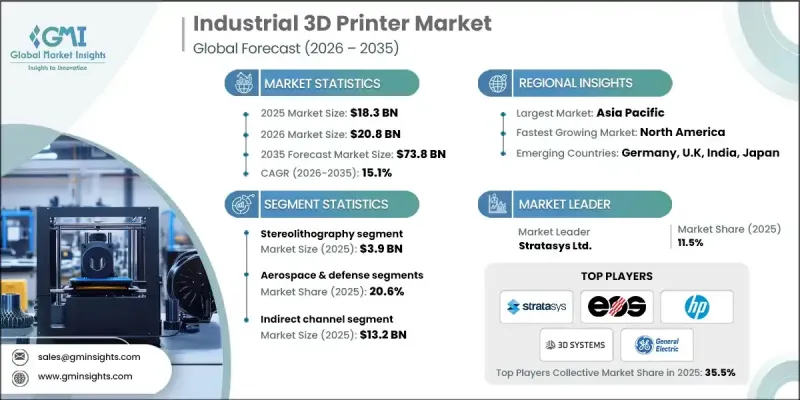
成本效益是市场成长的关键驱动力,它使製造商能够将模具成本降低高达 80-90%,这意味着在某些应用领域的小批量生产中,每个零件可节省超过 10 万美元。 3D 列印技术能够生产高度客製化、几何形状复杂的零件,从而为市场带来许多好处。在医疗领域,该技术可提供患者特异性的植入,并有助于改善修復效果。材料效率和永续性也发挥关键作用,3D 列印技术可根据应用的不同,减少 30-95% 的废弃物。金属增材製造和多材料列印等技术创新正透过催生新的工业应用案例,进一步拓展市场。政府的倡议和资助计画正在支持相关研究和应用,尤其是在需要高精度和先进材料性能的应用领域。
| 市场覆盖范围 | |
|---|---|
| 开始年份 | 2025 |
| 预测期 | 2026-2035 |
| 初始市场规模 | 183亿美元 |
| 市场规模预测 | 738亿美元 |
| 复合年增长率 | 15.1% |
立体光刻技术(SLA)技术预计到2025年将创造39亿美元的市场规模。 SLA能够以极高的精度生产复杂的原型和功能部件,使其成为复杂设计行业的理想选择。政府的资金支持和政策措施正在推动工业界对SLA技术的应用,并促进专用SLA树脂和特定应用领域的创新。
到2025年,航太和国防领域将占据20.6%的市场份额,这主要得益于对轻量化、节能型和几何形状先进的零件的需求。积层製造技术能够生产传统技术无法实现的晶格结构和随形冷却通道,这使得航太和国防领域稳居工业3D列印技术的主要应用领域。
预计到2025年,美国工业3D列印机市占率将达到78.1%。这一增长得益于强大的製造业基础和先进技术的快速普及。 Stratasys和3D Systems等主要企业正透过拓展产品线以满足航太和医疗等高精度产业的需求,并与主要製造商合作,推动3D生产线规模化发展,从而促进美国市场的成长。
目录
第一章:分析方法和范围
第二章执行摘要
第三章业界考察
- 产业生态系分析
- 供应商情况
- 利润率
- 每个阶段的附加价值
- 影响价值链的因素
- 产业影响因素
- 司机
- 快速原型製作的广泛应用
- 产品开发与供应链改进
- 政府对3D列印计划的投资
- 产业潜在风险与挑战
- 材料限制和品管
- 利用3D列印技术轻鬆复製设计
- 市场机会
- 医疗和生物列印应用
- 永续性和合规性解决方案
- 司机
- 成长潜力分析
- 未来市场趋势
- 科技与创新趋势
- 当前技术趋势
- 新兴技术
- 价格趋势
- 透过技术
- 按地区
- 监管环境
- 标准和合规要求
- 区域法规结构
- 认证标准
- 差距分析
- 风险评估与缓解
- 波特五力分析
- PESTEL 分析
第四章 竞争情势
- 介绍
- 公司市占率分析
- 按地区
- 北美洲
- 欧洲
- 亚太地区
- 拉丁美洲
- 中东和非洲
- 按地区
- 企业矩阵分析
- 主要企业的竞争分析
- 竞争定位矩阵
- 主要趋势
- 企业合併(M&A)
- 商业伙伴关係与合作
- 新产品发布
- 扩张计划
第五章 依技术分類的市场估计与预测(2022-2035 年)
- 选择性雷射烧结
- 立体光刻技术
- 熔融沈积成型
- 直接金属雷射烧结
- 喷墨列印
- 喷胶成形列印
- 电子束熔化
- 层压物製造
- 数位光处理技术
- 雷射金属沉积法
- 其他的
第六章 依最终使用者分類的市场估算与预测(2022-2035 年)
- 车
- 航太/国防
- 医疗保健
- 家用电子电器
- 食物与烹饪
- 电力和能源
- 其他的
第七章 按分销管道分類的市场估计和预测(2022-2035 年)
- 直接地
- 间接
第八章 各地区市场估算与预测(2022-2035 年)
- 北美洲
- 美国
- 加拿大
- 欧洲
- 德国
- 法国
- 英国
- 义大利
- 西班牙
- 亚太地区
- 中国
- 印度
- 日本
- 韩国
- 澳洲
- 拉丁美洲
- 巴西
- 墨西哥
- 阿根廷
- 中东和非洲
- 南非
- 沙乌地阿拉伯
- 阿拉伯聯合大公国
第九章:公司简介
- 3D Systems
- Desktop Metal
- EOS
- Formlabs
- General Electric
- HP
- Markforged
- Materialise
- Nano Dimension
- Prodways
- Renishaw
- SLM Solutions
- Stratasys
- Ultimaker
- Velo3D
The Global Industrial 3D Printer Market was valued at USD 18.3 billion in 2025 and is estimated to grow at a CAGR of 15.1% to reach USD 73.8 billion by 2035.
Cost efficiency remains a key factor driving market growth, with manufacturers able to reduce tooling costs by up to 80-90%, translating into savings of over USD 100,000 per part in certain applications, even for limited production runs. The market benefits from 3D printing's ability to produce highly customized and geometrically complex components. In the healthcare sector, companies are delivering patient-specific implants, enhancing recovery outcomes. Material efficiency and sustainability also play a crucial role, as 3D printing reduces waste by 30-95% depending on the application. Technological innovations, including metal additive manufacturing and multi-material printing, are further broadening the market by enabling new industrial use cases. Government initiatives and funding programs are supporting research and adoption, particularly for applications requiring precision and advanced material capabilities.
| Market Scope | |
|---|---|
| Start Year | 2025 |
| Forecast Year | 2026-2035 |
| Start Value | $18.3 Billion |
| Forecast Value | $73.8 Billion |
| CAGR | 15.1% |
The stereolithography (SLA) generated USD 3.9 billion in 2025. SLA enables the production of highly intricate prototypes and functional parts with exceptional precision, making it ideal for industries that demand complex designs. Its industrial adoption is bolstered by government funding and initiatives, fostering innovation in specialized SLA resins and targeted applications.
The aerospace and defense sector held 20.6% share in 2025, driven by the need for lightweight, fuel-efficient, and geometrically sophisticated components. Additive manufacturing allows production of lattice structures and conformal cooling channels that are impossible to achieve with conventional techniques, cementing aerospace and defense as a leading adopter of industrial 3D printing.
United States Industrial 3D Printer Market held 78.1% share in 2025. The growth is supported by a strong manufacturing base and rapid adoption of advanced technologies. Leading companies such as Stratasys and 3D Systems have propelled the U.S. market by expanding their portfolios to meet the demands of high-precision sectors, including aerospace and healthcare, and collaborating with major manufacturers to scale 3D production lines.
Key players in the Global Industrial 3D Printer Market include HP, Markforged, Nano Dimension, Prodways, SLM Solutions, 3D Systems, Stratasys, EOS, General Electric, Formlabs, Ultimaker, Velo3D, and Materialise. Companies in the Global Industrial 3D Printer Market are strengthening their position through several strategic initiatives. They are heavily investing in R&D to enhance precision, material versatility, and production speed. Partnerships with OEMs and industry leaders enable large-scale adoption of 3D printing technologies. Firms focus on expanding regional distribution networks and service infrastructure to improve accessibility and customer support. They are also introducing software solutions for process optimization and workflow integration. Emphasis on sustainability, including reducing material waste and energy consumption, helps companies meet regulatory requirements and attract environmentally conscious clients.
Table of Contents
Chapter 1 Methodology & Scope
- 1.1 Market scope and definition
- 1.2 Research design
- 1.2.1 Research approach
- 1.2.2 Data collection methods
- 1.3 Data mining sources
- 1.3.1 Global
- 1.3.2 Regional/Country
- 1.4 Base estimates and calculations
- 1.4.1 Base year calculation
- 1.4.2 Key trends for market estimation
- 1.5 Primary research and validation
- 1.5.1 Primary sources
- 1.6 Forecast model
- 1.7 Research assumptions and limitations
Chapter 2 Executive Summary
- 2.1 Industry 360° synopsis
- 2.2 Key market trends
- 2.2.1 Regional
- 2.2.2 Technology
- 2.2.3 End use
- 2.2.4 Distribution channel
- 2.3 CXO perspectives: Strategic imperatives
- 2.3.1 Key decision points for industry executives
- 2.3.2 Critical success factors for market players
- 2.4 Future outlook and strategic recommendations
Chapter 3 Industry Insights
- 3.1 Industry ecosystem analysis
- 3.1.1 Supplier landscape
- 3.1.2 Profit margin
- 3.1.3 Value addition at each stage
- 3.1.4 Factor affecting the value chain
- 3.2 Industry impact forces
- 3.2.1 Growth drivers
- 3.2.1.1 Wide use of rapid prototyping
- 3.2.1.2 Improvements in product development and supply chains
- 3.2.1.3 Government investments in 3D printing projects
- 3.2.2 Industry pitfalls & challenges
- 3.2.2.1 Material limitations and quality control
- 3.2.2.2 Ease of replicating designs with 3D printing technology
- 3.2.3 Opportunities
- 3.2.3.1 Expansion into healthcare and bioprinting
- 3.2.3.2 Sustainability and regulatory compliance solutions
- 3.2.1 Growth drivers
- 3.3 Growth potential analysis
- 3.4 Future market trends
- 3.5 Technology and innovation landscape
- 3.5.1 Current technological trends
- 3.5.2 Emerging technologies
- 3.6 Price trends
- 3.6.1 By technology
- 3.6.2 By region
- 3.7 Regulatory landscape
- 3.7.1 Standards and compliance requirements
- 3.7.2 Regional regulatory frameworks
- 3.7.3 Certification standards
- 3.8 Gap analysis
- 3.9 Risk assessment and mitigation
- 3.10 Porter's analysis
- 3.11 PESTEL analysis
Chapter 4 Competitive Landscape, 2025
- 4.1 Introduction
- 4.2 Company market share analysis
- 4.2.1 By region
- 4.2.1.1 North America
- 4.2.1.2 Europe
- 4.2.1.3 Asia Pacific
- 4.2.1.4 Latin America
- 4.2.1.5 Middle East and Africa
- 4.2.1 By region
- 4.3 Company matrix analysis
- 4.4 Competitive analysis of major market players
- 4.5 Competitive positioning matrix
- 4.6 Key developments
- 4.6.1 Mergers & acquisitions
- 4.6.2 Partnerships & collaborations
- 4.6.3 New product launches
- 4.6.4 Expansion plans
Chapter 5 Market Estimates & Forecast, By Technology, 2022-2035 (USD Billion) (Thousand Units)
- 5.1 Key trends
- 5.2 Selective laser sintering
- 5.3 Stereolithography
- 5.4 Fuse deposition modeling
- 5.5 Direct metal laser sintering
- 5.6 Inkjet printing
- 5.7 Polyjet printing
- 5.8 Electron beam melting
- 5.9 Laminated object manufacturing
- 5.10 Digital light processing
- 5.11 Laser metal deposition
- 5.12 Others
Chapter 6 Market Estimates & Forecast, By End-User, 2022-2035 (USD Billion) (Thousand Units)
- 6.1 Key trends
- 6.2 Automotive
- 6.3 Aerospace & defense
- 6.4 Healthcare
- 6.5 Consumer electronics
- 6.6 Food & culinary
- 6.7 Power & energy
- 6.8 Others
Chapter 7 Market Estimates & Forecast, By Distribution Channel, 2022-2035 (USD Billion) (Thousand Units)
- 7.1 Key trends
- 7.2 Direct
- 7.3 Indirect
Chapter 8 Market Estimates & Forecast, By Region, 2022-2035 (USD Billion) (Thousand Units)
- 8.1 Key trends
- 8.2 North America
- 8.2.1 U.S.
- 8.2.2 Canada
- 8.3 Europe
- 8.3.1 Germany
- 8.3.2 France
- 8.3.3 UK
- 8.3.4 Italy
- 8.3.5 Spain
- 8.4 Asia Pacific
- 8.4.1 China
- 8.4.2 India
- 8.4.3 Japan
- 8.4.4 South Korea
- 8.4.5 Australia
- 8.5 Latin America
- 8.5.1 Brazil
- 8.5.2 Mexico
- 8.5.3 Argentina
- 8.6 MEA
- 8.6.1 South Africa
- 8.6.2 Saudi Arabia
- 8.6.3 UAE
Chapter 9 Company Profiles
- 9.1 3D Systems
- 9.2 Desktop Metal
- 9.3 EOS
- 9.4 Formlabs
- 9.5 General Electric
- 9.6 HP
- 9.7 Markforged
- 9.8 Materialise
- 9.9 Nano Dimension
- 9.10 Prodways
- 9.11 Renishaw
- 9.12 SLM Solutions
- 9.13 Stratasys
- 9.14 Ultimaker
- 9.15 Velo3D

