


 |
市场调查报告书
商品编码
1913383
聚丙烯不织布市场:市场机会、成长驱动因素、产业趋势分析及预测(2026-2035)Polypropylene (PP) Nonwoven Fabrics Market Opportunity, Growth Drivers, Industry Trend Analysis, and Forecast 2026 - 2035 |
||||||

全球聚丙烯(PP)不织布市场预计到 2025 年将达到 502 亿美元,到 2035 年将达到 1,003 亿美元,年复合成长率为 7.3%。
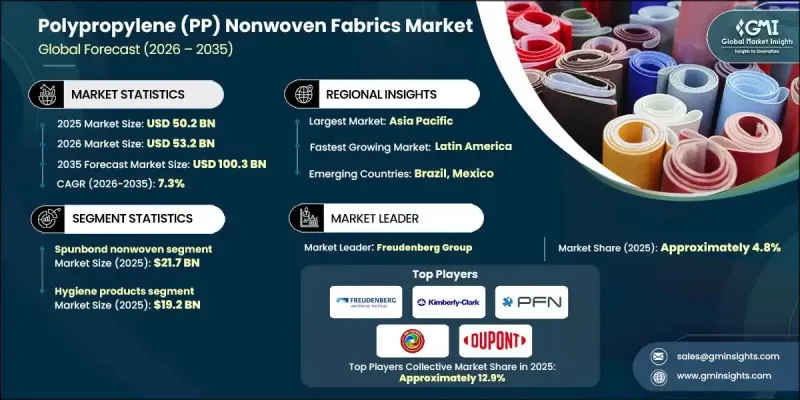
由于其在医疗、卫生和工业领域的应用日益广泛,市场正经历快速成长。聚丙烯不织布轻盈、耐用且经济高效,是製造口罩、罩衣、尿布和卫生用品的理想材料。日益增强的健康意识和更严格的职场安全标准进一步推动了医疗和工业领域的需求。此外,汽车产业也开始采用聚丙烯不织布製造座椅套、顶棚和空调滤芯,尤其是在电动和混合动力汽车中,因为这种轻质材料能够提高效率和舒适性。个人防护设备(PPE) 需求的激增也推动了市场成长,因为这些材料能够提供透气屏障,从而提高全球医护人员和工业工作者的安全。
| 市场覆盖范围 | |
|---|---|
| 开始年份 | 2025 |
| 预测期 | 2026-2035 |
| 初始市场规模 | 502亿美元 |
| 市场规模预测 | 1003亿美元 |
| 复合年增长率 | 7.3% |
预计2025年,纺粘不织布市场规模将达217亿美元,2026年至2035年的复合年增长率将达到7.5%。其强度高、用途广泛且重量轻,使其成为清洁、农业和汽车等行业中对耐用且经济高效材料的首选。对一次性产品和可重复使用产品的需求不断增长,正在推动其进一步普及。
预计到2025年,卫生用品市场规模将达到192亿美元,占市场份额的38.2%,到2035年将以7.5%的复合年增长率成长。尿布、卫生棉、手术罩衣和防护装备等应用领域的需求推动了市场成长,这些产品对舒适性、吸收性和防护性要求极高。消费者个人卫生和感染控制意识的不断提高,正在推动全球医疗保健和卫生用品行业的应用。
预计2025年,北美聚丙烯(PP)不织布市场规模将达129亿美元。市场扩张的主要驱动力来自该地区蓬勃发展的医疗保健和卫生用品行业,以及对医用一次性用品、工业擦拭巾和个人防护设备(PPE)日益增长的需求,同时,PP无纺布在汽车内部装潢建材和过滤领域的应用也日益广泛。製造商正投资于先进的生产技术、永续的工艺流程和本地化生产设施,以满足高品质标准和监管要求,这进一步推动了该地区市场的发展。
目录
第一章:分析方法和范围
第二章执行摘要
第三章业界考察
- 产业生态系分析
- 供应商情况
- 利润率
- 每个阶段的附加价值
- 影响价值链的因素
- 中断
- 产业影响因素
- 司机
- 产业潜在风险与挑战
- 市场机会
- 成长潜力分析
- 监管环境
- 北美洲
- 欧洲
- 亚太地区
- 拉丁美洲
- 中东和非洲
- 波特五力分析
- PESTEL 分析
- 价格趋势
- 按地区
- 副产品
- 未来市场趋势
- 科技与创新趋势
- 当前技术趋势
- 新兴技术
- 专利状态
- 贸易统计(註:仅提供主要国家的贸易统计)
- 主要进口国
- 主要出口国
- 永续性和环境方面
- 永续实践
- 减少废弃物策略
- 生产中的能源效率
- 环保倡议
- 碳足迹考量
第四章 竞争情势
- 介绍
- 公司市占率分析
- 按地区
- 北美洲
- 欧洲
- 亚太地区
- 拉丁美洲
- 中东和非洲
- 按地区
- 企业矩阵分析
- 主要企业的竞争分析
- 竞争定位矩阵
- 主要趋势
- 企业合併(M&A)
- 商业伙伴关係与合作
- 新产品发布
- 业务拓展计划
第五章 依产品类型分類的市场估算与预测(2022-2035 年)
- 纺粘不织布
- 单层纺粘
- 多层纺粘
- 熔喷不织布
- 纯熔喷
- 熔喷复合材料
- 复合不不织布
- 纺粘+熔喷(SM)
- 纺粘+熔喷+纺粘(SMS)
- 其他的
第六章 按应用领域分類的市场估算与预测(2022-2035 年)
- 卫生用品
- 婴儿尿布
- 女性用卫生用品
- 成人失禁用品
- 医疗保健
- 手术罩衣
- 口罩
- 窗帘和遮盖物
- 农业
- 作物保护覆盖物
- 播种覆盖物
- 家具和室内装饰
- 床垫套
- 靠垫衬里
- 车
- 内饰
- 隔热材料
- 工业的
- 过滤材料
- 地工织物
- 其他的
第七章 各地区市场估算与预测(2022-2035 年)
- 北美洲
- 美国
- 加拿大
- 欧洲
- 德国
- 英国
- 法国
- 义大利
- 西班牙
- 其他欧洲
- 亚太地区
- 中国
- 印度
- 日本
- 澳洲
- 韩国
- 亚太其他地区
- 拉丁美洲
- 巴西
- 墨西哥
- 阿根廷
- 其他拉丁美洲
- 中东和非洲
- 沙乌地阿拉伯
- 南非
- 阿拉伯聯合大公国
- 其他中东和非洲地区
第八章 公司简介
- DuPont de Nemours, Inc.
- NW Fabric
- Freudenberg Group
- PFNonwovens AS
- Kimberly-Clark Corporation
- First Quality Nonwovens, Inc.
- Toray Industries, Inc.
- Lydall, Inc.
- Mitsui Chemicals, Inc.
- Ahlstrom-Munksjo
- Asahi Kasei Corporation
- Mogul Co., Ltd.
- Global Nonwovens Ltd.
- Mewar Polytex International
The Global Polypropylene (PP) Nonwoven Fabrics Market was valued at USD 50.2 billion in 2025 and is estimated to grow at a CAGR of 7.3% to reach USD 100.3 billion by 2035.
The market is witnessing rapid expansion due to increasing adoption in medical, hygiene, and industrial applications. Its lightweight, durable, and cost-effective nature makes it ideal for manufacturing masks, gowns, diapers, and sanitary products. Rising health awareness and stringent workplace safety standards have further fueled demand across healthcare and industrial sectors. Additionally, the automotive industry is embracing polypropylene nonwovens for seat covers, headliners, and cabin filters, especially in electric and hybrid vehicles, where lightweight materials improve efficiency and comfort. The surge in personal protective equipment (PPE) demand has also accelerated market growth, as these fabrics provide a breathable barrier, enhancing safety for medical and industrial personnel worldwide.
| Market Scope | |
|---|---|
| Start Year | 2025 |
| Forecast Year | 2026-2035 |
| Start Value | $50.2 Billion |
| Forecast Value | $100.3 Billion |
| CAGR | 7.3% |
The spunbond nonwoven segment generated USD 21.7 billion in 2025 and is projected to grow at a CAGR of 7.5% from 2026 to 2035. Its strength, multifunctionality, and lightweight properties make it a preferred choice for industries requiring durable yet cost-effective materials, including cleaning, agriculture, and automotive applications. The rising demand for both disposable and reusable products has further propelled adoption.
The hygiene products segment recorded USD 19.2 billion in 2025, representing a 38.2% share, and is expected to grow at a CAGR of 7.5% through 2035. Growth is driven by applications in diapers, sanitary pads, surgical gowns, and protective equipment, where comfort, absorbency, and protection are essential. Increasing consumer awareness regarding personal hygiene and infection control is driving adoption across healthcare and hygiene sectors globally.
North America Polypropylene (PP) Nonwoven Fabrics Market accounted for USD 12.9 billion in 2025. Expansion is supported by the region's robust healthcare and hygiene sectors, rising demand for medical disposables, industrial wipes, and PPE, and growing adoption in automotive interiors and filtration. Manufacturers are investing in advanced production technologies, sustainable processes, and local facilities to meet high-quality standards and regulatory compliance, reinforcing the market's development in the region.
Key players in the Global Polypropylene (PP) Nonwoven Fabrics Market include PFNonwovens A.S., DuPont de Nemours, Inc., Freudenberg Group, Kimberly-Clark Corporation, NW Fabric, and others. Companies in the Global Polypropylene (PP) Nonwoven Fabrics Market are adopting multiple strategies to strengthen their market presence and expand their foothold. Investments in advanced manufacturing technologies enhance production efficiency, product quality, and sustainability. Firms are focusing on developing specialized, high-performance fabrics tailored for healthcare, hygiene, automotive, and industrial applications. Strategic partnerships and collaborations with OEMs, healthcare providers, and hygiene product manufacturers broaden market reach. Expanding production capacities, entering emerging markets, and optimizing supply chains help meet growing global demand.
Table of Contents
Chapter 1 Methodology
- 1.1 Market scope and definition
- 1.2 Research design
- 1.2.1 Research approach
- 1.2.2 Data collection methods
- 1.3 Data mining sources
- 1.3.1 Global
- 1.3.2 Regional/Country
- 1.4 Base estimates and calculations
- 1.4.1 Base year calculation
- 1.4.2 Key trends for market estimation
- 1.5 Primary research and validation
- 1.5.1 Primary sources
- 1.6 Forecast model
- 1.7 Research assumptions and limitations
Chapter 2 Executive Summary
- 2.1 Industry 360° synopsis
- 2.2 Key market trends
- 2.2.1 Regional
- 2.2.2 Product Type
- 2.2.3 Application
- 2.3 TAM Analysis, 2026-2035
- 2.4 CXO perspectives: Strategic imperatives
- 2.4.1 Executive decision points
- 2.4.2 Critical success factors
- 2.5 Future Outlook and Strategic Recommendations
Chapter 3 Industry Insights
- 3.1 Industry ecosystem analysis
- 3.1.1 Supplier Landscape
- 3.1.2 Profit Margin
- 3.1.3 Value addition at each stage
- 3.1.4 Factor affecting the value chain
- 3.1.5 Disruptions
- 3.2 Industry impact forces
- 3.2.1 Growth drivers
- 3.2.2 Industry pitfalls and challenges
- 3.2.3 Market opportunities
- 3.3 Growth potential analysis
- 3.4 Regulatory landscape
- 3.4.1 North America
- 3.4.2 Europe
- 3.4.3 Asia Pacific
- 3.4.4 Latin America
- 3.4.5 Middle East & Africa
- 3.5 Porter's analysis
- 3.6 PESTEL analysis
- 3.7 Price trends
- 3.7.1 By region
- 3.7.2 By product
- 3.8 Future market trends
- 3.9 Technology and Innovation landscape
- 3.9.1 Current technological trends
- 3.9.2 Emerging technologies
- 3.10 Patent Landscape
- 3.11 Trade statistics (Note: the trade statistics will be provided for key countries only)
- 3.11.1 Major importing countries
- 3.11.2 Major exporting countries
- 3.12 Sustainability and Environmental Aspects
- 3.12.1 Sustainable Practices
- 3.12.2 Waste Reduction Strategies
- 3.12.3 Energy Efficiency in Production
- 3.12.4 Eco-friendly Initiatives
- 3.13 Carbon Footprint Considerations
Chapter 4 Competitive Landscape, 2025
- 4.1 Introduction
- 4.2 Company market share analysis
- 4.2.1 By region
- 4.2.1.1 North America
- 4.2.1.2 Europe
- 4.2.1.3 Asia Pacific
- 4.2.1.4 LATAM
- 4.2.1.5 MEA
- 4.2.1 By region
- 4.3 Company matrix analysis
- 4.4 Competitive analysis of major market players
- 4.5 Competitive positioning matrix
- 4.6 Key developments
- 4.6.1 Mergers & acquisitions
- 4.6.2 Partnerships & collaborations
- 4.6.3 New Product Launches
- 4.6.4 Expansion Plans
Chapter 5 Market Estimates and Forecast, By Product Type, 2022- 2035 (USD Billion, Kilo Tons)
- 5.1 Key trends
- 5.2 Spunbond Nonwoven
- 5.2.1 Single-layer spunbond
- 5.2.2 Multi-layer spunbond
- 5.3 Meltblown Nonwoven
- 5.3.1 Pure meltblown
- 5.3.2 Meltblown composites
- 5.4 Composite Nonwoven
- 5.4.1 Spunbond + Meltblown (SM)
- 5.4.2 Spunbond + Meltblown + Spunbond (SMS)
- 5.5 Others
Chapter 6 Market Estimates and Forecast, By Application, 2022- 2035 (USD Billion, Kilo Tons)
- 6.1 Key trends
- 6.2 Hygiene Products
- 6.2.1 Baby diapers
- 6.2.2 Feminine hygiene products
- 6.2.3 Adult incontinence products
- 6.3 Medical & Healthcare
- 6.3.1 Surgical gowns
- 6.3.2 Face masks
- 6.3.3 Drapes and covers
- 6.4 Agriculture
- 6.4.1 Crop protection covers
- 6.4.2 Seed blankets
- 6.5 Furniture & Upholstery
- 6.5.1 Mattress covers
- 6.5.2 Cushion linings
- 6.6 Automotive
- 6.6.1 Interior trims
- 6.6.2 Insulation layers
- 6.7 Industrial
- 6.7.1 Filtration media
- 6.7.2 Geotextiles
- 6.8 Others
Chapter 7 Market Estimates and Forecast, By Region, 2022 - 2035 (USD Billion, Kilo Tons)
- 7.1 Key trends
- 7.2 North America
- 7.2.1 U.S.
- 7.2.2 Canada
- 7.3 Europe
- 7.3.1 Germany
- 7.3.2 UK
- 7.3.3 France
- 7.3.4 Italy
- 7.3.5 Spain
- 7.3.6 Rest of Europe
- 7.4 Asia Pacific
- 7.4.1 China
- 7.4.2 India
- 7.4.3 Japan
- 7.4.4 Australia
- 7.4.5 South Korea
- 7.4.6 Rest of Asia Pacific
- 7.5 Latin America
- 7.5.1 Brazil
- 7.5.2 Mexico
- 7.5.3 Argentina
- 7.5.4 Rest of Latin America
- 7.6 Middle East & Africa
- 7.6.1 Saudi Arabia
- 7.6.2 South Africa
- 7.6.3 UAE
- 7.6.4 Rest of Middle East & Africa
Chapter 8 Company Profiles
- 8.1 DuPont de Nemours, Inc.
- 8.2 NW Fabric
- 8.3 Freudenberg Group
- 8.4 PFNonwovens A.S.
- 8.5 Kimberly-Clark Corporation
- 8.6 First Quality Nonwovens, Inc.
- 8.7 Toray Industries, Inc.
- 8.8 Lydall, Inc.
- 8.9 Mitsui Chemicals, Inc.
- 8.10 Ahlstrom-Munksjo
- 8.11 Asahi Kasei Corporation
- 8.12 Mogul Co., Ltd.
- 8.13 Global Nonwovens Ltd.
- 8.14 Mewar Polytex International

 聚丙烯不织布市场:依技术、原料、克重、通路及应用划分-2026-2032年全球市场预测
 全球聚丙烯不织布市场规模、份额、趋势和成长分析报告(2026-2034年)
 聚丙烯不织布市场规模、份额和成长分析(按产品、纤维类型、织物结构、材料类型、应用和地区划分)—产业预测,2026-2033年
 聚丙烯不织布市场全球聚丙烯不织布袋和麻袋市场规模(按产品类型、最终用户、区域范围和预测)
 聚丙烯不织布市场,按产品类型、按材料类型、按应用、按国家和地区 - 2024-2032 年行业分析、市场规模、市场份额和预测
 2024-2028年全球聚丙烯不织布市场