


 |
市场调查报告书
商品编码
1913386
β-聚葡萄糖市场:市场机会、成长驱动因素、产业趋势分析及预测(2026-2035)Beta Glucan Market Opportunity, Growth Drivers, Industry Trend Analysis, and Forecast 2026 - 2035 |
||||||

全球β-聚葡萄糖市场预计到2025年将达到4.883亿美元,到2035年将达到11亿美元,年复合成长率为8.8%。
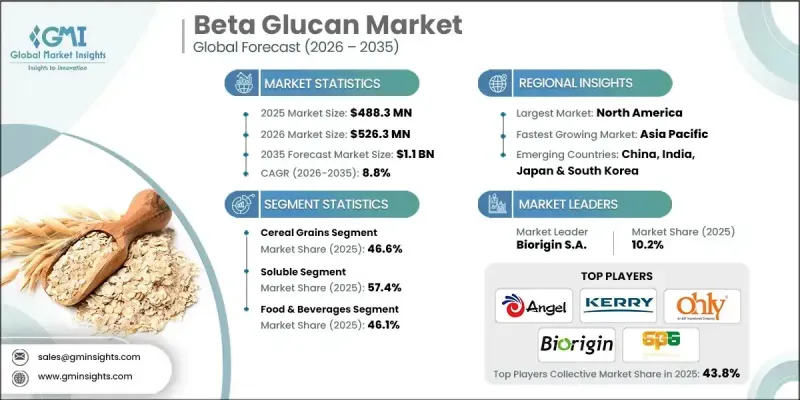
市场扩张的驱动力在于人们对β-聚葡萄糖生理益处的认识不断提高,以及其在食品、营养和製药领域应用范围的不断扩大。 β-聚葡萄糖是一种天然膳食纤维,因其支持免疫反应、调节胆固醇水平和促进碳水化合物代谢平衡而备受认可。其在促进心臟健康和增强免疫力方面的作用,正促使其在註重健康的食品配方中得到更广泛的应用。消费者对天然健康成分的日益青睐也进一步推动了市场需求。此外,β-葡聚醣在血糖值管理和抗氧化活性方面的其他益处,也使其在长期健康管理中发挥重要作用。从商业性角度来看,製造商正在拓展其应用领域,并将β-聚葡萄糖越来越多地添加到面向注重健康的消费者的食品和饮料配方中。这种多元化发展,加上科学检验和产品创新,正使全球市场保持强劲的成长动能。
| 市场覆盖范围 | |
|---|---|
| 开始年份 | 2025 |
| 预测期 | 2026-2035 |
| 初始市场规模 | 4.883亿美元 |
| 市场规模预测 | 11亿美元 |
| 复合年增长率 | 8.8% |
预计到2025年,谷物来源的β-聚葡萄糖市场份额将达到46.6%,并在2035年之前以8.9%的复合年增长率增长。此细分市场受益于消费者对植物来源功能性成分的长期接受度以及萃取效率的稳定提升。加工技术的进步提高了产品的纯度和均匀性,而日益增长的洁净标示趋势则推动了负责任采购原料的使用。已开发市场完善的法规结构也持续推动该细分市场的应用和商业性规模化。
预计到2025年,可溶性β-聚葡萄糖将占据57.4%的市场份额,并在2026年至2035年间以8.9%的复合年增长率增长。该类产品因其功能性强、吸收率高,且适用于心血管健康、免疫支持和血糖值调节等膳食补充剂,而被广泛应用。其生物利用度的提高也增强了其功效,并使其在多个应用领域中保持了持续的需求。
北美是β-聚葡萄糖市场最大的区域贡献者,预计到2025年将占38.8%的市占率。该地区市场成长的主要驱动力是消费者对健康产品的浓厚兴趣,以及食品、膳食补充剂和药品领域对功能性成分的日益增长的需求。消费者持续关注免疫健康、心臟健康和体重管理,这仍然是产品研发的重点,同时,对洁净标示和植物来源配方的需求也十分旺盛。
目录
第一章:分析方法和范围
第二章执行摘要
第三章业界考察
- 产业生态系分析
- 供应商情况
- 利润率
- 每个阶段的附加价值
- 影响价值链的因素
- 中断
- 产业影响因素
- 司机
- 产业潜在风险与挑战
- 市场机会
- 成长潜力分析
- 监管环境
- 北美洲
- 欧洲
- 亚太地区
- 拉丁美洲
- 中东和非洲
- 波特五力分析
- PESTEL 分析
- 价格趋势
- 按地区
- 依产品类型
- 未来市场趋势
- 科技与创新趋势
- 当前技术趋势
- 新兴技术
- 专利状态
- 贸易统计(HS编码)(註:仅提供主要国家的贸易统计)
- 主要进口国
- 主要出口国
- 永续性和环境方面
- 永续努力
- 减少废弃物策略
- 生产中的能源效率
- 环保倡议
- 考虑到碳足迹
第四章 竞争情势
- 介绍
- 公司市占率分析
- 按地区
- 北美洲
- 欧洲
- 亚太地区
- 拉丁美洲
- 中东和非洲
- 按地区
- 企业矩阵分析
- 主要市场公司的竞争分析
- 竞争定位矩阵
- 重大进展
- 併购
- 伙伴关係与合作
- 新产品发布
- 业务拓展计划
5. 按萃取物分類的市场估算和预测(2022-2035 年)
- 谷类
- 酵母菌
- 菇
- 海藻
第六章 按类型分類的市场估算与预测(2022-2035 年)
- 可溶性
- 不溶物
第七章 按应用领域分類的市场估算与预测(2022-2035 年)
- 食品/饮料
- 烘焙产品
- 早餐用麦片谷类和能量棒
- 机能饮料
- 乳製品和乳製品替代品
- 汤、酱汁和加工食品
- 零嘴零食
- 製药
- 临床营养
- 创伤护理和组织修復
- 药物输送系统
- 化妆品
- 护肤品
- 头髮和头皮护理
- 身体保养
- 动物饲料
- 家禽饲料(肉鸡、蛋鸡、火鸡和野禽)
- 猪饲料(适用于小猪、生长猪、育肥猪、母猪)
- 水产饲料(鱼、虾)
- 反刍动物饲料(牛/牛)
- 宠物营养(伴侣动物)
- 其他的
第八章 各地区市场估算与预测(2022-2035 年)
- 北美洲
- 美国
- 加拿大
- 欧洲
- 德国
- 英国
- 法国
- 西班牙
- 义大利
- 其他欧洲
- 亚太地区
- 中国
- 印度
- 日本
- 澳洲
- 韩国
- 亚太其他地区
- 拉丁美洲
- 巴西
- 墨西哥
- 阿根廷
- 其他拉丁美洲
- 中东和非洲
- 沙乌地阿拉伯
- 南非
- 阿拉伯聯合大公国
- 其他中东和非洲地区
第九章:公司简介
- Angel Yeast
- Biorigin SA
- DSM
- Givaudan
- Kemin Industries
- Kerry
- Lallemand
- Lantmannen Biorefineries
- Leiber GmbH
- Ohly
- Super Beta Glucan
- Tate &Lyle PLC
- VW-Ingredients
The Global Beta Glucan Market was valued at USD 488.3 million in 2025 and is estimated to grow at a CAGR of 8.8% to reach USD 1.1 billion by 2035.
Market expansion is linked to growing awareness of the physiological benefits associated with beta glucan and its widening use across food, nutrition, and pharmaceutical applications. Beta glucan is positioned as a naturally derived dietary fiber recognized for supporting immune response, managing cholesterol levels, and assisting in balanced carbohydrate metabolism. Its role in promoting heart health and immune defense has strengthened its adoption in wellness-focused product formulations. Consumers are increasingly inclined toward naturally sourced health ingredients, further reinforcing demand. Additional benefits related to blood sugar management and antioxidant activity continue to support its relevance in long-term health management. From a commercial perspective, manufacturers are broadening application areas, with beta glucan increasingly incorporated into food and beverage formulations aimed at health-conscious buyers. This diversification, combined with scientific validation and product innovation, is sustaining strong global market momentum.
| Market Scope | |
|---|---|
| Start Year | 2025 |
| Forecast Year | 2026-2035 |
| Start Value | $488.3 Million |
| Forecast Value | $1.1 Billion |
| CAGR | 8.8% |
The cereal grain-based beta glucan segment accounted for 46.6% share in 2025 and is forecast to grow at a CAGR of 8.9% through 2035. This segment benefits from long-term consumer acceptance of plant-derived functional ingredients and steady improvements in extraction efficiency. Advances in processing technologies are enhancing product purity and consistency, while clean-label preferences are encouraging the use of responsibly sourced raw materials. Supportive regulatory frameworks across developed markets continue to strengthen adoption and commercial scalability.
The soluble form of beta glucan held a 57.4% share in 2025 and is expected to grow at a CAGR of 8.9% from 2026 to 2035. This category is widely used due to its high functional performance, improved absorption, and suitability for nutritional formulations targeting cardiovascular wellness, immune support, and glucose regulation. Enhanced bioavailability contributes to its effectiveness and sustained demand across multiple application segments.
North America Beta Glucan Market held 38.8% share in 2025, making it the leading regional contributor. Market growth in the region is driven by strong consumer engagement with wellness-focused products and increasing incorporation of functional ingredients across food, supplement, and pharmaceutical categories. Emphasis on immune health, heart health, and weight management continues to support product development, while demand for clean-label and plant-based formulations remains high.
Key companies operating in the Global Beta Glucan Market include DSM, Kerry, Tate & Lyle PLC, Givaudan, Angel Yeast, Lallemand, Kemin Industries, Lantmannen Biorefineries, Leiber GmbH, Biorigin S.A., Ohly, Super Beta Glucan, and VW-Ingredients. Companies in the Global Beta Glucan Market are strengthening their competitive position through innovation-driven product development and strategic capacity expansion. Leading players are investing in advanced processing technologies to improve yield, consistency, and functional performance. Strategic collaborations with food, nutrition, and pharmaceutical manufacturers are helping companies expand application reach and secure long-term supply agreements. Firms are also focusing on clean-label positioning, sustainability commitments, and transparent sourcing to align with evolving consumer expectations.
Table of Contents
Chapter 1 Methodology & Scope
- 1.1 Market scope and definition
- 1.2 Research design
- 1.2.1 Research approach
- 1.2.2 Data collection methods
- 1.3 Data mining sources
- 1.3.1 Global
- 1.3.2 Regional/Country
- 1.4 Base estimates and calculations
- 1.4.1 Base year calculation
- 1.4.2 Key trends for market estimation
- 1.5 Primary research and validation
- 1.5.1 Primary sources
- 1.6 Forecast model
- 1.7 Research assumptions and limitations
Chapter 2 Executive Summary
- 2.1 Industry 3600 synopsis
- 2.2 Key market trends
- 2.2.1 Regional
- 2.2.2 Extract
- 2.2.3 Form
- 2.2.4 Application
- 2.3 TAM Analysis, 2026-2035
- 2.4 CXO perspectives: Strategic imperatives
- 2.4.1 Executive decision points
- 2.4.2 Critical success factors
- 2.5 Future Outlook and Strategic Recommendations
Chapter 3 Industry Insights
- 3.1 Industry ecosystem analysis
- 3.1.1 Supplier landscape
- 3.1.2 Profit margin
- 3.1.3 Value addition at each stage
- 3.1.4 Factor affecting the value chain
- 3.1.5 Disruptions
- 3.2 Industry impact forces
- 3.2.1 Growth drivers
- 3.2.2 Industry pitfalls and challenges
- 3.2.3 Market opportunities
- 3.3 Growth potential analysis
- 3.4 Regulatory landscape
- 3.4.1 North America
- 3.4.2 Europe
- 3.4.3 Asia Pacific
- 3.4.4 Latin America
- 3.4.5 Middle East & Africa
- 3.5 Porter's analysis
- 3.6 PESTEL analysis
- 3.7 Price trends
- 3.7.1 By region
- 3.7.2 By Product type
- 3.8 Future market trends
- 3.9 Technology and Innovation landscape
- 3.9.1 Current technological trends
- 3.9.2 Emerging technologies
- 3.10 Patent Landscape
- 3.11 Trade statistics (HS code) ( Note: The trade statistics will be provided for key countries only)
- 3.11.1 Major importing countries
- 3.11.2 Major exporting countries
- 3.12 Sustainability and environmental aspects
- 3.12.1 Sustainable practices
- 3.12.2 Waste reduction strategies
- 3.12.3 Energy efficiency in production
- 3.12.4 Eco-friendly initiatives
- 3.13 Carbon footprint consideration
Chapter 4 Competitive Landscape, 2025
- 4.1 Introduction
- 4.2 Company market share analysis
- 4.2.1 By region
- 4.2.1.1 North America
- 4.2.1.2 Europe
- 4.2.1.3 Asia Pacific
- 4.2.1.4 LATAM
- 4.2.1.5 MEA
- 4.2.1 By region
- 4.3 Company matrix analysis
- 4.4 Competitive analysis of major market players
- 4.5 Competitive positioning matrix
- 4.6 Key developments
- 4.6.1 Mergers & acquisitions
- 4.6.2 Partnerships & collaborations
- 4.6.3 New Product Launches
- 4.6.4 Expansion Plans
Chapter 5 Market Estimates and Forecast, By Extract, 2022-2035 (USD Million) (Kilo Tons)
- 5.1 Key trends
- 5.2 Cereal grains
- 5.3 Yeast
- 5.4 Mushroom
- 5.5 Seaweed
Chapter 6 Market Estimates and Forecast, By Form, 2022-2035 (USD Million) (Kilo Tons)
- 6.1 Key trends
- 6.2 Soluble
- 6.3 Insoluble
Chapter 7 Market Estimates and Forecast, By Application, 2022-2035 (USD Million) (Kilo Tons)
- 7.1 Key trends
- 7.2 Food & beverage
- 7.2.1 Bakery products
- 7.2.2 Breakfast cereals & bars
- 7.2.3 Functional beverages
- 7.2.4 Dairy & dairy alternatives
- 7.2.5 Soups, sauces & prepared foods
- 7.2.6 Snack foods
- 7.3 Pharmaceuticals
- 7.3.1 Clinical nutrition
- 7.3.2 Wound care & tissue repair
- 7.3.3 Drug delivery systems
- 7.4 Cosmetics
- 7.4.1 Skin care products
- 7.4.2 Hair & scalp care
- 7.4.3 Body care
- 7.5 Animal feed
- 7.5.1 Poultry feed (broiler, layer, turkey & game birds)
- 7.5.2 Swine feed (piglet, grower, finisher, sow)
- 7.5.3 Aquaculture feed (fish, shrimp)
- 7.5.4 Ruminant feed (dairy & beef cattle)
- 7.5.5 Pet nutrition (companion animals)
- 7.6 Others
Chapter 8 Market Estimates and Forecast, By Region, 2022-2035 (USD Million) (Kilo Tons)
- 8.1 Key trends
- 8.2 North America
- 8.2.1 U.S.
- 8.2.2 Canada
- 8.3 Europe
- 8.3.1 Germany
- 8.3.2 UK
- 8.3.3 France
- 8.3.4 Spain
- 8.3.5 Italy
- 8.3.6 Rest of Europe
- 8.4 Asia Pacific
- 8.4.1 China
- 8.4.2 India
- 8.4.3 Japan
- 8.4.4 Australia
- 8.4.5 South Korea
- 8.4.6 Rest of Asia Pacific
- 8.5 Latin America
- 8.5.1 Brazil
- 8.5.2 Mexico
- 8.5.3 Argentina
- 8.5.4 Rest of Latin America
- 8.6 Middle East and Africa
- 8.6.1 Saudi Arabia
- 8.6.2 South Africa
- 8.6.3 UAE
- 8.6.4 Rest of Middle East and Africa
Chapter 9 Company Profiles
- 9.1 Angel Yeast
- 9.2 Biorigin S.A.
- 9.3 DSM
- 9.4 Givaudan
- 9.5 Kemin Industries
- 9.6 Kerry
- 9.7 Lallemand
- 9.8 Lantmannen Biorefineries
- 9.9 Leiber GmbH
- 9.10 Ohly
- 9.11 Super Beta Glucan
- 9.12 Tate & Lyle PLC
- 9.13 VW-Ingredients

 β-聚葡萄糖产品市场:依原料、等级及地区划分
 β-聚葡萄糖市场 - 全球产业规模、份额、趋势、机会和预测(按类别、原材料、应用、地区和竞争格局划分),2021-2031年β-聚葡萄糖市场:依原料、应用和地区划分
 酵母来源β-葡聚醣市场规模、份额和成长分析(按来源、类别、应用和地区划分)-产业预测(2026-2033)酵母β-葡聚醣市场-全球产业规模、份额、趋势、机会和预测,按应用(食品饮料、个人护理和化妆品、製药、动物饲料等)细分,按地区和竞争情况,2020-2030 年预测
 β-聚葡萄糖市场 – 2025 年至 2030 年预测