


 |
市场调查报告书
商品编码
1913422
轻型车辆拖车市场机会、成长要素、产业趋势分析及2026年至2035年预测Light Car Trailer Market Opportunity, Growth Drivers, Industry Trend Analysis, and Forecast 2026 - 2035 |
||||||

预计到 2025 年,全球轻型车辆拖车市场价值将达到 15.8 亿美元,到 2035 年将达到 21.6 亿美元,年复合成长率为 3.2%。
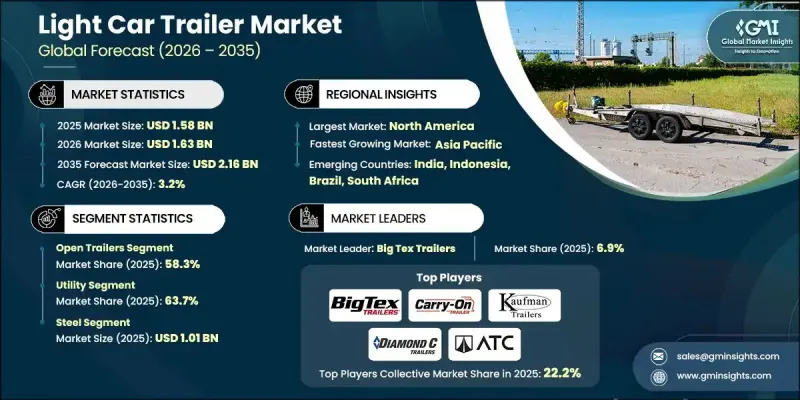
市场扩张与全球都市区和半都市区物流营运和短途配送网路的稳定成长密切相关。小规模企业和自由职业模式的日益普及推动了对经济灵活运输解决方案的需求,进而促进了轻型车辆拖车的广泛应用。最初,封闭式轻型车辆拖车仅在一些以生活方式为导向的特定应用场景中获得认可,这些场景的关键需求是耐用性、安全储存和耐候性。随后,由于其性能稳定、易于使用和安全性提升,这些拖车的应用范围逐渐扩展到其他领域。这种转变逐渐推动了它们在日常交通和商业应用中的普及。区域分析显示,北美凭藉其发达的交通基础设施、较高的消费者接受度和成熟的出行模式,成为关键市场。该地区对能够满足个人和商用运输需求的灵活牵引解决方案的偏好,也进一步推动了市场需求。
| 市场覆盖范围 | |
|---|---|
| 开始年份 | 2025 |
| 预测年份 | 2026-2035 |
| 起始值 | 15.8亿美元 |
| 预测金额 | 21.6亿美元 |
| 复合年增长率 | 3.2% |
截至2025年,敞篷拖车市占率将达到58.3%。据称,敞篷轻型车辆拖车因其在专业和工业领域的应用日益广泛而备受重视。其设计便于装卸超大或不规则货物,适用于需要便利装卸能力的场所。
预计到2025年,多用途拖车将占据63.7%的市场份额,到2035年市场规模将达到14亿美元。多用途轻型车辆拖车的特点是能够适应各种日常运输需求。其实实用设计使其能够重复用于商业和个人运输。丰富的配置选项提高了装载效率和整体便利性,使其市场渗透率高于专用拖车。
预计2025年,美国轻型车辆拖吊车市场规模将达5.182亿美元。由于休閒和商业活动领域长期以来的强劲需求,美国有望继续保持主导地位。国内物流行业的持续强劲成长以及线上零售分销的快速发展,推动了对适应性强的本地运输解决方案的需求。因此,越来越多的个体经营者以及郊区和区域的中小型企业正在将轻型车辆拖车纳入其日常营运中。
目录
第一章调查方法
第二章执行摘要
第三章业界考察
- 生态系分析
- 供应商情况
- 利润率
- 成本结构
- 每个阶段的附加价值
- 影响价值链的因素
- 中断
- 产业影响因素
- 司机
- 休閒车和旅行拖车的需求不断增长
- 户外探险旅游的成长
- 增加可支配收入和改善生活方式
- 拓展电子商务与最后一公里配送解决方案
- 产业潜在风险与挑战
- 高昂的初始投资和购买成本
- 新兴市场道路基础设施短缺
- 市场机会
- 新兴市场的扩张
- 永续轻型拖车材料的成长
- 旅游和户外休閒的扩展
- 可客製化和模组化拖车正变得越来越受欢迎
- 司机
- 成长潜力分析
- 监管环境
- 北美洲
- 美国交通部拖吊法规
- 州/省拖车登记和公路法规
- 美国国家公路交通安全管理局拖车合规标籤(美国)
- 欧洲
- 欧盟整车类型认证(WVTA)
- 联合国欧洲经济委员会(UNECE)条例(WP.29)
- 欧盟驾驶执照类别
- 亚太地区
- 澳洲设计规则(ADR)
- 中国GB标准
- 印度汽车法规
- 拉丁美洲
- 墨西哥 NOM-035-SCT-2 拖车安全标准
- 联合国欧洲经济委员会(UNECE)/联合国全球技术法规(GTRs)
- 道路交通安全标准
- 中东和非洲
- 沙乌地阿拉伯拖车技术法规(SASO)
- 海湾合作委员会车辆标准
- 阿联酋道路和交通管理局(RTA)拖车法规
- 北美洲
- 波特五力分析
- PESTEL 分析
- 科技与创新趋势
- 当前技术趋势
- 新兴技术
- 价格趋势
- 按地区
- 副产品
- 生产统计
- 生产基地
- 消费基础
- 出口和进口
- 成本細項分析
- 永续性和环境影响
- 环境影响评估
- 社会影响力和社区服务
- 公司管治与企业社会责任
- 永续金融与投资趋势
- 製造和设计趋势
- 从钢材转向铝材和复合材料
- 模组化和可自订拖车设计的演变
- 提高空气动力性能和燃油效率的考量因素
- 轻量化创新
- 经销和售后服务生态系统
- 经销商网路结构及覆盖范围分析
- 线上销售管道渗透与数位转型
- 售后零件和配件市场
- 维护和服务基础设施可用性
- 案例研究
- 未来前景与机会
第四章 竞争情势
- 介绍
- 公司市占率分析
- 北美洲
- 欧洲
- 亚太地区
- 拉丁美洲
- 中东和非洲
- 主要市场公司的竞争分析
- 竞争定位矩阵
- 战略展望矩阵
- 重大进展
- 併购
- 伙伴关係与合作
- 新产品发布
- 企业扩张计画和资金筹措
第五章 依设计分類的市场估算与预测,2022-2035年
- 打开拖车
- 平板拖车
- 倾斜式拖车
- 倾卸拖车
- 封闭式拖车
- 厢式拖车
- 特製封闭式拖车
第六章 按车轴分類的市场估算与预测,2022-2035年
- 单轴
- 多轴车辆
- 双人(串联式)
- 三重轴
第七章 按材料分類的市场估算与预测,2022-2035年
- 钢材
- 铝
- 复合材料/玻璃纤维
- 其他的
8. 依有效载荷分類的市场估算与预测,2022-2035 年
- 最高可达750公斤
- 751 kg~2,000 kg
- 2,001 kg~3,500 kg
第九章 按应用领域分類的市场估算与预测,2022-2035年
- 公用事业
- 贸易/建筑
- 农业
- 物流/小型配送
- 其他的
- 休閒用途
第十章 依最终用途分類的市场估计与预测,2022-2035年
- 船队所有
- 个人/私人
- 租赁/出租
第十一章 依销售管道分類的市场估计与预测,2022-2035年
- 直销
- 间接销售
第十二章 2022-2035年各地区市场估算与预测
- 北美洲
- 美国
- 加拿大
- 欧洲
- 德国
- 英国
- 法国
- 义大利
- 西班牙
- 俄罗斯
- 北欧国家
- 比荷卢经济联盟
- 亚太地区
- 中国
- 印度
- 日本
- 韩国
- ANZ
- 新加坡
- 马来西亚
- 印尼
- 越南
- 泰国
- 拉丁美洲
- 巴西
- 墨西哥
- 阿根廷
- 哥伦比亚
- 中东和非洲
- 南非
- 沙乌地阿拉伯
- 阿拉伯聯合大公国
第十三章:公司简介
- 世界公司
- Big Tex Trailers
- PJ Trailers
- Aluma
- ATC Trailers
- Ifor Williams Trailers
- Featherlite Trailers
- Sundowner Trailers
- Diamond C Trailers
- Haulmark Industries
- Felling Trailers
- Kaufman Trailers
- Pace American
- Wells Cargo
- Load Trail
- Woodford Trailers
- 本地公司
- Brian James Trailers
- Debon Trailers
- SylvanSport
- Pongratz Trailer
- Carry-On Trailer
- 新兴企业
- Vezeko
- UNSINN Fahrzeugtechnik
- Temared
- Nugent Engineering
- Erde SAS
The Global Light Car Trailer Market was valued at USD 1.58 billion in 2025 and is estimated to grow at a CAGR of 3.2% to reach USD 2.16 billion by 2035.
Market expansion is linked to the steady growth of logistics operations and short-distance delivery networks across global urban and semi-urban areas. Rising participation in small-scale enterprises and independent work models has increased demand for affordable and flexible transport solutions, supporting wider adoption of light car trailers. Initially, enclosed light car trailers gained recognition within limited lifestyle-oriented use cases, where durability, secure storage, and weather resistance were key requirements. Over time, consistent performance, ease of use, and improved safety features helped broaden awareness of these trailers beyond niche usage. This shift gradually encouraged their adoption for daily transport needs and professional applications. Regional analysis identifies North America as the leading market, supported by developed transport infrastructure, strong consumer acceptance, and established mobility patterns. Market demand in the region is further supported by preferences for flexible towing solutions that align with both personal and work-related transportation needs.
| Market Scope | |
|---|---|
| Start Year | 2025 |
| Forecast Year | 2026-2035 |
| Start Value | $1.58 Billion |
| Forecast Value | $2.16 Billion |
| CAGR | 3.2% |
The open trailers segment held an 58.3% share in 2025. Open-structure light car trailers are described as gaining prominence due to increased deployment in professional and industrial operations. Their design supports easier handling of oversized or irregular cargo, making them suitable for sectors that require straightforward loading and unloading capabilities.
The utility segment accounted for 63.7% share in 2025 and is forecast to reach USD 1.4 billion by 2035. Utility light car trailers are characterized by their adaptability across a wide range of routine hauling requirements. Their practical design supports repeated use across professional tasks and personal transport needs. Availability in multiple configurations improves efficiency during loading processes and enhances overall usability, contributing to their higher market penetration compared to purpose-specific trailer categories.
U.S. Light Car Trailer Market reached USD 518.2 million in 2025. The country is described as maintaining its leadership position due to long-standing demand across both leisure-oriented and commercial activities. Continued strength in the domestic logistics sector and rapid growth in online retail distribution have increased the need for adaptable local transport solutions. As a result, independent operators and smaller enterprises across suburban and rural regions are increasingly incorporating light car trailers into their daily operations.
Key companies active in the Global Light Car Trailer Market include Big Tex Trailers, Diamond C Trailer, Aluma Trailers, Carry-On Trailer, Featherlite Trailers, ATC Trailers, Kaufman Trailers, Pace American, Sylvansport, and Futura Trailers. Manufacturers operating in the Light Car Trailer Market are described as focusing on product durability, design optimization, and customization to strengthen their competitive position. Many companies are investing in lightweight materials and improved towing compatibility to enhance performance and efficiency. Expanding dealer networks and regional distribution channels remains a key priority to improve customer reach. Strategic pricing and flexible product portfolios are being used to address both personal and professional buyer segments.
Table of Contents
Chapter 1 Methodology
- 1.1 Research approach
- 1.2 Quality commitments
- 1.2.1 GMI AI policy & data integrity commitment
- 1.3 Research trail & confidence scoring
- 1.3.1 Research trail components
- 1.3.2 Scoring components
- 1.4 Data collection
- 1.4.1 Partial list of primary sources
- 1.5 Data mining sources
- 1.5.1 Paid sources
- 1.6 Base estimates and calculations
- 1.6.1 Base year calculation
- 1.7 Forecast model
- 1.8 Research transparency addendum
Chapter 2 Executive Summary
- 2.1 Industry 360° synopsis
- 2.2 Key market trends
- 2.2.1 Regional
- 2.2.2 Design
- 2.2.3 Axle
- 2.2.4 Material
- 2.2.5 Payload
- 2.2.6 Application
- 2.2.7 End Use
- 2.2.8 Sales Channel
- 2.3 TAM analysis, 2026-2035
- 2.4 CXO perspectives: Strategic imperatives
- 2.4.1 Executive decision points
- 2.4.2 Critical success factors
- 2.5 Future outlook and recommendations
Chapter 3 Industry Insights
- 3.1 Industry ecosystem analysis
- 3.1.1 Supplier landscape
- 3.1.2 Profit margin
- 3.1.3 Cost structure
- 3.1.4 Value addition at each stage
- 3.1.5 Factor affecting the value chain
- 3.1.6 Disruptions
- 3.2 Industry impact forces
- 3.2.1 Growth drivers
- 3.2.1.1 Rising demand for recreational vehicles and travel trailers
- 3.2.1.2 Growth in outdoor and adventure tourism
- 3.2.1.3 Increasing disposable income and lifestyle upgrades
- 3.2.1.4 Expansion of E-commerce and last-mile delivery solutions
- 3.2.2 Industry pitfalls and challenges
- 3.2.2.1 High initial investment and purchase cost
- 3.2.2.2 Limited road infrastructure in emerging markets
- 3.2.3 Market opportunities
- 3.2.3.1 Expansion in emerging markets
- 3.2.3.2 Growth of sustainable and lightweight trailer materials
- 3.2.3.3 Expansion in tourism and outdoor recreational segments
- 3.2.3.4 Rising Popularity of Customizable and Modular Trailers
- 3.2.1 Growth drivers
- 3.3 Growth potential analysis
- 3.4 Regulatory landscape
- 3.4.1 North America
- 3.4.1.1 DOT Trailer Regulations (U.S.)
- 3.4.1.2 State/Provincial Trailer Registration & Road Laws
- 3.4.1.3 NHTSA Trailer Compliance Labels (U.S.)
- 3.4.2 Europe
- 3.4.2.1 EU Whole Vehicle Type Approval (WVTA)
- 3.4.2.2 UNECE Regulations (WP.29)
- 3.4.2.3 EU Driver License Categories
- 3.4.3 Asia Pacific
- 3.4.3.1 Australian Design Rules (ADRs)
- 3.4.3.2 China GB standards
- 3.4.3.3 India Motor Vehicle Regulations
- 3.4.4 Latin America
- 3.4.4.1 Mexico NOM-035-SCT-2 Trailer Safety Specification
- 3.4.4.2 UNECE/UN Global Technical Regulations (GTRs)
- 3.4.4.3 Road Traffic Safety Codes
- 3.4.5 Middle East & Africa
- 3.4.5.1 Saudi Trailer Technical Regulation (SASO)
- 3.4.5.2 GCC Vehicle Standards
- 3.4.5.3 UAE Road & Transport Authority (RTA) Trailer Rules
- 3.4.1 North America
- 3.5 Porter's analysis
- 3.6 PESTEL analysis
- 3.7 Technology and innovation landscape
- 3.7.1 Current technological trends
- 3.7.2 Emerging technologies
- 3.8 Price trends
- 3.8.1 By region
- 3.8.2 By product
- 3.9 Production statistics
- 3.9.1 Production hubs
- 3.9.2 Consumption hubs
- 3.9.3 Export and import
- 3.10 Cost breakdown analysis
- 3.11 Sustainability and environmental impact
- 3.11.1 Environmental impact assessment
- 3.11.2 Social impact & community benefits
- 3.11.3 Governance & corporate responsibility
- 3.11.4 Sustainable finance & investment trends
- 3.12 Manufacturing and design trends
- 3.12.1 Shift from steel to aluminum and composite materials
- 3.12.2 Modular and customizable trailer design evolution
- 3.12.3 Aerodynamic improvements and fuel efficiency considerations
- 3.12.4 Lightweight engineering innovations
- 3.13 Distribution and after-sales ecosystem
- 3.13.1 Dealer network structure and coverage analysis
- 3.13.2 Online sales channel penetration and digital transformation
- 3.13.3 Aftermarket parts and accessories market
- 3.13.4 Maintenance and service infrastructure availability
- 3.14 Case studies
- 3.15 Future outlook & opportunities
Chapter 4 Competitive Landscape, 2025
- 4.1 Introduction
- 4.2 Company market share analysis
- 4.2.1 North America
- 4.2.2 Europe
- 4.2.3 Asia Pacific
- 4.2.4 LATAM
- 4.2.5 MEA
- 4.3 Competitive analysis of major market players
- 4.4 Competitive positioning matrix
- 4.5 Strategic outlook matrix
- 4.6 Key developments
- 4.6.1 Mergers & acquisitions
- 4.6.2 Partnerships & collaborations
- 4.6.3 New product launches
- 4.6.4 Expansion plans and funding
Chapter 5 Market Estimates & Forecast, By Design, 2022 - 2035 ($Bn, Units)
- 5.1 Key trends
- 5.2 Open trailers
- 5.2.1 Flatbed trailers
- 5.2.2 Ramped trailers
- 5.2.3 Dump-trailers
- 5.3 Enclosed trailers
- 5.3.1 Box Trailers
- 5.3.2 Specialty enclosed trailers
Chapter 6 Market Estimates & Forecast, By Axle, 2022 - 2035 ($Bn, Units)
- 6.1 Key trends
- 6.2 Single Axle
- 6.3 Multi-Axle
- 6.3.1 Tandem (Double)
- 6.3.2 Triple (Tri-Axle)
Chapter 7 Market Estimates & Forecast, By Material, 2022 - 2035 ($Bn, Units)
- 7.1 Key trends
- 7.2 Steel
- 7.3 Aluminum
- 7.4 Composite/Fiberglass
- 7.5 Others
Chapter 8 Market Estimates & Forecast, By Payload, 2022 - 2035 ($Bn, Units)
- 8.1 Key trends
- 8.2 Up to 750 kg
- 8.3 751 kg - 2,000 kg
- 8.4 2,001 kg - 3,500 kg
Chapter 9 Market Estimates & Forecast, By Application, 2022 - 2035 ($Bn, Units)
- 9.1 Key trends
- 9.2 Utility
- 9.2.1 Trade & Construction
- 9.2.2 Agriculture
- 9.2.3 Logistics/Parcel
- 9.2.4 Others
- 9.3 Recreational
Chapter 10 Market Estimates & Forecast, By End Use, 2022 - 2035 ($Bn, Units)
- 10.1 Key trends
- 10.2 Fleet-Owned
- 10.3 Private/Individual
- 10.4 Leased/Rental
Chapter 11 Market Estimates & Forecast, By Sales Channel, 2022 - 2035 ($Bn, Units)
- 11.1 Key trends
- 11.2 Direct
- 11.3 Indirect
Chapter 12 Market Estimates & Forecast, By Region, 2022 - 2035 ($Bn, Units)
- 12.1 Key trends
- 12.2 North America
- 12.2.1 US
- 12.2.2 Canada
- 12.3 Europe
- 12.3.1 Germany
- 12.3.2 UK
- 12.3.3 France
- 12.3.4 Italy
- 12.3.5 Spain
- 12.3.6 Russia
- 12.3.7 Nordics
- 12.3.8 Benelux
- 12.4 Asia Pacific
- 12.4.1 China
- 12.4.2 India
- 12.4.3 Japan
- 12.4.4 South Korea
- 12.4.5 ANZ
- 12.4.6 Singapore
- 12.4.7 Malaysia
- 12.4.8 Indonesia
- 12.4.9 Vietnam
- 12.4.10 Thailand
- 12.5 Latin America
- 12.5.1 Brazil
- 12.5.2 Mexico
- 12.5.3 Argentina
- 12.5.4 Colombia
- 12.6 MEA
- 12.6.1 South Africa
- 12.6.2 Saudi Arabia
- 12.6.3 UAE
Chapter 13 Company Profiles
- 13.1 Global companies
- 13.1.1 Big Tex Trailers
- 13.1.2 PJ Trailers
- 13.1.3 Aluma
- 13.1.4 ATC Trailers
- 13.1.5 Ifor Williams Trailers
- 13.1.6 Featherlite Trailers
- 13.1.7 Sundowner Trailers
- 13.1.8 Diamond C Trailers
- 13.1.9 Haulmark Industries
- 13.1.10 Felling Trailers
- 13.1.11 Kaufman Trailers
- 13.1.12 Pace American
- 13.1.13 Wells Cargo
- 13.1.14 Load Trail
- 13.1.15 Woodford Trailers
- 13.2 Regional companies
- 13.2.1 Brian James Trailers
- 13.2.2 Debon Trailers
- 13.2.3 SylvanSport
- 13.2.4 Pongratz Trailer
- 13.2.5 Carry-On Trailer
- 13.3 Emerging companies
- 13.3.1 Vezeko
- 13.3.2 UNSINN Fahrzeugtechnik
- 13.3.3 Temared
- 13.3.4 Nugent Engineering
- 13.3.5 Erde SAS


