


 |
市场调查报告书
商品编码
1913426
汽车电池管理系统市场机会、成长要素、产业趋势分析及预测(2026-2035年)Automotive Battery Management System Market Opportunity, Growth Drivers, Industry Trend Analysis, and Forecast 2026 - 2035 |
||||||

全球汽车电池管理系统市场预计到 2025 年将达到 48.6 亿美元,到 2035 年将达到 260.6 亿美元,年复合成长率为 18.6%。
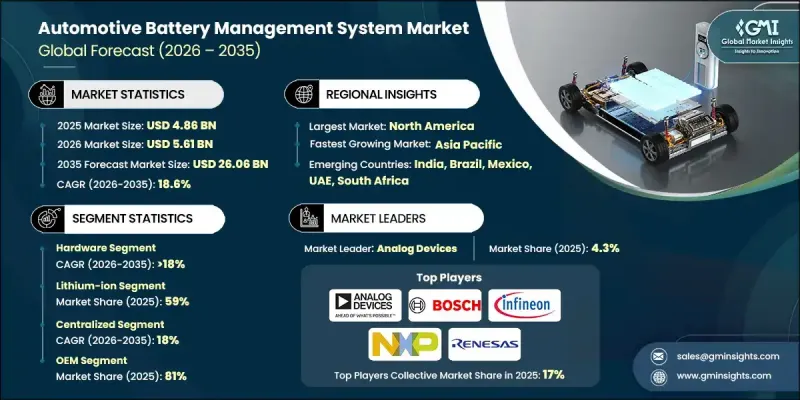
电动车的快速普及直接推高了对先进电池监控解决方案的需求。随着电动出行的扩展,高效的电池监控对于确保安全性、性能和长期可靠性至关重要。製造商和终端用户对能源优化和永续性的日益重视,正在加速智慧电池管理技术的应用。全球为减少碳排放和实现长期气候目标所做的努力,进一步强化了这个趋势。各国政府优先发展电气化交通和清洁能源系统,旨在减少温室气体排放的公共正在推动电动车相关技术(包括电池和能源储存系统)的投资。支持性的法规结构和国家清洁能源计画持续推动乘用车和商用车大规模采用电池管理系统,从而促进全球市场成长。
| 市场覆盖范围 | |
|---|---|
| 开始年份 | 2025 |
| 预测年份 | 2026-2035 |
| 起始值 | 48.6亿美元 |
| 预测金额 | 260.6亿美元 |
| 复合年增长率 | 18.6% |
预计到 2025 年,硬体部分将占市场份额的 78%,到 2035 年将以 18% 的复合年增长率增长。随着电池容量和能量密度在更严格的安全标准下不断提高,对精确电池控制、安全保障和性能监控的需求将推动对硬体的持续强劲需求。
预计到 2025 年,锂离子电池市占率将达到 59%,2026 年至 2035 年的复合年增长率将达到 19.1%。其主导地位得益于其卓越的性能特性以及在电动出行平台上的日益普及,这直接增加了对可靠电池管理解决方案的需求。
预计到 2025 年,美国汽车电池管理系统市场规模将达到 14.7 亿美元。市场成长的驱动因素包括电动车普及率的提高、安全要求的加强以及对乘用车和商用车先进监控、优化和能源效率技术投资的增加。
目录
第一章调查方法
第二章执行摘要
第三章业界考察
- 生态系分析
- 供应商情况
- 利润率
- 成本结构
- 每个阶段的附加价值
- 影响价值链的因素
- 中断
- 产业影响因素
- 司机
- 电动车日益普及,正在推动需求成长。
- 人们越来越关注能源效率和永续性。
- 政府法规促进清洁能源技术
- 电池技术和储能技术的进步
- 产业潜在风险与挑战
- 先进电池管理系统技术高昂的研发成本
- 与现有车辆架构的复杂集成
- 市场机会
- 电动车(EV)市场的扩张
- 先进技术的融合
- 扩大商用车的电气化程度
- 售后电池管理与改装
- 司机
- 成长潜力分析
- 监管环境
- 北美洲
- 美国环保署(EPA)
- 加拿大电动车标准
- 欧洲
- 欧盟一般安全规则(EU)
- 英国零排放车辆强制令
- 德国车辆认证/KBA型式认证
- 法国的奖金恶意制度
- 义大利国家电动车补助计画
- 亚太地区
- 工信部平行管理条例
- GB/T标准
- 印度阶段排放气体法规
- 日本型式认证/联合国欧洲经济委员会采纳
- ADR - 澳洲设计规则
- 拉丁美洲
- NOM-194-SCFI
- CONTRAN 规章
- 阿根廷车辆法规/法规框架
- 中东和非洲
- ESMA/阿联酋合格评定计划 (ECAS)
- SASO技术规则
- 北美洲
- 波特五力分析
- PESTEL 分析
- 科技与创新趋势
- 当前技术趋势
- 新兴技术
- 定价分析
- 副产品
- 按地区
- 生产统计
- 生产基地
- 消费基础
- 出口和进口
- 成本細項分析
- 总拥有成本 (TCO) 框架
- 按技术类型分類的总拥有成本
- 零件单价分析
- 积层製造与传统製造成本比较
- 专利分析
- 永续性和环境方面
- 永续实践
- 减少废弃物策略
- 生产中的能源效率
- 环保倡议
- 碳足迹考量
- 绘製关键用例和汽车平臺
- 按车辆类别分類的电池管理系统 (BMS) 需求
- 乘用车和商用车的区别
- 高效能平台与生产平台
- 按用例分類的设计权衡
- 电池管理系统标准化与平台策略
- 基于平台的楼宇管理系统发展趋势
- 跨车辆细分市场的可重复使用性
- 跨电压等级的扩充性
- 对OEM产品系列的影响
- 电池化学性质和电池管理系统相容性分析
- 以电池化学成分分類的BMS要求
- 电压、热和平衡控制的影响
- 安全性与效能之间的权衡
- 对OEM设计的影响
第四章 竞争情势
- 介绍
- 公司市占率分析
- 北美洲
- 欧洲
- 亚太地区
- 拉丁美洲
- 中东和非洲
- 主要市场公司的竞争分析
- 竞争定位矩阵
- 战略展望矩阵
- 重大进展
- 併购
- 伙伴关係与合作
- 新产品发布
- 企业扩张计画和资金筹措
第五章 按组件分類的市场估算与预测,2022-2035年
- 硬体
- 电池积体电路
- 电池感应器
- 其他的
- 软体
第六章 依电池类型分類的市场估计与预测,2022-2035年
- 锂离子电池
- 铅酸电池
- 镍基
- 其他的
7. 按拓朴结构分類的市场估算与预测,2022-2035 年
- 集中
- 模组化的
- 去中心化
第八章 按车辆类型分類的市场估算与预测,2022-2035年
- 搭乘用车
- 掀背车
- 轿车
- SUV
- 商用车辆
- 轻型商用车
- 中型商用车(MCV)
- 重型商用车(HCV)
第九章 按应用领域分類的市场估算与预测,2022-2035年
- 电池监控
- 电池保护
- 电池优化
第十章 依销售管道分類的市场估计与预测,2022-2035年
- OEM
- 售后市场
第十一章 2022-2035年各地区市场估计与预测
- 北美洲
- 美国
- 加拿大
- 欧洲
- 德国
- 英国
- 法国
- 义大利
- 西班牙
- 北欧国家
- 俄罗斯
- 波兰
- 罗马尼亚
- 亚太地区
- 中国
- 印度
- 日本
- 韩国
- ANZ
- 越南
- 印尼
- 拉丁美洲
- 巴西
- 墨西哥
- 阿根廷
- 中东和非洲
- 南非
- 沙乌地阿拉伯
- 阿拉伯聯合大公国
第十二章:公司简介
- 世界公司
- Analog Devices
- Bosch
- CATL
- Continental
- Infineon Technologies
- LG Chem
- NXP
- Panasonic
- STMicroelectronics
- Texas Instruments
- Toshiba
- 本地公司
- Eberspaecher Vecture
- Johnson Matthey
- Leclanche
- LEM International
- Midtronics
- Munich Electrification
- Navitas Systems
- Nuvation Engineering
- Renesas Electronics
- Sensata Technologies
- 新兴企业
- Elithion
- Ewert Energy Systems
- Exponential Power
- KPM Power
- Pulsetrain
The Global Automotive Battery Management System Market was valued at USD 4.86 billion in 2025 and is estimated to grow at a CAGR of 18.6% to reach USD 26.06 billion by 2035.
Rapid growth in electric vehicle adoption is directly increasing demand for advanced battery monitoring and control solutions. As electric mobility expands, efficient battery oversight becomes critical to ensure safety, performance, and long-term reliability. Both manufacturers and end users are placing greater emphasis on energy optimization and sustainability, which is accelerating the deployment of intelligent battery management technologies. Global efforts to reduce carbon emissions and meet long-term climate targets are further strengthening this trend, as governments prioritize electrified transportation and cleaner energy systems. Public policies aimed at reducing greenhouse gas output are driving investments in EV-related technologies, including batteries and energy storage systems. Supportive regulatory frameworks and national clean energy programs continue to encourage large-scale deployment of battery management systems across passenger and commercial vehicles, reinforcing market growth worldwide.
| Market Scope | |
|---|---|
| Start Year | 2025 |
| Forecast Year | 2026-2035 |
| Start Value | $4.86 Billion |
| Forecast Value | $26.06 Billion |
| CAGR | 18.6% |
The hardware segment accounted for 78% share in 2025 and is forecast to grow at a CAGR of 18% through 2035. Hardware demand remains strong due to the need for precise battery control, safety assurance, and performance monitoring as battery capacity and energy density continue to rise under stricter safety standards.
The lithium-ion batteries segment held 59% share in 2025 and is expected to grow at a CAGR of 19.1% between 2026 and 2035. Their dominance is supported by favorable performance characteristics and growing use across electric mobility platforms, which directly increases demand for reliable battery management solutions.
U.S. Automotive Battery Management System Market reached USD 1.47 billion in 2025. Market growth is supported by rising EV availability, tighter safety requirements, and increasing investments in advanced monitoring, optimization, and energy efficiency technologies across passenger vehicles and commercial fleets.
Key companies operating in the Global Automotive Battery Management System Market include Bosch, Renesas Electronics, Analog Devices, Toshiba, Continental, NXP, Infineon, LG Chem, Midtronics, and Johnson Matthey. Companies in the Automotive Battery Management System Market focus on innovation-driven growth to strengthen their market position. Leading players invest heavily in research and development to enhance system accuracy, safety features, and real-time monitoring capabilities. Strategic partnerships with automakers and battery manufacturers help align solutions with next-generation vehicle platforms. Firms also emphasize scalable production and cost optimization to remain competitive as EV volumes rise. Geographic expansion and localized manufacturing are used to improve supply chain efficiency and meet regional regulations. In addition, companies integrate software intelligence with hardware solutions to deliver predictive diagnostics and performance optimization.
Table of Contents
Chapter 1 Methodology
- 1.1 Market scope and definition
- 1.2 Research design
- 1.2.1 Research approach
- 1.2.2 Data collection methods
- 1.3 Data mining sources
- 1.3.1 Global
- 1.3.2 Regional/Country
- 1.4 Base estimates and calculations
- 1.4.1 Base year calculation
- 1.4.2 Key trends for market estimation
- 1.5 Primary research and validation
- 1.5.1 Primary sources
- 1.6 Forecast model
- 1.7 Research assumptions and limitations
Chapter 2 Executive Summary
- 2.1 Industry 360° synopsis
- 2.2 Key market trends
- 2.2.1 Regional
- 2.2.2 Component
- 2.2.3 Battery
- 2.2.4 Topology
- 2.2.5 Vehicle
- 2.2.6 Application
- 2.2.7 Sales channel
- 2.3 TAM analysis, 2026-2035
- 2.4 CXO perspectives: Strategic imperatives
- 2.4.1 Executive decision points
- 2.4.2 Critical success factors
- 2.5 Future outlook
- 2.6 Strategic recommendations
Chapter 3 Industry Insights
- 3.1 Industry ecosystem analysis
- 3.1.1 Supplier landscape
- 3.1.2 Profit margin
- 3.1.3 Cost structure
- 3.1.4 Value addition at each stage
- 3.1.5 Factor affecting the value chain
- 3.1.6 Disruptions
- 3.2 Industry impact forces
- 3.2.1 Growth drivers
- 3.2.1.1 Increasing electric vehicle (EV) adoption driving demand
- 3.2.1.2 Rising focus on energy efficiency and sustainability
- 3.2.1.3 Government regulations promoting clean energy technologies
- 3.2.1.4 Advancements in battery technologies and energy storage
- 3.2.2 Industry pitfalls and challenges
- 3.2.2.1 High development costs for advanced BMS technologies
- 3.2.2.2 Complex integration with existing vehicle architecture
- 3.2.3 Market opportunities
- 3.2.3.1 Expansion of electric vehicle (EV) market
- 3.2.3.2 Integration of advanced technologies
- 3.2.3.3 Growth in commercial vehicle electrification
- 3.2.3.4 Aftermarket battery management and retrofitting
- 3.2.1 Growth drivers
- 3.3 Growth potential analysis
- 3.4 Regulatory landscape
- 3.4.1 North America
- 3.4.1.1 EPA - U.S. Environmental Protection Agency
- 3.4.1.2 Canada’s Electric Vehicle Availability Standard
- 3.4.2 Europe
- 3.4.2.1 EU General Safety Regulation (EU)
- 3.4.2.2 UK ZEV Mandate (UK)
- 3.4.2.3 German Fahrzeugzulassung / KBA Type Approval
- 3.4.2.4 France Bonus-Malus System
- 3.4.2.5 Italy National EV Incentive Framework
- 3.4.3 Asia Pacific
- 3.4.3.1 MIIT Parallel Management Regulation
- 3.4.3.2 GB/T Standards
- 3.4.3.3 Bharat Stage Emission Standards
- 3.4.3.4 Japan Type Approval / UN-ECE Adoption
- 3.4.3.5 ADR - Australian Design Rules
- 3.4.4 Latin America
- 3.4.4.1 NOM-194-SCFI
- 3.4.4.2 CONTRAN Regulations
- 3.4.4.3 Argentina Vehicle Regulations / Decree Framework
- 3.4.5 Middle East & Africa
- 3.4.5.1 ESMA / Emirates Conformity Assessment Scheme (ECAS)
- 3.4.5.2 SASO Technical Regulations
- 3.4.1 North America
- 3.5 Porter's analysis
- 3.6 PESTEL analysis
- 3.7 Technology and innovation landscape
- 3.7.1 Current technological trends
- 3.7.2 Emerging technologies
- 3.8 Pricing analysis
- 3.8.1 By product
- 3.8.2 By region
- 3.9 Production statistics
- 3.9.1 Production hubs
- 3.9.2 Consumption hubs
- 3.9.3 Export and import
- 3.10 Cost breakdown analysis
- 3.10.1 Total cost of ownership (TCO) framework
- 3.10.2 TCO by technology type
- 3.10.3 Cost-per-part analysis
- 3.10.4 AM vs. traditional manufacturing cost comparison
- 3.11 Patent analysis
- 3.12 Sustainability and environmental aspects
- 3.12.1 Sustainable practices
- 3.12.2 Waste reduction strategies
- 3.12.3 Energy efficiency in production
- 3.12.4 Eco-friendly initiatives
- 3.12.5 Carbon footprint considerations
- 3.13 Key Use-Case & Vehicle Platform Mapping
- 3.13.1 BMS requirements by vehicle class
- 3.13.2 Passenger vs commercial vehicle differences
- 3.13.3 High-performance vs mass-market platforms
- 3.13.4 Design trade-offs by use case
- 3.14 BMS Standardization & Platform Strategy
- 3.14.1 Platform-based BMS development trends
- 3.14.2 Reusability across vehicle segments
- 3.14.3 Scalability across voltage classes
- 3.14.4 Impact on OEM product portfolio
- 3.15 Battery Chemistry-BMS Compatibility Analysis
- 3.15.1 BMS requirements by battery chemistry
- 3.15.2 Voltage, thermal, and balancing implications
- 3.15.3 Safety and performance trade-offs
- 3.15.4 OEM design implications
Chapter 4 Competitive Landscape, 2025
- 4.1 Introduction
- 4.2 Company market share analysis
- 4.2.1 North America
- 4.2.2 Europe
- 4.2.3 Asia Pacific
- 4.2.4 LATAM
- 4.2.5 MEA
- 4.3 Competitive analysis of major market players
- 4.4 Competitive positioning matrix
- 4.5 Strategic outlook matrix
- 4.6 Key developments
- 4.6.1 Mergers & acquisitions
- 4.6.2 Partnerships & collaborations
- 4.6.3 New product launches
- 4.6.4 Expansion plans and funding
Chapter 5 Market Estimates & Forecast, By Component, 2022 - 2035 ($Mn, Units)
- 5.1 Key trends
- 5.2 Hardware
- 5.2.1 Battery IC
- 5.2.2 Battery sensors
- 5.2.3 Others
- 5.3 Software
Chapter 6 Market Estimates & Forecast, By Battery, 2022 - 2035 ($Mn, Units)
- 6.1 Key trends
- 6.2 Lithium-ion
- 6.3 Lead-acid
- 6.4 Nickel-based
- 6.5 Others
Chapter 7 Market Estimates & Forecast, By Topology, 2022 - 2035 ($Mn, Units)
- 7.1 Key trends
- 7.2 Centralized
- 7.3 Modular
- 7.4 Distributed
Chapter 8 Market Estimates & Forecast, By Vehicle, 2022 - 2035 ($Mn, Units)
- 8.1 Key trends
- 8.2 Passenger cars
- 8.2.1 Hatchback
- 8.2.2 Sedan
- 8.2.3 SUV
- 8.3 Commercial vehicles
- 8.3.1 LCV (Light commercial vehicle)
- 8.3.2 MCV (Medium commercial vehicle)
- 8.3.3 HCV (Heavy commercial vehicle)
Chapter 9 Market Estimates & Forecast, By Application, 2022 - 2035 ($Mn, Units)
- 9.1 Key trends
- 9.2 Battery monitoring
- 9.3 Battery protection
- 9.4 Battery optimization
Chapter 10 Market Estimates & Forecast, By Sales channel, 2022 - 2035 ($Mn, Units)
- 10.1 Key trends
- 10.2 OEM
- 10.3 Aftermarket
Chapter 11 Market Estimates & Forecast, By Region, 2022 - 2035 ($Mn, Units)
- 11.1 Key trends
- 11.2 North America
- 11.2.1 US
- 11.2.2 Canada
- 11.3 Europe
- 11.3.1 Germany
- 11.3.2 UK
- 11.3.3 France
- 11.3.4 Italy
- 11.3.5 Spain
- 11.3.6 Nordics
- 11.3.7 Russia
- 11.3.8 Poland
- 11.3.9 Romania
- 11.4 Asia Pacific
- 11.4.1 China
- 11.4.2 India
- 11.4.3 Japan
- 11.4.4 South Korea
- 11.4.5 ANZ
- 11.4.6 Vietnam
- 11.4.7 Indonesia
- 11.5 Latin America
- 11.5.1 Brazil
- 11.5.2 Mexico
- 11.5.3 Argentina
- 11.6 MEA
- 11.6.1 South Africa
- 11.6.2 Saudi Arabia
- 11.6.3 UAE
Chapter 12 Company Profiles
- 12.1 Global companies
- 12.1.1 Analog Devices
- 12.1.2 Bosch
- 12.1.3 CATL
- 12.1.4 Continental
- 12.1.5 Infineon Technologies
- 12.1.6 LG Chem
- 12.1.7 NXP
- 12.1.8 Panasonic
- 12.1.9 STMicroelectronics
- 12.1.10 Texas Instruments
- 12.1.11 Toshiba
- 12.2 Regional players
- 12.2.1 Eberspaecher Vecture
- 12.2.2 Johnson Matthey
- 12.2.3 Leclanche
- 12.2.4 LEM International
- 12.2.5 Midtronics
- 12.2.6 Munich Electrification
- 12.2.7 Navitas Systems
- 12.2.8 Nuvation Engineering
- 12.2.9 Renesas Electronics
- 12.2.10 Sensata Technologies
- 12.3 Emerging players
- 12.3.1 Elithion
- 12.3.2 Ewert Energy Systems
- 12.3.3 Exponential Power
- 12.3.4 KPM Power
- 12.3.5 Pulsetrain

 2026年全球汽车电池管理系统市场报告
 汽车电池管理系统市场:按组件、电池化学成分、系统结构、销售管道和车辆类型划分-2026-2032年全球预测汽车级BMS AFE市场:按车辆类型、电池类型、通道数、应用和最终用户划分-2026-2032年全球预测
 日本动态负载管理系统市场规模、份额、趋势及预测(按组件、应用、技术、部署类型、最终用户和地区划分),2026-2034年
 摩托车电池管理系统市场 - 全球产业规模、份额、趋势、机会及预测(按电池类型、车辆类型、类型、地区和竞争格局划分),2021-2031年BMS AFE晶片市场按电池化学成分、均衡方式、技术、应用、终端用户产业和分销管道划分,全球预测,2026-2032年依技术类型、通路、额定电压和应用分類的烟火电池断开装置市场-2026年至2032年全球预测工业级BMS AFE市场依产品类型、电池化学成分、拓朴结构、终端用户产业及销售管道,全球预测,2026-2032年汽车烟火式电池断开装置市场(按组件、车辆类型、电池电压、分销管道、应用和最终用户划分)-2026-2032年全球预测
 汽车电池管理系统市场规模、份额和成长分析(按产品类型、容量、应用和地区划分)-产业预测,2026-2033年