


 |
市场调查报告书
商品编码
1913453
自行车滚筒煞车市场机会、成长要素、产业趋势分析及预测(2026年至2035年)Bicycle Roller Brake Market Opportunity, Growth Drivers, Industry Trend Analysis, and Forecast 2026 - 2035 |
||||||

2025 年全球自行车滚筒煞车市场价值 66 亿美元,预计到 2035 年将达到 127 亿美元,年复合成长率为 7%。
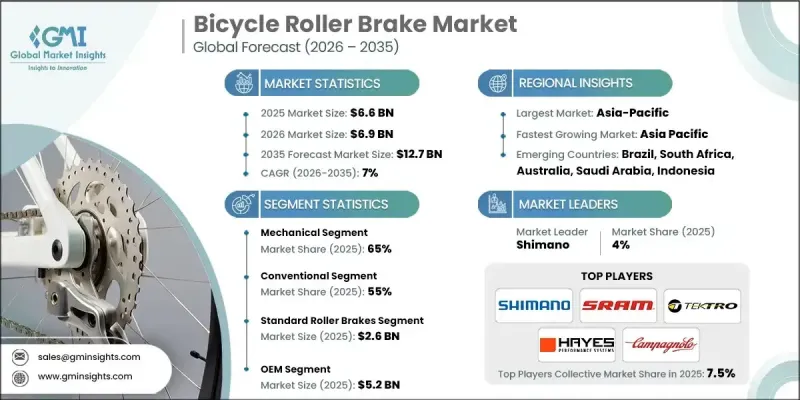
报告指出,由于骑乘者期望的改变、煞车技术的稳定发展以及城市交通行为的长期变化,市场正在经历重大变革时期。这些因素正在重塑竞争格局,并为那些能够快速回应不断变化的客户需求的品牌开闢新的收入来源。滚筒煞车被定位为一种密封煞车解决方案,旨在实现稳定的性能和长久的使用寿命,因此在都市区和实际骑乘环境中尤其受欢迎,因为在这些环境中,可靠性在各种天气条件下都至关重要。报告强调,对低维护自行车的需求不断增长是推动市场需求的主要因素,尤其是在寻求无需技术维护的可靠交通途径的城市通勤者中。市场趋势表明,整合式、低维护自行车平台的日益普及正在促进其普及。此外,报告指出,大规模共享旅游营运商越来越倾向于使用耐用的煞车系统来减少停机时间,这进一步加速了滚筒煞车的普及。总体而言,用户群优先考虑便利性、耐用性和易于拥有,这使得滚筒煞车成为成熟、高使用率自行车市场中的实用解决方案。
| 市场覆盖范围 | |
|---|---|
| 开始年份 | 2025 |
| 预测年份 | 2026-2035 |
| 起始值 | 66亿美元 |
| 预测金额 | 127亿美元 |
| 复合年增长率 | 7% |
预计到2025年,机械式煞车将占据65%的市场份额,并在2026年至2035年间以6%的复合年增长率成长。机械式滚筒煞车是一种钢索驱动系统,可在提供可靠煞车力道的同时保持成本效益。这些解决方案基于成熟的机械槓桿原理,确保长期稳定的性能。该细分市场受益于广泛的标准部件相容性、成熟的分销网络和简化的维护流程。此外,无需专用设备即可进行诊断和维修的特性也有助于其在全球市场中保持较高的渗透率。
预计到2025年,传统自行车市占率将达到55%,并在2035年之前以6.3%的复合年增长率成长。这一主导地位主要归功于自行车作为日常交通工具的高销量。这些产品定位为经济实惠的交通选择,而稳定的煞车性能至关重要。鑑于传统自行车设计创新空间有限,製造商正日益依赖滚筒煞车系统来提升现有产品的耐用性和吸引力。
预计到2025年,亚太地区自行车滚筒煞车市场规模将达21亿美元。该地区的主导地位归功于其完善的製造业基础设施和大规模的自行车用户层。中国、日本和印度是产能和消费需求的主要贡献者。中国是公认的主要製造地,约占全球自行车产量的68%。中国年产量达4,600万套,相当于每月约130万套,已成为滚筒煞车系统最大的消费国和供应国。
目录
第一章调查方法和范围
第二章执行摘要
第三章业界考察
- 生态系分析
- 供应商情况
- 零件製造商
- 煞车製造商和整合商
- 自行车製造商
- 售后市场通路
- 最终用户和服务网络
- 成本结构
- 利润率
- 每个阶段的附加价值
- 垂直整合趋势
- 颠覆者
- 供应商情况
- 影响因素
- 司机
- 都市化与通勤自行车的成长
- 电动式自行车和实用自行车的扩张
- 安全性和可靠性是轮圈煞车的首要考虑因素。
- 城市/舒适型自行车领域的OEM整合
- 产业潜在风险与挑战
- 采用碟煞的比赛
- 在陡坡上或高速行驶时出现过热问题
- 市场机会
- 低维护成本自行车平台的成长
- 与内部移位轮毂集成
- 共享单车的新需求趋势
- 产品改进(散热和调製性能)
- 司机
- 技术趋势与创新生态系统
- 目前技术
- 新兴技术
- 成长潜力分析
- 监管环境
- 北美洲
- 美国消费品安全委员会(CPSC)标准
- ASTM国际标准(F2043、F1898)
- 加拿大自行车安全法规
- 欧洲
- EN 15194(电动自行车标准)
- 欧洲的脚踏式自行车法规
- 低排放气体/城市交通政策
- 亚太地区
- 中国自行车和电动式自行车国家标准(GB)
- 印度汽车工业标准(AIS 052 电动自行车标准)
- 日本JIS标准
- 东协自行车标准
- 拉丁美洲
- 巴西ABNT NBR标准
- 阿根廷INTA/IRAM标准
- 墨西哥NOM标准
- 中东和非洲
- 阿联酋GSO/ESMA自行车法规
- 沙乌地阿拉伯 SASO 自行车标准
- 南非SABS自行车安全法规
- 北美洲
- 波特五力分析
- PESTEL 分析
- 成本細項分析
- 价格趋势
- 按地区
- 副产品
- 专利分析
- 生产统计
- 生产基地
- 消费中心
- 出口和进口
- 永续性和环境方面
- 永续实践
- 减少废弃物策略
- 製造业的能源效率
- 环保倡议
- 碳足迹考量
- 技术比较:滚筒煞车及其他技术
- 滚筒煞车与轮圈煞车
- 滚筒煞车与机械式碟式煞车的比较
- 滚筒煞车与液压碟式煞车的比较
- 效能、成本、可维护性和安全性之间的权衡
- OEM规格和采用策略
- 自行车类中滚筒煞车的采用情况
- 入门级和中阶车型的OEM定位
- 按地区分類的OEM偏好模式
- 兼顾成本和耐用性的设计之间的权衡
- 系统相容性和整合性考虑因素
- 售后市场需求趋势
第四章 竞争情势
- 介绍
- 公司市占率分析
- 北美洲
- 欧洲
- 亚太地区
- 拉丁美洲
- 中东和非洲
- 竞争定位矩阵
- 战略展望矩阵
- 重大进展
- 併购
- 伙伴关係与合作
- 新产品发布
- 企业扩张计画和资金筹措
第五章 2022-2035年按产品分類的市场估算与预测
- 标准滚筒煞车
- 高性能滚筒煞车
- 整合式轮毂齿轮滚轮煞车器
- 脚煞车
第六章 2022-2035年各细分市场的估计与预测
- 机械的
- 油压
第七章 自行车市场估算与预测,2022-2035年
- 传统的
- 电动自行车
第八章 按应用领域分類的市场估算与预测,2022-2035年
- 城市/都市自行车
- 山地自行车
- 赛车自行车
- 油电混合自行车
第九章 依销售管道分類的市场估计与预测,2022-2035年
- OEM
- 售后市场
第十章 2022-2035年各地区市场估计与预测
- 北美洲
- 美国
- 加拿大
- 欧洲
- 英国
- 德国
- 法国
- 义大利
- 西班牙
- 比利时
- 荷兰
- 瑞典
- 俄罗斯
- 亚太地区
- 中国
- 印度
- 日本
- 澳洲
- 新加坡
- 韩国
- 越南
- 印尼
- 拉丁美洲
- 巴西
- 墨西哥
- 阿根廷
- 中东和非洲
- 南非
- 沙乌地阿拉伯
- 阿拉伯聯合大公国
第十一章:公司简介
- 世界公司
- Campagnolo
- Hayes Performance Systems
- Magura
- Promax Components
- Shimano
- SRAM
- SunRace Sturmey-Archer
- Tektro Technology
- Region players
- Alhonga
- Avid
- Cane Creek
- Clarks Cycle Systems
- Dia-Compe
- Hope Technology
- Jagwire
- KCNC
- Paul Component Engineering
- 新兴製造商
- TRP Cycling Components
- Weinmann
- XLC Components
The Global Bicycle Roller Brake Market was valued at USD 6.6 billion in 2025 and is estimated to grow at a CAGR of 7% to reach USD 12.7 billion by 2035.
The market is described as undergoing notable transformation due to shifting rider expectations, steady advancements in braking technologies, and long-term changes in urban transportation behavior. It is explained that these forces are redefining competition and opening new revenue pathways for brands that respond quickly to evolving customer needs. Roller brakes are identified as enclosed braking solutions designed for consistent performance and long service life, particularly valued in urban and utility cycling environments where reliability in varied weather conditions is essential. It is emphasized that the rising preference for bicycles requiring minimal servicing has significantly supported demand, especially among city commuters seeking dependable transportation without technical upkeep. The market narrative highlights that the growing presence of integrated, low-maintenance bicycle platforms has contributed to increased adoption. It is further stated that large-scale shared mobility operators increasingly favor durable braking systems to limit downtime, which has accelerated acceptance. Overall, demand is said to be shaped by users prioritizing convenience, longevity, and ease of ownership, positioning roller brakes as a practical solution in mature and high-usage cycling markets.
| Market Scope | |
|---|---|
| Start Year | 2025 |
| Forecast Year | 2026-2035 |
| Start Value | $6.6 Billion |
| Forecast Value | $12.7 Billion |
| CAGR | 7% |
The mechanical segment accounted for 65% share in 2025 and is forecast to grow at a CAGR of 6% from 2026 to 2035. Mechanical roller brakes are described as cable-actuated systems that deliver dependable stopping power while remaining cost-efficient. These solutions are said to rely on established mechanical leverage principles that ensure stable performance over long periods. The segment benefits from widespread compatibility with standard components, mature distribution networks, and straightforward maintenance processes. It is further noted that the ability to diagnose and service these systems without specialized equipment continues to support their strong adoption across global markets.
The conventional bicycle segment held a 55% share in 2025 and is projected to grow at a CAGR of 6.3% through 2035. This dominance is attributed to high sales volumes associated with everyday transportation bicycles. It is explained that these products are positioned as affordable mobility options where consistent braking performance is essential. Manufacturers are said to increasingly rely on roller brake systems to enhance durability and product appeal within established categories, particularly as innovation opportunities remain limited in traditional bicycle designs.
Asia-Pacific Bicycle Roller Brake Market generated USD 2.1 billion in 2025. The region's leadership is linked to its extensive manufacturing infrastructure and large cycling population. China, Japan, and India are referenced as major contributors to production capacity and consumer demand. China is identified as the primary manufacturing hub, accounting for nearly 68% of worldwide bicycle output. Annual production in the country is stated at 46 million units, equal to approximately 1,300,000 bicycles per month, positioning China as both the largest consumer and supplier of roller brake systems.
Key companies operating in the Bicycle Roller Brake Market include Shimano, SRAM, Tektro Technology, Campagnolo, Magura, Hayes Performance Systems, Promax Components, Clarks Cycle Systems, Alhonga, and Hope Technology (IPCO). Companies in the Bicycle Roller Brake Market are said to be strengthening their positions through a combination of product innovation, manufacturing optimization, and strategic partnerships. Leading players are focusing on improving durability, heat management, and system efficiency to meet evolving performance expectations. Many manufacturers are investing in automation and localized production to reduce costs and ensure consistent quality. Strategic collaborations with bicycle manufacturers and fleet operators are also emphasized as a key approach to securing long-term supply agreements. In addition, companies are expanding their presence in high-growth regions by strengthening distribution networks and offering tailored solutions aligned with regional riding.
Table of Contents
Chapter 1 Methodology & Scope
- 1.1 Market scope and definition
- 1.2 Research design
- 1.2.1 Research approach
- 1.2.2 Data collection methods
- 1.3 Data mining sources
- 1.3.1 Global
- 1.3.2 Regional/Country
- 1.4 Base estimates and calculations
- 1.4.1 Base year calculation
- 1.4.2 Key trends for market estimation
- 1.5 Primary research and validation
- 1.5.1 Primary sources
- 1.6 Forecast model
- 1.7 Research assumptions and limitations
Chapter 2 Executive Summary
- 2.1 Industry 360° synopsis
- 2.2 Key market trends
- 2.2.1 Regional
- 2.2.2 Product
- 2.2.3 Break
- 2.2.4 Bicycle
- 2.2.5 Application
- 2.2.6 Sales Channel
- 2.3 TAM Analysis, 2026-2035
- 2.4 CXO perspectives: Strategic imperatives
- 2.4.1 Key decision points for industry executives
- 2.4.2 Critical success factors for market players
- 2.5 Future outlook and strategic recommendations
Chapter 3 Industry Insights
- 3.1 Industry ecosystem analysis
- 3.1.1 Supplier landscape
- 3.1.1.1 Component manufacturers
- 3.1.1.2 Break manufacturers & integrators
- 3.1.1.3 Bicycle manufacturers
- 3.1.1.4 Aftermarket distribution channels
- 3.1.1.5 End-user & service networks
- 3.1.2 Cost structure
- 3.1.3 Profit margin
- 3.1.4 Value addition at each stage
- 3.1.5 Vertical integration trends
- 3.1.6 Disruptors
- 3.1.1 Supplier landscape
- 3.2 Impact on forces
- 3.2.1 Growth drivers
- 3.2.1.1 Urbanization & growth of commuter cycling
- 3.2.1.2 Expansion of e-bikes & utility bikes
- 3.2.1.3 Safety & reliability preference over rim brakes
- 3.2.1.4 OEM integration in city/comfort bicycle segments
- 3.2.2 Industry pitfalls & challenges
- 3.2.2.1 Competition from disc brakes
- 3.2.2.2 Heat buildup under steep/high-speed use
- 3.2.3 Market opportunities
- 3.2.3.1 Growth of low-maintenance bicycle platforms
- 3.2.3.2 Integration with internal gear hubs
- 3.2.3.3 Emerging demand in bike-sharing fleets
- 3.2.3.4 Product improvements (heat dissipation & modulation)
- 3.2.1 Growth drivers
- 3.3 Technology trends & innovation ecosystem
- 3.3.1 Current technologies
- 3.3.2 Emerging technologies
- 3.4 Growth potential analysis
- 3.5 Regulatory landscape
- 3.5.1 North America
- 3.5.1.1 U.S. Consumer Product Safety Commission (CPSC) standards
- 3.5.1.2 ASTM international standards (F2043, F1898)
- 3.5.1.3 Canada bicycle safety regulations
- 3.5.2 Europe
- 3.5.2.1 EN 15194 (E-Bike Standard)
- 3.5.2.2 European pedal-powered bicycle regulations
- 3.5.2.3 Low-Emission / Urban mobility policies
- 3.5.3 Asia-Pacific
- 3.5.3.1 China GB standards for bicycles and e-bikes
- 3.5.3.2 India Automotive Industry Standards (AIS 052 for E-Bikes)
- 3.5.3.3 Japan JIS standards
- 3.5.3.4 ASEAN bicycle standards
- 3.5.4 Latin America
- 3.5.4.1 Brazil ABNT NBR standards
- 3.5.4.2 Argentina INTA / IRAM standards
- 3.5.4.3 Mexico NOM standards
- 3.5.5 Middle East & Africa
- 3.5.5.1 UAE GSO / ESMA bicycle regulations
- 3.5.5.2 Saudi Arabia SASO bicycle standards
- 3.5.5.3 South Africa SABS bicycle safety regulations
- 3.5.1 North America
- 3.6 Porter's analysis
- 3.7 PESTEL analysis
- 3.8 Cost breakdown analysis
- 3.9 Price trends
- 3.9.1 By region
- 3.9.2 By product
- 3.10 Patent analysis
- 3.11 Production statistics
- 3.11.1 Production hubs
- 3.11.2 Consumption hubs
- 3.11.3 Export and import
- 3.12 Sustainability and environmental aspects
- 3.12.1 Sustainable practices
- 3.12.2 Waste reduction strategies
- 3.12.3 Energy efficiency in production
- 3.12.4 Eco-friendly initiatives
- 3.12.5 Carbon footprint considerations
- 3.13 Technology benchmarking: roller brakes vs alternatives
- 3.13.1 Roller brakes vs rim brakes
- 3.13.2 Roller brakes vs mechanical disc brakes
- 3.13.3 Roller brakes vs hydraulic disc brakes
- 3.13.4 Performance, cost, maintenance & safety trade-offs
- 3.14 OEM specification & adoption strategy
- 3.14.1 Roller brake fitment by bicycle category
- 3.14.2 Entry-level vs mid-range OEM positioning
- 3.14.3 Regional OEM preference patterns
- 3.14.4 Design-for-cost vs design-for-durability trade-offs
- 3.15 System compatibility & integration considerations
- 3.16 Aftermarket demand dynamics
Chapter 4 Competitive Landscape, 2025
- 4.1 Introduction
- 4.2 Company market share analysis
- 4.2.1 North America
- 4.2.2 Europe
- 4.2.3 Asia-Pacific
- 4.2.4 Latin America
- 4.2.5 Middle East & Africa
- 4.3 Competitive positioning matrix
- 4.4 Strategic outlook matrix
- 4.5 Key developments
- 4.5.1 Mergers & acquisitions
- 4.5.2 Partnerships & collaborations
- 4.5.3 New product launches
- 4.5.4 Expansion plans and funding
Chapter 5 Market Estimates & Forecast, By Product, 2022 - 2035 ($Bn, Units)
- 5.1 Key trends
- 5.2 Standard roller brakes
- 5.3 High-performance roller brakes
- 5.4 Integrated hub-gear roller brakes
- 5.5 Coaster brakes
Chapter 6 Market Estimates & Forecast, By Break, 2022 - 2035 ($Bn, Units)
- 6.1 Key trends
- 6.2 Mechanical
- 6.3 Hydraulic
Chapter 7 Market Estimates & Forecast, By Bicycle, 2022 - 2035 ($Bn, Units)
- 7.1 Key trends
- 7.2 Conventional
- 7.3 E-bike
Chapter 8 Market Estimates & Forecast, By Application, 2022 - 2035 ($Bn, Units)
- 8.1 Key trends
- 8.2 City/Urban bicycles
- 8.3 Mountain bicycles
- 8.4 Racing bicycles
- 8.5 Hybrid bicycles
Chapter 9 Market Estimates & Forecast, By Sales Channel, 2022 - 2035 ($Bn, Units)
- 9.1 Key trends
- 9.2 OEM
- 9.3 Aftermarket
Chapter 10 Market Estimates & Forecast, By Region, 2022 - 2035 ($Bn, Units)
- 10.1 North America
- 10.1.1 US
- 10.1.2 Canada
- 10.2 Europe
- 10.2.1 UK
- 10.2.2 Germany
- 10.2.3 France
- 10.2.4 Italy
- 10.2.5 Spain
- 10.2.6 Belgium
- 10.2.7 Netherlands
- 10.2.8 Sweden
- 10.2.9 Russia
- 10.3 Asia Pacific
- 10.3.1 China
- 10.3.2 India
- 10.3.3 Japan
- 10.3.4 Australia
- 10.3.5 Singapore
- 10.3.6 South Korea
- 10.3.7 Vietnam
- 10.3.8 Indonesia
- 10.4 Latin America
- 10.4.1 Brazil
- 10.4.2 Mexico
- 10.4.3 Argentina
- 10.5 MEA
- 10.5.1 South Africa
- 10.5.2 Saudi Arabia
- 10.5.3 UAE
Chapter 11 Company Profiles
- 11.1 Global players
- 11.1.1 Campagnolo
- 11.1.2 Hayes Performance Systems
- 11.1.3 Magura
- 11.1.4 Promax Components
- 11.1.5 Shimano
- 11.1.6 SRAM
- 11.1.7 SunRace Sturmey-Archer
- 11.1.8 Tektro Technology
- 11.2 Region players
- 11.2.1 Alhonga
- 11.2.2 Avid
- 11.2.3 Cane Creek
- 11.2.4 Clarks Cycle Systems
- 11.2.5 Dia-Compe
- 11.2.6 Hope Technology
- 11.2.7 Jagwire
- 11.2.8 KCNC
- 11.2.9 Paul Component Engineering
- 11.3 Emerging players
- 11.3.1 TRP Cycling Components
- 11.3.2 Weinmann
- 11.3.3 XLC Components


