


 |
市场调查报告书
商品编码
1913456
医疗废弃物管理市场机会、成长要素、产业趋势分析及预测(2026年至2035年)Medical Waste Management Market Opportunity, Growth Drivers, Industry Trend Analysis, and Forecast 2026 - 2035 |
||||||

全球医疗废弃物管理市场预计到 2025 年将达到 167 亿美元,到 2035 年将达到 343 亿美元,年复合成长率为 7.5%。
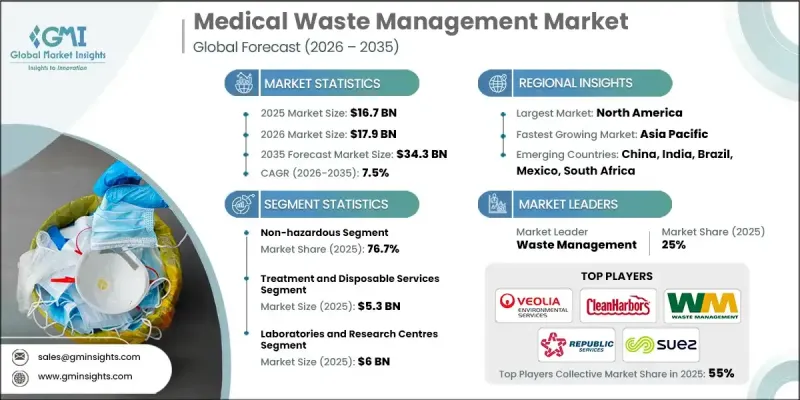
全球医疗基础设施(包括医院、诊所、实验室和研究中心)的快速扩张推动了这一增长,导致医疗废弃物产生量显着增加。人们对不当处置医疗废弃物所带来的健康和环境风险(包括感染疾病和抗药性微生物的传播)的认识不断提高,进一步推动了对高效废弃物管理解决方案的需求。随着监管机构日益严格地实施废弃物处置政策,医疗机构面临着采用扩充性、安全且对环境负责的处置方法的压力。全面的员工培训和教育计画对于确保医疗废弃物的正确收集、分类和处置至关重要,这为废弃物管理服务提供者拓展业务和提高合规性创造了重要机会。
| 市场覆盖范围 | |
|---|---|
| 开始年份 | 2025 |
| 预测年份 | 2026-2035 |
| 起始值 | 167亿美元 |
| 预测金额 | 343亿美元 |
| 复合年增长率 | 7.5% |
到2025年,非危险废弃物占比将达到76.7%。医疗设施的扩张,尤其是在都市区和发展中地区,正在推动非感染性废弃物的产生。有效管理这类废弃物有助于优化资源配置和最大限度地降低处置成本,从而降低营运成本。
2025 年,处理和处置服务部门创造了 53 亿美元的收入。这些服务专注于安全收集、处理和再利用医疗废弃物,包括塑胶、金属和其他无害材料,旨在最大限度地减少对环境的影响,并将废弃物转化为可重复使用的资源和能源。
预计2025年北美医疗废弃物管理市场规模将达到67亿美元,到2035年将达到136亿美元,复合年增长率(CAGR)为7.4%。该地区拥有完善的医疗基础设施,医疗废弃物量不断增长,且废弃物处理法规严格,这些都是推动市场成长的主要因素。医院、诊断中心和製药企业是该地区先进处理和处置服务的主要驱动力。
目录
第一章调查方法和范围
第二章执行摘要
第三章业界考察
- 生态系分析
- 产业影响因素
- 司机
- 全球医疗废弃物的产生量正在增加。
- 有效率且对环境负责的废弃物管理正变得越来越重要
- 政府加大力度管理医疗废弃物
- 医疗产业的快速发展,尤其是在开发中国家
- 产业潜在风险与挑战
- 缺乏对医疗废弃物相关健康危害的认识
- 缺乏正确处置医疗废弃物的培训
- 市场机会
- 采用先进的废弃物处理技术
- 司机
- 成长潜力分析
- 监管环境
- 北美洲
- 欧洲
- 亚太地区
- 技术格局
- 未来市场趋势
- 波特五力分析
- PESTEL 分析
第四章 竞争情势
- 介绍
- 公司市占率分析
- 世界
- 北美洲
- 欧洲
- 企业矩阵分析
- 主要市场公司的竞争分析
- 竞争定位矩阵
- 重大进展
- 併购
- 伙伴关係与合作
- 新产品发布
- 扩张计划
第五章 依废弃物类型分類的市场估算与预测,2021-2034年
- 危险废弃物
- 一般废弃物
第六章 依服务分類的市场估计与预测,2021-2034年
- 收集、运输和仓储服务
- 处理和处置服务
- 焚化
- 高压釜处理
- 微波处理
- 其他处理和处置服务
- 回收服务
- 其他服务
7. 按废弃物来源分類的市场估算与预测,2021-2034 年
- 医院
- 实验室和研究中心
- 护理机构
- 其他废弃物来源
第八章 2021-2034年各地区市场估算与预测
- 北美洲
- 美国
- 加拿大
- 欧洲
- 德国
- 英国
- 法国
- 西班牙
- 义大利
- 荷兰
- 亚太地区
- 中国
- 日本
- 印度
- 澳洲
- 韩国
- 拉丁美洲
- 巴西
- 墨西哥
- 阿根廷
- 中东和非洲
- 南非
- 沙乌地阿拉伯
- 阿拉伯聯合大公国
第九章:公司简介
- Bertin Technologies
- BioMedical Waste Solutions
- Clean Harbors
- Daniels Sharpsmart
- Environmental Solutions Group
- Gamma Waste Systems
- GRP &Associates
- MedPro Disposal
- Republic Services
- Suez Recycling and Recovery
- Triumvirate Environmental
- US Ecology
- Veolia Environmental Services
- Waste Management
The Global Medical Waste Management Market was valued at USD 16.7 billion in 2025 and is estimated to grow at a CAGR of 7.5% to reach USD 34.3 billion by 2035.
The growth is driven by the rapid expansion of healthcare infrastructure worldwide, including hospitals, clinics, laboratories, and research centers, which has led to a substantial increase in medical waste generation. Rising awareness of health and environmental risks associated with improper disposal, such as the spread of infectious diseases and antimicrobial-resistant microorganisms, is further fueling demand for efficient waste management solutions. Regulatory authorities are increasingly implementing strict waste handling policies, prompting healthcare providers to adopt scalable, safe, and environmentally responsible practices. Comprehensive staff training and education programs are becoming essential in ensuring proper collection, segregation, and disposal of medical waste, creating significant opportunities for waste management service providers to expand their operations and improve compliance.
| Market Scope | |
|---|---|
| Start Year | 2025 |
| Forecast Year | 2026-2035 |
| Start Value | $16.7 Billion |
| Forecast Value | $34.3 Billion |
| CAGR | 7.5% |
In 2025, the non-hazardous segment held 76.7% share. The expansion of healthcare facilities, particularly in urban and developing areas, is driving the production of non-infectious waste. Effective management of this waste helps reduce operational costs by optimizing resource allocation and minimizing disposal expenses.
The treatment and disposal services segment generated USD 5.3 billion in 2025. These services focus on the safe collection, processing, and repurposing of medical waste, including plastics, metals, and other non-hazardous materials, aiming to minimize environmental impact and convert suitable waste into reusable resources or energy.
North America Medical Waste Management Market accounted for USD 6.7 billion in 2025 and is expected to reach USD 13.6 billion by 2035, growing at a CAGR of 7.4%. The region leads the market due to its extensive healthcare infrastructure, rising medical waste volumes, and strict regulations for waste disposal. Hospitals, diagnostic centers, and pharmaceutical facilities are significant drivers for advanced treatment and disposal services in the region.
Key players in the Global Medical Waste Management Market include Veolia Environmental Services, Clean Harbors, Waste Management, Republic Services, Bertin Technologies, BioMedical Waste Solutions, Daniels Sharpsmart, Environmental Solutions Group, Gamma Waste Systems, GRP & Associates, MedPro Disposal, Suez Recycling and Recovery, Triumvirate Environmental, and US Ecology. Companies in the Global Medical Waste Management Market are strengthening their market presence by expanding service networks, investing in state-of-the-art treatment technologies, and offering scalable solutions for diverse healthcare settings. Strategic partnerships with hospitals, laboratories, and research centers help secure long-term contracts and enhance brand recognition. Businesses are also focusing on sustainability by implementing recycling and energy recovery initiatives, which improve environmental credentials.
Table of Contents
Chapter 1 Methodology and Scope
- 1.1 Market scope and definitions
- 1.2 Research design
- 1.2.1 Research approach
- 1.2.2 Data collection methods
- 1.3 Base estimates and calculations
- 1.3.1 Base year calculation
- 1.3.2 Key trends for market estimation
- 1.4 Forecast model
- 1.5 Primary research and validation
- 1.5.1 Primary sources
- 1.5.2 Data mining sources
Chapter 2 Executive Summary
- 2.1 Industry 360° synopsis
- 2.2 Key market trends
- 2.2.1 Regional trends
- 2.2.2 Type of waste trends
- 2.2.3 Service trends
- 2.2.4 Waste generator trends
- 2.3 CXO perspectives: Strategic imperatives
- 2.3.1 Key decision points for industry executives
- 2.3.2 Critical success factors for market players
- 2.4 Future outlook and strategic recommendations
Chapter 3 Industry Insights
- 3.1 Industry ecosystem analysis
- 3.2 Industry impact forces
- 3.2.1 Growth drivers
- 3.2.1.1 Increasing volume of medical waste generated globally
- 3.2.1.2 Increasing importance for effective and eco-friendly waste management
- 3.2.1.3 Growing government initiatives for medical waste disposal
- 3.2.1.4 Surging healthcare industry especially in developing economies
- 3.2.2 Industry pitfalls and challenges
- 3.2.2.1 Lack of awareness regarding health hazards associated with medical waste
- 3.2.2.2 Lack of training for proper disposal of medical waste
- 3.2.3 Market opportunity
- 3.2.3.1 Adoption of advanced waste treatment technologies
- 3.2.1 Growth drivers
- 3.3 Growth potential analysis
- 3.4 Regulatory landscape
- 3.4.1 North America
- 3.4.2 Europe
- 3.4.3 Asia Pacific
- 3.5 Technological landscape
- 3.6 Future market trends
- 3.7 Porter's analysis
- 3.8 PESTEL analysis
Chapter 4 Competitive Landscape, 2024
- 4.1 Introduction
- 4.2 Company market share analysis
- 4.2.1 Global
- 4.2.2 North America
- 4.2.3 Europe
- 4.3 Company matrix analysis
- 4.4 Competitive analysis of major market players
- 4.5 Competitive positioning matrix
- 4.6 Key developments
- 4.6.1 Merger and acquisition
- 4.6.2 Partnership and collaboration
- 4.6.3 New product launches
- 4.6.4 Expansion plans
Chapter 5 Market Estimates and Forecast, By Type of Waste, 2021 - 2034 ($ Mn)
- 5.1 Key trends
- 5.2 Hazardous
- 5.3 Non-hazardous
Chapter 6 Market Estimates and Forecast, By Service, 2021 - 2034 ($ Mn)
- 6.1 Key trends
- 6.2 Collection, transportation and storage services
- 6.3 Treatment and disposable services
- 6.3.1 Incineration
- 6.3.2 Autoclaving
- 6.3.3 Microwaving
- 6.3.4 Other treatment and disposable services
- 6.4 Recycling services
- 6.5 Other services
Chapter 7 Market Estimates and Forecast, By Waste Generator, 2021 - 2034 ($ Mn)
- 7.1 Key trends
- 7.2 Hospitals
- 7.3 Laboratories and research centers
- 7.4 Nursing homes
- 7.5 Other waste generators
Chapter 8 Market Estimates and Forecast, By Region, 2021 - 2034 ($ Mn)
- 8.1 Key trends
- 8.2 North America
- 8.2.1 U.S.
- 8.2.2 Canada
- 8.3 Europe
- 8.3.1 Germany
- 8.3.2 UK
- 8.3.3 France
- 8.3.4 Spain
- 8.3.5 Italy
- 8.3.6 Netherlands
- 8.4 Asia Pacific
- 8.4.1 China
- 8.4.2 Japan
- 8.4.3 India
- 8.4.4 Australia
- 8.4.5 South Korea
- 8.5 Latin America
- 8.5.1 Brazil
- 8.5.2 Mexico
- 8.5.3 Argentina
- 8.6 Middle East and Africa
- 8.6.1 South Africa
- 8.6.2 Saudi Arabia
- 8.6.3 UAE
Chapter 9 Company Profiles
- 9.1 Bertin Technologies
- 9.2 BioMedical Waste Solutions
- 9.3 Clean Harbors
- 9.4 Daniels Sharpsmart
- 9.5 Environmental Solutions Group
- 9.6 Gamma Waste Systems
- 9.7 GRP & Associates
- 9.8 MedPro Disposal
- 9.9 Republic Services
- 9.10 Suez Recycling and Recovery
- 9.11 Triumvirate Environmental
- 9.12 US Ecology
- 9.13 Veolia Environmental Services
- 9.14 Waste Management

 医疗废弃物管理市场:依废弃物类型、处理方法、服务类型和最终用户划分-2026-2032年全球市场预测
 2026年全球医疗废弃物管理市场报告医疗废弃物收集箱市场:依产品类型、废弃物类型、材料、最终用户和分销管道划分-全球预测,2026-2032年
 全球医疗废弃物管理市场规模、份额、趋势和成长分析报告(2026-2034年)全球医药废弃物管理市场规模、份额、趋势和成长分析报告(2026-2034年)
 日本医疗废弃物管理市场规模、份额、趋势和预测:按处理设施、处理方法和地区划分,2026-2034年全球医用固化剂市场按类型、应用、最终用户和分销管道划分,2026-2032年预测全球医药废弃物容器市场(按废弃物类型、材料、容器类型、容器容量和最终用户划分)预测(2026-2032年)医疗危险废弃物处理服务市场(按废弃物类型、处理技术、服务模式、容器类型和最终用户划分)-全球预测,2026-2032年
 医疗废弃物管理市场规模、份额和成长分析(按服务、废弃物类型、处理设施、废弃物来源和地区划分)-2026-2033年产业预测