


 |
市场调查报告书
商品编码
1928862
月经疼痛缓解产品市场机会、成长要素、产业趋势分析及2026年至2035年预测Menstrual Pain Products Market Opportunity, Growth Drivers, Industry Trend Analysis, and Forecast 2026 - 2035 |
||||||

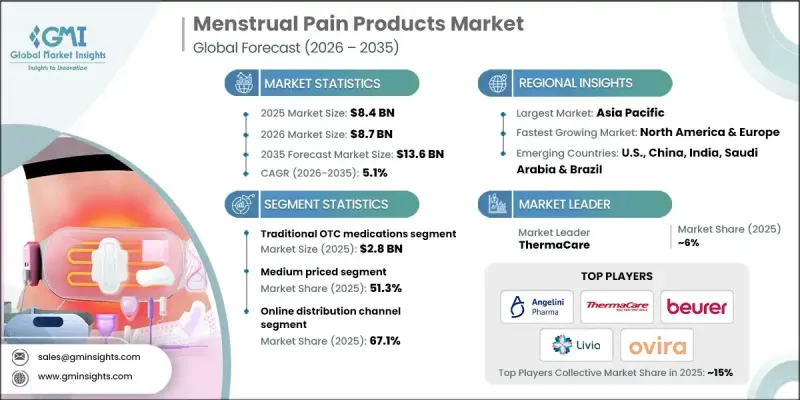
全球月经疼痛产品市场预计到 2025 年将达到 84 亿美元,到 2035 年将达到 136 亿美元,年复合成长率为 5.1%。
这一增长主要源于全球范围内越来越多的女性报告月经不适,以及围绕月经健康的广泛讨论、减少污名化和提高健康素养。女性在应对月经越来越有信心,也更愿意选择符合自身舒适度、安全性和长期健康目标的解决方案。对药物止痛长期副作用的担忧也促使消费者关注强调天然、非侵入性和个人化照护的替代方法。同时,永续性因素也在影响购买决策,环保和有机产品也越来越受到消费者的青睐。这些行为、医疗和环境因素的综合作用持续重塑市场需求模式,并支持已开发经济体和新兴经济体市场的持续成长。
| 市场覆盖范围 | |
|---|---|
| 开始年份 | 2025 |
| 预测年份 | 2026-2035 |
| 起始值 | 84亿美元 |
| 预测金额 | 136亿美元 |
| 复合年增长率 | 5.1% |
传统店面销售药市场预计到 2025 年将创造 28 亿美元的收入,从 2026 年到 2035 年将以 5.5% 的复合年增长率成长。这些产品之所以继续被广泛使用,是因为消费者对其高度信任、能够快速缓解疼痛、在零售店广泛销售,以及药局和量贩店通路中拥有值得信赖的品牌的悠久历史。
预计到2025年,线上销售将占总销售额的67.1%。数位平台透过提供便利性、丰富的选择、极具竞争力的价格以及订阅配送选项,彻底改变了消费者获取产品的方式。直销模式和个人化购物体验的兴起,进一步巩固了线上分销的主导地位。
美国月经疼痛缓解产品市场预计到 2025 年将达到 15 亿美元,从 2026 年到 2035 年将以 6.2% 的复合年增长率成长。人们对月经健康状况的高度关注、强大的购买力以及先进的医疗保健基础设施,持续推动创新非药物疼痛管理解决方案的普及。
目录
第一章调查方法和范围
第二章执行摘要
第三章业界考察
- 生态系分析
- 供应商情况
- 利润率
- 每个阶段的附加价值
- 影响价值链的因素
- 产业影响因素
- 司机
- 月经发生率不断上升,以及人们健康意识的增强
- 转向非药物和天然解决方案
- 有机和环保经期用品越来越受欢迎
- 产业潜在风险与挑战
- 发展中国家与月经及相关产品有关的社会议题
- 月经用品对环境的负面影响
- 机会
- 天然、草本、环保产品
- 个人化与数位健康整合
- 司机
- 成长潜力分析
- 未来市场趋势
- 科技与创新趋势
- 当前技术趋势
- 新兴技术
- 价格趋势
- 按地区
- 依产品类型
- 监管环境
- 标准和合规要求
- 区域法规结构
- 认证标准
- 贸易统计
- 主要进口国
- 主要出口国
- 波特分析
- PESTEL 分析
- 消费行为分析
- 购买模式
- 偏好分析
- 消费行为的区域差异
- 电子商务对购买决策的影响
第四章 竞争情势
- 介绍
- 公司市占率分析
- 按地区
- 北美洲
- 欧洲
- 亚太地区
- 拉丁美洲
- 中东和非洲
- 按地区
- 企业矩阵分析
- 主要市场公司的竞争分析
- 竞争定位矩阵
- 重大进展
- 併购
- 伙伴关係与合作
- 新产品发布
- 扩张计划
第五章 依产品类型分類的市场估算与预测,2022-2035年
- 非处方药
- 非类固醇消炎剂(NSAIDs)
- 止痛药
- 抗惊厥药
- 局部止痛药
- 含薄荷醇的乳霜和凝胶
- Lidocaine乳膏
- 辣椒素贴片
- CBD润唇膏和滚珠
- 热疗产品
- 免洗热敷贴
- 微波炉适用加热包
- 电暖垫
- 穿戴式保暖腰带
- 穿戴式止痛装置
- 经皮神经电刺激(TENS)设备
- 智慧腰带,具备加热和振动功能
- 应用程式连接装置
- 草药和天然疗法
- 花草茶
- 精油滚珠型
- 补充
- 混合和多模态解决方案
第六章 按应用领域分類的市场估算与预测,2022-2035年
- 预防性使用
- 缓解急性疼痛
- 慢性疼痛管理
- 随时随地的舒适
第七章 2022-2035年按价格分類的市场估计与预测
- 低价位
- 中号
- 高价位范围
第八章 按年龄组别分類的市场估计与预测,2022-2035年
- 成年雌性
- 少女
9. 2022-2035年按分销管道分類的市场估算与预测
- 在线的
- 电子商务
- 我们的网站
- 离线
- 大型零售商店
- 健康与保健专卖店
- 订阅服务
- 药房和药品商店
- 其他的
第十章 2022-2035年各地区市场估计与预测
- 北美洲
- 我们
- 加拿大
- 欧洲
- 德国
- 英国
- 法国
- 义大利
- 西班牙
- 亚太地区
- 中国
- 印度
- 日本
- 韩国
- 澳洲
- 印尼
- 马来西亚
- 拉丁美洲
- 巴西
- 墨西哥
- 阿根廷
- 中东和非洲
- 沙乌地阿拉伯
- 阿拉伯聯合大公国
- 南非
第十一章 公司简介
- Angelini Pharma
- Beurer
- Bridges CHC
- Chiaro Technology
- Cora
- Livia by iPulse Medical
- Matri
- Meyer Organics
- Nua
- Ovira
- Sirona Hygiene
- SteadySense
- Sumitomo Pharma America
- ThermaCare
- Thermaissance
- Welme
The Global Menstrual Pain Products Market was valued at USD 8.4 billion in 2025 and is estimated to grow at a CAGR of 5.1% to reach USD 13.6 billion by 2035.
Growth is strongly supported by a higher number of women reporting menstrual discomfort worldwide and by broader conversations around menstrual well-being that have reduced stigma and improved health literacy. Women are increasingly confident in managing their menstrual needs and are actively choosing solutions that align with comfort, safety, and long-term wellness goals. Concerns related to the long-term effects of drug-based pain relief have also shifted consumer interest toward alternative approaches that emphasize natural, non-invasive, and personalized care. At the same time, sustainability considerations are influencing purchasing decisions, as environmentally responsible and organic options gain greater acceptance. Together, these behavioral, medical, and environmental factors continue to reshape demand patterns and support consistent market growth across both developed and emerging economies.
| Market Scope | |
|---|---|
| Start Year | 2025 |
| Forecast Year | 2026-2035 |
| Start Value | $8.4 Billion |
| Forecast Value | $13.6 Billion |
| CAGR | 5.1% |
The traditional over-the-counter solutions segment generated USD 2.8 billion in 2025 and is forecast to grow at a CAGR of 5.5% from 2026 to 2035. These products continue to be widely used due to strong consumer confidence, rapid pain relief, broad retail availability, and the long-standing presence of trusted brands across pharmacy and mass-market channels.
The online sales segment accounted for 67.1% share in 2025. Digital platforms have transformed product access by offering convenience, broader assortments, competitive pricing, and recurring delivery options. The growth of direct-to-consumer models and personalized purchasing experiences has further strengthened the dominance of online distribution.
U.S. Menstrual Pain Products Market reached USD 1.5 billion in 2025 and is projected to grow at a CAGR of 6.2% from 2026 to 2035. High awareness of menstrual health conditions, strong purchasing power, and advanced healthcare infrastructure continue to encourage the adoption of innovative and non-drug pain management solutions.
Key companies active in the Global Menstrual Pain Products Market include Ovira, Angelini Pharma, ThermaCare, Nua, Chiaro Technology, Sumitomo Pharma America, Sirona Hygiene, Beurer, Welme, SteadySense, Cora, Matri, Livia by iPulse Medical, Meyer Organics, Thermaissance, and Bridges CHC. Companies operating in the Global Menstrual Pain Products Market are focusing on innovation, brand differentiation, and consumer engagement to strengthen their market position. Many players are investing in product development to deliver discreet, wearable, and technology-enabled solutions that improve comfort and usability. Strategic partnerships, especially with digital platforms and wellness communities, help brands expand visibility and reach targeted audiences. Firms are also emphasizing sustainability through responsible sourcing, eco-conscious packaging, and transparent manufacturing practices.
Table of Contents
Chapter 1 Methodology & Scope
- 1.1 Market scope and definition
- 1.2 Research design
- 1.2.1 Research approach
- 1.2.2 Data collection methods
- 1.3 Data mining sources
- 1.3.1 Global
- 1.3.2 Regional/Country
- 1.4 Base estimates and calculations
- 1.4.1 Base year calculation
- 1.4.2 Key trends for market estimation
- 1.5 Primary research and validation
- 1.5.1 Primary sources
- 1.6 Forecast model
- 1.7 Research assumptions and limitations
Chapter 2 Executive Summary
- 2.1 Industry 360° synopsis
- 2.2 Key market trends
- 2.2.1 Regional
- 2.2.2 Product type
- 2.2.3 Usage
- 2.2.4 Price
- 2.2.5 Age group
- 2.2.6 Distribution channel
- 2.3 CXO perspectives: Strategic imperatives
- 2.3.1 Key decision points for industry executives
- 2.3.2 Critical success factors for market players
- 2.4 Future outlook and strategic recommendations
Chapter 3 Industry Insights
- 3.1 Industry ecosystem analysis
- 3.1.1 Supplier landscape
- 3.1.2 Profit margin
- 3.1.3 Value addition at each stage
- 3.1.4 Factor affecting the value chain
- 3.2 Industry impact forces
- 3.2.1 Growth drivers
- 3.2.1.1 Rising dysmenorrhea prevalence & health awareness
- 3.2.1.2 Shift toward non-pharmaceutical & natural solutions
- 3.2.1.3 Increasing inclination towards adoption of organic and eco-friendly menstrual products
- 3.2.2 Industry pitfalls & challenges
- 3.2.2.1 Social challenges associated with menstruation and its products in developing countries
- 3.2.2.2 Adverse effects of menstrual products on the environment
- 3.2.3 Opportunities
- 3.2.3.1 Natural, herbal & eco-friendly products
- 3.2.3.2 Personalized & digital health integration
- 3.2.1 Growth drivers
- 3.3 Growth potential analysis
- 3.4 Future market trends
- 3.5 Technology and innovation landscape
- 3.5.1 Current technological trends
- 3.5.2 Emerging technologies
- 3.6 Price trends
- 3.6.1 By region
- 3.6.2 By product type
- 3.7 Regulatory landscape
- 3.7.1 Standards and compliance requirements
- 3.7.2 Regional regulatory frameworks
- 3.7.3 Certification standards
- 3.8 Trade statistics
- 3.8.1 Major importing countries
- 3.8.2 Major exporting countries
- 3.9 Porter';s analysis
- 3.10 PESTEL analysis
- 3.11 Consumer behavior analysis
- 3.11.1 Purchasing patterns
- 3.11.2 Preference analysis
- 3.11.3 Regional variations in consumer behavior
- 3.11.4 Impact of e-commerce on buying decisions
Chapter 4 Competitive Landscape, 2025
- 4.1 Introduction
- 4.2 Company market share analysis
- 4.2.1 By Region
- 4.2.1.1 North America
- 4.2.1.2 Europe
- 4.2.1.3 Asia Pacific
- 4.2.1.4 Latin America
- 4.2.1.5 Middle East & Africa
- 4.2.1 By Region
- 4.3 Company matrix analysis
- 4.4 Competitive analysis of major market players
- 4.5 Competitive positioning matrix
- 4.6 Key developments
- 4.6.1 Mergers & acquisitions
- 4.6.2 Partnerships & collaborations
- 4.6.3 New product launches
- 4.6.4 Expansion plans
Chapter 5 Market Estimates & Forecast, By Product Type, 2022 - 2035, (USD Billion) (Million Units)
- 5.1 Key trends
- 5.2 OTC pharmaceuticals
- 5.2.1 NSAIDs
- 5.2.2 Analgesics
- 5.2.3 Antispasmodics
- 5.3 Topical pain relief
- 5.3.1 Menthol-based creams and gels
- 5.3.2 Lidocaine creams
- 5.3.3 Capsaicin patches
- 5.3.4 CBD-infused balms and roll-ons
- 5.4 Heat therapy products
- 5.4.1 Disposable heat patches
- 5.4.2 Microwaveable heat packs
- 5.4.3 Electric heating pads
- 5.4.4 Wearable heat belts
- 5.5 Wearable pain relief devices
- 5.5.1 TENS units
- 5.5.2 Smart belts with heat/vibration
- 5.5.3 App-connected devices
- 5.6 Herbal & natural remedies
- 5.6.1 Herbal teas
- 5.6.2 Essential oil roll-ons
- 5.6.3 Supplements
- 5.7 Combination & multi-modal solutions
Chapter 6 Market Estimates & Forecast, By Usage, 2022 - 2035, (USD Billion) (Million Units)
- 6.1 Key trends
- 6.2 Preventive use
- 6.3 Acute pain relief
- 6.4 Chronic pain management
- 6.5 On-the-go relief
Chapter 7 Market Estimates & Forecast, By Price, 2022 - 2035, (USD Billion) (Million Units)
- 7.1 Key trends
- 7.2 Low
- 7.3 Medium
- 7.4 High
Chapter 8 Market Estimates & Forecast, By Age Group, 2022 - 2035, (USD Billion) (Million Units)
- 8.1 Key trends
- 8.2 Adult women
- 8.3 Teen girls
Chapter 9 Market Estimates & Forecast, By Distribution Channel, 2022 - 2035, (USD Billion) (Million Units)
- 9.1 Key trends
- 9.2 Online
- 9.2.1 E-commerce
- 9.2.2 Company website
- 9.3 Offline
- 9.3.1 Mega retail stores
- 9.3.2 Health & wellness stores
- 9.3.3 Subscription services
- 9.3.4 Pharmacies and drugstores
- 9.3.5 Others
Chapter 10 Market Estimates & Forecast, By Region, 2022 - 2035, (USD Billion) (Million Units)
- 10.1 Key trends
- 10.2 North America
- 10.2.1 U.S.
- 10.2.2 Canada
- 10.3 Europe
- 10.3.1 Germany
- 10.3.2 UK
- 10.3.3 France
- 10.3.4 Italy
- 10.3.5 Spain
- 10.4 Asia Pacific
- 10.4.1 China
- 10.4.2 India
- 10.4.3 Japan
- 10.4.4 South Korea
- 10.4.5 Australia
- 10.4.6 Indonesia
- 10.4.7 Malaysia
- 10.5 Latin America
- 10.5.1 Brazil
- 10.5.2 Mexico
- 10.5.3 Argentina
- 10.6 MEA
- 10.6.1 Saudi Arabia
- 10.6.2 UAE
- 10.6.3 South Africa
Chapter 11 Company Profiles
- 11.1 Angelini Pharma
- 11.2 Beurer
- 11.3 Bridges CHC
- 11.4 Chiaro Technology
- 11.5 Cora
- 11.6 Livia by iPulse Medical
- 11.7 Matri
- 11.8 Meyer Organics
- 11.9 Nua
- 11.10 Ovira
- 11.11 Sirona Hygiene
- 11.12 SteadySense
- 11.13 Sumitomo Pharma America
- 11.14 ThermaCare
- 11.15 Thermaissance
- 11.16 Welme


