


 |
市场调查报告书
商品编码
1928872
除雪设备市场机会、成长要素、产业趋势分析及2026年至2035年预测Snow Removal Equipment Market Opportunity, Growth Drivers, Industry Trend Analysis, and Forecast 2026 - 2035 |
||||||

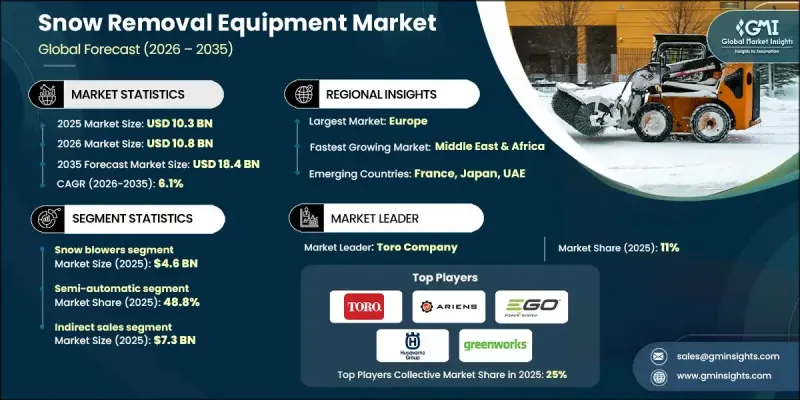
全球除雪设备市场预计到 2025 年将达到 103 亿美元,到 2035 年将达到 184 亿美元,年复合成长率为 6.1%。
日益多变的冬季天气模式推动了市场需求,迫使用户依赖能够应对突发和持续降雪的可靠设备。公共机构、商业运营商和业主优先考虑维护安全、畅通和业务连续性,因此寻求高效的除雪解决方案。人们越来越期望设备能够在低温环境下可靠运行,并在长时间使用过程中最大限度地减少机械应力。严酷的冬季条件增加了交通和基础设施网路的营运风险,因此更需要能够适应各种路况和积雪密度的多功能机械。因此,市场持续受益于对耐用、高性能除雪解决方案的持续投资,这些解决方案有助于冬季交通的连续性和风险的降低。
| 市场覆盖范围 | |
|---|---|
| 开始年份 | 2025 |
| 预测年份 | 2026-2035 |
| 起始值 | 103亿美元 |
| 预测金额 | 184亿美元 |
| 复合年增长率 | 6.1% |
预计到2025年,除雪机市场规模将达46亿美元。这些机器因其高效的除雪能力而广泛应用,能够清除住宅和商业场所的积雪。除雪机采用电力或燃油动力系统,设计快速清除积雪,恢復冬季道路通行。其易用性和高效性使其在住宅和商业用户中广受欢迎,尤其是在降雪频繁的地区。
截至2025年,半自动设备市占率为48.8%。这种自动化程度的设备能够在部分功能上自主运行,同时仍需操作员的监督与决策。这种方法减少了重复性的人工操作,但又不完全消除人为控制,因此非常适合那些仍然需要判断力和柔软性的应用场景。
预计2025年,美国除雪设备市场规模将达到30亿美元,占74.6%的市占率。这主要得益于多变的天气条件对持续除雪解决方案的需求。市政当局、商业服务供应商和个人消费者的广泛采用,确保了整个冬季设备的稳定供应。
目录
第一章调查方法和范围
第二章执行摘要
第三章业界考察
- 生态系分析
- 供应商情况
- 利润率
- 每个阶段的附加价值
- 影响价值链的因素
- 产业影响因素
- 司机
- 降雪量增加和异常天气
- 都市化和基础设施扩张
- 提高安全性和无障碍要求
- 产业潜在风险与挑战
- 季节性和收入波动
- 极寒环境下的性能限制
- 机会
- 锂电池驱动的全自动吹雪机
- 智慧互联的除雪设备
- 司机
- 成长潜力分析
- 未来市场趋势
- 科技与创新趋势
- 当前技术趋势
- 新兴技术
- 价格趋势
- 按地区
- 依产品类型
- 监管环境
- 标准和合规要求
- 区域法规结构
- 认证标准
- 波特分析
- PESTEL 分析
第四章 竞争情势
- 介绍
- 公司市占率分析
- 按地区
- 企业矩阵分析
- 主要市场公司的竞争分析
- 竞争定位矩阵
- 重大进展
- 併购
- 伙伴关係与合作
- 新产品发布
- 扩张计划
第五章 依产品类型分類的市场估算与预测,2022-2035年
- 吹雪机
- 吹雪机
- 吹雪机
- 防冻装置
- 其他的
第六章 2022-2035年按能源类型分類的市场估算与预测
- 电池供电
- 锂离子电池
- 铅酸蓄电池
- 镍基电池
- 其他(钠离子电池等)
- 汽油动力
- 有线电
- 混合动力(汽油/电动)
第七章 按应用领域分類的市场估算与预测,2022-2035年
- 对于住宅/家庭
- 商业的
- 市政当局/政府
8. 依自动化程度分類的市场估算与预测,2022-2035 年
- 手动的
- 半自动
- 自动化
9. 2022-2035年按分销管道分類的市场估算与预测
- 直销
- 间接销售
第十章 2022-2035年各地区市场估计与预测
- 北美洲
- 我们
- 加拿大
- 欧洲
- 德国
- 英国
- 法国
- 义大利
- 西班牙
- 亚太地区
- 中国
- 日本
- 印度
- 澳洲
- 韩国
- 拉丁美洲
- 巴西
- 墨西哥
- 阿根廷
- 中东和非洲
- 南非
- 沙乌地阿拉伯
- 阿拉伯聯合大公国
第十一章 公司简介
- Ariens Company
- BOSS Snowplow
- EGO Power+
- Greenworks
- Husqvarna AB
- Kobalt
- Kobi
- Makita
- Roborock
- Simplicity
- Snoquip
- Snow Joe+Sun Joe
- Stanley Black &Decker
- Techtronic Industries-TTI
- Toro Company
The Global Snow Removal Equipment Market was valued at USD 10.3 billion in 2025 and is estimated to grow at a CAGR of 6.1% to reach USD 18.4 billion by 2035.
Demand is reinforced by growing variability in winter weather patterns, which compell users to rely on dependable equipment capable of managing sudden and prolonged snowfall events. Public authorities, commercial operators, and property owners are prioritizing efficient snow-clearing solutions to maintain safety, accessibility, and continuity of operations. Equipment is increasingly required to perform consistently in low-temperature environments while minimizing mechanical stress during extended use. Extreme winter conditions are heightening operational risks across transportation and infrastructure networks, reinforcing the need for versatile machines that can adapt to different surface conditions and snow densities. As a result, the market continues to benefit from sustained investments in durable, high-performance snow removal solutions that support uninterrupted mobility and risk mitigation during winter seasons.
| Market Scope | |
|---|---|
| Start Year | 2025 |
| Forecast Year | 2026-2035 |
| Start Value | $10.3 Billion |
| Forecast Value | $18.4 Billion |
| CAGR | 6.1% |
The snow blowers segment generated USD 4.6 billion in 2025. These machines are widely adopted due to their efficiency in clearing accumulated snow from private and commercial properties. Powered by electric or fuel-based systems, snow blowers are designed to remove snow rapidly while restoring accessibility during winter conditions. Their ease of use and effectiveness contribute to strong adoption across residential and business users, particularly in regions experiencing recurring snowfall.
The semi-automatic category held 48.8% share in 2025. This level of automation allows equipment to perform certain functions independently while still relying on operator oversight and decision-making. The approach reduces repetitive manual effort without removing human control, making it suitable for applications where judgment and flexibility remain essential.
U.S. Snow Removal Equipment Market held 74.6% share, generating USD 3 billion in 2025. Demand is supported by diverse climatic conditions that require consistent snow management solutions. Adoption remains strong across municipal bodies, commercial service providers, and individual consumers, ensuring stable equipment utilization throughout winter seasons.
Key companies active in the Global Snow Removal Equipment Market include Toro Company, Ariens Company, Husqvarna AB, Stanley Black & Decker, Techtronic Industries (TTI), BOSS Snowplow, Snow Joe + Sun Joe, Greenworks, Makita, EGO Power+, Kobalt, Kobi, Roborock, Snoquip, and Simplicity. Companies operating in the Snow Removal Equipment Market are reinforcing their market positions through product innovation, portfolio diversification, and geographic expansion. Manufacturers are investing in advanced motor technologies, improved battery performance, and enhanced durability to meet evolving user expectations. Strategic partnerships with distributors and retailers are being used to strengthen supply chains and improve market reach. Many players are focusing on automation features that balance efficiency with operator control. Branding initiatives and after-sales service enhancements are helping build customer loyalty.
Table of Contents
Chapter 1 Methodology and Scope
- 1.1 Market scope and definition
- 1.2 Research design
- 1.2.1 Research approach
- 1.2.2 Data collection methods
- 1.3 Data mining sources
- 1.3.1 Global
- 1.3.2 Regional/Country
- 1.4 Base estimates and calculations
- 1.4.1 Base year calculation
- 1.4.2 Key trends for market estimation
- 1.5 Primary research and validation
- 1.5.1 Primary sources
- 1.6 Forecast model
- 1.7 Research assumptions and limitations
Chapter 2 Executive Summary
- 2.1 Industry 360° synopsis
- 2.2 Key market trends
- 2.2.1 Regional
- 2.2.2 Product type
- 2.2.3 Power source
- 2.2.4 Application
- 2.2.5 Automation level
- 2.2.6 Distribution channel
- 2.3 CXO perspectives: Strategic imperatives
- 2.3.1 Key decision points for industry executives
- 2.3.2 Critical success factors for market players
- 2.4 Future outlook and strategic recommendations
Chapter 3 Industry Insights
- 3.1 Industry ecosystem analysis
- 3.1.1 Supplier landscape
- 3.1.2 Profit margin
- 3.1.3 Value addition at each stage
- 3.1.4 Factor affecting the value chain
- 3.2 Industry impact forces
- 3.2.1 Growth drivers
- 3.2.1.1 Increasing snowfall & extreme weather conditions
- 3.2.1.2 Urbanization & infrastructure expansion
- 3.2.1.3 Rising safety & accessibility requirements
- 3.2.2 Industry pitfalls & challenges
- 3.2.2.1 Seasonal dependency & revenue volatility
- 3.2.2.2 Performance limitations in extreme cold
- 3.2.3 Opportunities
- 3.2.3.1 Lithium-battery powered & fully automated snow blowers
- 3.2.3.2 Smart, connected snow equipment
- 3.2.1 Growth drivers
- 3.3 Growth potential analysis
- 3.4 Future market trends
- 3.5 Technology and innovation landscape
- 3.5.1 Current technological trends
- 3.5.2 Emerging technologies
- 3.6 Price trends
- 3.6.1 By region
- 3.6.2 By product type
- 3.7 Regulatory landscape
- 3.7.1 Standards and compliance requirements
- 3.7.2 Regional regulatory frameworks
- 3.7.3 Certification standards
- 3.8 Porter';s analysis
- 3.9 PESTEL analysis
Chapter 4 Competitive Landscape, 2025
- 4.1 Introduction
- 4.2 Company market share analysis
- 4.2.1 By region
- 4.2.1.1 North America
- 4.2.1.2 Europe
- 4.2.1.3 Asia Pacific
- 4.2.1.4 Latin America
- 4.2.1.5 Middle East and Africa
- 4.2.1 By region
- 4.3 Company matrix analysis
- 4.4 Competitive analysis of major market players
- 4.5 Competitive positioning matrix
- 4.6 Key developments
- 4.6.1 Mergers & acquisitions
- 4.6.2 Partnerships & collaborations
- 4.6.3 New product launches
- 4.6.4 Expansion plans
Chapter 5 Market Estimates and Forecast, By Product Type, 2022 - 2035 (USD Billion) (Thousand Units)
- 5.1 Key trends
- 5.2 Snow blowers
- 5.3 Snow plows
- 5.4 Snow sweepers
- 5.5 De-icing equipment
- 5.6 Others
Chapter 6 Market Estimates and Forecast, By Power Source, 2022 - 2035 (USD Billion) (Thousand Units)
- 6.1 Key trends
- 6.2 Battery-powered
- 6.2.1 Lithium-ion battery powered
- 6.2.2 Lead-acid battery-powered
- 6.2.3 Nickel-based battery-powered
- 6.2.4 Others (sodium-ion batteries, etc.)
- 6.3 Gas-powered
- 6.4 Electric corded
- 6.5 Hybrid gas-electric
Chapter 7 Market Estimates and Forecast, By Application, 2022 - 2035 (USD Billion) (Thousand Units)
- 7.1 Key trends
- 7.2 Residential/household
- 7.3 Commercial
- 7.4 Municipal/government
Chapter 8 Market Estimates and Forecast, By Automation Level, 2022 - 2035 (USD Billion) (Thousand Units)
- 8.1 Key trends
- 8.2 Manual
- 8.3 Semi-automatic
- 8.4 Automatic
Chapter 9 Market Estimates and Forecast, By Distribution Channel, 2022 - 2035 (USD Billion) (Thousand Units)
- 9.1 Key trends
- 9.2 Direct sales
- 9.3 Indirect sales
Chapter 10 Market Estimates and Forecast, By Region, 2022 - 2035 (USD Billion) (Thousand Units)
- 10.1 Key trends
- 10.2 North America
- 10.2.1 U.S.
- 10.2.2 Canada
- 10.3 Europe
- 10.3.1 Germany
- 10.3.2 UK
- 10.3.3 France
- 10.3.4 Italy
- 10.3.5 Spain
- 10.4 Asia Pacific
- 10.4.1 China
- 10.4.2 Japan
- 10.4.3 India
- 10.4.4 Australia
- 10.4.5 South Korea
- 10.5 Latin America
- 10.5.1 Brazil
- 10.5.2 Mexico
- 10.5.3 Argentina
- 10.6 Middle East and Africa
- 10.6.1 South Africa
- 10.6.2 Saudi Arabia
- 10.6.3 UAE
Chapter 11 Company Profiles
- 11.1 Ariens Company
- 11.2 BOSS Snowplow
- 11.3 EGO Power+
- 11.4 Greenworks
- 11.5 Husqvarna AB
- 11.6 Kobalt
- 11.7 Kobi
- 11.8 Makita
- 11.9 Roborock
- 11.10 Simplicity
- 11.11 Snoquip
- 11.12 Snow Joe + Sun Joe
- 11.13 Stanley Black & Decker
- 11.14 Techtronic Industries - TTI
- 11.15 Toro Company

 融雪融冰系统市场:2026年至2032年全球预测(依系统类型、组件、系统功能、安装方式、应用及通路划分)除雪机市场:依产品类型、动力来源、引擎功率、应用和通路划分-2026-2032年全球预测除雪机市场:依产品类型、引擎类型、动力来源、最终用户、应用和分销管道划分,全球预测,2026-2032年天线式融雪除冰系统市场:依产品、类型、安装方式、通路、应用领域划分,全球预测(2026-2032年)
 2026年全球推雪机市场报告
 智慧锂电池家用吹雪机市场机会、成长要素、产业趋势分析及2026年至2035年预测
 机场除雪车辆设备市场-全球产业规模、份额、趋势、机会、预测:依产品类型、机场类型、地区和竞争格局划分,2021-2031年
 除雪服务市场:依服务类型、顾客类型、定价模式、服务频率、通路及地区划分
 除雪机:全球市占率和排名、总销售量和需求预测(2025-2031年)铁路融雪系统市场(按类型、技术、应用、地点和最终用户)—2025-2030 年全球预测