


 |
市场调查报告书
商品编码
1928873
畜牧监测机器人市场机会、成长要素、产业趋势分析及2026年至2035年预测Livestock Monitoring Robot Market Opportunity, Growth Drivers, Industry Trend Analysis, and Forecast 2026 - 2035 |
||||||

全球牲畜监测机器人市场预计到 2025 年将达到 35 亿美元,到 2035 年将达到 58 亿美元,年复合成长率为 5.3%。
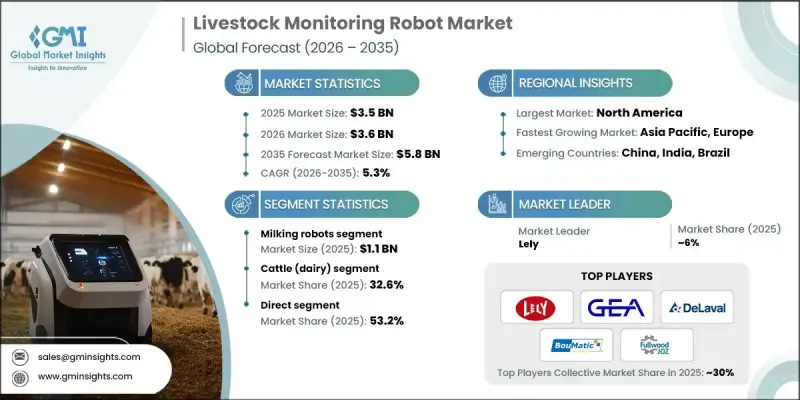
全球人口成长和开发中国家可支配收入的提高是推动市场成长的主要因素,二者共同作用,导致肉类、牛奶、鸡蛋和其他动物蛋白质的需求超过了目前的供应水平。畜牧业经营者面临越来越大的压力,需要在扩大经营规模的同时,维持永续性、效率和适当的动物福利标准。传统的养殖方式已无法满足需求,它们严重依赖人工劳动和过时的流程,限制了生产力。为了保持竞争力并满足消费者的期望,生产商正在加速向先进的机器人解决方案转型。畜牧监测机器人透过将自动化和数据驱动的洞察融入日常农场运营,为提高效率、改善产品品质和加强动物福利管理提供了途径。这些系统透过支持持续监测、减少对劳动力的依赖以及实现更智慧的生产计画,正在改变畜牧业,成为现代畜牧生产中不可或缺的工具。
| 市场覆盖范围 | |
|---|---|
| 开始年份 | 2025 |
| 预测年份 | 2026-2035 |
| 起始值 | 35亿美元 |
| 预测金额 | 58亿美元 |
| 复合年增长率 | 5.3% |
预计到2025年,挤乳机器人市场规模将达到11亿美元,并在2026年至2035年间以5.7%的复合年增长率成长。这一细分市场的成长主要受酪农频繁且劳力密集挤乳作业的驱动。自动化挤奶解决方案可以减少对劳动力的依赖,有助于提高牛奶产量,并创造更温和的挤奶环境,从而有益于动物健康。这些系统还能收集宝贵的营运和健康相关数据,使生产者能够做出明智的决策并改善牛管理。
预计到2025年,牛将占据32.6%的市场份额,并在2035年之前以5.6%的复合年增长率成长。全球对乳製品的强劲消费支撑了这一市场主导地位,因此,对饲料管理、健康状况和生产週期进行持续监测对酪农至关重要。机器人监测工具有助于确保牛奶品质、降低疾病风险并简化日常运营,使酪农专注于提高效率和製定长期成长策略。
美国畜牧监测机器人市场预计到2025年将达到10亿美元,2026年至2035年的复合年增长率(CAGR)为6.7%。推动市场成长的因素包括大规模畜牧养殖、先进农业技术的快速普及以及持续的劳动力短缺。扶持性的农业政策,加上对精密农业和以动物福利为中心的农业系统的强劲需求,持续推动全美对智慧机器人平台的投资。
目录
第一章调查方法和范围
第二章执行摘要
第三章业界考察
- 生态系分析
- 供应商情况
- 利润率
- 每个阶段的附加价值
- 影响价值链的因素
- 产业影响因素
- 司机
- 动物性蛋白质需求不断成长
- 精准畜牧业简介
- 物联网和人工智慧的进步
- 挑战与困难
- 初始投资额较高。
- 基础设施需求
- 机会
- 人工智慧驱动的预测性健康监测
- 综合农场管理平台
- 司机
- 成长潜力分析
- 未来市场趋势
- 科技与创新趋势
- 当前技术趋势
- 新兴技术
- 价格趋势
- 按地区
- 副产品
- 监管环境
- 北美洲
- 美国:消费品安全委员会(CPSC)联邦法规(CFR)第16篇第1512部分
- 加拿大:国际标准化组织(ISO)4210
- 欧洲
- 德国:德国标准化协会 (DIN) 欧洲标准 (EN) ISO 4210
- 英国:欧洲标准 (EN) ISO 4210 /英国合格评定 (UKCA)
- 法国:欧洲标准 (EN) ISO 4210
- 亚太地区
- 中国:国家标准(GB)3565
- 印度:印度标准 (IS) 10613
- 日本:日本工业标准(JIS)D 9110
- 拉丁美洲
- 巴西:巴西技术标准协会 (ABNT) 巴西标准 (NBR) ISO 4210
- 墨西哥:国际标准化组织(ISO)4210
- 中东和非洲
- 南非:南非国家标准 (SANS) 311
- 沙乌地阿拉伯:沙乌地阿拉伯标准、计量和品质组织 (SASO) 海湾标准组织 (GSO) ISO 4210
- 北美洲
- 贸易统计(HS编码 - 8479.50.00)
- 主要进口国
- 主要出口国
- 波特分析
- PESTEL 分析
第四章 竞争情势
- 介绍
- 公司市占率分析
- 按地区
- 北美洲
- 欧洲
- 亚太地区
- 拉丁美洲
- 中东和非洲
- 按地区
- 企业矩阵分析
- 主要市场公司的竞争分析
- 竞争定位矩阵
- 重大进展
- 併购
- 伙伴关係与合作
- 新产品发布
- 扩张计划
第五章 依产品类型分類的市场估算与预测,2022-2035年
- 挤乳机器人
- 餵食机器人
- 健康监测机器人
- 清洁机器人
- 其他(畜牧业、多功能)
第六章 2022-2035年各畜种市场估算与预测
- 牛
- 牛(牛)
- 猪
- 家禽
- 绵羊和山羊
- 其他的
7. 按农场类型分類的市场估计和预测,2022-2035 年
- 酪农
- 家禽养殖场
- 养猪场
- 其他(例如:马场、综合用途农场等)
第八章 依最终用途分類的市场估算与预测,2022-2035年
- 商业农场
- 研究机构/学术用途
- 其他使用者(非政府组织等)
第九章 按分销管道分類的市场估算与预测,2022-2035年
- 直销
- 间接
第十章 2022-2035年各地区市场估计与预测
- 北美洲
- 我们
- 加拿大
- 欧洲
- 德国
- 英国
- 法国
- 义大利
- 西班牙
- 亚太地区
- 中国
- 印度
- 日本
- 韩国
- 澳洲
- 拉丁美洲
- 巴西
- 墨西哥
- 阿根廷
- 中东和非洲
- 沙乌地阿拉伯
- 阿拉伯聯合大公国
- 南非
第十一章 公司简介
- AMS Galaxy USA
- AT-Collections BV
- BouMatic
- Cormall A/S
- Dairymaster
- DeLaval
- Fullwood JOZ
- GEA Group
- HETWIN Automation Systems GmbH
- Lely
- Milkomax
- Swine Robotics, Inc.
- System Happel GmbH
- Trioliet BV
- Waikato Milking Systems
The Global Livestock Monitoring Robot Market was valued at USD 3.5 billion in 2025 and is estimated to grow at a CAGR of 5.3% to reach USD 5.8 billion by 2035.
The market growth is driven by rising global population levels and increasing disposable income across developing economies, which together are pushing demand for meat, milk, eggs, and other animal-based protein beyond current supply levels. Livestock producers face mounting pressure to scale operations while maintaining sustainability, efficiency, and acceptable animal welfare standards. Conventional farming practices are no longer sufficient, as they depend heavily on manual labor and aging processes that limit productivity. Producers are increasingly turning toward advanced robotic solutions to remain competitive and meet consumer expectations. Livestock monitoring robots offer a path toward higher efficiency, improved output quality, and better welfare management by integrating automation and data-driven insights into daily farm operations. These systems are transforming livestock production by supporting consistent monitoring, reducing labor dependency, and enabling smarter production planning, making them an essential tool for modern animal farming.
| Market Scope | |
|---|---|
| Start Year | 2025 |
| Forecast Year | 2026-2035 |
| Start Value | $3.5 Billion |
| Forecast Value | $5.8 Billion |
| CAGR | 5.3% |
The milking robot category generated USD 1.1 billion in 2025 and is forecast to grow at a CAGR of 5.7% between 2026 and 2035. This segment leads the overall market because dairy operations require frequent, labor-intensive milking routines. Automated milking solutions reduce workforce dependence, support higher milk output, and promote calmer milking conditions that benefit animal health. These systems also capture valuable operational and health-related data, allowing producers to improve herd management through informed decision-making.
The dairy cattle segment accounted for 32.6% share in 2025 and is expected to register a CAGR of 5.6% through 2035. Strong global consumption of dairy products drives this dominance, as dairy farms rely on continuous oversight of feeding, health, and production cycles. Robotic monitoring tools help safeguard milk quality, minimize disease risks, and streamline routine tasks, enabling farm operators to focus on efficiency improvements and long-term growth strategies.
United States Livestock Monitoring Robot Market reached USD 1 billion in 2025 and is projected to grow at a CAGR of 6.7% from 2026 to 2035. Market leadership is supported by large-scale livestock operations, rapid adoption of advanced agricultural technologies, and persistent labor constraints. Supportive agricultural policies, combined with strong demand for precision and welfare-focused farming systems, continue to encourage investment in intelligent robotic platforms across the country.
Key companies active in the Global Livestock Monitoring Robot Market include DeLaval, Lely, GEA Group, BouMatic, Dairymaster, Fullwood JOZ, Waikato Milking Systems, Trioliet B.V., Cormall A/S, Milkomax, AMS Galaxy USA, System Happel GmbH, HETWIN Automation Systems GmbH, Swine Robotics, Inc., and AT-Collections B.V. Companies operating in the Global Livestock Monitoring Robot Market are strengthening their market position through continuous technology innovation, product customization, and strategic collaborations. Many players are investing heavily in research and development to integrate advanced analytics, automation, and system reliability into their solutions. Firms are also expanding their global distribution networks and offering tailored solutions to meet region-specific farming needs. Partnerships with agricultural cooperatives and service providers help improve market access and customer trust.
Table of Contents
Chapter 1 Methodology & Scope
- 1.1 Market scope & definitions
- 1.2 Research design
- 1.2.1 Research approach
- 1.2.2 Data collection methods
- 1.3 Base estimates and calculations
- 1.3.1 Base year calculation
- 1.3.2 Market estimates & forecasts parameters
- 1.4 Forecast Model
- 1.4.1 Key trends for market estimates
- 1.4.2 Quantified market impact analysis
- 1.4.2.1 Mathematical impact of growth parameters on forecast
- 1.4.3 Scenario analysis framework
- 1.5 Primary research and validation
- 1.5.1 Some of the primary sources (but not limited to)
- 1.6 Data mining sources
- 1.6.1 Paid Sources
- 1.7 Primary research and validation
- 1.7.1 Primary sources
- 1.8 Research Trail & confidence scoring
- 1.8.1 Research trail components
- 1.8.2 Scoring components
- 1.9 Research transparency addendum
- 1.9.1 Source attribution framework
- 1.9.2 Quality assurance metrics
- 1.9.3 Our commitment to trust
- 1.10 Market Definitions
Chapter 2 Executive Summary
- 2.1 Industry 360° synopsis
- 2.2 Key market trends
- 2.2.1 Regional
- 2.2.2 Product type
- 2.2.3 Livestock type
- 2.2.4 Farm type
- 2.2.5 End user
- 2.2.6 Distribution channel
- 2.3 CXO perspectives: Strategic imperatives
- 2.3.1 Key decision points for industry executives
- 2.3.2 Critical success factors for market players
- 2.4 Future outlook and strategic recommendations
Chapter 3 Industry Insights
- 3.1 Industry ecosystem analysis
- 3.1.1 Supplier landscape
- 3.1.2 Profit margin
- 3.1.3 Value addition at each stage
- 3.1.4 Factor affecting the value chain
- 3.2 Industry impact forces
- 3.2.1 Growth drivers
- 3.2.1.1 Growing demand for animal protein
- 3.2.1.2 Precision livestock farming adoption
- 3.2.1.3 IoT & AI advancements
- 3.2.2 Pitfalls & Challenges
- 3.2.2.1 High initial investment
- 3.2.2.2 Infrastructure requirement
- 3.2.3 Opportunities
- 3.2.3.1 AI-powered predictive health monitoring
- 3.2.3.2 Integrated farm management platforms
- 3.2.1 Growth drivers
- 3.3 Growth potential analysis
- 3.4 Future market trends
- 3.5 Technology and innovation landscape
- 3.5.1 Current technological trends
- 3.5.2 Emerging technologies
- 3.6 Price trends
- 3.6.1 By region
- 3.6.2 By product
- 3.7 Regulatory landscape
- 3.7.1 North America
- 3.7.1.1 US: Consumer Product Safety Commission (CPSC) 16 Code of Federal Regulations (CFR) part 1512
- 3.7.1.2 Canada: International Organization for Standardization (ISO) 4210
- 3.7.2 Europe
- 3.7.2.1 Germany: Deutsches Institut fur Normung (DIN) European Norm (EN) ISO 4210
- 3.7.2.2 UK: European Norm (EN) ISO 4210 / United Kingdom Conformity Assessed (UKCA)
- 3.7.2.3 France: European Norm (EN) ISO 4210
- 3.7.3 Asia Pacific
- 3.7.3.1 China: Guobiao (GB) 3565
- 3.7.3.2 India: Indian Standard (IS) 10613
- 3.7.3.3 Japan: Japanese Industrial Standard (JIS) D 9110
- 3.7.4 Latin America
- 3.7.4.1 Brazil: Associacao Brasileira de Normas Tecnicas (ABNT) Norma Brasileira (NBR) ISO 4210
- 3.7.4.2 Mexico: International Organization for Standardization (ISO) 4210
- 3.7.5 Middle East & Africa
- 3.7.5.1 South Africa: South African National Standard (SANS) 311
- 3.7.5.2 Saudi Arabia: Saudi Standards, Metrology and Quality Organization (SASO) Gulf Standardization Organization (GSO) ISO 4210
- 3.7.1 North America
- 3.8 Trade statistics (HS code- 8479.50.00)
- 3.8.1 Major importing countries
- 3.8.2 Major exporting countries
- 3.9 Porter';s analysis
- 3.10 PESTEL analysis
Chapter 4 Competitive Landscape, 2025
- 4.1 Introduction
- 4.2 Company market share analysis
- 4.2.1 By Region
- 4.2.1.1 North America
- 4.2.1.2 Europe
- 4.2.1.3 Asia Pacific
- 4.2.1.4 Latin America
- 4.2.1.5 Middle East & Africa
- 4.2.1 By Region
- 4.3 Company matrix analysis
- 4.4 Competitive analysis of major market players
- 4.5 Competitive positioning matrix
- 4.6 Key developments
- 4.6.1 Mergers & acquisitions
- 4.6.2 Partnerships & collaborations
- 4.6.3 New product launches
- 4.6.4 Expansion plans
Chapter 5 Market Estimates & Forecast, By Product Type, 2022 - 2035, (USD Billion) (Thousand Units)
- 5.1 Key trends
- 5.2 Milking robots
- 5.3 Feeding robots
- 5.4 Health monitoring robots
- 5.5 Cleaning robots
- 5.6 Others (herding, multi-functional)
Chapter 6 Market Estimates & Forecast, By Livestock Type, 2022 - 2035, (USD Billion) (Thousand units)
- 6.1 Key trends
- 6.2 Cattle (Dairy)
- 6.3 Cattle (beef)
- 6.4 Swine
- 6.5 Poultry
- 6.6 Sheep & Goats
- 6.7 Others
Chapter 7 Market Estimates & Forecast, By Farm Type, 2022 - 2035, (USD Billion) (Thousand units)
- 7.1 Key trends
- 7.2 Dairy farms
- 7.3 Poultry farms
- 7.4 Swine farms
- 7.5 Others (e.g., equine, mixed-use farms)
Chapter 8 Market Estimates & Forecast, By End Use, 2022 - 2035, (USD Billion) (Thousand units)
- 8.1 Key trends
- 8.2 Commercial farms
- 8.3 Research institutions / academic use
- 8.4 Other users (NGOs, etc.)
Chapter 9 Market Estimates & Forecast, By Distribution Channel, 2022 - 2035, (USD Billion) (Thousand Units)
- 9.1 Key trends
- 9.2 Direct
- 9.3 Indirect
Chapter 10 Market Estimates & Forecast, By Region, 2022 - 2035, (USD Billion) (Thousand Units)
- 10.1 Key trends
- 10.2 North America
- 10.2.1 U.S.
- 10.2.2 Canada
- 10.3 Europe
- 10.3.1 Germany
- 10.3.2 UK
- 10.3.3 France
- 10.3.4 Italy
- 10.3.5 Spain
- 10.4 Asia Pacific
- 10.4.1 China
- 10.4.2 India
- 10.4.3 Japan
- 10.4.4 South Korea
- 10.4.5 Australia
- 10.5 Latin America
- 10.5.1 Brazil
- 10.5.2 Mexico
- 10.5.3 Argentina
- 10.6 MEA
- 10.6.1 Saudi Arabia
- 10.6.2 UAE
- 10.6.3 South Africa
Chapter 11 Company Profiles
- 11.1 AMS Galaxy USA
- 11.2 AT-Collections B.V.
- 11.3 BouMatic
- 11.4 Cormall A/S
- 11.5 Dairymaster
- 11.6 DeLaval
- 11.7 Fullwood JOZ
- 11.8 GEA Group
- 11.9 HETWIN Automation Systems GmbH
- 11.10 Lely
- 11.11 Milkomax
- 11.12 Swine Robotics, Inc.
- 11.13 System Happel GmbH
- 11.14 Trioliet B.V.
- 11.15 Waikato Milking Systems

 2026年全球云端低温运输管理市场报告
 基于云端的低温运输管理市场规模、份额和成长分析:按解决方案组件、服务交付模式、产业、部署模式和地区划分-2026-2033年产业预测2026年全球低温运输追踪与监控市场报告
 低温运输追踪与监控市场规模、份额、趋势及预测:按系统、解决方案、最终用户和地区划分,2026-2034年
 低温运输追踪与监控市场-2026-2031年预测
 低温运输追踪与监控市场规模、份额及成长分析(按组件、应用、最终用户和地区划分)-2026-2033年产业预测
 全球冷链追踪与监控市场—第五版
 动物/牲畜追踪和监测市场规模、份额和成长分析(按动物、牲畜类型、解决方案、应用、农场规模、产业和地区划分)—产业预测(2026-2033 年)
 云端基础的低温运输管理市场预测至 2030 年:按组件、运输、部署、温度范围、技术、最终用户和地区进行的全球分析
 基于云端的冷链管理市场:全球产业分析、市场规模、占有率、成长、趋势和未来预测(2025-2032)