


 |
市场调查报告书
商品编码
1928885
汽车事故维修估价软体市场机会、成长要素、产业趋势分析及2026年至2035年预测Auto Collision Estimating Software Market Opportunity, Growth Drivers, Industry Trend Analysis, and Forecast 2026 - 2035 |
||||||

全球汽车事故评估软体市场预计到 2025 年将达到 22 亿美元,到 2035 年将达到 48 亿美元,年复合成长率为 8.4%。
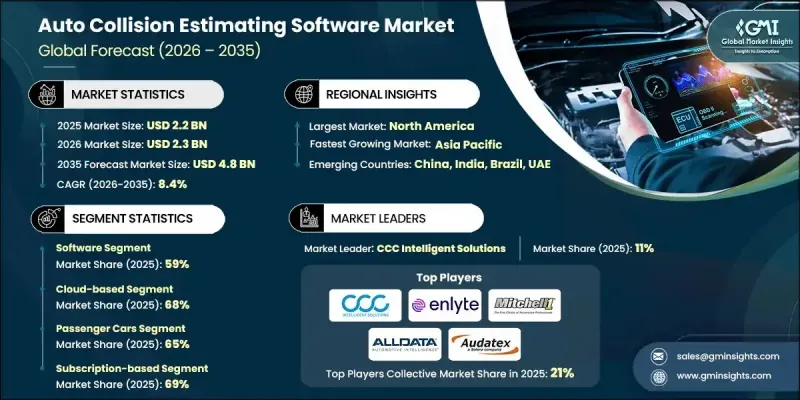
汽车产业向数位化平台的快速转型推动了成长,这些平台提升了数据处理能力、营运透明度和效率。云端架构因其支援扩充性营运、即时更新以及在维修、保险和理赔生态系统中实现无缝连接而日益受到青睐。碰撞估价解决方案受益于云端技术的应用,提高了可近性并降低了基础设施成本。人工智慧 (AI) 也正在透过实现自动损伤评估、提高报价准确性和加快决策速度来改变市场。这些技术透过学习过去的维修绩效和定价数据来提高一致性。法律规范强调透明度和消费者保护,也持续影响科技的采用。保险渗透率高且车辆保有量大的地区仍是需求的主要驱动力。从人工评估向完全数位化和混合理赔工作流程的转变,进一步加速了技术的采用,因为保险公司和维修机构在整个维修生命週期中都将速度、准确性和客户满意度放在首位。
| 市场覆盖范围 | |
|---|---|
| 开始年份 | 2025 |
| 预测年份 | 2026-2035 |
| 起始值 | 22亿美元 |
| 预测金额 | 48亿美元 |
| 复合年增长率 | 8.4% |
2025年,软体业务占了59%的市场份额,预计2026年至2035年将以8.6%的复合年增长率成长。该业务的收入来源包括订阅模式、授权模式和按使用量计费。核心产品包括报价引擎、定价资料库、工时标准、维修文件和使用者介面。先进的自动化和数据驱动功能持续推动高价值应用和永续成长。
预计2026年至2035年间,服务业务部门的复合年增长率将达8.1%。此板块涵盖实施协助、配置、使用者入职、培训、系统整合、区域客製化和工作流程咨询等服务。服务在确保大型多站点组织中软体的一致性、整合性和高效利用方面发挥着至关重要的作用。
美国汽车事故维修估价软体市场预计将继续成为北美地区的主要成长领域,从 2026 年到 2035 年将以 6.8% 的复合年增长率成长。推动市场成长的因素包括成熟的维修生态系统、数位技术的广泛应用以及保险公司、维修机构和车队营运商之间的密切合作,所有相关人员都在追求更快的理赔处理速度和更高的维修准确性。
目录
第一章调查方法
第二章执行摘要
第三章业界考察
- 生态系分析
- 供应商情况
- 利润率分析
- 成本结构
- 每个阶段的附加价值
- 影响价值链的因素
- 中断
- 产业影响因素
- 司机
- 汽车事故和维修需求不断增加
- 向维修店引入数位化工具
- 保险公司对自动化理赔处理的依赖
- 人工智慧和云端软体的进步
- 标准化维修估价条例
- 产业潜在风险与挑战
- 小规模维修店的初始软体成本较高
- 与现有系统的整合问题
- 市场机会
- 新兴市场的成长
- 人工智慧和机器学习的融合
- 基于云端的可扩展解决方案
- 与保险公司建立合作关係
- 用于现场评估的行动应用程式
- 成长潜力分析
- 监管环境
- 北美洲
- 美国 - 加州消费者隐私法案 (CCPA)
- 加拿大 - 个人资讯保护和电子文件法 (PIPEDA)
- 欧洲
- 德国 -一般资料保护规则(GDPR)
- 英国- 英国通用资料保护条例
- 法国-GDPR(一般资料保护规则)及其在法国国内由CNIL(法国国家资讯自由委员会)实施的情况
- 俄罗斯 - 个人资料联邦法(第152-FZ号)
- 亚太地区
- 中国 - 个人资讯保护法(PIPL)
- 印度 - 数位个人资料保护法
- 日本-个人资讯保护法(APPI)
- 澳洲 - 1988 年隐私权法
- 拉丁美洲
- 巴西 - 通用资料保护法 (LGPD)
- 阿根廷 - 个人资料保护法(第 25,326 号法律)
- 中东和非洲
- 南非 - 个人资讯保护法 (POPIA)
- 沙乌地阿拉伯 - 个人资料保护法 (PDPL)
- 北美洲
- 波特分析
- PESTEL 分析
- 科技与创新趋势
- 当前技术趋势
- 新兴技术
- 专利分析
- 用例和成功案例
- 永续性和环境方面
- 永续努力
- 减少废弃物策略
- 生产中的能源效率
- 环保倡议
- 碳足迹考量
- 未来前景与机会
第四章 竞争情势
- 介绍
- 公司市占率分析
- 北美洲
- 欧洲
- 亚太地区
- 拉丁美洲
- 中东和非洲
- 主要市场公司的竞争分析
- 竞争定位矩阵
- 战略展望矩阵
- 重大进展
- 併购
- 伙伴关係与合作
- 新产品发布
- 企业扩张计画和资金筹措
第五章 按组件分類的市场估算与预测,2022-2035年
- 软体
- 基于云端的报价平台
- 现场报价系统
- 行动报价应用程式
- 基于人工智慧的图像报价工具
- 服务
- 部署与集成
- 培训和支持
- 咨询
- 维护和升级
第六章 按车型分類的市场估计与预测,2022-2035年
- 本地部署
- 基于云端的
第七章 依车辆类型分類的市场估计与预测,2022-2035年
- 搭乘用车
- 掀背车
- 轿车
- SUV
- 商用车辆
- 轻型商用车(LCV)
- 中型商用车(MCV)
- 重型商用车(HCV)
- 电动车
第八章 2022-2035年按定价模型分類的市场估算与预测
- 订阅类型
- 基于许可
- 按报价收费/按使用收费
9. 依最终用途分類的市场估计与预测,2022-2035 年
- 独立汽车修理店
- 零售商
- 车队管理公司
- 保险公司
- 其他的
第十章 2022-2035年各地区市场估计与预测
- 北美洲
- 我们
- 加拿大
- 欧洲
- 德国
- 英国
- 法国
- 义大利
- 西班牙
- 俄罗斯
- 北欧国家
- 比荷卢经济联盟
- 亚太地区
- 中国
- 印度
- 日本
- 澳洲
- 韩国
- 新加坡
- 泰国
- 印尼
- 越南
- 拉丁美洲
- 巴西
- 墨西哥
- 阿根廷
- 哥伦比亚
- 中东和非洲
- 南非
- 沙乌地阿拉伯
- 阿拉伯聯合大公国
第十一章 公司简介
- 世界玩家
- Alldata
- Audatex Solutions
- CCC Intelligent Solutions
- Enlyte Group
- Estify
- Mitchell Repair Information
- Shop Ware
- Smart Estimator
- Torque360
- Web-Est
- 区域玩家
- ABF System Software
- Auto Repair Invoice
- AutoLeap
- AutoTraker
- Constellation RO Writer
- Genio
- RepairShopr
- Scott Systems
- Utility Mobile
- 新兴科技创新者
- AutoServe1
- Bodyshop Booster
- DamageiD
- Exzeo
- Nexsyis Collision
The Global Auto Collision Estimating Software Market was valued at USD 2.2 billion in 2025 and is estimated to grow at a CAGR of 8.4% to reach USD 4.8 billion by 2035.
Growth is driven by the automotive industry's accelerated shift toward digital platforms that improve data handling, operational transparency, and efficiency. Cloud-based architectures are increasingly preferred as they support scalable operations, real-time updates, and seamless connectivity across repair, insurance, and claims ecosystems. Collision estimating solutions benefit significantly from cloud deployment, offering improved accessibility and reduced infrastructure costs. Artificial intelligence is also reshaping the market by enabling automated damage assessment, enhanced estimation accuracy, and faster decision-making. These technologies improve consistency by learning from historical repair and pricing data. Regulatory oversight continues to shape adoption by emphasizing transparency and consumer protection. Regions with strong insurance penetration and high vehicle ownership remain key contributors to demand. The transition from manual assessments to fully digital and hybrid claims workflows further strengthens adoption, as insurers and repair facilities prioritize speed, accuracy, and customer satisfaction across the repair lifecycle.
| Market Scope | |
|---|---|
| Start Year | 2025 |
| Forecast Year | 2026-2035 |
| Start Value | $2.2 Billion |
| Forecast Value | $4.8 Billion |
| CAGR | 8.4% |
The software segment accounted for 59% share in 2025 and is expected to grow at a CAGR of 8.6% from 2026 to 2035. Revenue from this segment includes subscription-based access, licensing models, and usage-based pricing. Core offerings cover estimation engines, pricing databases, labor standards, repair documentation, and user interfaces. Advanced automation and data-driven capabilities continue to support higher value adoption and sustained growth.
The services segment is forecast to grow at a CAGR of 8.1% between 2026 and 2035. This segment includes deployment support, configuration, user onboarding, training, system integration, regional customization, and workflow consulting. Services play a critical role for large organizations managing multiple locations, ensuring consistency, integration, and effective software utilization across operations.
United States Auto Collision Estimating Software Market is expected to grow at a CAGR of 6.8% from 2026 to 2035 and remains the leading contributor within North America. Market leadership is supported by a mature repair ecosystem, widespread digital adoption, and strong collaboration between insurers, repair facilities, and fleet operators seeking faster claims resolution and improved repair accuracy.
Key companies operating in the Global Auto Collision Estimating Software Market include CCC Intelligent Solutions, Mitchell Repair Information, Audatex Solutions, Enlyte, Alldata, Web-Est, Constellation R.O. Writer, Scott Systems, RepairShopr, and Smart Estimator App. Companies in the Global Auto Collision Estimating Software Market strengthen their competitive position through continuous platform innovation and cloud-first deployment strategies. Investment in artificial intelligence and analytics enhances estimation accuracy and automation. Vendors expand integration capabilities to connect seamlessly with insurance, repair, and parts ecosystems. Flexible pricing models support adoption across businesses of varying sizes. Strategic partnerships with insurers and repair networks help secure long-term contracts.
Table of Contents
Chapter 1 Methodology
- 1.1 Research approach
- 1.2 Quality commitments
- 1.3 Research trail and confidence scoring
- 1.3.1 Research trail components
- 1.3.2 Scoring components
- 1.4 Data collection
- 1.4.1 Partial list of primary sources
- 1.5 Data mining sources
- 1.5.1 Paid sources
- 1.6 Best estimates and calculations
- 1.6.1 Base year calculation for any one approach
- 1.7 Forecast model
- 1.8 Research transparency addendum
Chapter 2 Executive Summary
- 2.1 Industry 360° synopsis, 2022 - 2035
- 2.2 Key market trends
- 2.2.1 Regional
- 2.2.2 Component
- 2.2.3 Deployment Model
- 2.2.4 Vehicle
- 2.2.5 Pricing Model
- 2.2.6 End Use
- 2.3 TAM Analysis, 2026-2035
- 2.4 CXO perspectives: Strategic imperatives
- 2.4.1 Executive decision points
- 2.4.2 Critical success factors
- 2.5 Future outlook and strategic recommendations
Chapter 3 Industry Insights
- 3.1 Industry ecosystem analysis
- 3.1.1 Supplier landscape
- 3.1.2 Profit margin analysis
- 3.1.3 Cost structure
- 3.1.4 Value addition at each stage
- 3.1.5 Factor affecting the value chain
- 3.1.6 Disruptions
- 3.2 Industry impact forces
- 3.2.1.1 Growth drivers
- 3.2.1.2 Rising vehicle accidents and repair needs
- 3.2.1.3 Adoption of digital tools in repair shops
- 3.2.1.4 Insurance reliance on automated claims
- 3.2.1.5 AI and cloud-based software advancements
- 3.2.1.6 Regulations for standardized repair estimates
- 3.2.2 Industry pitfalls and challenges
- 3.2.2.1 High initial software costs for small repair shops
- 3.2.2.2 Integration challenges with existing systems
- 3.2.3 Market opportunities
- 3.2.3.1 Growth in emerging markets
- 3.2.3.2 AI and machine learning integration
- 3.2.3.3 Cloud-based scalable solutions
- 3.2.3.4 Partnerships with insurance companies
- 3.2.3.5 Mobile apps for on-site assessment
- 3.3 Growth potential analysis
- 3.4 Regulatory landscape
- 3.4.1 North America
- 3.4.1.1 United States - California Consumer Privacy Act (CCPA)
- 3.4.1.2 Canada - Personal Information Protection and Electronic Documents Act (PIPEDA)
- 3.4.2 Europe
- 3.4.2.1 Germany - General Data Protection Regulation (GDPR)
- 3.4.2.2 United Kingdom - UK GDPR
- 3.4.2.3 France - GDPR with CNIL national implementation
- 3.4.2.4 Russia - Federal Law on Personal Data (No. 152-FZ)
- 3.4.3 Asia Pacific
- 3.4.3.1 China - Personal Information Protection Law (PIPL)
- 3.4.3.2 India - Digital Personal Data Protection Act
- 3.4.3.3 Japan - Act on the Protection of Personal Information (APPI)
- 3.4.3.4 Australia - Privacy Act 1988
- 3.4.4 Latin America
- 3.4.4.1 Brazil - General Data Protection Law (LGPD)
- 3.4.4.2 Argentina - Personal Data Protection Law (Law No. 25,326)
- 3.4.5 MEA
- 3.4.5.1 South Africa - Protection of Personal Information Act (POPIA)
- 3.4.5.2 Saudi Arabia - Personal Data Protection Law (PDPL)
- 3.4.1 North America
- 3.5 Porter';s analysis
- 3.6 PESTEL analysis
- 3.7 Technology and innovation landscape
- 3.7.1 Current technological trends
- 3.7.2 Emerging technologies
- 3.8 Patent analysis
- 3.9 Use cases & success stories
- 3.10 Sustainability and environmental aspects
- 3.10.1 Sustainable practices
- 3.10.2 Waste reduction strategies
- 3.10.3 Energy efficiency in production
- 3.10.4 Eco-friendly Initiatives
- 3.10.5 Carbon footprint considerations
- 3.11 Future outlook and opportunities
Chapter 4 Competitive Landscape, 2025
- 4.1 Introduction
- 4.2 Company market share analysis
- 4.2.1 North America
- 4.2.2 Europe
- 4.2.3 Asia Pacific
- 4.2.4 LATAM
- 4.2.5 MEA
- 4.3 Competitive analysis of major market players
- 4.4 Competitive positioning matrix
- 4.5 Strategic outlook matrix
- 4.6 Key developments
- 4.6.1 Mergers & acquisitions
- 4.6.2 Partnerships & collaborations
- 4.6.3 New product launches
- 4.6.4 Expansion plans and funding
Chapter 5 Market Estimates & Forecast, By Component, 2022 - 2035 ($Bn)
- 5.1 Key trends
- 5.2 Software
- 5.2.1 Cloud-based estimating platforms
- 5.2.2 On-premise estimating systems
- 5.2.3 Mobile estimating applications
- 5.2.4 AI-driven image-based estimating tools
- 5.3 Services
- 5.3.1 Implementation & integration
- 5.3.2 Training & support
- 5.3.3 Consulting
- 5.3.4 Maintenance & upgrades
Chapter 6 Market Estimates & Forecast, By Deployment Model, 2022 - 2035 ($Bn)
- 6.1 Key trends
- 6.2 On-premises
- 6.3 Cloud-based
Chapter 7 Market Estimates & Forecast, By Vehicle, 2022 - 2035 ($Bn)
- 7.1 Key trends
- 7.2 Passenger vehicles
- 7.2.1 Hatchback
- 7.2.2 Sedan
- 7.2.3 SUVs
- 7.3 Commercial vehicles
- 7.3.1 Light commercial vehicles (LCVs)
- 7.3.2 Medium commercial vehicles (MCVs)
- 7.3.3 Heavy commercial vehicles (HCVs)
- 7.4 Electric vehicles
Chapter 8 Market Estimates & Forecast, By Pricing Model, 2022 - 2035 ($Bn)
- 8.1 Key trends
- 8.2 Subscription-based
- 8.3 License-based
- 8.4 Pay-per-estimate / usage-based
Chapter 9 Market Estimates & Forecast, By End Use, 2022 - 2035 ($Bn)
- 9.1 Key trends
- 9.2 Independent auto repair shops
- 9.3 Dealerships
- 9.4 Fleet management companies
- 9.5 Insurance companies
- 9.6 Others
Chapter 10 Market Estimates & Forecast, By Region, 2022 - 2035 ($Bn)
- 10.1 Key trends
- 10.2 North America
- 10.2.1 US
- 10.2.2 Canada
- 10.3 Europe
- 10.3.1 Germany
- 10.3.2 UK
- 10.3.3 France
- 10.3.4 Italy
- 10.3.5 Spain
- 10.3.6 Russia
- 10.3.7 Nordics
- 10.3.8 Benelux
- 10.4 Asia Pacific
- 10.4.1 China
- 10.4.2 India
- 10.4.3 Japan
- 10.4.4 Australia
- 10.4.5 South Korea
- 10.4.6 Singapore
- 10.4.7 Thailand
- 10.4.8 Indonesia
- 10.4.9 Vietnam
- 10.5 Latin America
- 10.5.1 Brazil
- 10.5.2 Mexico
- 10.5.3 Argentina
- 10.5.4 Colombia
- 10.6 MEA
- 10.6.1 South Africa
- 10.6.2 Saudi Arabia
- 10.6.3 UAE
Chapter 11 Company Profiles
- 11.1 Global Players
- 11.1.1 Alldata
- 11.1.2 Audatex Solutions
- 11.1.3 CCC Intelligent Solutions
- 11.1.4 Enlyte Group
- 11.1.5 Estify
- 11.1.6 Mitchell Repair Information
- 11.1.7 Shop Ware
- 11.1.8 Smart Estimator
- 11.1.9 Torque360
- 11.1.10 Web-Est
- 11.2 Regional Players
- 11.2.1 ABF System Software
- 11.2.2 Auto Repair Invoice
- 11.2.3 AutoLeap
- 11.2.4 AutoTraker
- 11.2.5 Constellation R.O. Writer
- 11.2.6 Genio
- 11.2.7 RepairShopr
- 11.2.8 Scott Systems
- 11.2.9 Utility Mobile
- 11.3 Emerging Technology Innovators
- 11.3.1 AutoServe1
- 11.3.2 Bodyshop Booster
- 11.3.3 DamageiD
- 11.3.4 Exzeo
- 11.3.5 Nexsyis Collision

 正面防撞雷达市场:依频率、雷达类型、应用、安装方式、车辆类型划分,全球预测(2026-2032年)交通防撞系统市场:按系统类型、最终用户、平台和安装类型分類的全球预测,2026-2032年交通预警和防碰撞系统市场:按平台、系统类型、安装类型和最终用户划分,全球预测,2026-2032年
 2026年全球防碰撞系统市场报告
 列车防撞系统市场规模、份额和成长分析(按系统类型、技术、推进方式、应用和地区划分)—产业预测(2026-2033 年)
 汽车防碰撞雷达市场机会、成长驱动因素、产业趋势分析及预测(2025-2034年)
 全球列车防撞系统市场全球汽车碰撞评估软体市场
 全球列车防撞系统市场:预测至 2032 年 - 按类型、解决方案类型、列车类型、推进类型、组件、应用、最终用户和地区进行分析
 注射器安全防护系统市场分析与预测(至 2034 年):类型、产品、技术、材料类型、应用、最终用户、部署、功能、设备